
“Myf.” Three letters — and two completely different messages hiding inside them. If you have ever received a bare “myf” and wondered whether you were being apologised to or missed, this article is for you. The myf meaning in text is usually one of two things: “My Fault,” a quick way of owning a mistake, or “Miss Your Face,” a warm way of saying someone misses seeing you. Same letters, opposite jobs — and the sentence around them almost always tells you which one you got.
That “almost always” matters. MYF is a smaller, less settled acronym than LOL or BRB. The old version of this article made things worse: it never mentioned “My Fault” at all, and it presented two unattested readings — “Mind Your Face” and “Move Your Feet” — as established meanings. This rewrite fixes that, openly, below.
What Does MYF Mean in Text?
MYF is an initialism that never settled on one expansion — it picked up two, both in everyday use:
- My Fault — “that one was on me.” An apology shrunk to three letters.
- Miss Your Face — “I miss seeing you.” Affection shrunk to three letters.
Both are shortcuts for sentences people find awkward to say in full: a full apology can feel heavy for a small slip, and a full “I miss seeing you” can feel heavy for a casual friendship. MYF keeps both at arm’s length — which is why people reach for it, and why it confuses readers.
Other readings live in different rooms: in work and IT chats MYF can mean “Move Your Files,” offline it has been a church youth-group name for decades, and a blunt, sometimes vulgar version of “mind your business” also exists. None is what a friend usually means by “myf.”
One honest limit: nobody has measured how often each reading is used — there is no frequency study for MYF, so this article prints no percentages and no league table. The two leading readings are “My Fault” and “Miss Your Face”; guides agree on the pair while arguing about the order, so do not trust any guide that claims the ranking is settled.
The Fault-or-Face Test
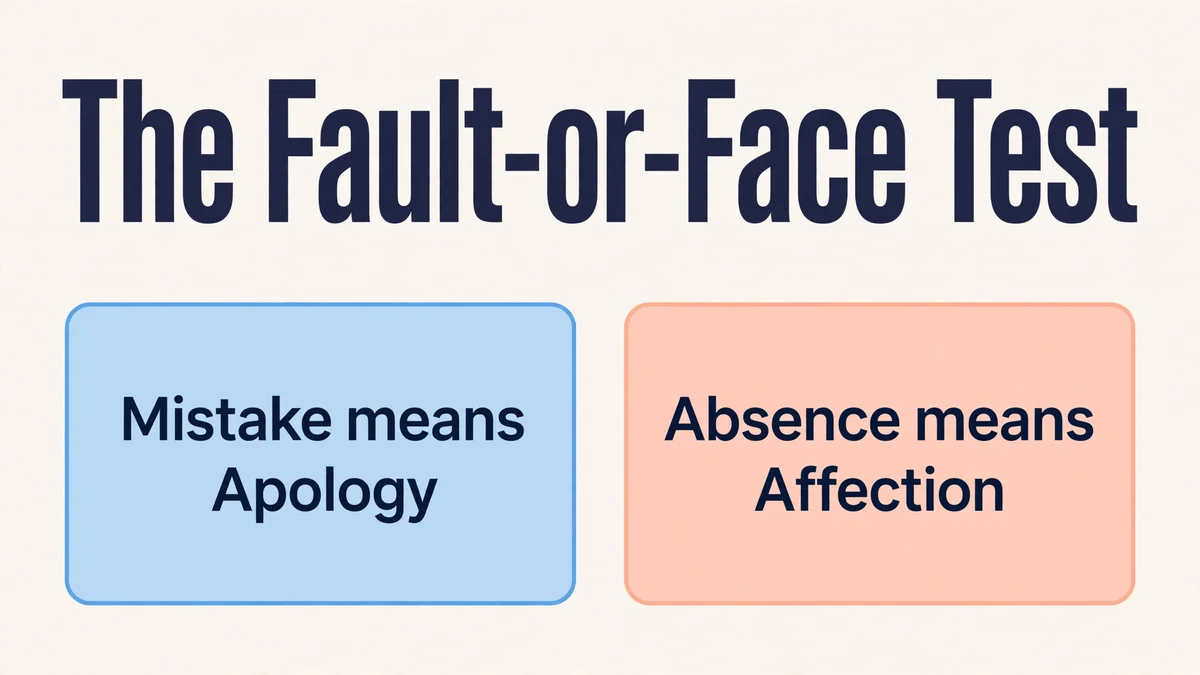
Here is this article’s named method. Call it the Fault-or-Face Test: three checks, run in order, on any MYF you receive.
Check 1: What just happened? Look at the message before the MYF, not at the letters. A mistake, a delay, a missed reply, a wrong group chat — all point to “My Fault.” Distance, a throwback photo, a long silence, “when are you back” — all point to “Miss Your Face.” MYF is almost always a reaction to something, and that something names the reading.
Check 2: Who is the sentence about? “My Fault” is about the sender’s own slip. “Miss Your Face” is about the other person’s absence. Try both rewrites: “ran late, myf” rewrites cleanly as “ran late, my fault,” and collapses as affection — nobody apologises for being late by saying they miss your face. “Myf, when are you home?” rewrites cleanly as affection, and collapses as apology — there is no mistake to own.
Check 3: What reply fits? If “all good, no worries” fits, you were sent an apology. If matching warmth fits — “miss yours too,” “not long now” — you were sent affection. If neither fits, say so: “my fault or miss your face?” is a completely normal question, and it beats answering an apology with affection or affection with a shrug.
One worked example: a friend you have not spoken to in a month sends a photo from last summer captioned “myf.” Memory trigger, your absence, “miss yours too” fits — affection, three times over. Now the opposite: “sent the wrong link, myf” — mistake, own slip, “all good” fits. Same letters, opposite verdicts.
“My Fault”: The Apology Reading
“My Fault” is MYF at its most practical — the job of “my bad” with a fraction more ownership. Shortened to three letters, it suits small mistakes well, and fails on big ones.
- “Ran late, myf” — a delay, owned, no drama attached.
- “Myf, I totally forgot to reply” — a missed message, owned before the other person has to raise it.
Notice the pattern: the mistake is always visible in the same message or the one before it — “My Fault” never arrives unaccompanied. That is also why this reading dominates group and gaming chats, where mistakes are public and frequent.
“My Fault” is sized for small mistakes: a three-letter shrug for something that genuinely hurt someone reads as dismissive. If the mistake mattered, the apology needs real words.
“Miss Your Face”: The Affection Reading
“Miss Your Face” is MYF at its warmest, and the reading most people picture first. Saying “I miss you” in full can feel heavy, even exposed. “Miss your face” is softer and slightly sillier — the “face” part makes it specific and playful instead of grand.
- “Myf, when are you back?” — affection plus a plan, the strongest form of this reading.
- “Found this old photo of us. MYF.” — the photo carries the memory; the letters carry the feeling.
This reading lives where closeness already exists, and usually follows a gap — a move, a busy month, a friendship gone quiet. Inside a daily chat that never stopped, it is rarer, because there is no absence to notice: if you talked yesterday, a sudden “myf” is more likely an apology.
Two cautions: do not upgrade it — from a friend it is friendship, not a confession; from a crush, interest, not a declaration. And after a genuinely hard absence, say “I’ve really missed you” in full.
The Blunt Reading — Placed Last, on Purpose
Yes, MYF can also stand in for a blunt version of “mind your business” — sometimes with a vulgar intensifier tucked inside it. This article describes it without spelling out the vulgar form.
It sits last because most guides get the emphasis wrong: people who want to tell someone to back off usually type the phrase out, because bluntness is the whole point. So the abbreviated blunt reading is genuinely uncommon, and a guide that opens with it teaches readers to expect hostility from letters that usually carry an apology or affection.
When the blunt reading does appear, tone controls everything: between close friends it reads as teasing; from someone you barely know, as hostile. If you cannot tell, do not guess — ask, or step back. To set a boundary yourself, plain words work better: “I’d rather not talk about it” cannot be misread as an apology.
In IT chats MYF can also mean “Move Your Files,” and offline it is a church youth-group name — both announced so loudly by context that neither competes with the texting readings.
MYF on Texting, Snapchat, Instagram, TikTok, WhatsApp, and in Gaming

No platform gives MYF a fixed definition — and guides that claim otherwise disagree with each other, which is the tell: one calls TikTok apology-leaning, another boundary-leaning; one calls Snapchat affection-leaning, another mixed. What changes by platform is which reading you are most likely to meet.
Texting (SMS, WhatsApp, iMessage). MYF’s home ground, and the apology reading’s strongest room. Chats run on logistics, and logistics produce mistakes, which produce “My Fault.” WhatsApp leans apology, its chats being more logistical than photo-driven.
Snapchat. The affection reading’s strongest room. Snapchat runs on close friendships and memories: replies to throwback photos and stories after someone has been away.
Instagram. Split along the DM-versus-comment line. In DMs, MYF behaves like texting: mostly “My Fault” after a mix-up, sometimes “Miss Your Face” after time apart. In comments under old photos, it leans affection.
TikTok. Comments move fast, and both readings appear: “My Fault” as a quick correction (“myf, I misread the caption”) and, less often than some guides claim, the blunt reading as a joking reply to an unwanted question.
Gaming chats. Almost always “My Fault.” A missed shot, a bad call, a lost round — the pace leaves no room for affection or boundary-setting, and the mistake is visible to the whole lobby.
Tone and Sender Context: Who Sent It
MYF’s tone is not in the letters; it is in the trigger, the wrapping, and the relationship. Some guides run “from a girl / from a guy” sections; that framing is refused here — the relationship decides, never the sender’s sex.
From a close friend, MYF is the default room for both readings, and shared history does the decoding. A friend’s usual MYF habit is your best evidence going forward.
From a crush or a partner, the affection reading carries more weight, but do not upgrade it: a partner’s “myf, when are you home?” is affection with a plan; a crush’s “myf” is interest, not a confession.
From family, MYF is usually affection with a practical tail: “myf, call me when you’re free.” Answer the practical part too — the call is the real message.
From a coworker, in a casual team chat, “My Fault” is usually understood, and “Move Your Files” is unambiguous when files are being discussed. In anything formal, spell it out: “My mistake, I’ll fix it” can never be misread as the blunt reading.
From a stranger, or in a public comment, MYF is a gamble. The sender assumes shared shorthand that may not exist, and the reader may half-remember the blunt reading and take an apology as an insult. Senders: spell it out for strangers. Readers: run the test before reacting.
How to Reply to MYF
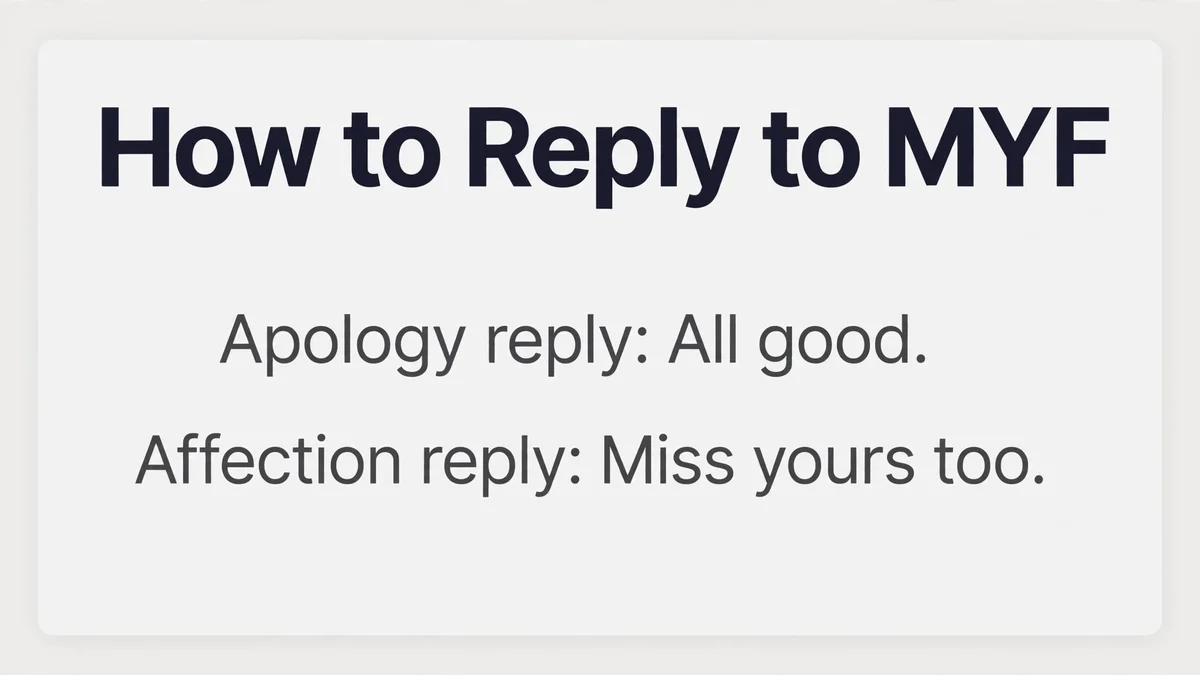
Match the reading, keep it short, and you are done.
If it was “My Fault”: accept it cleanly. “All good, no worries” is the standard reply — it closes the loop without making the apology bigger than the mistake. A DW-style comfort pairs naturally here: “dw about it” tells the sender the matter is closed.
If it was “Miss Your Face”: match the warmth, and add a plan if you can. “Miss yours too, not long now” mirrors the feeling without overcommitting. “Let’s fix that — free Saturday?” turns longing into a plan, and an FT invitation does the same work across distance: “FT tonight?” If you cannot match the warmth honestly, try: “aw, that means a lot — let’s catch up soon.”
If you cannot tell: ask, plainly. “Wait — my fault or miss your face?” is a normal, low-stakes question. It prevents the two expensive misreads: answering affection with a shrug, or answering an apology with warmth the sender never asked for.
If you are sending MYF yourself: use it with people who already text you in abbreviations, and only when the shared context makes the reading obvious. With everyone else, spell out the sentence you actually mean.
MYF vs IMY, MB, MYOB, and “Miss You Friend”
MYF does the job of three more specific abbreviations rolled into one.
| Term | What it actually says | When it fits instead of MYF |
|---|---|---|
| MYF | My Fault / Miss Your Face | When context already decides — or when you want the softer, shorter form |
| IMY | I miss you | When you want the missing stated plainly, with no apology confusion |
| MB | My bad | When you want the apology with zero risk of the blunt misread — the safer apology abbreviation |
| MYOB | Mind your own business | When you actually mean the boundary, said in full, with no softening |
| TTYL | Talk to you later | When you are pausing, not apologising or missing anyone |
| BRB | Be right back | When you are stepping away for minutes, not owning a mistake |
| “Miss You Friend” | A platonic variant of Miss Your Face | Named, not linked: no established page for it, and it adds nothing the affection reading does not already cover |
The useful pairs: MYF versus IMY is the affection distinction — IMY says “I miss you” with no second reading, so it is the clearer choice when you want to be understood without a test. MYF versus MB is the apology distinction — MB does the same job as “My Fault” MYF, but is more widely recognised and carries zero risk of the blunt misread. MYF versus MYOB is the boundary distinction: MYOB says the blunt thing in full, on purpose; MYF only hints at it.
Corrections: What the Old Article Got Wrong
The old article is still live, so readers deserve to know exactly what changed and why.
- “My Fault” was missing entirely. The apology reading — the reading user-generated slang references list first — never appeared in the old article. A reader who received “ran late, myf” would have found no help at all. It is now the article’s first reading.
- “Mind Your Face” is withdrawn. No competitor, dictionary entry, or slang reference found in this research supports it. It reads as a garbled blend of “Miss Your Face” and the blunt “mind your business” reading. It appears in the new article only here, in its withdrawal.
- “Move Your Feet” is withdrawn as a general meaning. No source supports it as an established abbreviation sense. At most it is a literal instruction in a single moment, not a meaning of the letters.
- The readings were presented as equals. They are not equals. Two readings do nearly all the work in real messages; the blunt reading is uncommon in abbreviated form; the files reading belongs to IT chats; the organisation name belongs offline. The new article weights them accordingly.
- “Widely used” claims are withdrawn. The old article called MYF commonly used without evidence. MYF is a smaller, less settled acronym than the article implied, and some recipients will not know it at all. The new article says so.
- The platform section claimed without distinguishing. “Widely used on WhatsApp, Instagram, Snapchat, and Facebook” told the reader nothing about which reading appears where. The new platform section names six rooms and their leanings.
- Repetition replaced information. Around twenty sections restated “context decides” in near-identical sentences. The new article keeps the context rule but gives it a mechanism — the Fault-or-Face Test.
- No reply guidance, no sender ladder, no tone rule. The old tone section reduced to “punctuation and emojis affect meaning.” The new article covers six sender types and gives a reply for each reading, including when you cannot tell.
When Not to Use MYF
MYF is a joy in its habitat and a misfire outside it. Skip it when:
- The mistake actually mattered. A three-letter shrug for a real hurt reads as dismissive. Real apologies deserve real words.
- The feeling actually matters. After a real absence or a hard time, “myf” undersells the feeling. Say “I’ve really missed you” in full.
- You are writing to a client, a manager, or anyone formal. “My mistake, I’ll fix it” never gets misread.
- The other person may not know the acronym. Because MYF has a blunt sense floating around, a reader who half-remembers that one could take your apology as an insult — entirely avoidable by spelling it out.
- You mean it as a boundary. If you want someone to back off, say so plainly. An abbreviated brush-off is either too soft or, misread, a fight.
- You are using it to test someone. Sending “myf” to see whether the other person cares enough to reply turns a warm message into a loyalty check. If you need reassurance, ask directly — an LMK-style open question (“lmk how you’re feeling?”) beats a test disguised as slang.
Never answer a “myf” you cannot read with a confident guess: a BTW-style aside — “btw, I wasn’t sure which myf you meant” — prevents a misread no later explanation can undo.
Quick Answers
What does MYF mean in text?
MYF usually means “My Fault” — a quick way to own a small mistake — or “Miss Your Face” — a warm way to say you miss seeing someone. A mistake points to the apology; distance or a photo points to the affection.
Is MYF rude?
Usually not. Its two leading readings are an apology and affection, both friendly. There is a blunt reading, but it is uncommon in abbreviated form, because people setting a boundary usually type it out. The risk is misreading, not rudeness.
What is the difference between MYF and IMY?
IMY means only “I miss you,” with no second reading. MYF can mean that too, but it can also mean “My Fault,” so it always needs its context read first.
Can I use MYF at work?
In a casual team chat, “My Fault” MYF is usually understood. In client emails or formal messages, spell out what you mean — “my mistake” or “I’ll move the files” — because its blunt shadow makes it a needless risk.
What should I reply to MYF?
Match the reading. For an apology: “all good, no worries.” For affection: “miss yours too” or a plan, like “free Saturday?” If you cannot tell, ask: “my fault or miss your face?”
Does MYF mean “Mind Your Face” or “Move Your Feet”?
No. Neither is an established meaning of MYF: “Mind Your Face” appears in no dictionary or slang reference found in this research, and “Move Your Feet” has no attestation as an abbreviation sense. Both are withdrawn in the corrections section above.
Final Thoughts
MYF is three letters doing two opposite jobs — owning a mistake and naming a longing — and that is why it confuses people: the letters never change, so the reader has to. But the sentence almost always tells you which job MYF is doing. If something just went wrong, it is an apology. If someone has just been gone, it is affection. Run the Fault-or-Face Test before you reply: check what just happened, check who the sentence is about, and check which reply fits. Get that right, and MYF stays a fast, warm shorthand, not a coin flip between “sorry” and “I miss you.”
