
Someone texts you back with a single word: “ard.” No emoji, no punctuation, no follow-up. Did they just agree with you, brush you off, or say something about how hard a song goes? That one-word reply is the whole puzzle of ard meaning in text: it is almost always a relaxed way of saying “alright,” but where it sits in the sentence — and what sits around it — decides exactly what it is doing.
ARD is short for “alright.” It grew out of the way “alright” sounds when it is spoken fast in Philadelphia and in African American Vernacular English, where “aight” became “ard,” and the spelling followed the sound into text messages. This guide shows you how to read any ARD in a second, including the rare moment it means something else.
What ARD Means in Text
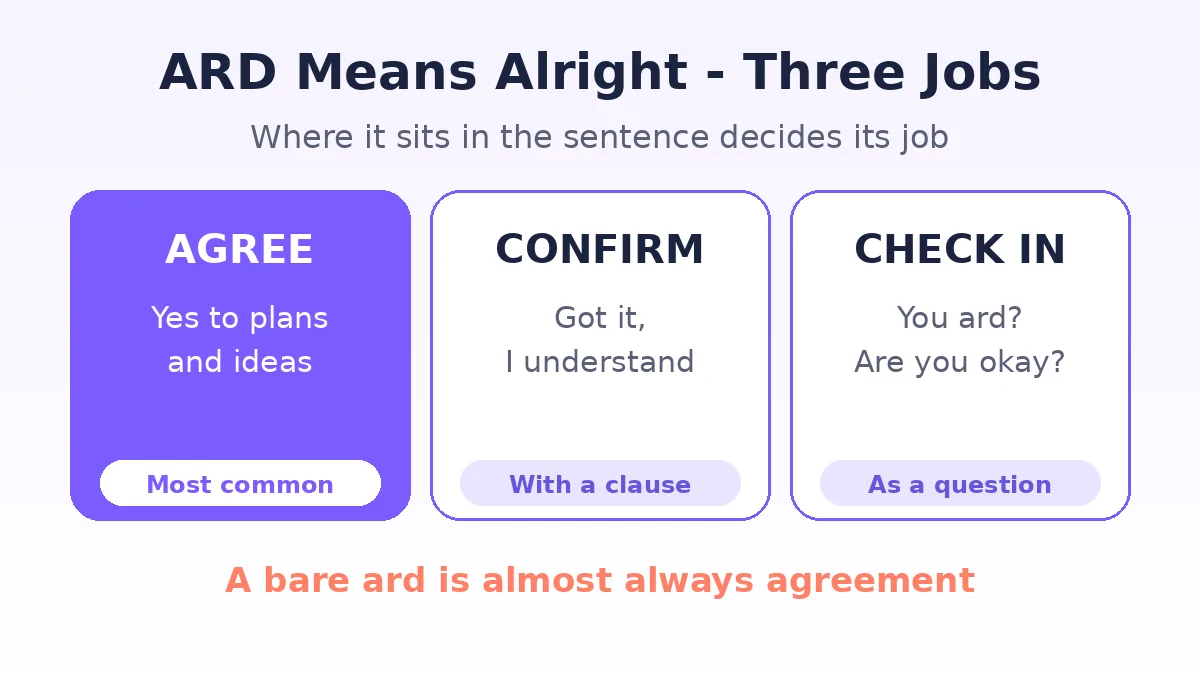
At its core, ARD means “alright” or “okay.” Wiktionary lists it plainly as a contraction of “all right,” marked as chiefly African American Vernacular and Philadelphia slang, with “aight” as its closest cousin. When someone sends it, they are agreeing, confirming, or simply letting you know they heard you.
That is why ARD is a reply word, not a question word. It almost always answers something you said, rather than starting a new thought. “Meet at 7?” — “Ard.” “Do not forget your keys.” — “Ard, thanks.” “We good?” — “Ard, we straight.” In each case the sender is saying yes, got it, or all good, and the conversation moves on.
Capitalization changes nothing: lowercase “ard” is simply the most relaxed spelling. ARD is not an acronym — the letters do not stand for three separate words. It is a sound written down.
The ARD Three-Slot Test
Here is the named reader test for this article: the ARD Three-Slot Test. Where ARD sits in the sentence decides its job, so look at the slot first and the letters second.
Slot 1: ARD alone — “Ard.” When ARD is the whole message, it is agreement or acknowledgment. “We are meeting at 8, right?” — “Ard.” It is the most common slot by far, and if you only learn one, learn this one.
Slot 2: ARD plus a clause — “Ard, I will be there.” When ARD opens a sentence, it confirms and then adds what happens next. “Ard, I got you.” “Ard, let me know when you are ready.” The clause after it tells you what the alright is attached to — a promise, a plan, or a thank-you.
Slot 3: ARD as a question — “You ard?” When ARD sits inside a question, it stops meaning agreement and starts meaning a check-in: “are you okay?” “You seem quiet today. You ard?” Wiktionary records this second sense too — “okay; average; nothing special” — which is exactly what the question is asking about.
The trap check: ARD after a noun. If ARD follows a noun about music, style, or skill — “that track goes ard,” “that fit is ard” — it is the rare “hard” reading, meaning impressive or strong. The noun is the giveaway: ARD only means “hard” when it describes a thing, never when it answers a person.
If the slot still leaves you unsure, read the message above it. ARD is always a reaction to what came before, and the message above is the evidence.
ARD in Real Conversations
Agreeing to plans. The most common use of all.
Sam: “Let us meet at 6?”
Alex: “Ard, sounds good.”
Sam: “Cool, see you there.”
Confirming you understood. ARD works as a receipt.
Mom: “Do not forget to lock the door.”
You: “Ard, I got it.”
A confident “of course” often rides along with it: “Ard, of course I will be there.” The two words do different jobs — ARD agrees, OFC underlines the certainty — but they travel together constantly.
ARD on TikTok, Snapchat, Instagram, and in Texting
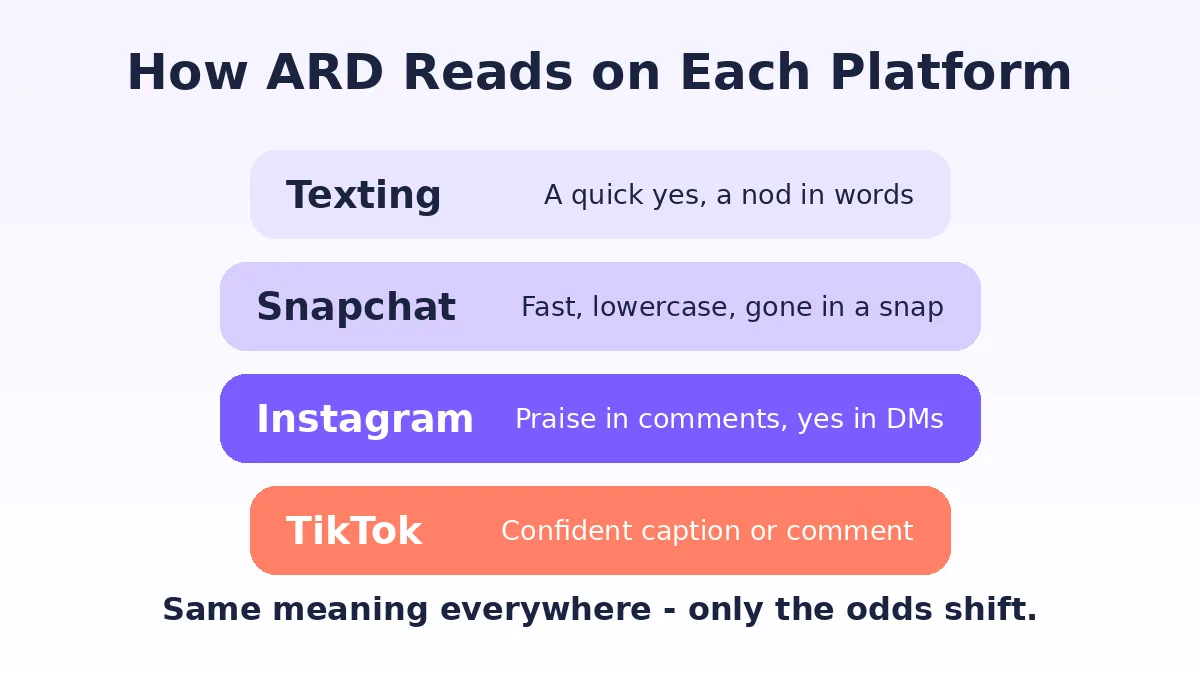
In texting, SMS, and WhatsApp, ARD is at home: a quick reply in a private chat, usually about plans, a favor, or something that needs confirming. It is the texting equivalent of a nod, and it works because both people already know the context.
On Snapchat, ARD lives in fast DMs and snap replies, often in lowercase — “ard” after a confusing snap or a plan. Because snaps disappear, the reply can feel more urgent: the thing it agrees to may already be gone from the screen.
On Instagram, ARD appears in DMs, comment threads, and replies to Stories. In comments it often turns into praise: “ARD 🔥” under a new outfit or a new song is the “hard” reading, not agreement — it means the thing looks good. In DMs it is usually the plain, agreeable version. On TikTok, ARD is a comment-section and caption regular: “ARD bet 😎” under a video, or “ARD this trend go” as a caption. The public setting makes the confident, approving tone more common than in a private chat. No platform officially defines ARD, and the meaning does not change from one app to another — only the odds shift. The same rule that governs the tone notes in what FR means in text applies here: believe the setting and the emoji over the letters.
Who Sent It Changes How It Lands
From a close friend, ARD is almost always easy: a quick yes, a relaxed confirmation, a joke. You know whether “ard 😂” is agreement or amusement, because you know them. From a crush, it can carry a relaxed, unbothered charm (“Ard, sounds good”), but it is still just agreement, not a confession. Do not read romance into the letters alone — and do not read rejection into them either.
From a stranger or a new dating-app match, ARD is genuinely ambiguous, because you do not yet know their habits. A bare “ard” from someone you just met can feel either relaxed or uninterested. In a group chat, ARD usually answers the last message, not the whole group — check which message sits directly above it.
An honest opener often sits next to it: “Ard. To be honest, I was not sure that would work.”
The Other ARD: When It Means “Hard”
Most of the time, ARD means “alright.” But the same letters have one other established reading, and knowing it keeps you out of a misunderstanding.
“Hard” is contextually supported. In some slang communities, ARD is a shortened spelling of “hard,” meaning impressive, strong, or tough. “That new track goes ard” means the track is very good. “That fit is ard” means the outfit looks strong. The reading only works when ARD describes a thing — a song, an outfit, a performance. Without a noun to describe, nobody reads ARD this way.
How do you tell? Use the Three-Slot Test and the trap check. If ARD answers a person, it is “alright.” If ARD follows a noun about music or style, it is “hard.”
Two misreadings deserve a clear warning, because other pages publish them as fact. ARD does not mean “already” — one rival page claims it, but that contradicts Wiktionary and every major slang source. ARD does not mean “already read” either — that reading appears on one low-quality page and nowhere else; it is an invented backronym, not real slang.
ARD vs AIGHT vs IGHT vs BET
ARD gets confused with its cousins more than with anything else. The table clears it up at a glance.
| ARD | AIGHT | IGHT | BET | |
|---|---|---|---|---|
| Full form | Alright | Alright | Alright | You bet / agreed |
| Core meaning | Agree / confirm | Agree / confirm | Agree / confirm | Agree with enthusiasm |
| Flavor | Philly, clipped | Original spoken form | Shortest, most casual | Confident, upbeat |
| Difference | A spelling of the sound | The classic spelling | Drops the A too | Adds energy, not just yes |
AIGHT is the original spoken form of “alright,” the one most people say out loud. ARD is the same sound with a harder edge, tied to Philadelphia speech. IGHT drops the opening A as well and is the shortest of the three. All three mean the same thing; the choice is habit and hometown, not meaning.
BET is different: it agrees, but it adds confidence and energy. “Ard” says “okay.” “Bet” says “okay, and I mean it.” That is why “ard bet” works as a pair: the ARD agrees, the BET underlines it.
Another opinion-shaped abbreviation worth knowing is what IMO means in text — it states a view, while ARD agrees with one.
How to Reply to ARD
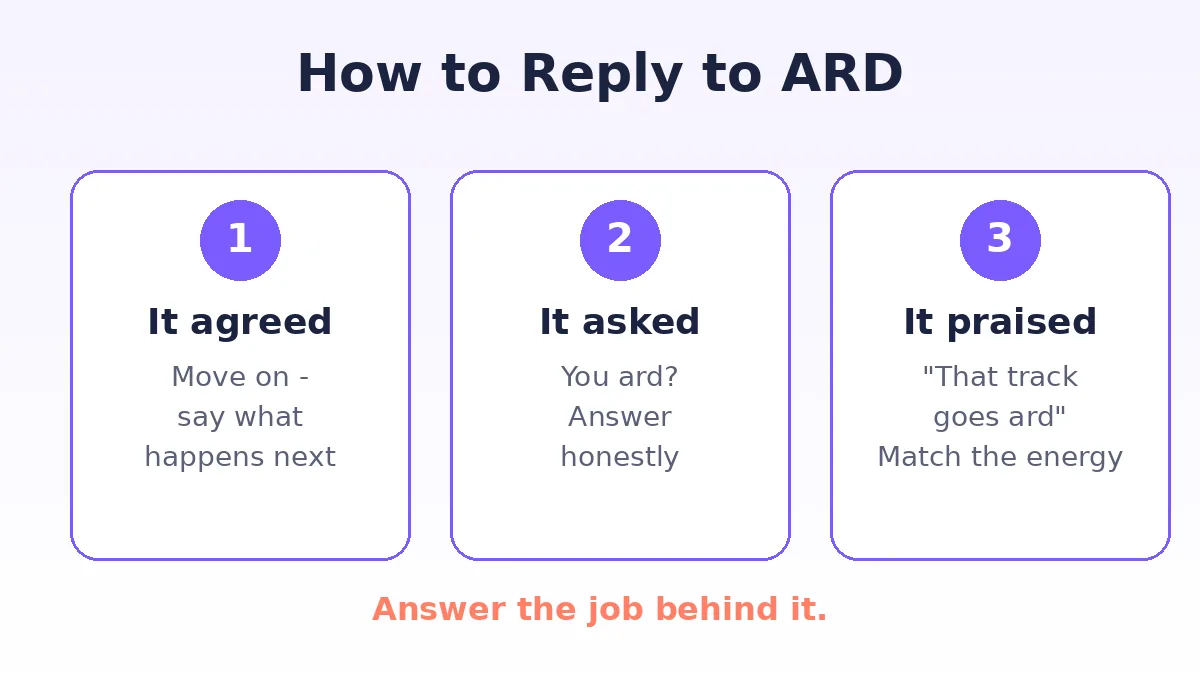
The right reply depends entirely on which ARD you just received. Pick your script by the slot it sat in, not by habit.
When ARD was agreement, move the conversation forward: “Cool, see you then.” “Bet, let us go.” Do not ask them to repeat themselves — they already said yes. When ARD was confirmation with a clause, acknowledge the plan, not the word: “Perfect, I will send the address.” When ARD was a check-in (“You ard?”), answer the question behind it: “Yeah, I am good, just tired.” When ARD was the “hard” reading, match the energy: “Fr, that track is crazy.” A short follow-up keeps the thread warm: “Let me know when you are ready” — or, in the usual shorthand, what LMK means in text.
When a Bare “Ard” Feels Cold
ARD is short, and short replies carry a risk: when your message is long and the reply is one word, the gap itself sends a message.
The length-mismatch rule: if your message took effort — a long explanation, bad news, an apology, something emotional — and the reply is just “ard,” it will feel dismissive even when the sender only meant “okay.” A three-letter reply to a three-paragraph message reads as uninterested, whatever the sender intended.
The fix is simple on both sides. If you receive a bare “ard” after a long message, give it a second before reacting — it may be a busy thumb, not a cold shoulder. If you send ARD, add one small thing when the conversation deserves it: “Ard, thank you for telling me.” One extra clause turns a nod into a response.
A friendly check-in has its own shorthand instead: what WBU means in text — “What about you?” — which asks a real question rather than closing the thread.
When Not to Use ARD
Leave ARD alone in professional emails, job applications, and messages to customers, where a three-letter slang reply reads as careless or unprofessional. Skip it in serious or emotional conversations — “ard” after bad news can look dismissive even when you only meant “okay.” Do not use it with anyone who may not know texting slang, or with people outside the US who may read it as a typo for “hard.”
When you step away mid-chat, the usual sign-off is what BRB means in text — “Be right back” — which says something ARD never does: that you are leaving and coming back.
Quick Answers About ARD
What does ARD mean in text?
ARD means “alright” or “okay” — a short, casual way to agree, confirm, or show you understood.
What does ARD mean on TikTok?
On TikTok, ARD usually means “alright” in comments and captions. Under a video about music or style it can also mean “hard,” as in impressive.
What does ARD mean on Snapchat?
On Snapchat, ARD means “alright” in DMs and snap replies, usually in lowercase, sent as a quick agreement.
What does ARD mean on Instagram?
On Instagram, ARD means “alright” in DMs and Story replies. In comments it often means “hard” — praise for an outfit, a song, or a post.
Is ARD rude?
ARD is not rude on its own, but a bare “ard” can feel cold or dismissive, especially as a reply to a long or emotional message. The word is neutral; the length of the reply is what stings.
What is the difference between ARD and AIGHT?
ARD and AIGHT mean the same thing: “alright.” AIGHT is the classic spoken spelling; ARD is the harder, clipped Philadelphia spelling. The choice is habit and hometown, not meaning.
What does “You ard?” mean?
“You ard?” means “Are you okay?” It is ARD used as a check-in question, asking whether everything is fine.
Does ARD ever mean “hard”?
Sometimes. When ARD follows a noun about music or style — “that track goes ard” — it means “hard,” as in impressive or strong. This reading is much less common than “alright.”
The Bottom Line on ARD
ARD is three letters doing one job: saying “alright” the way it sounds when it is spoken fast. It agrees, it confirms, it acknowledges, and once in a while it checks in on you or praises a song. Find the slot it sits in, read the message above it, and you will know which one it is.
