
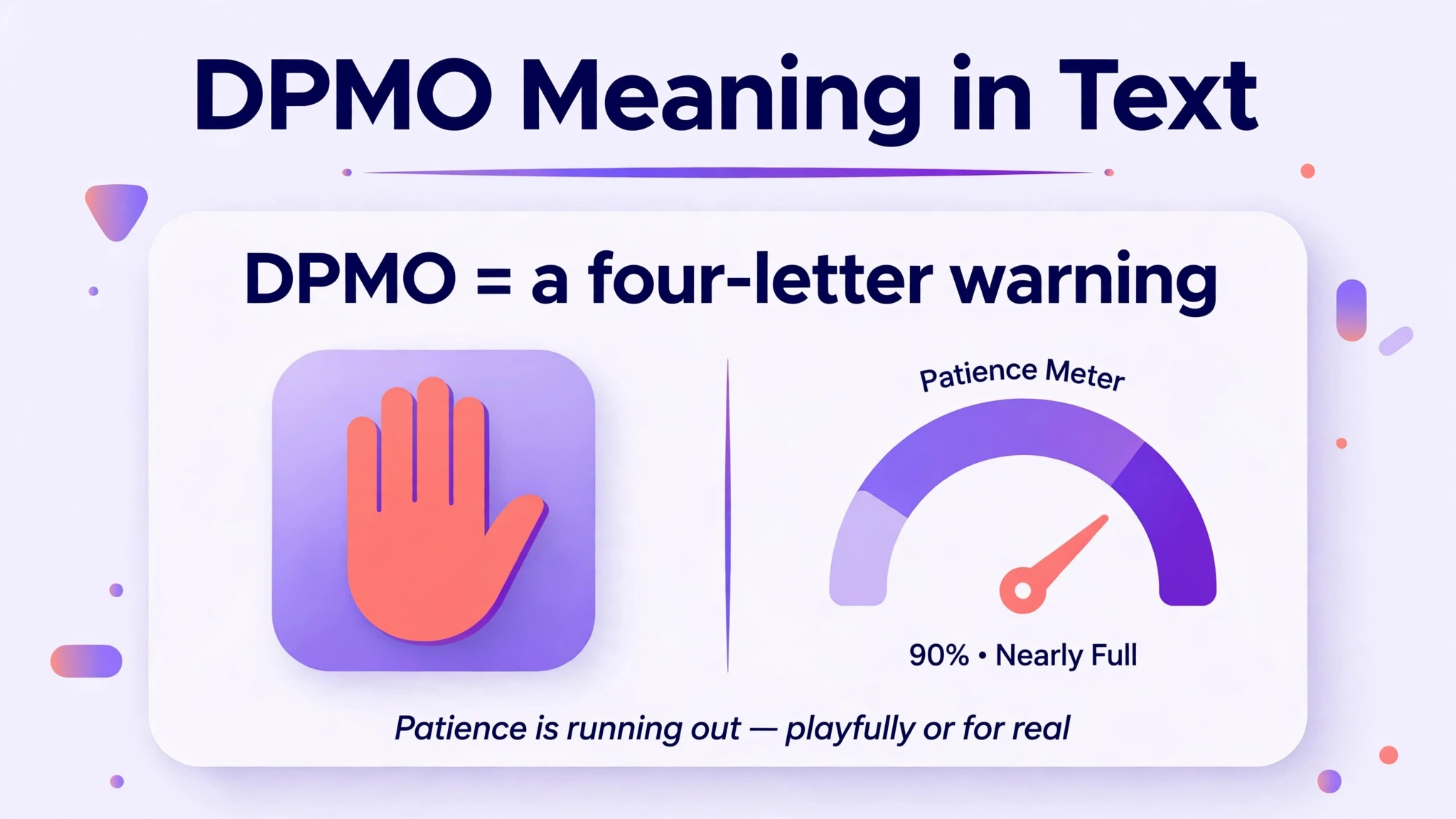
Some acronyms you can safely ignore. DPMO isn’t one of them — it’s a warning, and if it just landed in your chat, someone is telling you they’re close to their limit. If you’re looking up the dpmo meaning in text, this guide explains what it stands for, why it’s usually softer than it sounds, how it differs from its cousin PMO, and how to respond depending on whether it was a joke.
DPMO stands for “don’t p*ss me off.” It’s blunt by design: a short, sharp way to say stop pushing, I’m nearly out of patience. But like most strong slang, it lives a double life — between close friends it often arrives as an exaggerated joke, while in a tense exchange it means exactly what it says. Reading which one you got is the whole skill.
The Short Answer
| Question | Answer |
|---|---|
| What it means | “Don’t p*ss me off” — a warning that patience is running out |
| What it does | Draws a line: stop annoying me, teasing me, or pushing me right now |
| Tone | Blunt; playful and exaggerated between friends, genuinely sharp when flat |
| Where it sits | Usually a standalone reaction or the start of a message (“dpmo, I’m serious”) |
| Register | Casual only — close friends, siblings, group chats; never professional |
| Formal alternative | “Please stop,” “I’m not in the mood for this,” or “Give me some space” |
A Warning, Not a Description: How DPMO Works
DPMO is best understood as a preemptive message. It doesn’t describe something that already happened — it tries to stop something from happening. The sender is holding up a hand: one more push and this stops being fun.
That timing is what separates it from plain anger. Someone who types “dpmo” is usually still in control — they’re warning you while there’s still time to back off. The four letters do the work of a whole sentence (“I am having a bad day, you are testing me, please stop”) at the speed a heated chat demands.
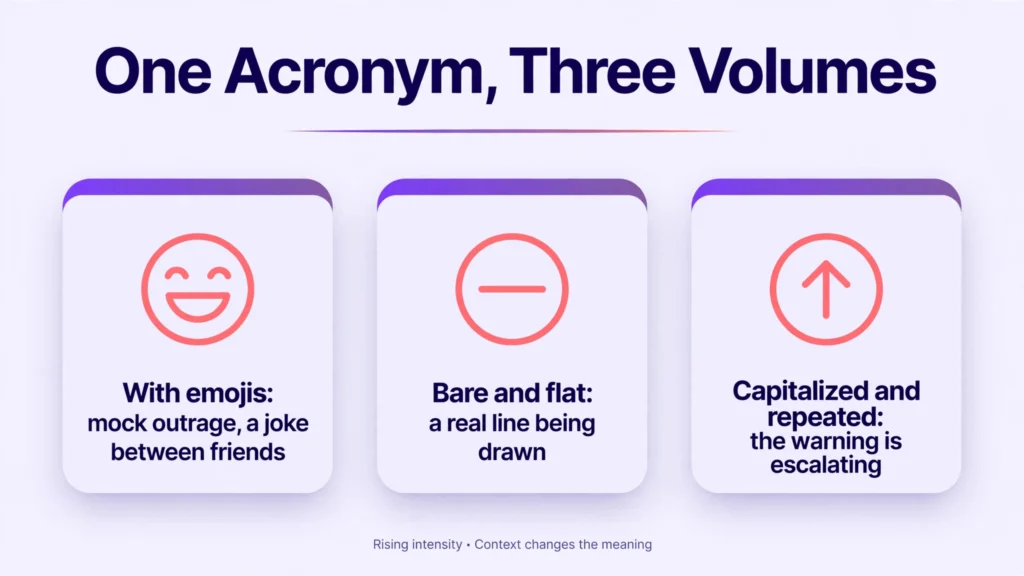
It also works as a boundary with a volume knob:
- With emojis or laughter attached (“dpmo 😭”), it’s mock outrage — the sender is performing annoyance, usually because something small and funny happened, like a friend eating their leftovers.
- Bare and flat (“dpmo.”), it’s a real line being drawn. No softeners means no joke.
- Repeated or capitalized (“DPMO. I mean it.”), the warning is escalating — the next message probably won’t be slang.
Because the phrase carries mild profanity, DPMO stays in informal territory. It’s also not an everyday acronym like LOL or BRB — it appears in bursts, when patience is actually being tested, which is part of why it keeps its edge.
DPMO vs. PMO: The Cousin With Two Meanings
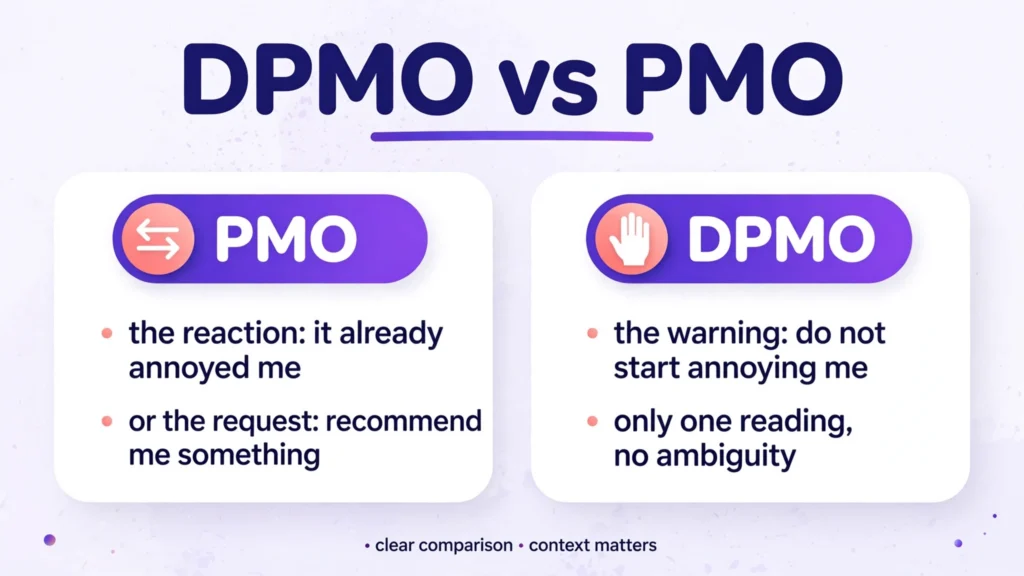
DPMO grew out of a shorter acronym: PMO. In chats, PMO most often means “p*ss me off” (“that really pmo” = “that really annoyed me”) — a reaction to something that already happened. But PMO picked up a second, completely different meaning in the early 2020s: “put me on,” as in recommend something to me (“pmo to some good shows”). Same three letters, opposite moods.
DPMO exists because of that split. Adding the “don’t” removes the ambiguity:
- PMO (reaction): “Loud chewing pmo.” — It annoys me.
- PMO (request): “Pmo with a new series.” — Recommend me one.
- DPMO (warning): “Dpmo while I’m working.” — Don’t start annoying me.
Nobody says “don’t put me on” when asking for a recommendation, so DPMO can only be read one way. If PMO is the ambiguous cousin, DPMO is the one who says exactly what they mean. You can read the full breakdown in our guide to PMO — but for DPMO itself, the warning reading is the only one.
DPMO in Real Conversations
The exchanges below are illustrative examples, not real messages.
The playful version
- Sam: “so… I ate your leftovers”
- Jordan: “DPMO 😭 those were mine!!”
The crying-laughing emoji does the tonal work. Jordan isn’t furious — they’re performing outrage over fries. This is DPMO at its most common: a joke with a real (tiny) grievance inside it.
The bad-day warning
- Alex: (sends a sixth meme in a row)
- Riley: “bro dpmo, I’m already having a day”
Here the acronym is a hand held up. Riley isn’t joking, but they’re still communicating rather than exploding. The correct response is to stop, not to send meme seven.
The argument line
- Casey: “you always do this, you never listen—”
- Morgan: “dpmo and let me finish my sentence.”
Mid-argument, DPMO marks a boundary about how the fight is going: don’t interrupt, don’t escalate. It’s sharp, but it’s still a request, not a threat.
The sibling setting
- Taylor: “I’m telling mom you broke the vase”
- Jamie: “dpmo, I’ll literally pay you”
Half warning, half negotiation. Among siblings, DPMO is practically punctuation — strong words, low actual stakes.
Joke or Genuine? Reading the Temperature
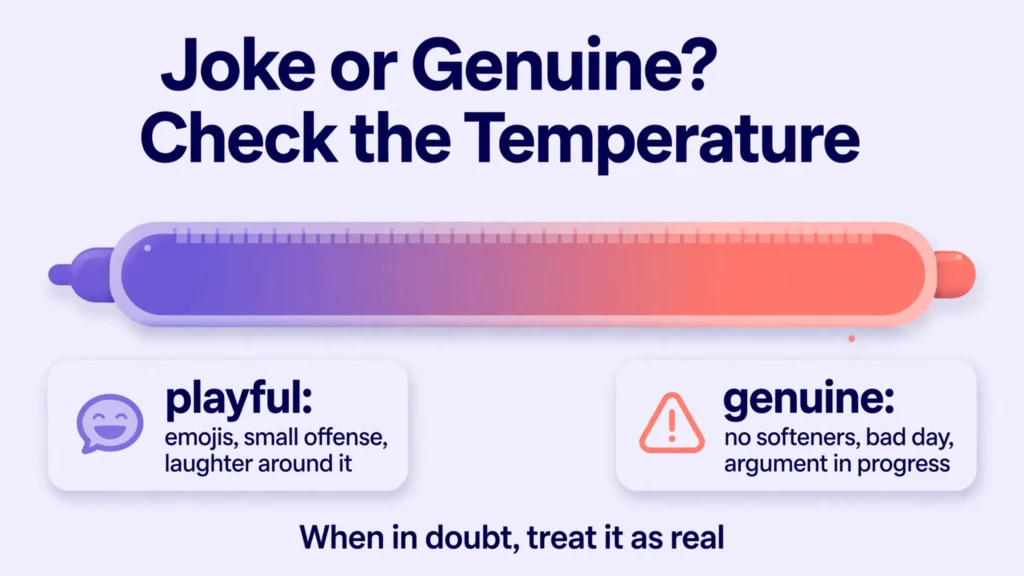
Because DPMO swings between comedy and conflict, a quick temperature check helps:
Signs it’s a joke: emojis (😭, 💀, 😂), an obviously small offense (leftovers, a lost game, a teased haircut), laughter in the messages around it, and a relationship where roasting is normal. A “SMH” from the same person in the same chat usually travels at this temperature too — exasperation played for laughs.
Signs it’s real: no softeners, a bad day already mentioned, an argument in progress, caps or a period, or the same request repeated. If someone has already asked nicely once, the DPMO that follows is not banter.
When you can’t tell: treat it as real. Backing off a joke costs nothing; laughing at a genuine warning costs a lot. A simple “my bad — I’m done” works for both readings, which is exactly why the MB (“my bad”) reflex exists.
And if a chat is genuinely turning hostile, leaving beats escalating: a plain GTG (“got to go”) exit cools things down far better than matching energy.
DPMO vs. Harsher and Softer Neighbors
DPMO vs. STFU. STFU is the louder command — it demands silence, now, and reads harsher in almost every context. DPMO warns about annoyance building; STFU slams the door. DPMO is the earlier, more negotiable of the two.
DPMO vs. SMH. SMH (“shaking my head”) is a reaction to foolishness — disappointment at a distance. DPMO is directed: it’s about what you are doing to me, right now.
DPMO vs. IDC. Opposite signals. “Idc” (“I don’t care”) shrugs a topic away; DPMO cares intensely and wants the behavior to change. One cools a chat by disengaging, the other by confronting.
DPMO vs. an OML moment. OML (“oh my lord”) expresses exasperation without an instruction. DPMO is an instruction: stop. If the message tells you to do something (or stop doing it), you’re in DPMO territory.
The Other DPMO: A Workplace Term That Isn’t Slang
If you meet DPMO in a professional document, it means something entirely unrelated: Defects Per Million Opportunities, a quality-management metric from Six Sigma used to measure how often a process produces a defect. Engineers and quality managers use it daily, and in that world it has zero connection to texting.
The two DPMOs never really collide — nobody vents about a factory metric in a group chat — but the collision explains odd search results, and it’s one more reason the slang version stays out of work messages: in a professional setting, the letters already have a job.
Where DPMO Works and Where It Doesn’t
Where it works: close friendships, sibling chats, gaming squads, and group chats where strong-worded banter is the house style and everyone knows the difference between the joke and the line.
Where it doesn’t: work chats, family group chats with mixed generations, new relationships, customer anything, and any conversation where you don’t already know how the other person handles bluntness. The mild profanity inside it disqualifies it anywhere formal — and with anyone whose limits you don’t know yet.
A fairness rule: DPMO is a warning, so it should arrive before the explosion, not as a substitute for one. Used at the first real annoyance, it’s honest communication. Saved up and deployed as an ambush after ten annoyances, it’s just a fight with an acronym attached.
How to Reply to DPMO
- It was playful: match the performance. “😭 SORRY, I’ll buy you new ones” keeps the bit alive.
- It was a bad-day warning: stop, acknowledge, done. “You’re right, I’ll chill” — short and complete.
- It was mid-argument: address the boundary, not the tone. “Okay. Finish your sentence” respects the request without surrendering your side.
- You genuinely didn’t know: apologize once, plainly. “MB, I actually didn’t realize” beats a defensive essay.
- You think it’s unfair: say so calmly, later. In the moment, piling on just confirms their point. Cool down first — an IDC-style shrug in the moment, real talk when things are calm.
- It’s becoming a pattern: if every chat with this person ends in warnings, the acronym isn’t the problem. That’s a conversation about the friendship, not the slang.
Quick Answers
What does DPMO mean in text?
“Don’t p*ss me off” — a blunt warning that someone’s patience is nearly gone. Between friends, it’s often a joke; delivered flat, it means exactly what it says.
Is DPMO rude?
It’s strong, yes. The phrase contains mild profanity and issues a direct warning, so it’s ruder than most slang — but between friends it’s commonly used as exaggerated, playful annoyance.
What’s the difference between DPMO and PMO?
PMO usually describes a reaction (“that pmo” — that annoyed me) and can also mean “put me on” (recommend me something). DPMO is only the warning: don’t start annoying me. The “don’t” removes the ambiguity.
How do I know if someone is joking?
Look for emojis, laughter, and a small offense — that’s the joke version. No softeners, a bad day, or an argument in progress means it’s real. When unsure, treat it as real.
Can DPMO mean something in business?
Yes: Defects Per Million Opportunities, a Six Sigma quality metric. Completely unrelated to the slang — and one reason to keep the slang out of work chats.
What should I reply to DPMO?
If it’s playful, play along (“😭 sorry!”). If it’s serious, stop and acknowledge: “you’re right, I’ll drop it.” Don’t argue with the warning in the moment.
Is DPMO worse than STFU?
No — STFU is harsher. DPMO warns that annoyance is building; STFU is a direct order to be quiet. DPMO usually comes earlier and leaves more room to fix things.
Why is it spelled with just initials?
Speed and softening. The initials carry the warning without typing the full profanity — a small layer of distance that makes the blunt phrase sendable.
The Short Version
DPMO means “don’t p*ss me off” — a four-letter warning that patience is nearly out. It grew out of PMO but dropped PMO’s ambiguity: DPMO is always the warning, never the request. Between friends it often plays as exaggerated comedy; flat and bare, it’s a real boundary. Read the softeners, respect the line either way, and remember it has a completely different, very professional twin — Defects Per Million Opportunities — waiting in the workplace. In a chat, though, there’s only one DPMO, and it means: stop, while stopping is still easy.
