
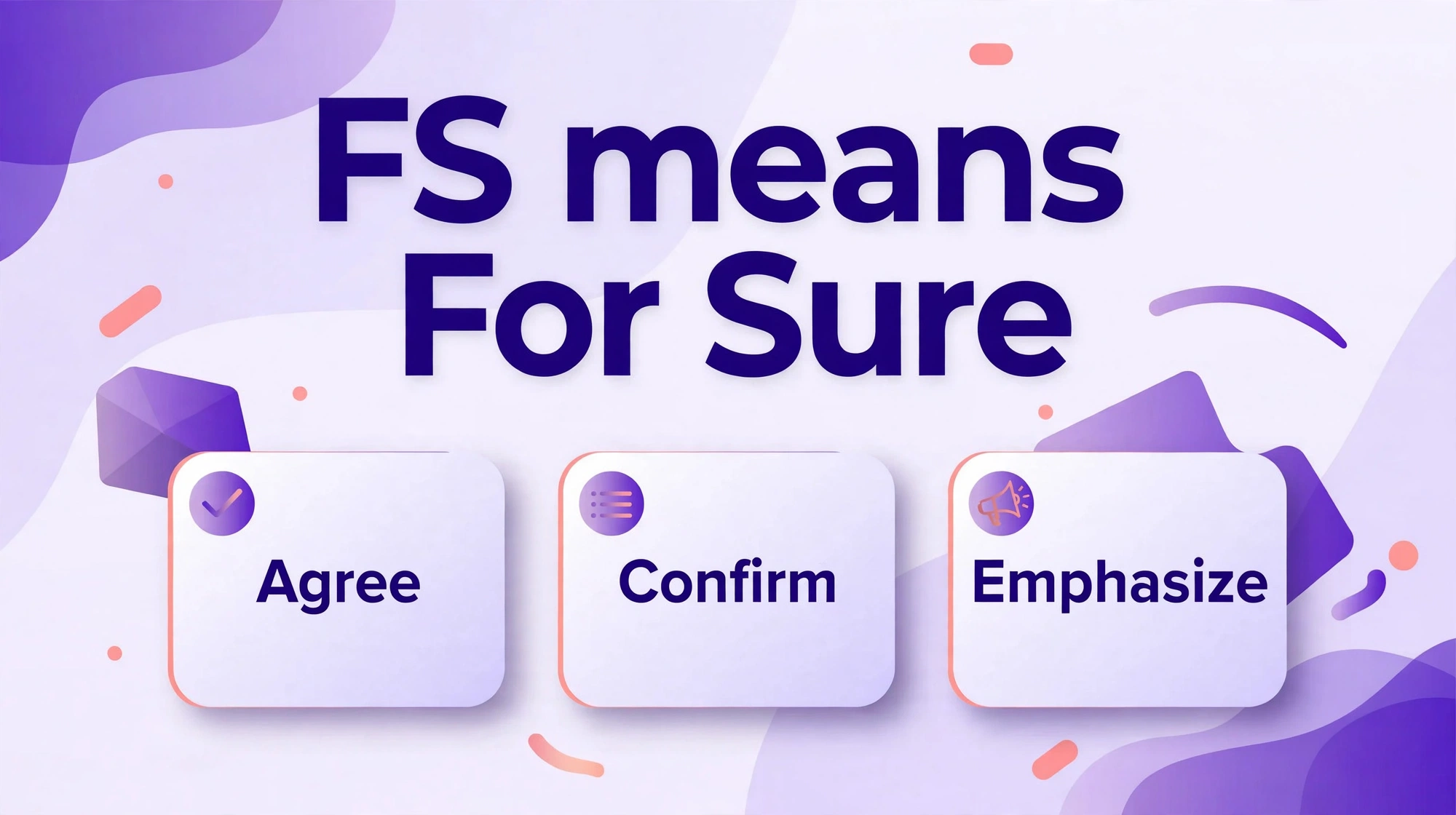
If a reply that just says “fs” lands in your chat, you probably already feel what it means — and that feeling is the whole point. The fs meaning in text is usually “for sure”: a short, confident yes, a confirmation, or a way of adding weight to something you just said.
FS means “for sure.” In a casual text, DM, or comment, it says “definitely,” “absolutely,” or “I agree.” The rest of this guide covers the exceptions: when the same letters mean something is for sale, when they mean going all in, and when a bare “fs” sounds warm, flat, or sarcastic.
What Does FS Mean in Text?
FS is an initialism: it takes the first letter of each word in “for sure.” Dictionaries define the phrase itself plainly — “for sure” means without a doubt, certainly, definitely — and texting simply squeezed that phrase down to its initials.
In practice, FS does three jobs. Agreeing: “That finale was unreal.” — “fs.” Confirming: “You still coming tonight?” — “fs, see you at 7.” Here it is a commitment, not just agreement. Emphasizing: “That song goes hard fs,” meaning it really does, no doubt about it.
One honest limit: no established general dictionary carries an entry for the abbreviation FS itself meaning “for sure,” and Wiktionary’s FS entry lists specialist senses instead. That does not make the texting meaning doubtful — every independent slang explainer checked agrees on it, and the phrase itself is dictionary-attested — but this guide claims nothing about when FS was coined or how many people use it, since no frequency study exists.
The Room-and-Register Test: How to Read Any FS

Here is this article’s named method, and its upgrade over a simple definition list: before settling on a meaning, run three quick questions. Call it the Room-and-Register Test.
Question 1: What room is this? A private chat, a public comment thread, a marketplace listing, or a technical document are different rooms, and FS changes its clothes in each one. In a chat or comment, assume “for sure” first. In a listing with a price, assume “for sale” first. In a server log or finance report, assume a specialist term first.
Question 2: What job is FS doing? Is it answering a question, agreeing with an opinion, or emphasizing a statement? An FS answering “are you coming?” is a confirmation — treat it as a promise. An FS following an opinion is agreement — reply to the opinion, not to the letters. An FS tacked onto a sentence is emphasis — the sentence itself is the real message.
Question 3: What does the typing say? Case, punctuation, and the words around FS carry the tone. Lowercase “fs” reads relaxed; uppercase “FS” reads firmer, closer to “absolutely.” An exclamation mark adds excitement, while a full stop after a lone “fs.” can flatten it. Still unsure? Ask: “fs as in for sure?”
FS in Three Positions: Start, End, or Standing Alone
Where FS sits in a message changes what it does, and this position grammar is the part most short explainers skip.
At the start. “fs, I’ll be there by 8.” FS opens like a nod before the sentence begins, telling the reader first that what follows is certain. This is the most useful position for confirming plans.
At the end. “That new album goes hard fs.” FS closes like an underline: the statement came first, and FS stamps it. This is the natural home of the emphasis job.
Standing alone. “You still down for Saturday?” — “fs.” A lone FS is a complete reply: yes, definitely, count me in. It is also the easiest form to misread, because a one-word reply gives the reader nothing else to work with. After a long, emotional message, a bare “fs” can feel dismissive — brevity after vulnerability reads as distance — so add a few words: “fs, always” or “fs, I got you.” Do not wedge FS into a verb phrase: “I’ll be there fs” works, but “I fs will be there” reads like a typo.
FS on TikTok, Snapchat, Instagram, and in Texting
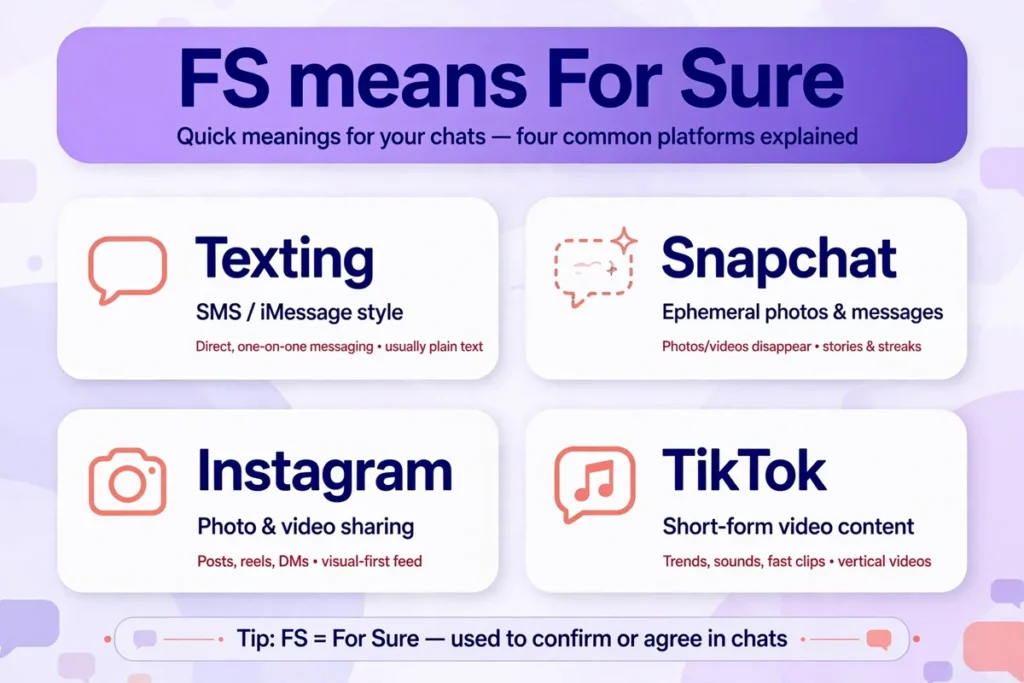
No platform gives FS a different default meaning — a claim worth stating plainly, because several thin guides invent platform-specific definitions where none is supported. What changes is where you are most likely to meet FS, and how public the message is, which changes how much a wrong guess costs.
Texting and DMs are FS’s home: confirming plans and agreeing fast, with the relationship doing most of the interpreting. Snapchat rewards short slang, and lowercase “fs” fits as a full reply on its own. Instagram DMs work like texting, while comments use “fs” as a quick nod of support — except in shop posts, where a price nearby can flip it to “for sale.” TikTok comments use “fs” as a co-sign, but on stunt videos it can slide toward “full send,” so read the video first. Discord and gaming chat follow the same pattern.
Tone and Sender Context: Who Sent It, and How It Was Typed
FS has no fixed volume. Warm: “I got you fs, don’t stress” — reassurance makes it support, not just agreement. Neutral: “That works fs” — plain confirmation. Flat: a lone “fs” after a long message can feel low-effort, though usually it is just a nod; if a normally wordy sender suddenly drops to a bare “fs.”, the shift in pattern says more than the letters do. Sarcastic: “yeah fs” with an eye-roll emoji can mean the opposite — sarcasm lives in the words around FS, never in the letters alone. Hyped: “FS!!” is enthusiasm with the volume up; match it rather than analysing it.
Sender context sharpens this. From a close friend, FS is almost always warm agreement; from a partner, often reassurance; from a crush, it agrees with whatever came before it — flirtation lives in the rest of the exchange, not in FS itself. There is no evidence FS changes meaning by the sender’s gender, and this guide does not repeat that claim. From a stranger, it is usually just a public co-sign; from a boss or teacher, a yellow flag.
Other Meanings: When FS Is Not “For Sure”
Most of the time in a chat, FS means “for sure.” This section exists so the exceptions do not catch you out, and each meaning is graded honestly.
“For sale” — contextually supported. The strongest alternate meaning, and the easiest to spot. In marketplace listings, classified ads, and selling posts, “FS” followed by an item and a price means the item is for sale: “FS: 2019 Civic, $12k.” If there is no price and no item, this reading is almost certainly wrong.
“Full send” — contextually supported. In gaming, extreme sports, and stunt-adjacent slang, “full send” means committing fully without holding back, and FS is its shorthand. “Should we just FS this?” before a risky move is encouragement to go all in, not agreement. Outside those circles it is rare, and in an ordinary text it should not be your first guess.
“File system” and “financial statement” — contextually supported, specialist only. In technology writing, FS is the system that organizes files on a computer; in accounting, a company’s financial statements. Both are real — and neither is what a friend means in a DM.
A vulgar frustration reading — weak, handled briefly. In some casual posts, FS is used as a shortened frustration expression, masked here as “f***’s sake.” Treat this with care: the standard, widely recognized form of that expression adds a third letter, and FS alone for it is uncommon and heavily context-dependent. Per this site’s policy, the full vulgar expansion appears nowhere in this article’s title, summary, metadata, or image text; this masked mention in the body is all it gets, and you should not use FS to mean it yourself when a clearer word exists.
A long tail of further specialist expansions is real elsewhere and irrelevant in a text, so it is omitted deliberately: the room tells you which world you are in.
FS vs FR, FFS, and Similar Terms
FS vs FR. FR means “for real.” The difference is one of job: FS confirms (“for sure, I’m in”), while FR stresses sincerity (“for real, that happened”). In comments they swap almost freely; for precision, use FS for agreement and FR for “I’m not exaggerating.”
FS vs FFS. This is the one to watch. Adding one letter reverses the emotional register entirely: the three-letter form is the standard frustration expression, while FS is calm agreement. When a message’s tone and its letters seem to disagree, trust the tone and re-read the letters.
FS vs Ofc, Def, and Bet. “Ofc” (of course) and “Def” (definitely) do the same agreement job as FS, with different flavours: Ofc reads slightly more polite, Def slightly more emphatic. “Bet” agrees too, but softer and sometimes ironic — it can mean “we’ll see” as easily as “deal.” FS is firmer: it commits where Bet hedges. If someone answers your plan with “bet,” you may still need to confirm; if they answer with “fs,” the plan is on.
How to Reply to FS, and How to Use It Well

If someone sends you FS, they are agreeing with you. If you asked about plans and got “fs,” move them forward: “Perfect, meet at 7?” If you shared an opinion and got “fs,” thank them or expand: “Right? I’ve been saying this for weeks.” If you asked for a favor and got “fs,” close the loop: “Legend, thanks.” If FS arrived alone with no context, ask what it was agreeing with: “fs to which part?”
When you send FS yourself, use it with friends, in group chats, in DMs, and in comments. Pair a lone FS with a few words when the other person has been vulnerable, because certainty without warmth can land as dismissal. Do not use it to answer a serious question that deserves a full answer: “Are you upset with me?” answered with “fs” is avoidance, not reassurance.
When Not to Use FS
FS reads relaxed by design, and that works against you in the wrong room. Skip it in professional emails, in messages to a boss, professor, or client, and in formal writing. Skip it in spoken conversation — saying “eff ess” out loud lands awkwardly — and with anyone who does not text slang, unless you are happy to explain it. The line is register, not age: read the person you are texting, not their birth year. And do not use FS for the frustration reading: it will be read as agreement by almost everyone.
Quick Answers
What does FS mean in text?
FS usually means “for sure” — definitely, absolutely, or I agree — confirming plans, agreeing with an opinion, or emphasizing a statement.
What does FS mean on Snapchat?
On Snapchat, FS means “for sure”: a fast, usually lowercase agreement to plans, snaps, or opinions.
What does FS mean on TikTok?
On TikTok, FS generally means “for sure” in comments and captions, but on stunt videos it can also mean “full send” — read the video first.
What does FS mean on Instagram?
On Instagram, FS means “for sure” in DMs and comments, but in a shop post, a price nearby can flip it to “for sale.”
Is FS the same as FR?
Nearly. FS (“for sure”) confirms and agrees, while FR (“for real”) stresses that something is true or serious.
Is FS rude or sarcastic?
Not by itself. A lone “fs.” can feel flat, and “yeah fs” with a sarcastic emoji can mean the opposite. Punctuation and context decide.
Can I use FS in a work email?
No. FS is informal slang, best kept to texts, DMs, and casual comments. In a work email, write “for sure,” “definitely,” or “yes” in full.
Does FS mean “for sale”?
Only in the right room: in a listing with an item and a price, FS means “for sale.” In an ordinary chat, it means “for sure.”
Final Thoughts
FS is two letters doing three jobs in three positions across several rooms, which is why it rewards a test instead of a definition. Run the Room-and-Register Test: check the room, name the job, read the typing.
Most of the time, the simplest reading is right: someone typed “fs” because they agree with you, they are in, or they are sure.
Related reading: EYP meaning in text, FYA meaning in text, TGIF meaning in text, BMS meaning in text, DM meaning in text, DWBI meaning in text, TTYL meaning in text, YK meaning in text.
