
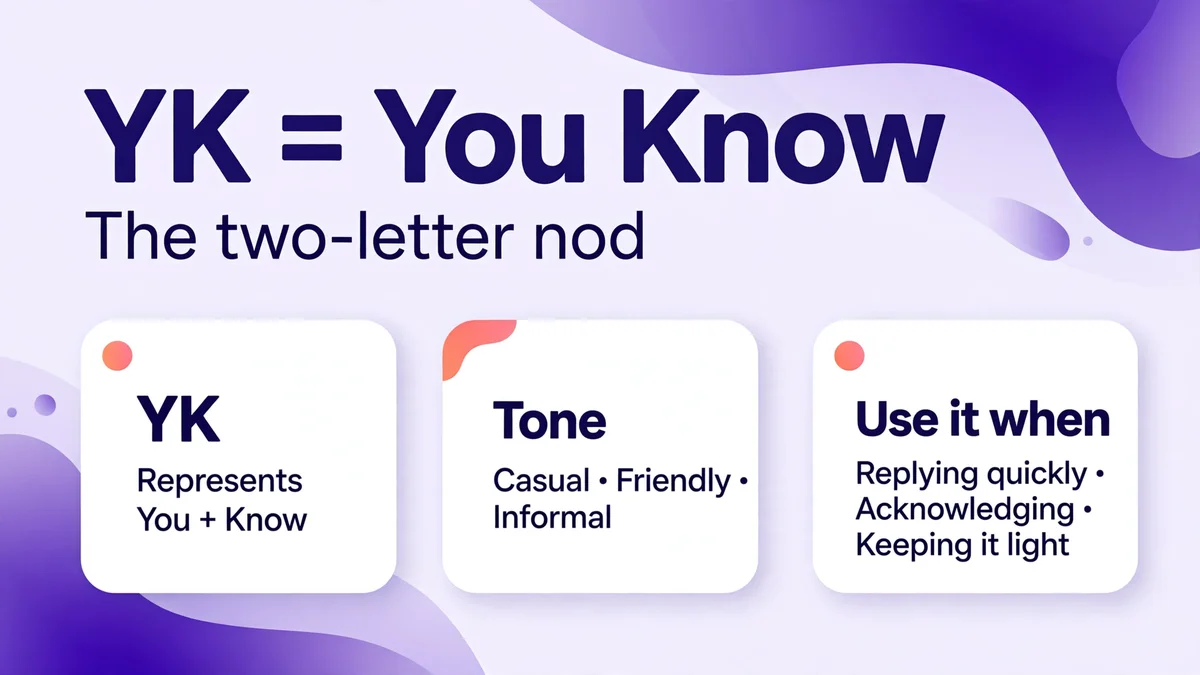
"It was kinda awkward, yk." Two letters that add nothing to the sentence — and everything to its tone. If you have ever read a YK and wondered whether the sender was agreeing with you, softening a blow, or calling you a liar, you have felt the exact confusion this article exists to clear up. The yk meaning in text is simple to state, and its trick is that the letters themselves barely matter. Where they sit does.
YK usually means "you know" — a soft nod that says "we're on the same page here," not a statement of fact. That is the whole definition in nearly every text you will ever receive. The useful part is telling that nod apart from YK's rare second life as disbelief — which is exactly what the Position Test below does.
What Does YK Mean in Text?
YK is an initialism, and its letters spell the phrase out: You Know. But unlike most abbreviations, YK does not carry information. It carries social weight. Linguists have a name for phrases like "you know": discourse markers — small pieces of language that do not change what a sentence literally means, but manage the relationship between the people in the conversation. They are social glue. They say: I assume some common ground exists between us.
That is why YK feels so familiar even to people who have never thought about it. "You know" was already a fixture of casual spoken English for decades before texting compressed it to two letters — texting did not invent the habit, it just gave an old habit a keyboard shortcut. When someone texts "he's always late yk," they are not asking whether you have information about his lateness. They are tacking on a verbal habit that says: we both get it.
Real-world YK, done right:
- "It was kinda awkward, yk." — Seeking a shared shrug, not information.
- "I was really nervous, yk." — Softening a vulnerable statement.
- "So I was walking home, yk, and suddenly it started raining." — Storytelling flow, the way "like" works in speech.
Notice what YK never does in these examples: it never adds a fact. Remove it from any of the three sentences and the information stays identical. What disappears is the warmth — the sense that the sender is talking with you, not at you.
The Position Test
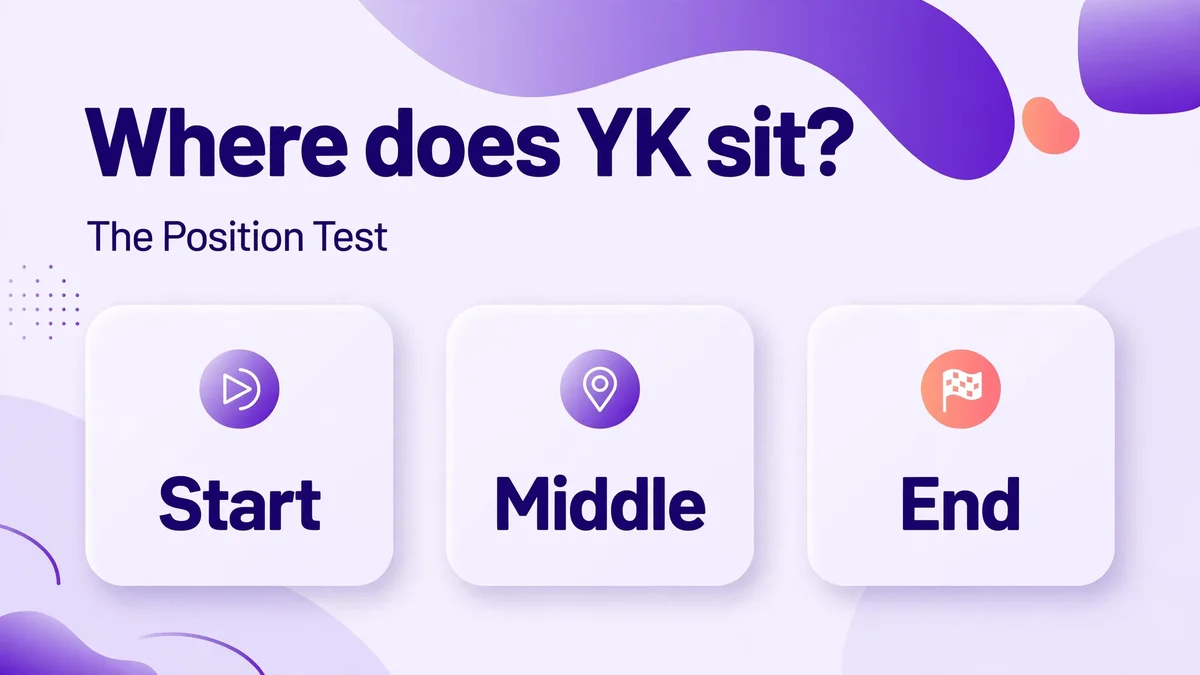
Here is this article's named method. Call it the Position Test: three checks, run in order, on any YK you receive or are about to send.
Check 1: Where does YK sit? Position is the whole game. At the start of a sentence, YK softens what is coming: "yk, I actually liked that movie" eases the listener in. In the middle, it works like "like" or "I mean" — a discourse marker that buys thinking time while keeping the message flowing: "it's just, yk, complicated right now." At the end, it invites agreement: "she never texts back yk" is really asking "you know what I mean?"
Check 2: Is it a standalone reply to surprising news? This is the only place the second meaning lives. If someone shares shocking news and the reply is a bare "YK?" or "YK!", that is "you're kidding" — disbelief, not a nod. "I just got tickets to the finals." "YK?!" is not seeking agreement; it is raising eyebrows. But note how narrow this room is: it needs surprising news, a standalone position, and usually a question mark or exclamation mark. Without all three, the default reading wins.
Check 3: What does the punctuation do? A question mark turns YK into a genuine check: "you get what I'm saying, yk?" is closer to "does that make sense?" and expects an answer. A bare "yk" with no punctuation reads more like a shrug — an agreement invite that needs no reply at all. "YK!" with an exclamation mark after news reads as disbelief; "yk." at the end of a statement reads as warmth.
Run all three and the verdict is almost always the same: inside the sender's own statement, YK means "you know." Only as a standalone reaction to news does it mean "you're kidding" — and even then, most readers will still default to "you know" unless the surprise is obvious. That default is the single biggest misread to avoid: assuming disbelief when the sender meant connection.
You Know: The Three Jobs
"You know" does three distinct jobs in a message, and naming them is how you stop treating YK as one vague blur.
The softener. YK takes the edge off a statement that might land hard. "He's sweet yk, just not my type" balances a compliment with a boundary. "Not gonna lie, yk, I kinda expected that" softens an opinion before it lands. The pattern: YK arrives just before or just after the part that could sting.
The agreement-check. At the end of a sentence, YK asks whether you are tracking: "It's been a rough week, yk?" is really "you know what I mean?" It does not need a yes — a nod, a "totally," or silence all accept it. This is YK's most common job, and the one most worth recognizing, because it is invisible until you look for it.
The storytelling flow. Mid-sentence, YK keeps a story moving the way pauses and hedges do in speech: "So I was walking home, yk, and suddenly it started raining." Nothing factual is added. What is added is the feeling of a voice — a person thinking aloud, not a report being filed. This is also why YK shows up in captions and comments ("thrifted fits just hit different yk"): it makes a flat block of text feel like an actual person.
You're Kidding: The Rare Reaction
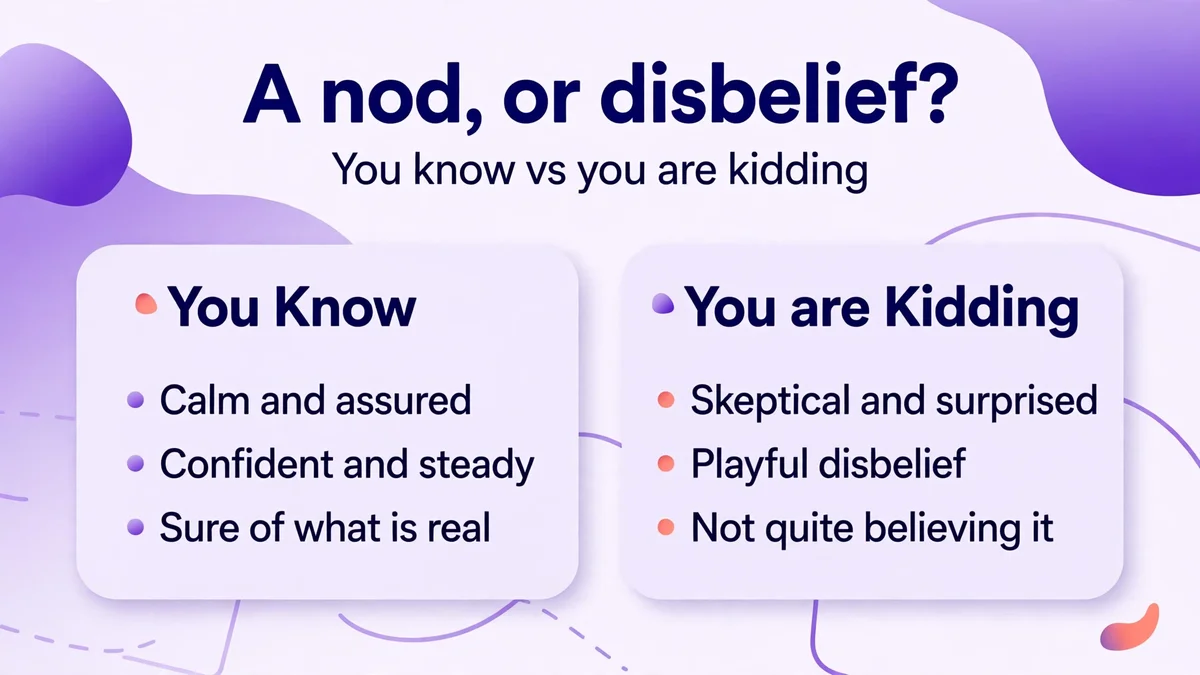
The second meaning is real, and it is rare. Treat it as the exception it is.
"You’re kidding" YK only works as a reaction to surprising news, and it almost always stands alone: "I'm moving to NY!" "YK!" — "Jake broke up with Stephanie!" "YK!!" — "I met your favorite artist today." "YK?" In each case, YK is not inside the sender's statement at all. It is the whole reply, and its job is disbelief: "Really? Seriously? No way."
Two warnings. First, the rarity matters: one guide puts it plainly that "you know" is almost always the reading, and "you're kidding" is a much rarer, context-dependent one. If you default to disbelief, you will misread most YKs you meet. Second, the platform-split story — that texting means "you're kidding" while social media means "you know" — is a single site's invention, contradicted by every other guide. Position and news value decide, not the app.
YK Tone: Warm Nod or Vague Hedge?
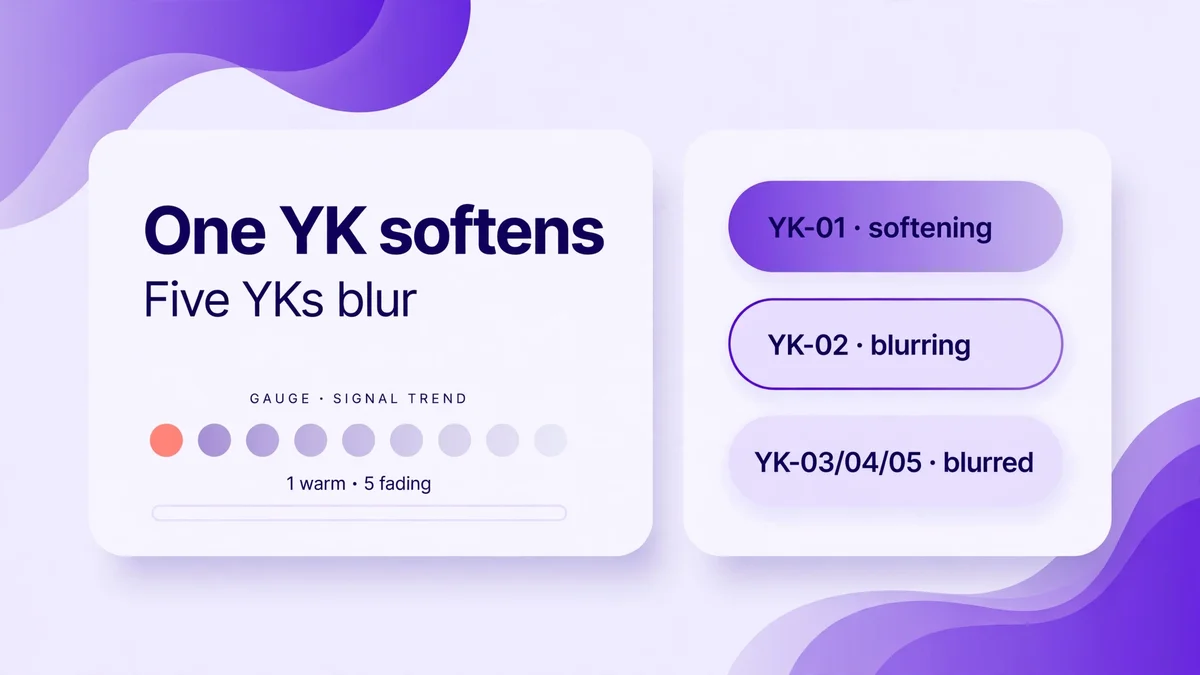
YK's default tone is warm and casual. But like every hedge, it has a dose problem: one YK softens, five YKs blur.
One YK: warmth. A single YK at the end of a feeling — "I was just overwhelmed, yk" — sounds more emotional and human than the same sentence without it. It says: I trust you to get this.
Every message: evasion. When every message ends in YK, the pattern flips. "Maybe we could hang out sometime yk" three times in a row, without ever suggesting a real plan, stops reading as warmth and starts reading as noncommittal — the sender avoiding directness. On dating apps especially, overuse quietly kills momentum: the other person cannot tell whether you are interested or just hedging.
Workplace: precision problem. YK relies on the listener already knowing something, and work cannot always guarantee that shared knowledge. "The deadline moved, yk, so we should be fine" is vague about what moved and why; "the deadline moved to Friday, which gives us more room" names the fact. The problem is not that YK is rude — it is that it trades precision for warmth, and work usually needs the precision. A BTW-style aside has the same warmth without the vagueness: "btw, the deadline moved to Friday" says everything YK leaves out.
Sender context matters by relationship, not by gender. From a friend, YK is the default room: feelings, stories, and shared shrugs. From a crush, it keeps things low-pressure ("not really looking for anything serious rn yk?") — warm, but vague if it never sharpens into a plan. From a stranger, YK assumes a common ground that may not exist yet; with someone new, spell it out first. From a boss or coworker, skip it unless the chat is genuinely casual — and never when the message carries a fact someone must act on.
Where You'll See YK: Texting, Captions, and Group Chats
YK means the same thing on every platform: a nod, not a statement. What changes is the room, not the meaning — and no platform gives it a special definition.
Texting (SMS, WhatsApp, iMessage). This is YK's home. One-to-one chats, usually around feelings and stories rather than logistics: "I was just tired, yk." When a message is purely about scheduling, YK rarely appears — there is no emotional weight to soften, so the filler has nothing to do.
Captions and comments (Instagram, TikTok, Snapchat). Here YK makes a post feel relatable rather than communicating anything specific: "not the whole outfit falling apart 5 minutes in yk." The tone is self-deprecating and throwaway, which fits caption culture — the poster is not taking themselves too seriously, and YK is how they signal it.
Group chats and gaming (Discord, lobbies). Fast rooms reward short messages, and YK lets someone react without breaking the pace: "that ambush was actually clean yk." In a group thread, it also keeps the tone friendly when several people are typing at once and nobody wants to write a paragraph.
The pattern: the letters stay the same, but the room changes the job. Private rooms nod; public rooms perform relatability. And the meaning never changes by app — only the frequency does.
How to Reply to YK
Your reply depends on which YK you just received. Run the Position Test first, then match it.
If it was "you know": mirror the agreement. "Totally, can relate" or "Right? I had it on repeat!" both accept the nod. A DW-style comfort pairs well when the YK carried a feeling: "dw, I get it" answers the emotion behind the nod, not just the letters.
If it was "you're kidding": confirm or deny the news. "No, it's actually happening! I leave next month" closes the disbelief loop. A bare "yeah!" works too — the reaction just wants a verdict.
If you are unsure: one clarifying question beats guessing — "you know, or you're kidding?" costs five words and prevents the classic misread: answering a nod with a denial, or a denial with a nod.
If the YK was vague and it matters: ask for the fact. "YK" after "the deadline moved" deserves "moved to when?" — warmth is nice, but a plan needs a date.
If you genuinely don't care: don't hide behind a nod. An IDC is blunt, but at least it is honest — a YK that pretends to agree when you have already checked out is worse than a plain no.
YK vs TBH, FR, LMK, and IK
YK sits in a family of tone-and-truth shorthand, and the cousins are easy to confuse because they all feel casual. The difference: YK is the only one that adds no content at all.
| Term | Full form | What it actually does |
|---|---|---|
| YK | You Know | Adds tone, not content — assumes shared understanding |
| TBH | To Be Honest | Introduces honesty or a confession — adds a claim |
| FR | For Real | Adds emphasis or agreement — strengthens a claim |
| LMK | Let Me Know | Asks for information or a decision — requests content |
| JS | Just Saying | A soft remark — like YK, tones down what came before |
| IK | I Know | Confirms understanding — the mirror of YK |
The useful pairs: YK assumes shared understanding; IK confirms it. "It's been a rough week, yk?" assumes you get it; "IK, it's been tough for me too" confirms it. TBH and FR both strengthen what is said — TBH by claiming honesty, FR by claiming emphasis — while YK strengthens only the relationship. And JS is YK's closest cousin: both soften what came before, but JS ("just saying") frames a remark as an aside, while YK frames it as shared ground.
Debunked: What YK Does NOT Mean
Short letters collect false meanings, and YK has collected a few:
- Yikes / Yeah Okay / Your Kind — look-alikes and sound-alikes. Each appears on exactly one site's confusion table, and none is a real texting meaning. "Yikes" looks similar, "yeah okay" sounds similar when spoken, "your kind" misleads by context — all three are misreads, not meanings.
- YK Osiris / Young King — a name, not texting. The R&B singer's stage name uses YK for "Young King." In a chat, nobody means the singer unless they are talking about the singer.
- YKTV ("you know the vibe") — related slang, not YK. An extended phrase with its own meaning; it does not make YK mean "vibe."
- The platform split — a myth. Texting does not mean "you're kidding" while social media means "you know." Position and news value decide, on every app.
- "18% of gamer texts" — fake precision. One site claims a percentage from its own "analysis" of gaming logs. No study, no method, no number worth printing.
- Generational and regional claims — refused. "Gen Z slang" labels and country-by-country usage splits come from listicles, not studies. YK's habit is old, wide, and not owned by any age group.
- "YK is meaningless filler" — a myth. It carries no factual content, but it carries social weight: agreement, softening, flow. Calling it meaningless misses the entire job it does.
- NVM is not YK's cousin. NVM cancels something ("forget I asked"); YK softens something. Different jobs, and confusing them turns a nod into a retraction.
When Not to Use YK
YK is a joy in its habitat and a misfire outside it. Skip it when:
- The setting is formal. Emails, reports, essays, client messages — YK reads as careless there. "As you know, clients tend to be anxious before deadlines" says what "yk how clients get" only gestures at.
- Precision matters. If someone must act on your message, name the fact. "The campaign numbers are a bit off yk" forces a follow-up call; naming the metric, the cause, and the plan does not.
- The listener may not know it. With someone unfamiliar with texting slang, YK is a locked door. Spell it out: "you know what I mean?"
- You are using it every message. One YK softens; five YKs hedge. If every sentence ends in YK, you are avoiding directness, and the other person can feel it.
- You actually need a yes or no. "Yk?" as a question still needs the question spelled out when the stakes are real. A nod is not an answer.
Quick Answers
What does YK mean in text?
YK usually means "you know" — a soft nod that assumes shared understanding, not a statement of fact. It softens statements, checks agreement, and keeps stories flowing.
Can YK mean "you're kidding"?
Yes, but rarely, and only as a standalone reaction to surprising news — "I'm moving to NY!" "YK?!" Everywhere else, the default reading is "you know."
Is YK the same as "you know"?
Yes — YK is simply the shortened form of "you know." The full phrase is clearer and more expressive; YK is shorter and more casual.
Is YK rude?
No. Its default tone is warm and casual. It only feels evasive when overused — every message ending in YK reads as hedging rather than warmth.
Can I use YK at work?
In a genuinely casual team chat, occasionally. Never in email, reports, or anything where precision matters — YK trades precision for warmth, and work usually needs the precision.
YK vs IK — what's the difference?
YK assumes shared understanding ("It's been a rough week, yk?"); IK confirms it ("IK, it's been tough for me too"). YK reaches for common ground; IK says you are already standing on it.
YK is two letters doing the work of a nod across the table — "you know what I mean?" Run the Position Test before you read it and before you send it: check where it sits, check whether it answers news, and check the punctuation. Get that right, and YK stays what it should be — a warm nod, not a vague hedge and not a misread.
