
It is 11:47 pm. The chat has been going for an hour — jokes, plans for the weekend, a photo of someone’s dog in a raincoat — and then a single message lands: “gn 🌙”. No sentence. No “talk tomorrow”. Just two letters and a moon. Is that warm, or a brush-off? That tiny moment of doubt is exactly what gn meaning in text is about.
GN means “good night.” It is the shortest way to close the day’s conversation and wish someone a good sleep. “I’m beat. Gn 🌙” means “I’m going to bed now, talk tomorrow.” The meaning is the easy part. The hard part is reading the warmth behind it.
What GN Means in Text
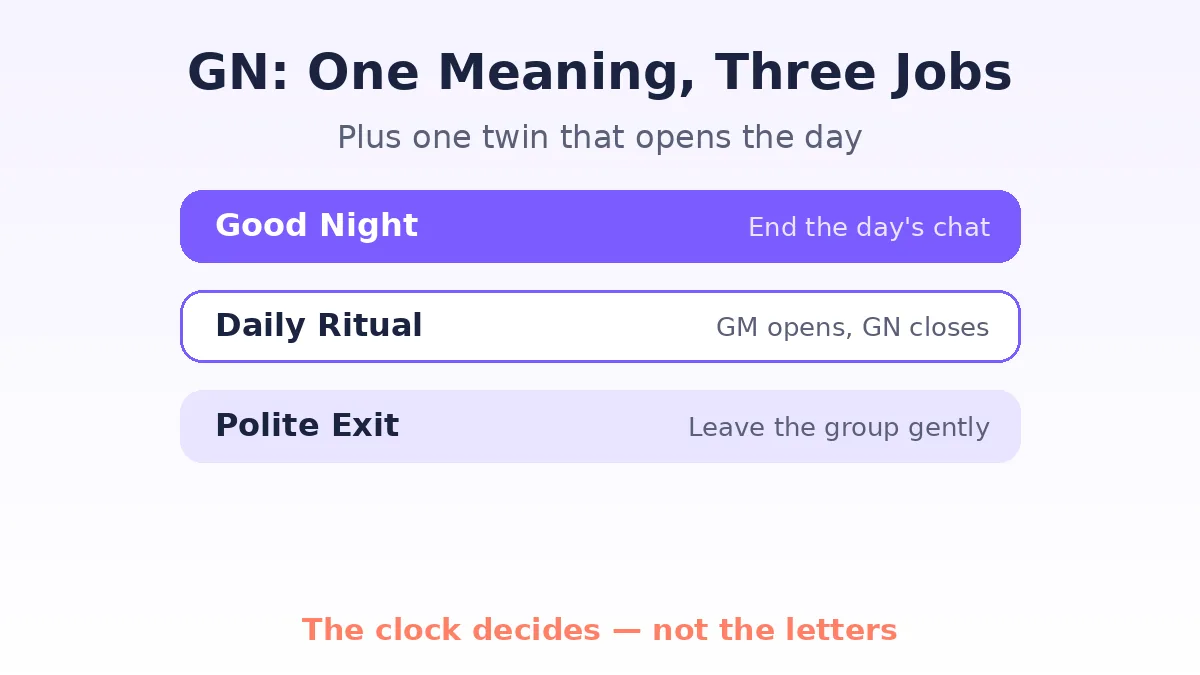
GN stands for “good night.” It is an initialism: G for good, N for night. People send it when they are heading to sleep, signing off for the evening, or closing a conversation that has run its natural course. “Alright, gn! Talk tomorrow” is the whole job in five words.
GN does three jobs, all of them gentle ways of ending something. It ends the night’s conversation: you are tired, the chat is done, and GN is the full stop. It is a small daily ritual: couples and close friends trade a good morning and a good night every day, and the two messages become the brackets around the whole texting day. And it is a polite exit from a group chat: “Gn everyone ✌️” tells the group you are leaving without ghosting anyone.
The twin matters. GM means “good morning” — it opens the day; GN closes it. Our guide to what GM means in text covers the morning half. GN is never a mid-conversation word: if it shows up at 2 pm, it is a joke, a mistake, or a polite exit wearing a night-time word.
The GN Clock Test
Here is the named reader test for this article: the GN Clock Test. For GN, the clock decides what the message means.
Question 1: What time is it? A GN sent at 11 pm is a genuine farewell. A GN sent at 2 pm is a joke, a mistake, or an exit — read the rest of the chat before you decide which. If the hour fits bedtime, the letters are doing their normal job. If it does not, look at the next question instead of trusting the letters.
Question 2: What came just before it? Read the last five messages, not just the GN. A warm, funny chat followed by “gn 🌙” is a warm goodnight. A long, personal message from you followed by a bare “gn” is the one that stings: the reply is much shorter than what it answers. The message before the GN is the real message; the GN is only the envelope.
Question 3: What does tomorrow’s first message look like? If tomorrow opens with a normal “gm” or a chatty message, last night’s GN was exactly what it looked like — a goodnight, nothing more. If tomorrow opens with silence, or with a careful “hey, about last night…”, then the GN was carrying something heavier. A single GN is a data point, not a verdict.
GN in Real Conversations
The sleepy sign-off.
Maya: “My eyes are closing as I type this 😴”
Leo: “😂 gn, go to sleep.”
The couple’s ritual.
A: “Gn ❤️”
B: “Gn, sleep well. See you tomorrow.”
Leaving the group chat.
A: “Okay I’m out, gn everyone!”
B: “Gn!”
C: “Night!”
In real chats, GN is the least mysterious abbreviation in texting — the mystery only appears when you read it alone.
How the Feeling Around GN Changes
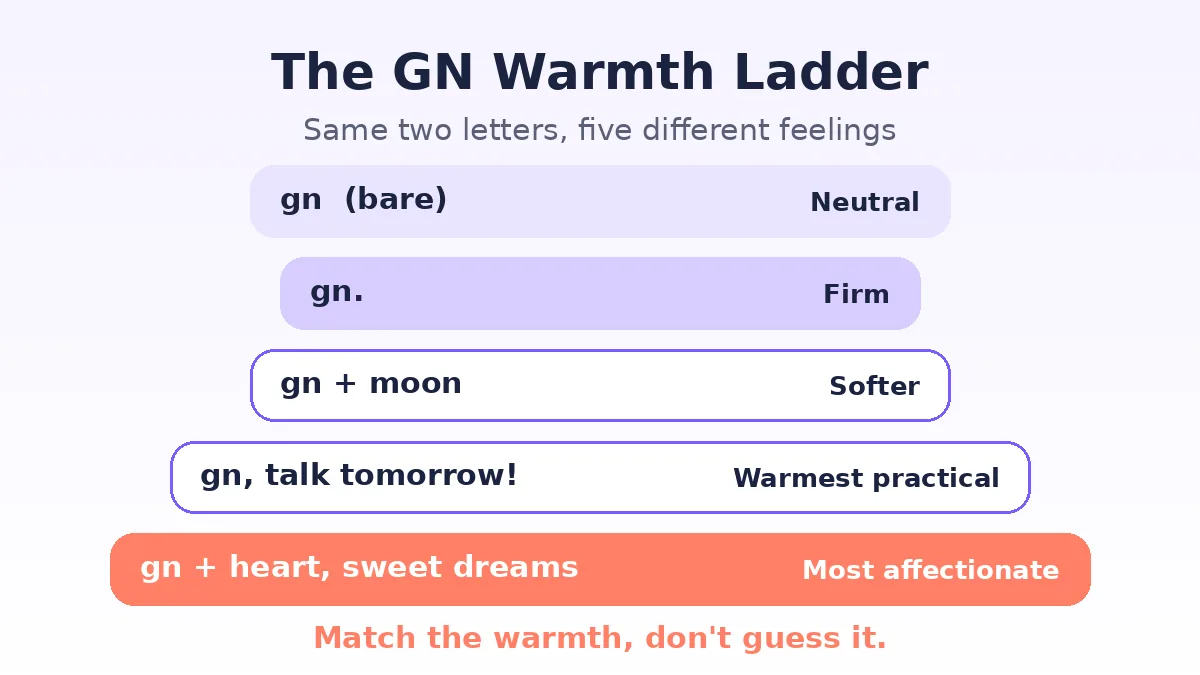
GN is almost always kind — it says “I was thinking of you right before sleep.” But the same two letters can sit on very different rungs of a ladder. At the bottom is the bare “gn” — neutral, standard, the default goodnight. One rung up is “gn.” with a full stop, which can feel firm or final after an emotional chat. Then comes “gn 🌙”, softer, with the moon doing the warming work. Then “gn, talk tomorrow!” — the warmest practical version, because it promises the conversation will continue. At the top is “gn ❤️ sweet dreams”, usually reserved for a partner, a close friend, or family.
The empty GN is the only real problem. A GN can feel cold, and pretending otherwise would be dishonest — one popular guide even claims GN is “essentially impossible to misread negatively,” which is simply wrong. The dry-GN checklist is short: the message is unusually short compared with how this person normally texts; it comes after an emotional or detailed message from you; it has no emoji and no friendly closing; it follows an argument; or it ends the conversation suddenly. One item means little. Three or more means the GN is carrying distance, not sleepiness.
GN on TikTok, Snapchat, Instagram, and in Texting
In texting, SMS, and WhatsApp, GN is at home. It is the natural end of a one-to-one chat, and the clues are richest there because you know the sender, their hours, and their habits.
On Snapchat, GN is a staple of streaks and late-night chats — quick, frequent, and intimate, often the last snap of the night. “Streaks done. GN 💤” is a complete message: the streak is safe, the day is over.
On Instagram, GN shows up in DMs and story replies as a warm closer — “Alright, I’ll reply tomorrow. GN ✨” — and in live chats, where “GN everyone, thanks for joining the live” addresses followers rather than one person. On TikTok, GN lives in comments on night-time posts and “going to bed” videos: “Posting soon, but for now GN 😴.” It is a wave to the room rather than a whisper to one person.
Who Sent It Changes How It Lands
From a parent or grandparent, GN is simple and sweet. Answer warmly and let it go: “Gn! Sleep well 😊.” Nobody overthinks a parent’s goodnight, and that is the correct response.
From a close friend, GN is easy: a night out ending, a late shift finishing, a study session closing. “I’m exhausted after work. GN, talk tomorrow” needs nothing more than “GN, sleep well!” back. Friends do not grade each other’s goodnights.
From a crush or a partner, GN carries the most weight, because in early dating every small message gets weighed. A plain “GN” from a crush could mean they are politely ending the chat, they are tired, they want to acknowledge you before going offline, or they simply text in a brief style. Do not judge their feelings from one abbreviation alone — look at the pattern, not the letters. Between partners, the GM/GN exchange often becomes a ritual, and the ritual itself is the message.
From a coworker or a boss, GN belongs only in relaxed team chats. “GN everyone” at the end of a late shift is fine; in a formal email, write “good night” out in full.
After an argument, GN changes completely. “Fine. GN.” is not a goodnight; it is a door closing for the night, with the word “fine” and the full stop doing the real talking.
GN vs GM vs TTYL vs BRB
GN gets mixed up with its neighbours because they all manage endings. They are not the same — the difference is the clock.
| GN | GM | TTYL | BRB | |
|---|---|---|---|---|
| Stands for | Good night | Good morning | Talk to you later | Be right back |
| Job | End the day | Start the day | End the chat for now | Short pause |
| When | Night, before sleep | Morning | Any time | Any time, minutes |
| Answers | “Gn! Sleep well” | “Gm! Morning” | “Talk soon” | “Okay” |
GN vs GM is the classic pair. GM opens the day; GN closes it. Many couples and friend groups trade both daily: one says “I’m here, let’s talk,” the other says “I’m signing off, sleep well.”
GN vs TTYL is a question of finality. TTYL ends the chat for now, at any hour; GN ends the day. “Gotta run, ttyl!” at 3 pm is normal. “Gotta run, gn!” at 3 pm is a joke or a mistake.
GN vs BRB is a question of scale. BRB means a pause of minutes — the person is coming back. GN means a pause of hours — the person is going to sleep. Confusing the two is how you end up waiting up for someone who has already gone to bed — the territory of what DWU means in text.
The Other GNs
GN is a busy pair of letters outside texting. In publishing and comics, GN is short for graphic novel. As a language code, lowercase gn is the ISO code for Guarani. Dictionary.com’s entry for G.N. lists Graduate Nurse and Guinea — real expansions, none of them about texting. In a late-night text, though, it is good night.
How to Reply When Someone Says GN

When a friend sends GN, match it lightly: “GN! Sleep well 🌙” or “Night! Talk tomorrow.” A friend’s goodnight needs warmth, not an essay.
When a partner sends GN, match the affection: “Gn ❤️ sweet dreams” or “Good night, I loved talking to you.” And to be honest, the sweetest reply is often the specific one: “Gn — today was really fun” beats a robotic “gn” every time.
When a group chat sends GN, a single “Night!” or “gn!” is enough. You are waving at the room, not writing to one person.
When the GN feels empty, do not answer the letters — answer the pattern. If their GN is suddenly shorter than usual, try “Everything okay? Seemed a bit short tonight.” If they were not gonna lie tired, they will say so; if something is wrong, you have opened the door without accusing them. And if you don’t know what they meant, ask instead of guessing all night: “Headed to bed, or just wrapping up?”
When someone sends GN and then keeps texting, do not call it out. GN is a signal of intent, not a lock on the phone — people send it when they are getting into bed, then carry on scrolling and replying for a while. It does not mean they were trying to get rid of you.
When Not to Use GN
GN is appropriate in most casual conversations, but the full phrase is better when the moment deserves more than two letters. Do not use GN to dodge a conversation — dropping it mid-argument to escape reads as avoidance, so finish the thought first and sleep on it after. Do not use it after an emotional conversation, when a fuller goodnight would show you were listening. Do not use it with clients or in formal emails — write “good night” out in full. And do not use it when you do not mean the sign-off: nothing undermines a goodnight like ten more messages, so if you send GN, mean it — or at least pause the chat. If someone answers your GN by waiting up anyway, expect a head-shake — the territory of what SMH means in text — because you asked for the one thing they did not give you: a quiet night.
Quick Answers
What does GN mean in text?
GN means “good night.” It is a short, friendly sign-off sent when someone is heading to sleep or ending the conversation for the evening, often with a moon emoji: “gn 🌙”.
Is GN rude?
No — GN is a standard, polite abbreviation. But after a personal or emotional chat, a bare GN can feel cold, and a fuller goodnight can feel kinder.
What is the difference between GN and GM?
GM means “good morning” and opens the day; GN means “good night” and closes it. They are a natural pair, and many people exchange both daily.
What does GNSD mean?
Good night, sweet dreams. It is a more affectionate version of GN, usually sent to a partner or someone close.
What does GN mean on Snapchat?
The same as everywhere: “good night.” On Snapchat it is a common final message in streaks and late-night chats — the last snap before sleep.
Can I use GN at work?
In relaxed team chats, a casual “gn everyone” at the end of a late shift is fine. In formal emails or client messages, write “good night” out in full.
What else does GN stand for?
Outside texting, GN can mean graphic novel, Graduate Nurse, Guinea, or the Guarani language code. In a late-night text, it is always “good night.”
Why did someone send GN and then keep texting?
Because GN is a signal of intent, not a lock on the phone. People send it when they are getting into bed, then keep scrolling and replying.
