
If you woke up to a message that just says "gm" and wondered whether you missed something, you are asking the right question. In short, gm meaning in text is almost always "good morning." It is a short, friendly greeting that opens the day, checks in on someone, or simply says, "I am here, and I am thinking of you." Usually, the sender just wanted to say good morning faster.
That simplicity is also what makes GM easy to misread: the same two letters can mean something else in a game, at work, or on a food label. Context does the real work, and this guide shows you how to use it.
What GM Means in Text
GM is an initialism for "good morning." Wiktionary lists it as an interjection in internet slang and text messaging, and every major slang explainer agrees on the same core reading. When someone sends GM at the start of the day, they are greeting you, not asking a question or giving an instruction.
It works as a complete message on its own: "GM! Did you sleep okay?" or "GM, are we still on for coffee?" The greeting stays the same; only the next sentence changes, and that next sentence tells you what kind of morning message it is.
GM is also the mirror image of GN, good night: GM opens a conversation in the morning, GN closes one at night. One more point matters: GM is casual. To a hiring manager, teacher, or new client, spell out "Good morning" instead.
The Clock-and-Context Test
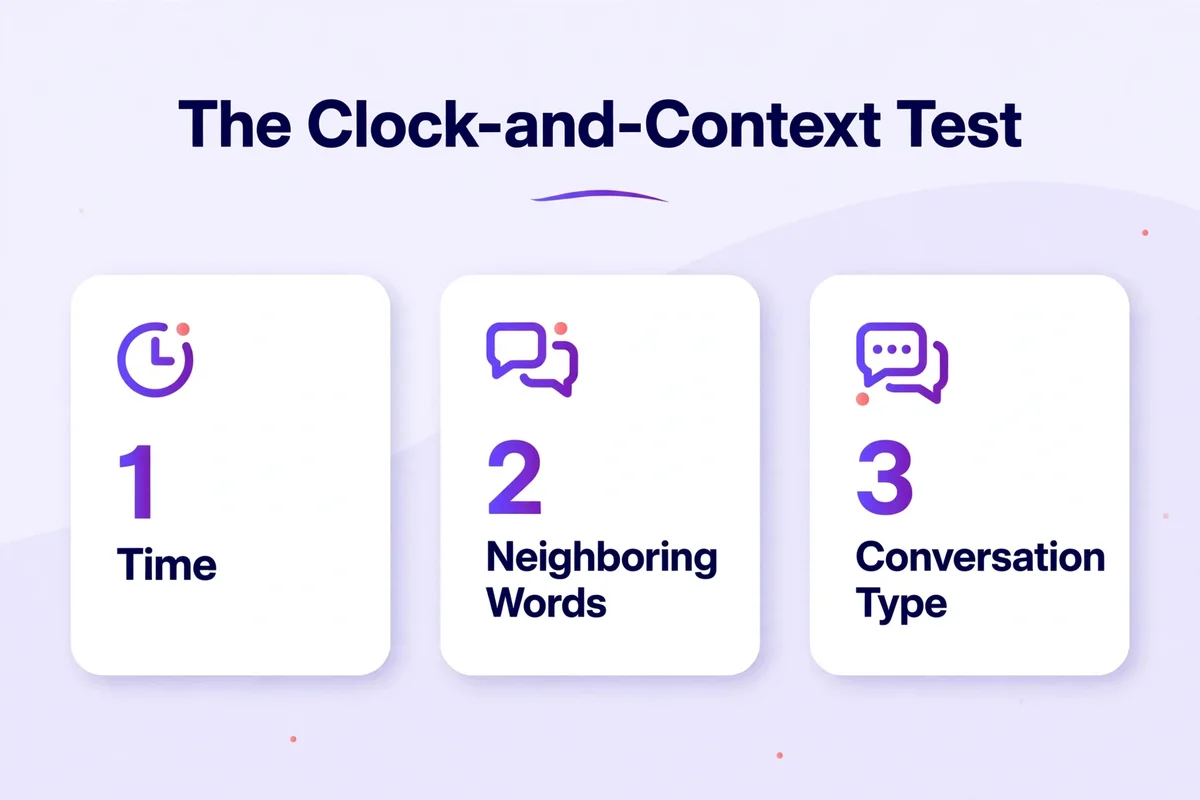
Most guides stop at "GM means good morning" and leave you to guess the rest. This article gives you something more useful: the Clock-and-Context Test. It has three questions, and you can run through them in about five seconds.
1. What time is it for the sender? If it is morning where they are, "good morning" is the natural reading. Time zones complicate this in group chats, so treat the clock as a strong clue rather than a rule.
2. What comes right before and right after GM? A GM followed by a question about the day or a friendly check-in is a greeting. A GM after a clever play in a game, next to a job title, or in front of a food ingredient is probably something else. The neighboring words are usually more informative than the letters themselves.
3. What kind of conversation is this? A one-to-one text, a friends' group chat, or a public morning post all point to the greeting. A role-playing game session, a work channel discussing a manager, or a label discussing ingredients points away from it. Match the meaning to the room you are in.
Try it on a tricky example. A friend sends "GM" at 2 p.m. your time, but lives in another time zone, opens a new conversation, and adds "how is your day going?" All three answers still point to "good morning." Now try the opposite: "GM, that was a brilliant move" in a chess chat. The clock might be morning, but the words after GM and the gaming room both point to "good move."
When GM Means Something Else
Outside a morning greeting, GM has several established meanings. None is a secret texting meaning. They are ordinary words from other fields that share the same letters, and they only appear when the topic makes them likely.
Game master. In tabletop role-playing games, the GM runs the game and plays the non-player characters. Wiktionary lists this as a noun sense of GM, seen in phrases like "ask the GM." It is a role, not a greeting, and the game context makes it obvious.
General manager. In business and sports, a GM is a senior manager who runs a team, a store, or a department. "The GM approved the schedule" is about a person with a job, not about the morning. Surrounding verbs such as approved, hired, or announced give it away.
Genetically modified. As an adjective, GM describes food or crops whose genes have been altered, as in "GM corn." It usually appears before a noun in a discussion of food or farming. It is not something someone says to you in a morning text.
General Motors. GM is also the name of the American car company. In car news or dealership talk, "GM" on its own can refer to the company. The topic is the giveaway: cars and models, not mornings.
Good move. In chess and competitive gaming, GM can mean "good move," said after a strong play. This is the alternate reading most likely to appear in a chat, and the easiest to spot: it follows the move it praises, rather than opening a conversation. A DM from a chess partner that says "GM" right after a clever move is praise, not a greeting.
Gram. Lowercase "gm" after a number, as in "250 gm flour," is a unit of mass, related to the gram. The number before it and the ingredient after it rule out the greeting completely.
GM has no separate, hidden meaning per app: a GM on TikTok is not secretly different from a GM in a text message. The greeting travels unchanged; only how public, playful, or routine it feels changes.
GM on TikTok, Snapchat, Instagram, and in Texting
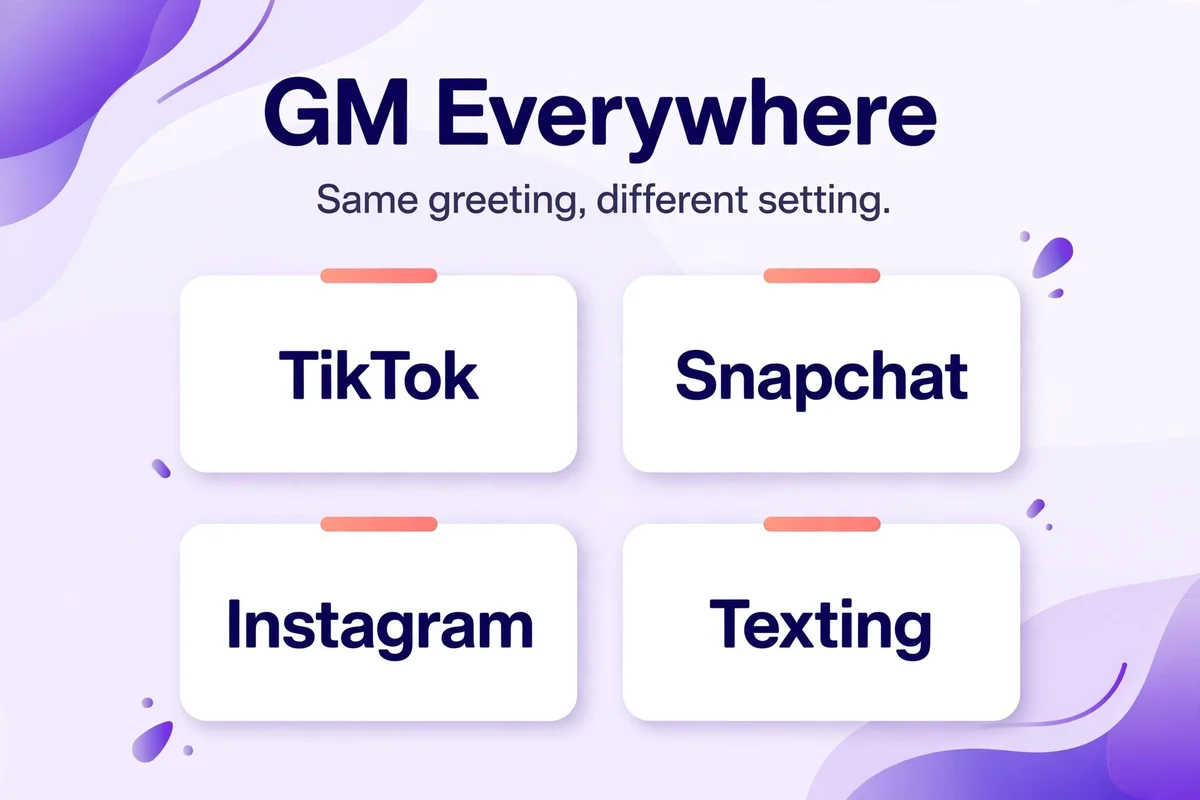
On TikTok, GM often appears in comments and captions as a public morning greeting. Creators post "GM everyone" to open the day with their audience, and commenters reply in kind: a greeting for a crowd, not just one person.
On Snapchat, GM is more private and routine. It shows up in streaks, morning snaps, and one-to-one chats, often with a breakfast or sunrise photo: a check-in signaling that the friendship is still active. If you are sorting out similar streak shorthand, the FS guide explains another abbreviation from the same daily-check-in world.
On Instagram, GM appears in stories, captions, and direct messages. A story that says "GM" over a coffee photo is a broadcast greeting, while a GM in a direct message is personal. The difference is the audience, not the meaning.
In plain texting, GM is at its most personal: the first message of the day to a partner, friend, or family member, often carrying an unspoken question: "Are you awake? How are you?" Across all four settings, one pattern holds: GM opens something, a day, a conversation, a streak, or a thread. If you see GM mid-argument or in a technical discussion, pause and run the Clock-and-Context Test.
Tone and Sender Context: Who Is Saying GM, and Why It Lands Differently
GM is a neutral greeting, and that neutrality is its strength and its trap. The same two letters can feel warm, routine, flirty, or distant, depending on who sends them and what usually follows.
From a close friend, GM usually means warmth and routine. From a partner, it often carries more affection, especially with a pet name or an emoji. That affection comes from the relationship and the extras, not from the letters themselves.
From a crush, GM is best read as friendly interest, not as a confession. Look at the pattern instead: does this person greet you most mornings, ask follow-up questions, and remember what you said yesterday? That pattern matters far more than any single GM.
From a colleague in a casual team chat, GM is a friendly opener, and a short "GM! Hope your day goes well" back is plenty. From a stranger or a creator, it is a broadcast inviting a like or a short reply, not a personal relationship.
There is one more sender context worth naming: the community GM. In some online communities, especially crypto and Web3 groups, members post GM as a daily ritual. The expansion is still "good morning," but the function is bigger: it signals membership and optimism, often regardless of the time of day. If you see GM posted at midnight in such a group, the sender is not confused about the time; they are performing belonging, and the test's third question, the room you are in, explains it. A useful comparison is LOL, which also drifted from a literal expansion into a tone and belonging marker.
How to Reply to GM, and When to Spell It Out
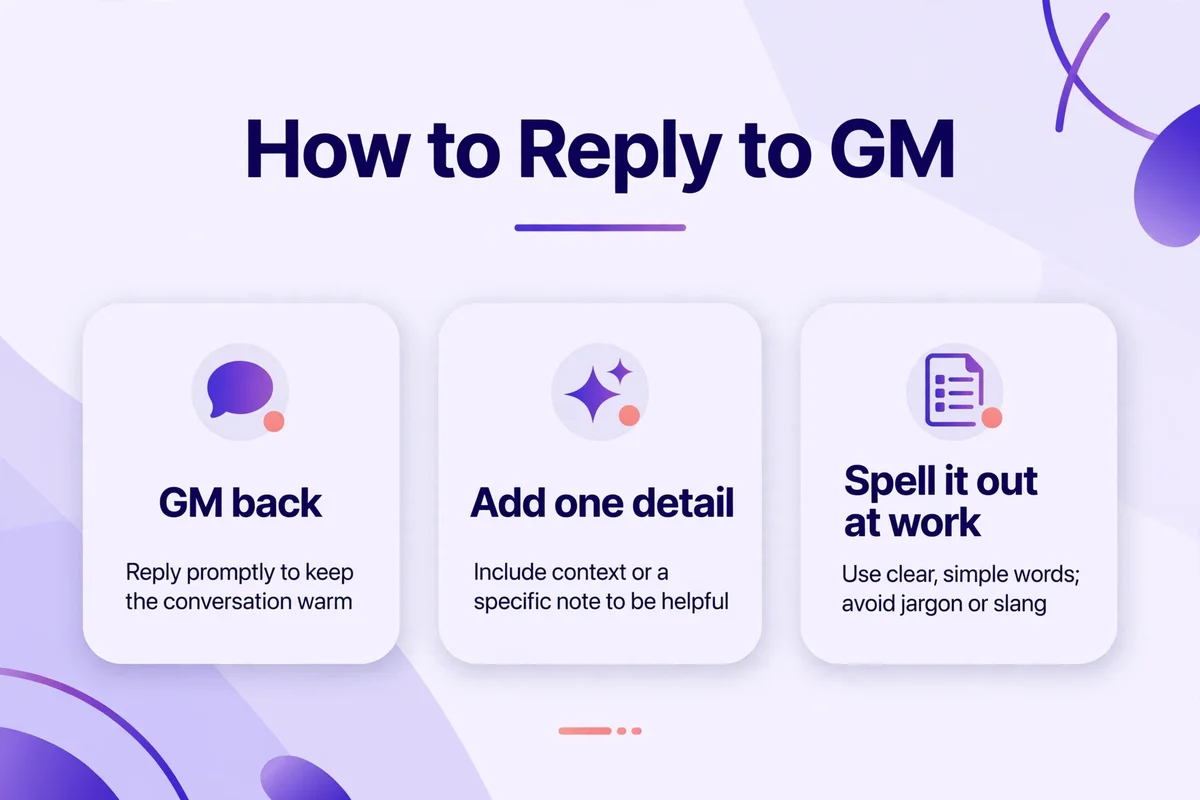
Replying to GM is easy, and that is the point. Match the energy of the sender, add one small thing of your own, and you are done: "GM! Slept well, how about you?" or "Good morning! What is on your agenda today?" If the GM came from a group chat or a public post, a short "GM everyone!" is enough. You do not need to answer a question that was not asked.
There are times to spell out "Good morning" instead. Use the full phrase in formal emails, in first messages to professional contacts, and whenever the abbreviation could collide with another meaning, for example in a work message about a general manager. Spelling it out removes the ambiguity for free. The EYP guide makes a similar point about choosing the fuller phrase when clarity matters more than speed.
Also, do not send GM late at night and expect it to land as a greeting; "good evening" fits better unless you are in a community where GM is a ritual. If you reply hours later, acknowledge the gap: "Good afternoon now, but GM anyway!" Finally, capitalization does not change the meaning. "GM," "Gm," and "gm" are the same greeting; read the words around it, not the casing.
Mistakes to Avoid
First, do not treat GM as a romantic signal on its own. A morning greeting from a crush is friendly, but it is not a declaration. Wait for a pattern of attention and follow-through before drawing conclusions about feelings.
Second, do not assume GM always means the greeting. In a game, after a move, it may mean "good move." At work, it may mean "general manager." In a recipe, "250 gm" is a weight. Run the Clock-and-Context Test before you reply, especially when the conversation is not a morning chat.
Third, do not use GM where the full phrase would serve better: formal emails, condolence messages, and first professional introductions are not the place for shorthand. The FYA guide covers another abbreviation where the same rule applies. Fourth, do not over-reply to a broadcast GM; a creator's public "GM everyone" does not need a paragraph in return. And fifth, do not invent a platform-specific meaning. GM does not secretly mean one thing on TikTok and another on Snapchat. The TGIF guide covers a time-based abbreviation tied to the week, while the BRB guide explains a mid-conversation pause, and neither changes what GM means.
Quick Answers
Is GM just short for good morning?
Yes, in texting and on social media, GM is short for "good morning." It is a greeting, not a question or an instruction, and it usually opens a conversation or a day.
Does GM mean anything else?
Yes, in other contexts. It can mean game master, general manager, genetically modified, General Motors, good move, or gram. The topic and the neighboring words tell you which one applies.
Is it rude to just reply "GM" back?
No. Replying "GM" back is the normal, polite response. To be warmer, add a question such as "GM! How did you sleep?" but a bare GM back is never rude.
Can I use GM at work?
In a casual team chat, yes, if that is your team's culture. In formal emails or first messages to senior contacts, spell out "Good morning" instead.
What is the difference between GM and GN?
GM opens the day and means "good morning." GN closes the day and means "good night." They are a pair: hello in the morning, goodbye at night.
Why do some people post GM even when it is not morning?
In some online communities, GM works as a daily ritual and a sign of belonging, not just a literal time greeting.
Should I use GM with someone I just met?
A GM to a new acquaintance is friendly but very casual, fine in a casual chat or group thread. For a first professional message, use the full "Good morning" until you know the tone of the relationship.
What should I do if GM confuses me in a game or at work?
Run the Clock-and-Context Test: check the time, read the words around GM, and consider the room you are in. If GM follows a clever play, it likely means "good move." If it sits next to a job title, it likely means "general manager." When still unsure, ask; a quick clarification beats a wrong guess.
Final Thoughts
GM is a small greeting with a long shadow. At its heart it is simple: good morning, said quickly and kindly. The Clock-and-Context Test is the habit to take away: check the time, read the neighboring words, and notice the room. With those three questions, you will read GM correctly in a text, a comment, a streak, a game chat, and a work thread alike, and you will know when the two letters are enough and when "Good morning," spelled out, is clearer.
If you liked this guide, you may also enjoy the FT guide, which tackles another abbreviation whose meaning flips completely with context.
