
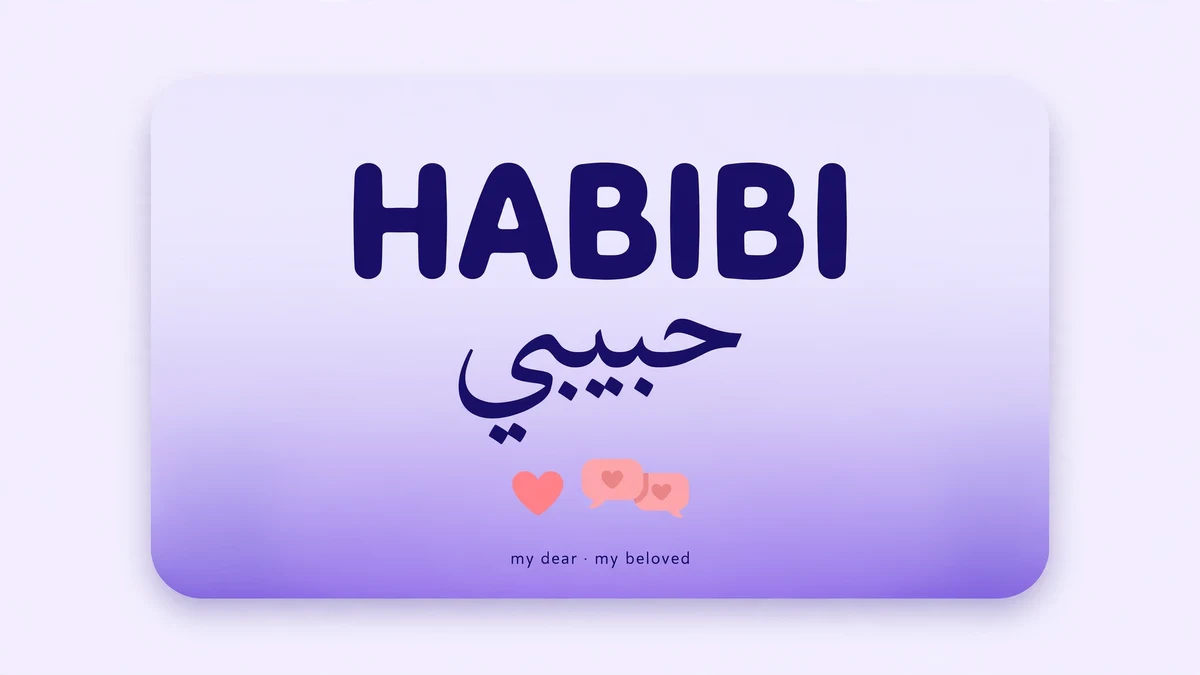
You open your phone and there it is: “Good morning, habibi!” Maybe it came from a close friend, a crush, or a stranger in a TikTok comment. You know it sounds warm — but warm how? That is the exact question behind every search for habibi meaning in text, and the honest answer is that the word carries its whole history with it. Habibi is Arabic for “my beloved” or “my dear,” and it has travelled from Arabic poetry into group chats and DMs around the world.
The tricky part is that habibi never means just one thing. Between partners it can sound like “my love.” Between old friends it can sound like “bro.” Said to a stranger, it can sound odd or even pushy. This guide starts where the word itself starts — in Arabic — and then walks through how it behaves in a text, on each platform, and in each kind of relationship.
Where Habibi Comes From: One Root, One Word of Love
Habibi is not internet slang invented last year. It is a real Arabic word with centuries of everyday use behind it, in poetry, in songs, in markets, and at home.
The word breaks down cleanly. It comes from the Arabic root ḥ-b-b, which is all about love — hubb means love, habib means beloved or dear one, and the little -i on the end means “my.” Put it together and habibi literally means “my beloved.” In Arabic script it is written حبيبي, and the closest English translations are “my love,” “my dear,” and “my darling.”
Before you ever type it, know this: habibi is pronounced “ha-BEE-bee,” with the stress on the middle syllable. The first sound is a deep throaty h that English does not quite have, but a plain English h is perfectly understandable. And the spelling is habibi — not “habbi,” a mistake that shows up a lot online.
Habibi or Habibti? Picking the Right Form
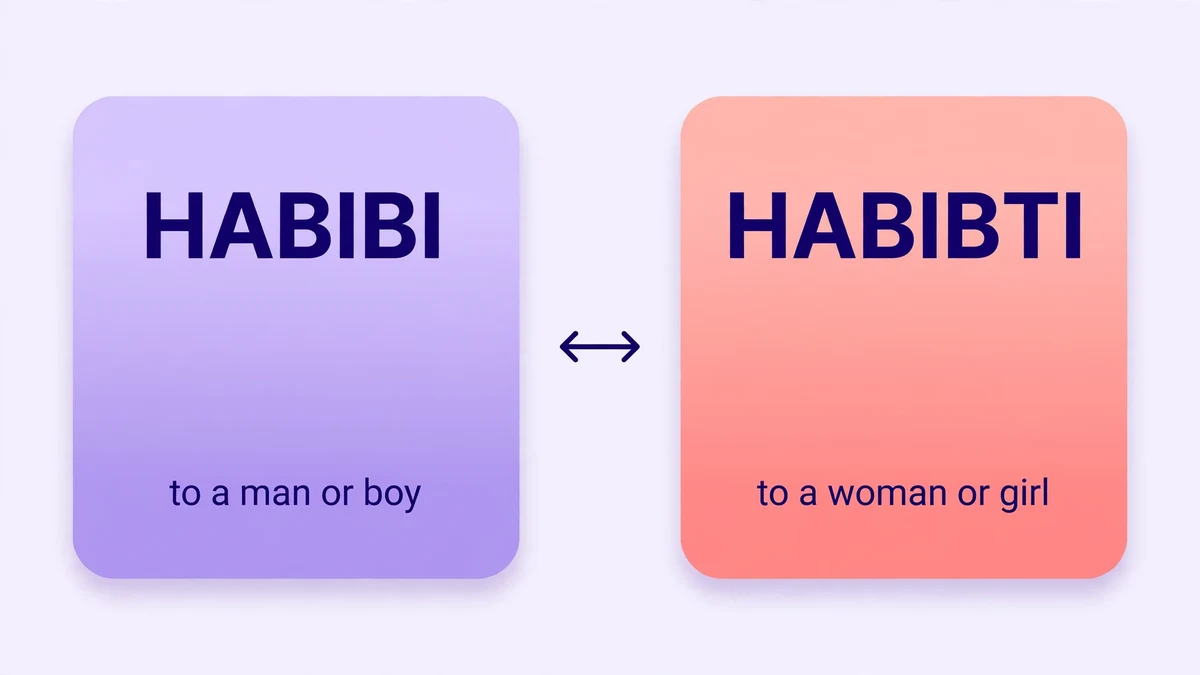
Arabic is a gendered language, and habibi follows the rule. The form you use depends on the person you are talking to — not on you, the speaker. That one detail trips up almost every new user, so here it is plainly:
- Habibi is the form you use when you are speaking to a man or a boy.
- Habibti is the form you use when you are speaking to a woman or a girl.
Both mean the same thing — “my beloved” or “my dear.” The difference is grammatical gender, not emotional intensity. A woman texting her boyfriend says “habibi,” and a man texting his girlfriend says “habibti.” Friends use it the same way, regardless of gender.
Online, non-Arabic speakers often use habibi for everyone, since pop culture spread the masculine form furthest. Native speakers notice, but they almost always understand the intent, so a wrong form is a small mistake, not an insult.
What Habibi Actually Means in a Text Message
At its core, habibi means “my dear” or “my beloved.” That is the literal meaning, supported by every dictionary and every serious guide. When a partner texts “Miss you, habibi,” that is exactly what they mean.
Between friends, the same word softens into something closer to “buddy,” “bro,” or “my friend.” In many Arabic-speaking communities, male friends call each other habibi all day without a single romantic thought. “Relax, habibi, we will fix it” is reassurance, not flirting.
Between people who are dating or flirting, the word sharpens again: “Goodnight, habibi” with a heart emoji is intimate, and everyone reading it knows that.
There are two more tones worth recognising. The first is playful: on the internet, habibi shows up as a joke or a meme line — “Habibi, come to Dubai” or “Trust me, habibi” — where the affection is real but the performance is part of the fun. The second is sarcastic: said with the wrong tone, the same word can sound impatient, as in “Sure, habibi, whatever you say.”
What habibi does not mean matters just as much. It does not mean “hello,” “goodbye,” or “sorry” — it can make a greeting or an apology warmer, but it is not the greeting itself. It does not literally mean “baby,” even though it can feel similar when a partner says it. And it is not a religious word: it is cultural and linguistic, not tied to worship or doctrine.
Habibi on TikTok, Snapchat, Instagram, and in Your DMs
On TikTok, habibi lives mostly in comments and captions, where creators and commenters use it as a warm compliment or a joke. An exaggerated “Relax, habibi” under a dramatic video is a punchline, not a love letter.
On Snapchat, the setting is private, and that changes the temperature. A snap that says “habibi” to one person feels personal in a way a public comment never does. Between friends it is still casual — a warm check-in, the same way someone might open with a quick hru before getting to the point.
On Instagram, habibi shows up in comments (“Looking good, habibi”), captions (“Good vibes only, habibi”), and DMs. A public comment is usually friendly hype; a DM is where the meaning gets personal.
In plain texting and WhatsApp, habibi is at its most natural, because this is where the word has always lived: between people who already know each other. “Good morning, habibi.” “Take care, habibi.” In a text thread, the word is usually punctuation for a relationship that already exists — a little warmth added to an ordinary sentence.
The Relationship Test: Who Can Call Whom Habibi?
Habibi is a relationship word, so before you say it — or before you decide what it meant when someone said it to you — run the Three-Question Relationship Test:
1. Would you hug this person hello? If yes — a partner, a family member, a close friend — habibi fits. If no, the word is borrowing a closeness that is not there yet.
2. Have they ever called you something warm first? Habibi works best as a reply, not an opening move. If they have used a pet name with you, matching it is safe. If every message so far has been formal, jumping to habibi is a leap.
3. Would it sound fine said out loud in front of their family? This is the real filter. Said to a partner or a close friend in front of their parents, it sounds sweet and normal. Said to a colleague in a meeting, it would sound strange to everyone in the room.
Run real relationships through the test. Between partners, habibi passes all three questions easily. Between parents and children it passes too, and between close friends it is where the word does its most everyday work.
Between coworkers, the test usually fails at question three. A close work friend might pass, but a manager, a client, or a new colleague does not — the word is too personal for a professional setting. Between strangers, it fails at question one, and that is why a stranger calling you habibi can feel uncomfortable even though the word itself is kind: the affection is real, but it has not been earned yet.
One boundary deserves a clear line. Habibi can be romantic, but it is not a word that makes a relationship romantic on its own. If you are wondering whether a friend who calls you habibi is flirting, the word alone cannot answer that — look at the whole pattern, not one word. And if the line between friendship and something more is on your mind, our guide to fwb explains where that boundary sits.
When Habibi Lands Wrong
Habibi is a kind word, and kind words can still land wrong. The failures are almost never about the dictionary meaning — they are about timing, audience, and tone.
Work is the most common place it goes wrong. In an email, a formal chat, or a first message to a client, habibi sounds too personal. If you would not sign off a work email with “love,” do not open a work message with habibi.
Strangers are the second place. Calling someone you have just met habibi assumes a warmth you have not built, and the other person may hear it as pushy or oddly familiar. Across cultures the risk grows: a non-Arabic speaker hearing it for the first time may read romance into it that was never intended. If you are not sure the other person knows the word, use their name instead.
Serious moments are the third. During an argument or a difficult conversation, a pet name can sound dismissive, as if you are smoothing over something that deserves a straight answer. “Relax, habibi, you don’t know anything” is not warm; it is condescending. In a serious conversation, drop the nickname and say what you mean plainly.
How to Reply When Someone Calls You Habibi
You do not need a complicated reply. Match the tone, and you will almost always get it right.
If it was friendly, answer friendly: “Thanks, habibi.” “You too, habibi.” Mirroring the word back is the simplest move there is, and it tells the other person you heard the warmth and you are returning it.
If it was playful, play back. “Calm down, habibi.” “Okay, boss, habibi.”
If it was flirty and you like it, lean in gently: “Hey you.” If you do not like it, do not mirror the word — a plain “Thanks” or a change of subject sets the boundary without making a scene. A warm little aww can soften that redirect if you want to stay friendly while stepping back.
If you are not sure what tone it was, stay neutral. “Got it.” “Thanks.” “Sounds good — lmk what you decide.” A neutral reply costs you nothing and gives the other person a chance to make their meaning clearer. There is no rule that you must answer habibi with habibi.
And if it made you uncomfortable, say so, briefly and kindly: “Hey, I’d rather you just use my name.” Most people will respect that immediately.
Habibi Next to the Words You Already Know
Habibi is not the only warm word in your messages. Here is how it sits next to the ones you probably already use.
A bff is a title for a best friend — a fact about the friendship. Habibi is a feeling about the person, and it works even for people who are not your best friend at all. A bsf is similar: it names the bond, while habibi names the warmth inside it. Ml is short for “my love,” the closest English cousin to habibi’s literal meaning — but it is almost always romantic, while habibi can be friendly, familial, or romantic depending on the day. And a b — used as a pet name in texts — is habibi’s casual English neighbour: short, affectionate, and just as dependent on tone.
The difference is range. Most pet names belong to one kind of relationship; habibi belongs to closeness itself, and that is why one word can cover a partner, a parent, and a best friend — as long as the closeness is real.
Quick Answers
Is habibi always romantic?
No. It can be romantic between partners, but it is just as often familial or friendly. The relationship decides, not the word.
Can a woman say habibi to a man?
Yes. The form depends on the person being addressed, not the speaker.
What is the difference between habibi and habibti?
Both mean “my beloved” or “my dear.” Habibi is the masculine form, for a man or boy; habibti is the feminine form, for a woman or girl. The meaning is the same; only the grammar changes.
Does habibi mean baby?
Not literally. Habibi means “my beloved” or “my dear.” It can feel similar to “baby” when a partner says it, but it is about being beloved, not about age.
Is habibi rude or offensive?
The word itself is not rude or offensive; in Arabic-speaking cultures it is everyday language. It can feel uncomfortable if said by a stranger, used mockingly, or dropped into a professional setting — but then the problem is the situation, not the word.
Can I call a stranger habibi?
You can, but you probably should not. Habibi assumes a closeness you have not built with a stranger yet, and it can come across as pushy or oddly familiar. Use their name until you actually know them.
How do you pronounce habibi correctly?
It is pronounced “ha-BEE-bee,” with the stress on the middle syllable. A plain English h is perfectly understandable. Habibti is pronounced “ha-BEEB-tee.” And it is spelled habibi, not “habbi.”
Should I reply with habibi if someone calls me that?
You can if the conversation is casual and you are comfortable — mirroring it back is the simplest warm reply there is. If the chat is professional or you are unsure of the tone, a neutral reply like “Thanks” works just as well.
Final Thoughts
Habibi is a small word carrying a long history: centuries of Arabic affection, folded into six letters, now travelling through group chats and comment sections. Its literal meaning is simple — “my beloved,” “my dear” — but its real meaning is whatever the relationship between two people makes of it: love between partners, loyalty between friends, care in a family, and a question mark between strangers.
Learn the two forms, run the relationship test before you use it, and match the tone when you answer it. Do that, and habibi will do what it has always done: make an ordinary message feel a little warmer than it had to be.