
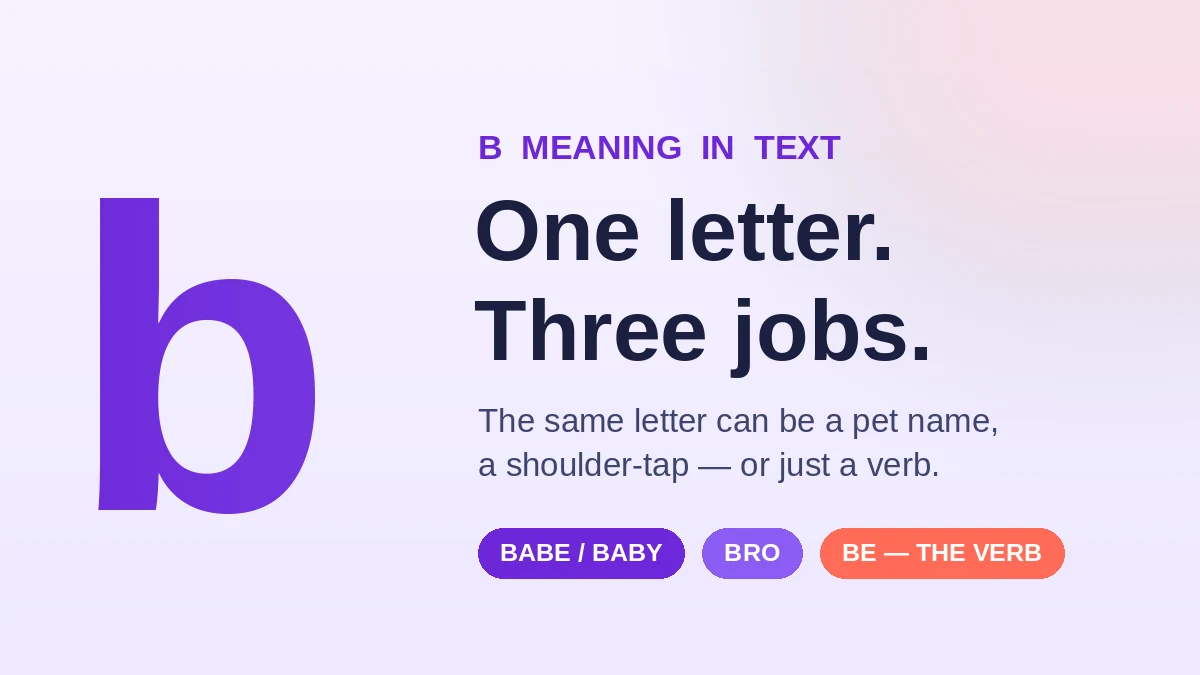
One letter arrives in your messages — “hey b,” “thanks b,” “goodnight b” — doing more work than words ten times its size. The b meaning in text confuses people because that single letter can carry affection, friendship, or nothing personal at all — and the letter itself never says which. The sender does.
The short version: calling you “b” clips a longer word to its first letter — babe or baby when affectionate, bro when friendly. Elsewhere in the sentence, b may not address you at all: it can be the verb be. Three jobs, one letter — separated below with a quick test, a map by sender, and reply guidance.
B Meaning at a Glance
| Main meaning | A clipped term of endearment — short for “babe” or “baby” |
| Also used as | A friendly address, short for “bro” |
| Not an address at all | The verb “be” (“b ready at 8”) |
| Tone | Warm, casual, familiar |
| Common in | Texts, DMs, Snapchat, Instagram and TikTok comments |
| Avoid | Work chats, formal messages, people you have just met |
The Address Test: Swap, Sender, Surroundings
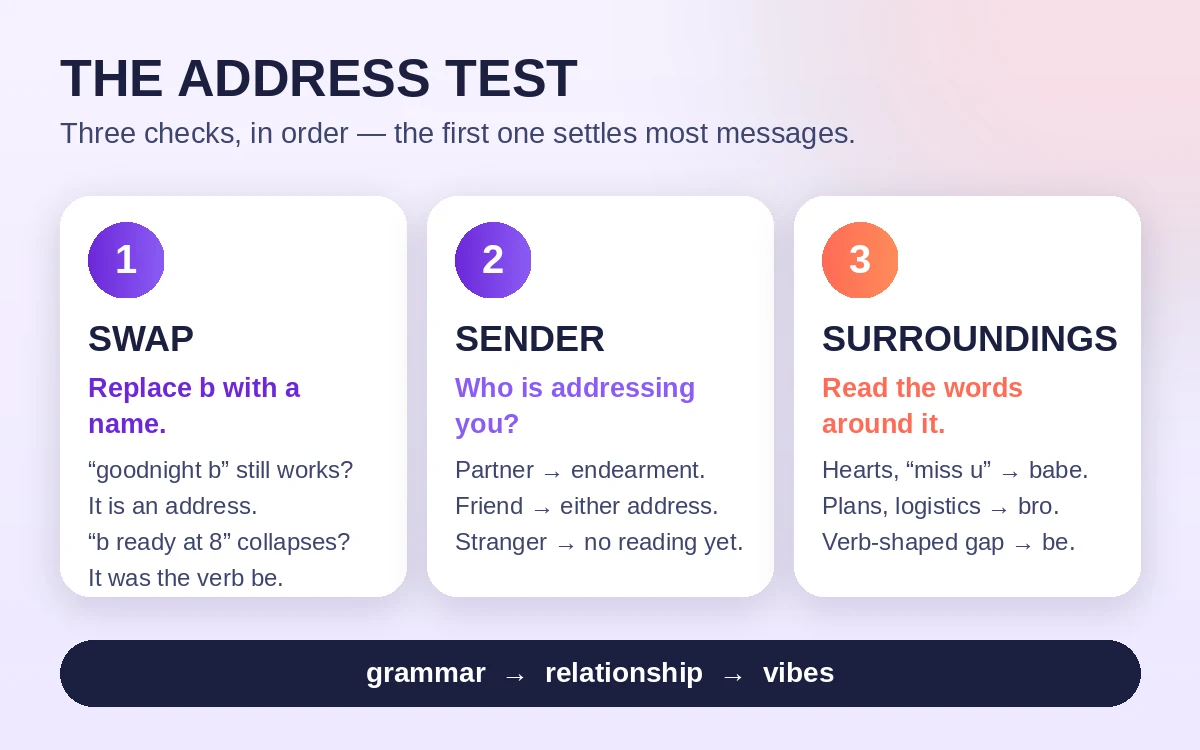
Every “b” you receive can be sorted with three checks, run in order — the first settles most messages alone.
1. Swap. Replace the b with your name and reread. If the sentence still works, the b is a name-substitute: someone is addressing you. “Goodnight b” becomes “goodnight, Sam” — it survives. But “b ready at 8” becomes “Sam ready at 8” — it collapses, because this b was never a name. It is the verb be in a shorter coat.
2. Sender. Who is addressing you? A partner or dating interest defaults to the endearment. A friend could mean endearment or bro; step three separates those. A stranger or new match gets no automatic reading — the letter alone proves nothing.
3. Surroundings. Read the words around the letter. Hearts, “miss u,” a goodnight at midnight lean endearment. Plans and group-chat logistics — “b we leaving at 9 or what” — lean bro. A b where a verb belongs was be all along.
Swap, sender, surroundings: grammar first, relationship second, vibes last — vibes are where people invent readings the sentence never supported.
Job One: The Endearment — Babe, Clipped to a Letter
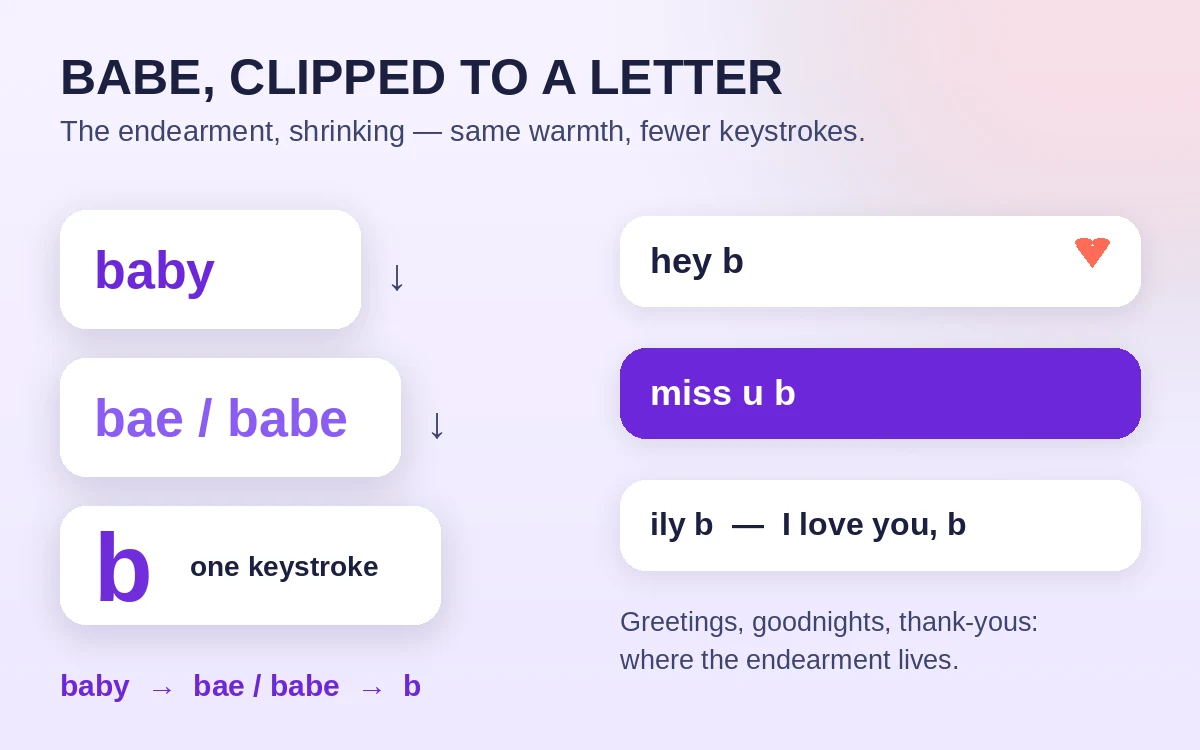
The most searched-for b is the affectionate one. In partner, dating and close-person chats, b is babe or baby reduced to one keystroke: “hey b,” “miss u b,” “ily b” (I love you, b). The full words are long-established terms of endearment — dictionaries define babe as an affectionate form of address, and bae, itself a clipping of baby/babe, as “sweetheart, baby.” The letter is the next step down the same staircase: baby → bae/babe → b.
One correction, because half the internet gets it wrong: bae is often expanded as an acronym, “before anyone else.” That is a backronym — a meaning invented afterwards to fit the letters. Bae came from clipping baby/babe, not from initialising a phrase. Nobody texting you b is sending an acronym — just the smallest possible version of a pet name.
That smallness is the point. A full “baby” can feel heavy in a quick exchange; “b” keeps the warmth and drops the ceremony, clustering around greetings, goodnights and check-ins. “You eat yet b?” is not really a question about food.
Close friends borrow this b constantly, and the borrowing causes most confusion. Between best friends, “thanks b” is often purely platonic — the endearment doing friendship duty. The letter signals closeness, which has more than one shape. Does b “mean bestie”? It does not expand to that word — no source defines it so — though the friend called b is usually at bestie distance.
A near relative: some write the same warmth out in full as ML — “much love.” B compresses affection into a letter; ML spells it out so nobody can misread it.
Job Two: The Friend Address — Bro, Without the Rest of the Word
The second b is the mate, not the date. In group chats and friend traffic, b works as a clipped bro: “yo b, you coming?”; “nah b, I’m wiped.” Slang glossaries define it plainly as bro or brother — a familiarity marker, not an endearment.
You can almost hear the difference: endearment-b arrives at the end of a message, like a signature (“proud of u b”); bro-b arrives at the start, like a tap on the shoulder (“b. b. guess what happened”).
Two cautions: this b presumes a familiarity that must already exist — dropped on a near-stranger, it reads as forcing a close-friend vibe. And it is not gendered in practice; reading romance into a group-chat “yo b” is a classic misread.
Job Three: The Verb — When B Just Means “Be”
The third b is not about you at all: in fast writing, b is shorthand for the verb be — “b ready by 8,” “u b fine,” “ima b home late.” It is the one sense dictionaries formally record for the letter: Wiktionary lists exactly this abbreviation, citing real posts like “it would b rly nice.”
Position is the fastest tell. Address-b stands where a name could stand; verb-b sits mid-sentence, in the verb’s chair, among other compressed words (u, ima, rly, tn). Nobody is being called anything in “dont b late” — the sentence is not cold, just busy.
It is also the b of “2b or not 2b” — sound-alike shorthand, nothing deeper. Once you see it, you stop reading affection into reminders about being on time.
The Sender Map: Partner, Friend, or Stranger?
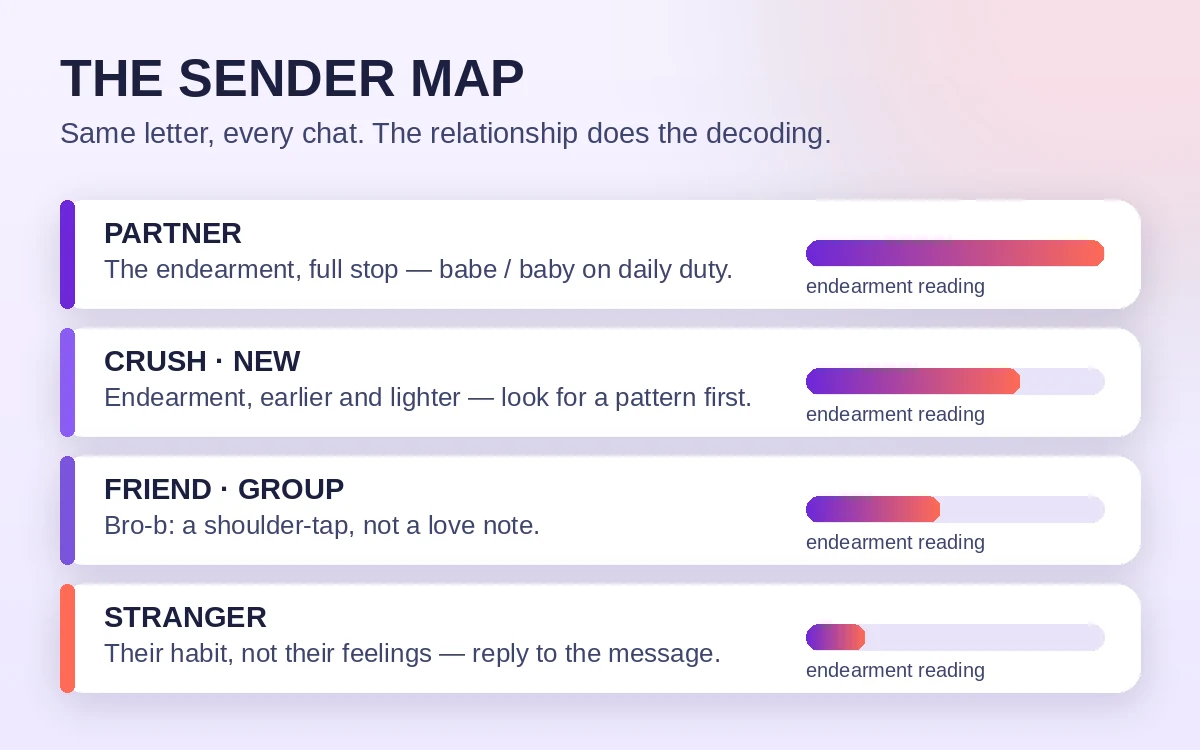
The letter is identical in every chat, so the sender’s relationship to you does most of the decoding. Readings, not guarantees:
From a partner. The endearment, full stop — the everyday form of babe/baby, noticed when it goes missing in an argument.
From a crush or someone newly dating you. The endearment family, earlier and lighter: a “goodnight b” with real conversation around it is a signal; a lone b among one-word replies is just a style.
From a close friend. Either address, genuinely ambiguous, rarely worth decoding — friends mix babe-b and bro-b freely.
From a group chat. Bro-b, near enough always — group settings strip endearments of privacy, so a b there does attention work.
From a stranger or a new match. Slow down: some people call everyone b. With no history behind it, an instant b describes their habits, not their feelings — reply to the message, not the letter.
B on TikTok, Snapchat, Instagram, and in Texts
Same three jobs everywhere; each platform stages them differently.
Text messages are b’s home ground — the private, ongoing conversation where both addresses live naturally and verb-b does reminder work (“b there at 8”), with the most history to decode a confusing b.
Snapchat runs on streaks and quick replies — b’s most compressed habitat: “gn b,” “thanks b.” Real intimacy, low effort by design: maintenance affection, not declarations.
Instagram puts b in public: captions like “my b forever” under a partner or best friend’s photo, the endearment partly performed for an audience. A public b claims a relationship; a private one just is one.
TikTok splits the letter in two. In comments and DMs it behaves normally — “stoppp b that’s so cute” is friend-address in the wild. But TikTok is also home to the red 🅱️ meme, which swaps 🅱️ into words for comic effect; a 🅱️ in a caption is not someone calling you b.
Reading and Replying: Four Conversations
The exchanges below are illustrative examples, not real messages.
The partner closer — endearment, answered in kind
- Jess: “finally home. today was LONG”
- Sam: “u made it b 💛 food’s in the oven”
- Jess: “best news all day. love u”
Nothing to decode: the b rides with care (food, a heart), and the reply matches the warmth without escalating it — the YW principle: in close chats, answers stay short.
The friend opener — bro-b with logistics attached
Two b’s, both bro — the surroundings are plans and a location question. B with logistics is a shoulder-tap, not a love note; reply about Saturday.
The group-chat tap — b as a doorbell
- Ana: “b”
- Ana: “B”
- Ana: “flight lands at 6 now, not 4. lmk if pickup still works”
A name-substitute used purely to ping. Reply with the pickup answer; the b needed none of its own.
The new-match b — the one to read slowly
- Kai: “today was crazy tbh“
- Ren: “felt that. rest up b, you earned it”
Day two, one soft b, no pattern yet. Reply normally (“thanks, you too”) and let more days show whether b is Ren’s everyone-word or deliberate warmth — one letter is a question, not an answer.
Not This B: Three Look-Alikes
“My b” is an apology, not a nickname. “My b, wrong file” means my bad — a quick admission of a mistake. The b belongs to “bad” (close cousin: MB). Nobody is calling you anything; they are owning something.
The 🅱️ emoji is a meme, not a message to you. The red B-button emoji began as a blood-type symbol and became an ironic meme letter swapped into words for absurd effect — not a term of address at all.
A capital B doing other jobs. “Got a B” is a grade; “Plan B” is a backup; signing “— B” is usually an initial. In an argument, a clipped “b” can stand in for the full b-word — the fight around it gives that away.
When B Lands Wrong
- With someone you just met. The endearment presumes closeness that may not exist; arriving early, it reads as presumptuous — worst on dating apps, where it looks copy-pasted.
- At work, in email, or with clients. Every job of b is casual-register only; “thanks b” in a professional thread reads as careless, not friendly.
- Read as automatic romance. A b from a friend or habitual b-user is not a confession.
- Mirrored back before the pattern is verified. Mirroring a stranger’s first-message b upgrades the intimacy on your side too — awkward if reflexive.
Quick Answers
What does “b” mean in text?
Usually a term of endearment — “babe” or “baby” clipped to one letter for someone close: “hey b,” “goodnight b.” In friend chats it can be a clipped “bro”; mid-sentence it can be the verb “be” (“b ready at 8”). The sender, and where the letter sits, decide the job.
What does “hey b” mean from someone you are dating?
“Hey babe” (or “hey baby”) in its shortest form — maintenance affection, the pet name on daily duty. A good sign of comfort, but early on not a milestone by itself; some people greet everyone that way.
Does “b” always mean babe?
No — three jobs: endearment (babe/baby), friendly address (bro), and the verb “be.” The swap test separates them: replace b with a name — if the sentence works, it is an address; if it collapses, it was the verb. Sender and surroundings separate babe-b from bro-b.
What does “my b” mean?
Something different: “my bad” — a quick apology (“my b, I sent the wrong link”). The b belongs to “bad”; nobody is being addressed. Family to the two-letter apology MB.
Is “b” flirty?
It can be — its main job is clipping a pet name — but flirtiness lives in the pattern, not the letter. A “goodnight b” from a crush, with conversation around it, leans flirty; the same letter from a best friend is closeness or habit.
How should I reply when someone calls me “b”?
Answer the message and let the letter ride. Comfortable? Mirror lightly — an occasional “hey b” back. Unsure? A normal warm reply (“you too”) is never wrong. Dislike it? Saying so early is kind, not dramatic.
Is “b” rude or offensive?
In its address uses, no — affectionate or friendly by design. It is wrong for formal settings, premature with strangers, and unwelcome once someone prefers their name. Its one hostile relative, a clipped b-word in an argument, is obvious from context.
The Short Version
B is one letter doing three jobs. As an address — why most people search for it — it is a clipped endearment, babe or baby at minimum size: “hey b,” “ily b,” “goodnight b.” Between friends it is a clipped bro, a shoulder-tap rather than a pet name. Mid-sentence, doing grammar instead of feelings, it is the verb be. The Address Test sorts any sighting in seconds: swap in a name, check the sender, read the surroundings. Reply to the message, mirror only the closeness you actually share — never let one letter carry more meaning than its sender put there.
