

Your friend posts the opinion you have held for years, worded better than you ever managed. You could type “yes”, but “yes” feels flat — it agrees and then sits down. You type four letters instead: “IKTR”. It lands like applause. If you have ever wondered what iktr meaning in text actually is, the short version is simple: IKTR means “I know that’s right”, and it is the most confident way to agree with someone in a text or a comment. The four letters carry more than their expansion, though. They carry a tone, a history, and a grammar trick — and once you see the trick, you will never confuse IKTR with its quieter cousin IKR again.
The Short Answer: IKTR in One Breath
IKTR means “I know that’s right”. People send it as a reaction — almost never as an opener — when someone says something they strongly agree with, find relatable, or want to hype up. It is informal, positive, and confident, and it works best as a reply to a statement, a hot take, or a boundary. One line covers most of what you need: IKTR = “Exactly. You are absolutely right, and I feel that too.”
That is the whole definition, and it is the only texting meaning IKTR has. Wiktionary lists it as internet slang for “I know that’s right”, “often used as an affirmational response”, and every ranking guide agrees. There is no second meaning hiding behind it. What changes is the energy, not the definition — and the energy is where this guide earns its keep.
“I Know That’s Right” — What “Right” Actually Means Here
The first thing to notice is the grammar, because the grammar is the whole point. IKR means “I know, right?” — a rhetorical question that invites a shared feeling. IKTR means “I know that’s right” — a flat statement that declares the agreement as a fact. One asks, the other states. One softens, the other stands up.
That difference explains why the two abbreviations are not interchangeable. Send IKR to a friend who says “Mondays are the worst” and you are sharing a sigh. Send IKTR to a friend who says “I am not answering work emails after 7 PM anymore” and you are standing behind her. IKR is conversational. IKTR is a standing ovation in four letters.
The “right” in IKTR is also worth a second look. It does not mean the statement is proven true, and it does not mean the writer knew the fact in advance. IKTR says “I agree that what you said is right” — the knowledge in the phrase is agreement, not a claim about the past. What IKTR really does is validate a person, not just a point: a plain “yes” confirms a fact; IKTR confirms the person who said it, in public. That is why it almost always arrives as a reaction, not an opener — someone makes a statement and IKTR answers it.
Where It Came From: A Spoken Phrase Learns to Type

The phrase “I know that’s right” did not start on the internet. It has been part of everyday spoken English for decades, and the guides that rank for this term agree it has deep roots in African American Vernacular English, where it works as an emphatic way to agree with or reinforce a statement — often delivered with a snap, a nod, or a knowing look.
The abbreviation came later. An Urban Dictionary entry defining IKTR as “I know that’s right” dates back to 2005, so the shortened form is not a brand-new social media invention. It gained serious momentum on Twitter and TikTok. The phrase is old; the four letters are its texting-age shape.
The Hype Scale: Five Ways to Send IKTR

IKTR is not one reply, it is a scale. The same four letters carry five different energies depending on how you type them. Call it the Hype Scale — five rungs, from a calm nod to a standing ovation, with one rung that quietly flips the meaning.
The first rung is lowercase iktr: softer, more casual, often a little deadpan. “iktr, no skips allowed” under a group-chat playlist reads as relaxed agreement, not a speech — the version for private chats with friends. The second rung is plain capitals, IKTR — the standard: confident, warm, public. It is the version that fills TikTok comments under a bold video and group chats under a hot take. If you only ever use one form, use this one.
The third rung is IKTR! — one exclamation mark, and the applause gets louder: hype with a smile in it, for good news, wins, and moments when someone finally says the thing out loud. The fourth rung is IKTR!! — two exclamation marks, maximum energy. Save it for the statements that genuinely deserve it: a friend setting a boundary, a creator nailing a speech, a take so good it needed no debate. Overuse it and it stops meaning anything.
The fifth rung is the trap: IKTR. with a period. A period after IKTR dries the whole thing out. Under an apology post, or from someone annoyed, “IKTR.” can read as sarcasm — “of course you did” rather than “you are right”. The letters are the same; the punctuation changes the room. If the tone feels off, trust the tone, not the letters, and check the message above it. Stretch it to IKTRR for the most intense version of all. None of these change the definition. They change the volume.
IKTR in Real Chats: Five Exchanges, Decoded
Examples only help if someone decodes them, so here are five real-feeling exchanges with the tone labelled.
1. The boundary. Friend: “I am done apologising for having standards.” You: “IKTR, say it louder.” The tone is validation. Your friend took a stand, and IKTR tells her the stand was worth taking.
2. The relatable truth. Post: “Nothing feels better than cancelling plans and staying home.” Comment: “IKTR.” The tone is recognition — “that is my life too”.
3. The hype reply. Creator caption: “Protect your peace at all costs.” Comment: “IKTR!!” The tone is applause. On TikTok and Instagram, creators love this version: a flood of IKTR replies tells them the audience is with them.
4. The co-sign on your own words. “Nobody is doing it like her right now, IKTR.” The writer tacks IKTR onto the end of their own sentence, like patting themselves on the back and inviting everyone else to agree. The message is: I said it, I stand by it.
5. The sarcastic flip. Friend: “I forgot my homework again.” You: “IKTR.” The tone is a raised eyebrow: the same four letters that cheered a boundary now mean “of course you did”. Read the message above it first, every time.
Where You Will See IKTR: TikTok, Instagram, Group Chats, and DMs
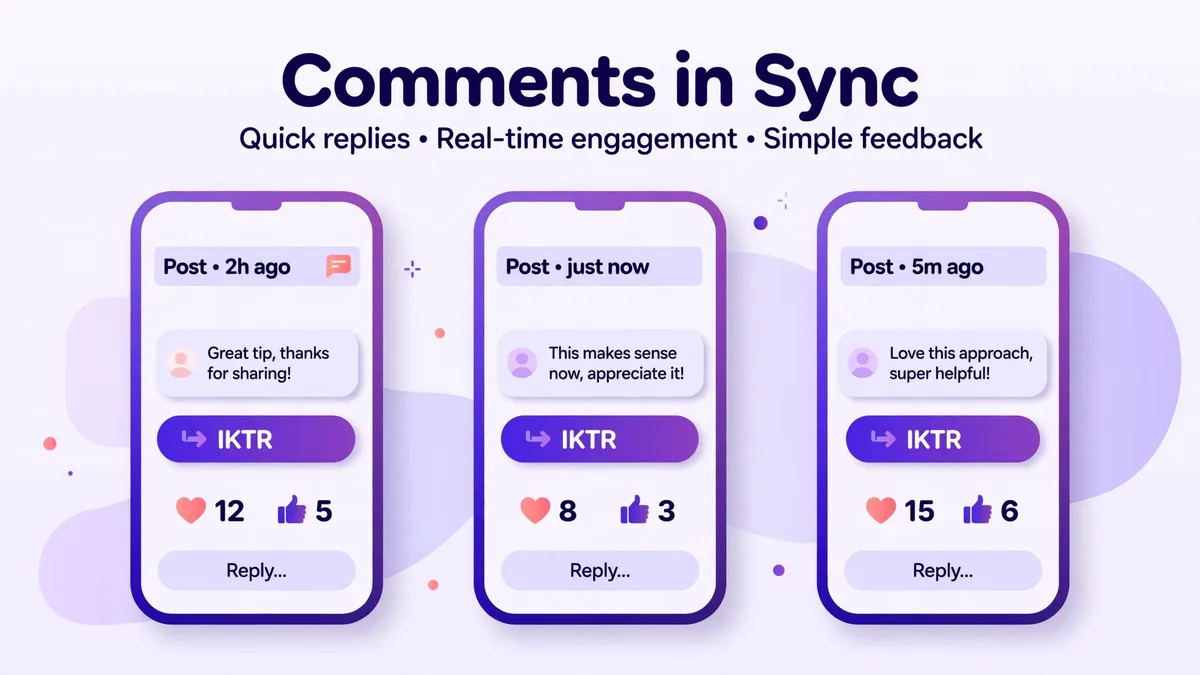
The meaning never changes from one platform to the next, but the stage changes how loud it sounds.
TikTok is where IKTR is loudest. It shows up in comments under confident, relatable, or empowering videos, where a short reply is all the room allows and a flood of “IKTR” tells the creator the take landed. People scroll fast, so IKTR lets them participate without writing a paragraph — and it feels more energetic than typing “true” or “facts”. Instagram works the same way, in comments and captions under bold posts.
Snapchat is quieter: IKTR arrives in chat replies to a friend’s story, a quick co-sign between two people. On X, it travels as quote tweets and replies to bold takes. Group chats are where IKTR does its most useful work — one “IKTR” backs up a hot take and ends the debate. In one-on-one DMs it is softer, often in lowercase, often with an emoji. In gaming chats and Discord servers, it shows up when the whole group strongly agrees with something, working the same way as “Facts” or “Exactly” but with more swagger.
The Co-Sign Test: Three Questions Before You Send IKTR
Before you type IKTR, run the Co-Sign Test — three questions that take five seconds.
Question one: would I say this out loud in the room? IKTR is a public co-sign. If you would not nod and say “that is right” with people watching, do not send it. This catches the two most common mistakes at once: using IKTR when you only mildly agree, and using it to disagree as a joke.
Question two: am I backing the person, or just the point? IKTR validates a person, not just a fact. That is its power — and its risk. If someone shares sad news, IKTR reads as hype in a moment that needs empathy. If the room is hurting, use real words instead.
Question three: would a plain “yes” feel thin here? If the answer is no, IKTR is the wrong tool. A friend saying “that movie was good” does not need a standing ovation. Save IKTR for the statements that genuinely deserve it. Its power comes from emphasis, and emphasis only works when it is rare. Pass all three questions and send it; fail any one and pick a quieter reply.
When IKTR Lands Wrong: Four Misfires
Even a friendly abbreviation misfires — four classic ones, each with a simple fix.
Misfire one: using it to disagree. IKTR is agreement-only. Replying “IKTR” to something you actually disagree with confuses people, because the abbreviation has no built-in irony detector. If you disagree, say so in words.
Misfire two: dropping it on serious news. Someone shares a personal struggle or an emotional moment, and you reply “IKTR”. Even if you meant “I hear you”, it reads as hype in a moment that needs empathy. Match the energy instead: “I am here” or simply “I hear you” — in full words.
Misfire three: using it at work. Work emails, client chats, and formal documents are IKTR-free zones. One slang abbreviation can undo a paragraph of professionalism. Use the professional alternative instead: “I completely agree” or “Well said”. Same validation, no slang.
Misfire four: overusing it until it loses its punch. If every reply is “IKTR”, none of them are. The abbreviation’s power comes from emphasis, and emphasis is a limited resource. Only send it when the statement genuinely deserves the hype.
IKTR Next to IKR, FR, Facts, NGL, and 100
IKTR belongs to a crowded family of agreement abbreviations. IKR asks “right?” and shares a feeling; IKTR states “that is right” and validates a person. The shorthand shelf around IKTR is full of short replies that carry a whole attitude: IGL is the gaming term for the In-Game Leader, the teammate who calls the shots, IDEK is the shrug that says you genuinely do not know, GYATT is the stunned reaction to something eye-catching, HABIBI is the warm term of affection, HYW is the question that asks how you are, IG is the casual “I guess”, GNG is the sign-off for when you are heading out, and ALR is the quick “alright” or “already” that keeps a chat moving.
Want to sound supportive and warm? IKTR. Casual and chill? IKR. Dead-serious? FR. Honest-to-a-fault? NGL. A full endorsement with no words at all? 100. Each one agrees in a different voice — and IKTR’s voice is the loudest, warmest one in the room.
How to Reply When Someone Says IKTR
If someone sends you IKTR, take it as a compliment. They validated you, so a short warm reply is enough: “Right?”, “Exactly”, “You get it”, or “That is what I am saying”. If you want to keep it playful, try “Finally someone understands” or “Facts only”. If the IKTR sounded sarcastic — the dry “IKTR.” with a period — check the message above it before you decide what it meant.
Quick Answers
What does IKTR mean in text?
IKTR means “I know that’s right”. It is a reaction phrase people use to show strong agreement or enthusiastic support for something someone just said or posted.
Is IKTR the same as IKR?
No. IKR means “I know, right?” and asks agreement as a rhetorical question. IKTR means “I know that’s right” and states agreement as a fact. They are cousins, not twins.
Where did IKTR come from?
IKTR comes from the spoken phrase “I know that’s right”, long used in African American Vernacular English as an affirmation. The abbreviation has been used online since at least 2005.
What does IKDR mean, and is it the same as IKTR?
IKDR means “I know dat’s right” — the same meaning, spelled the way the phrase sounds in slang pronunciation, with “that” as “dat”. Wiktionary lists it as an alternative form of IKTR.
Can IKTR be sarcastic?
Yes, but it is usually warm and supportive. A dry “IKTR.” with a period, or an “oh, IKTR” under a bad take, can carry a sassy or sarcastic edge.
Can I use IKTR at work?
No. It is informal slang, and in a work chat or a formal message it will look out of place. Keep it for friends, and use plain words like “I completely agree” at work.
Does IKTR mean “I know the rules”?
No. That reading has no support in any guide and does not match how IKTR is used. In casual texting, IKTR always means “I know that’s right”.
Does IKTR mean the person knew something in advance?
No. The “I know” in IKTR is agreement, not a claim of prior knowledge. It means “I agree that what you said is right”, not “I already knew it”.
The Final Word on IKTR
IKTR is agreement with confidence built in. It means “I know that’s right”, and it says more than “yes” ever could: the statement is correct, it deserves to be heard, and the writer is glad someone said it. The four letters do two jobs at once — they agree with the point and they validate the person who made it — and they do both in public.
Now you can read it at a glance. A confident opinion plus IKTR means warm support. A bad take plus a sarcastic IKTR means the opposite. A period after it means read the room again. Run the Co-Sign Test first, pass all three questions, and send it.