
You open your phone and there it is — a message from someone you have not talked to in weeks, and the whole message is three letters long: "hyw?" No hello, no name, no context. Just three letters and a question mark.
If you searched for hyw meaning in text, here is the honest answer up front: HYW most often means "How you?" — a shortened, casual way of asking "How are you?" It is a greeting, not a quiz. One honest caveat: no major dictionary lists HYW. Wiktionary has no entry for it, and Wikipedia treats it as an airport code, not slang. What we know comes from how people actually use it — and the sources do not all agree.
What "HYW" Actually Stands For
Say the letters out loud — H, Y, W — and you can hear the phrase hiding inside them: "How you?" People drop the little words, keep the bones of the phrase, and trust the reader to fill in the rest.
That is why the most reliable reading of HYW is the simplest one. "How are you?" is the default — the meaning three of the five sources I checked agree on, and the one that fits nearly every context. "How you doing?" is the same question with a more relaxed accent; the phrase has been documented as an informal greeting since the 1940s. And "How you been?" is the version that shows up after a gap, when someone you have not spoken to in a while opens with "long time no talk, hyw?"
There is one more reading worth knowing, because the second-biggest guide on this term leads with it: "How you workin'?" or "How's your work?" In some parts of the United States, "how you workin'?" is a real spoken greeting, and that guide argues HYW grew out of it. But no other source backs it as the main meaning, so treat it as a context clue, not the default — if the conversation is about work, the work reading may fit; if not, it almost certainly does not.
Then there is the reading you should ignore. One page on the internet claims HYW stands for "Here's Your Warning," as if it were a heads-up before bad news. That claim appears on exactly one site, which contradicts itself on another page, and no other source supports it. It is a mistake that got published. The same goes for "how you weighin'?" and "how you want?" — a single page lists them, flags them as rare, and nobody else repeats them. So the working rule is simple: unless the conversation gives you a reason to think otherwise, HYW means "How you?"
The Reply Test: What the Sender Really Wants Back

Here is the part no other guide on HYW gives you. I call it the Reply Test, and it takes about five seconds.
When someone sends you "hyw?", they are not really asking for information. They are asking for a signal: are you there, are you in a talking mood, and is there something worth talking about? Your reply answers all three at once, which is why the best replies are short, warm, and end with something the other person can grab onto. Test your reply before you send it: does it say I am here, does it say how I am in one honest beat, and does it hand the conversation back? "I'm good, you?" passes all three. "Fine." fails — it answers the question and kills the conversation in the same breath.
Here are replies that pass the test. If you are doing well and want to talk: "Pretty good! Just finished work — how about you?" If you are busy but happy to hear from them: "Hey! I'm good, bit swamped today though — what's up?" If you are not doing great and do not want to pretend: "Honestly, kind of a rough day. Thanks for asking though — how's yours?" And if you do not want to talk at all: "Hey, I'm good! Bit tied up right now, but let's catch up soon?" is kind, clear, and honest.
Reading the Room: HYW From a Friend, a Crush, and a Stranger
From a close friend, HYW is almost always just a check-in — the equivalent of knocking on your door because they were thinking of you and three letters were the fastest way to say so. "Hyw bro?" means "I have a minute and I wanted to talk to you." The right reply is whatever is true, plus a question back.
From a crush, HYW carries a little more weight, and you can feel it. When someone you like opens with "hey, hyw 😊", the question is the same but the subtext is different: they are testing the water with the lowest-pressure message they could think of. If you like them back, do not overthink it — match their warmth, add one detail about your day, and ask them something back. If you are not interested, a friendly, brief reply is kinder than silence.
From a stranger, HYW is a cold open, and it deserves a cooler reading. On a dating app or in a DM request, "hyw?" from someone you have never spoken to is usually a fishing line: they are casting a wide net with the least effort possible. That does not make it rude — it makes it low-effort, and you are allowed to match that energy. A short reply is fine. No reply is also fine. In a group chat, the same logic applies: "hyw team?" is a roll call, and "here, what's the plan?" is exactly the right reply.
HYW on TikTok, Snapchat, Instagram, and Plain Texting

On Snapchat, HYW is a natural fit. The app is built for fast, disappearing messages, and a three-letter greeting is exactly the kind of thing people send when they are half-watching a story and want to restart a conversation — often as a reply to a story, like "hyw? didn't see you online lately." Snapchat is also where HYW is most likely to be a typo: the W and E keys sit next to each other, so "hyw" gets mixed up with "hey" more often than anyone admits.
On Instagram, HYW shows up in DMs, usually as a conversation restarter after someone has liked a few of your posts. If they have been engaging with your content, the greeting is probably genuine; if it is a brand-new follower, treat it like any other cold DM. On TikTok, HYW lives mostly in comments and DMs — a quick, friendly check-in from a follower, closer to waving than to starting a real conversation.
In plain texting — SMS, iMessage, WhatsApp — HYW is at its most ordinary, and that is where it is easiest to read. A "good morning" text and a "hyw?" text do the same job in different clothes, which is why the two often travel together: a morning greeting opens the day, and a "hyw?" later on reopens it. Our guide to GM meaning in text covers the morning version, and GN meaning in text covers the sign-off that usually ends the same chat.
HYW vs. HRU vs. HBU vs. HMU: Four Greetings, Four Different Jobs
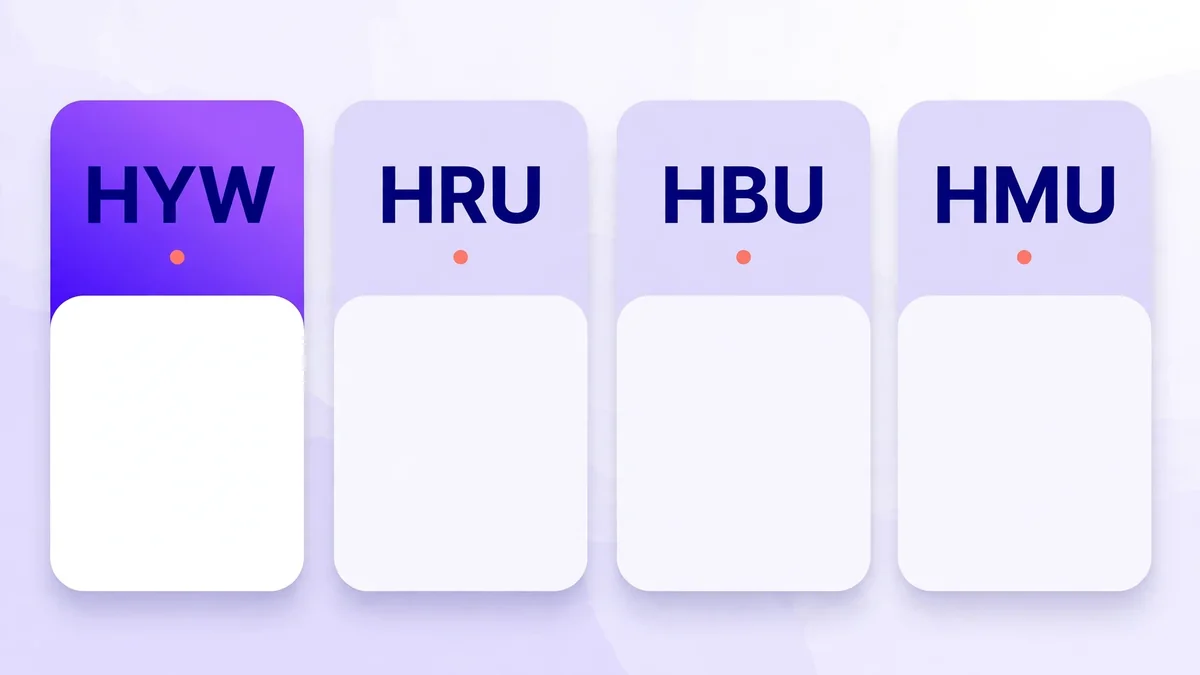
HYW asks how you are. It opens a conversation, and it is the only one of the four that works as a cold opener from nothing — you can send "hyw?" to someone you have not spoken to in months, and it makes sense. HRU asks the same thing, more explicitly: HRU stands for "how are you," spelled out in full, and it is the closest synonym HYW has. The difference is mostly effort — HRU is the careful version, HYW is the lazy one — and the reply is the same either way.
HBU does the opposite job. HBU means "how about you," and it is a return, not an opener. You almost never start a conversation with HBU, because there is nothing to return yet. It shows up after someone has already told you how they are doing — "I'm good, hbu?" — and bounces the question back. Replying to "hyw?" with "hbu?" technically answers, but it also dodges the question.
HMU is not a greeting at all. HMU means "hit me up" — a request for contact later, not a question about how you are now. "HMU tomorrow" means "message me tomorrow." HYW means "how are you right now." And WTD asks what you are doing — an activity, not a feeling. "WTD?" expects "nothing much, just watching a show." "HYW?" expects "I'm good." Answer the wrong one and the conversation wobbles.
The quick way to keep them straight is to ask what the sender wants back. HYW wants a feeling. HRU wants the same feeling, spelled out. HBU wants the question returned. HMU wants a message later. WTD wants an activity.
When HYW Is the Wrong Move
HYW is a good opener, but it is not a universal one. Do not use it at work — not in an email, not in a Slack message to your manager. It reads as careless in a setting where care is the point, and "Hey, how are you doing?" costs you four seconds. Do not use it when someone is going through something serious, either: if a friend is having a hard time, a three-letter greeting can feel dismissive, as if their situation deserved a full sentence and got an abbreviation instead.
Do not use HYW with someone who does not speak internet shorthand — a parent or grandparent may read "hyw?" and see a typo rather than a greeting. And do not use HYW as your only move: if every message you send someone is "hyw?", the greeting stops being friendly and starts being a habit. Vary your openers. Ask about something specific. Finally, do not use HYW when you need an answer to a real question — "HYW with the report?" dresses a work question in a casual greeting's clothes. If you need a status update, ask for it.
None of this makes HYW a bad term. It makes it a specific one — a casual greeting for casual relationships in casual moments.
Quick Answers
What does HYW mean in a text message?
HYW most often means "How you?" — a short, casual way of asking "How are you?" It is a greeting and a conversation opener. In a work context it can occasionally mean "How you workin'?", but the greeting reading is the default unless the conversation is about a job.
Is HYW the same as HRU?
Almost. Both ask how you are, and you can reply to them the same way. The difference is form: HRU spells out "how are you" in full, while HYW compresses the spoken phrase "how you?" into three letters. HRU feels slightly more careful; HYW feels lazier.
What is the best reply to "HYW?"?
The best reply is short, honest, and ends with a question back: "I'm good, you?" is the classic, and "Pretty good! Just finished work — how about you?" is even better, because it adds a detail the other person can respond to. Avoid one-word replies like "fine" with no follow-up.
Can HYW mean "how you workin'"?
It can, but only in context. One guide leads with "How you workin'?" as the main meaning, pointing to the spoken greeting used in some parts of the United States. No other source agrees with that as the primary meaning, so treat it as a possible reading when the conversation is about work.
Is HYW flirty?
It can be, but it is not flirty by itself. HYW is neutral — a friendly check-in. It turns flirty when the sender and the situation make it flirty: a crush opening a DM with "hey, hyw 😊", or the same greeting on a dating app. The letters do not flirt. The person does.
Is HYW rude or lazy?
It is lazy in the literal sense — a shortcut, and shortcuts save effort. But it is not rude. It is a normal, friendly greeting among people who text each other often. It only feels lazy or cold when it arrives without any warmth around it — no emoji, no name, no follow-up.
What does HYW mean on Snapchat?
On Snapchat, HYW means the same thing it means everywhere else — "How you?" — but it usually arrives as a conversation restarter, often as a reply to a story. It is also the platform where HYW is most likely to be a typo for "hey", because the W and E keys sit next to each other.
What does HYW mean on TikTok?
On TikTok, HYW appears in comments and DMs as a quick, friendly check-in, usually from a follower to a creator. It means "How you?" there too. It is less common as a video caption, because TikTok captions tend to be longer.
The Last Word on HYW
HYW is a small word doing a simple job, and that is exactly why it is worth understanding properly. It is a greeting, not a puzzle. It means "How you?" — a fast, friendly way of asking how someone is. It has cousins that do different jobs, and a few false meanings that do not survive a second look.
The next time "hyw?" lands in your inbox, you will not need to search for it. Run the Reply Test: say how you are in one honest beat, add one small detail, and hand the question back. That is all the sender wanted — a sign that you are there, and a reason to keep talking. If you want a clean way to close that conversation later, TTYL meaning in text covers the sign-off that pairs naturally with a "hyw?" opener.