
You asked a perfectly normal question and got one word back: “idek.”
Not “I don’t know.” Not an explanation. Just four lowercase letters, like a shrug in text form. Annoyed? Confused? Laughing? Or done with the conversation?
If you have ever looked up the idek meaning in text, you know the tricky part: the letters are easy, the feeling is not. IDEK stands for “I don’t even know” — and that one extra word does more work than the other three combined. It turns plain ignorance into something emotional: I don’t know, and I’ve stopped trying to figure it out. This guide covers all of it.
The Shrug in Four Letters — What “idek” Really Says

Idek is short for “I don’t even know” — Wiktionary lists it as an abbreviation of that exact phrase, built on the older idk.
But “I don’t even know” is not the same sentence as “I don’t know,” and the difference is the whole point. In English, even is an intensifier: it pushes a statement past neutral and into feeling. “I don’t care” is flat; “I don’t even care” is a door slamming.
That is why idek almost always arrives in lowercase — capitals look like shouting a shrug — and why it rarely stands alone. A bare “idk.” is a complete answer; a bare “idek.” usually trails off: “idek anymore,” “idek what to say.”
The Honesty Test: Real Not-Knowing or a Polite Dodge?
Are they genuinely lost, or dodging you? The letters are identical either way, so run the Honesty Test — three questions, five seconds.
First, what came before the idek? If the conversation just hit something genuinely confusing, the idek is almost certainly honest. If it lands right after a question the person could answer but would rather not — “so are we still on for Saturday?” — the odds of a dodge climb sharply.
Second, what came with it? Honest idek usually brings friends: an explanation, a laugh, or an emoji — “idek lol this is wild” shares the confusion with you. But a lone “idek.” — full stop, no emoji, no follow-up — closes the door instead of opening one.
Third, what happens after it? Send a gentle follow-up — “haha fair, want me to figure it out?” — and watch what comes back. A genuinely lost person will re-engage; a dodger will repeat the shrug, go quiet, or change the subject. One idek tells you nothing — the reply to your reply tells you everything.
Try it. “Why did the teacher move the exam?” — “idek, she just posted it in the group.” Honest: you do not know, you said so, and you added the one fact you do have. Now imagine your partner asks, “What’s wrong?” and you answer, “idek.” That is a dodge wearing honesty’s clothes. Trust idek with context and a willingness to keep talking; treat a lone, repeated idek as a signal to ask a kinder, smaller question.
One Word, Four Moods: How Tone Rewrites “idek”
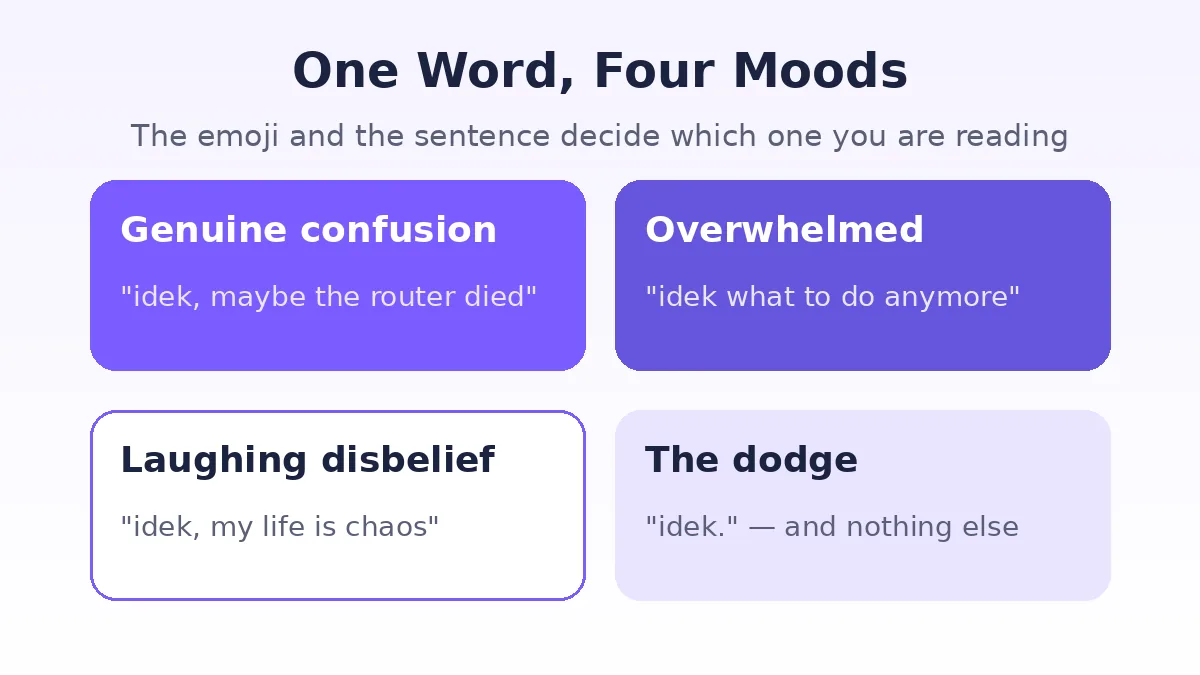
One word, four moods — decided by the emoji, the punctuation, the sentence, and who sent it.
The first mood is genuine confusion: the person truly does not know, and says so plainly. “Why is the Wi-Fi so slow today?” — “idek, maybe the router died again.” It often comes with a guess, an offer to check, or a shrug emoji.
The second mood is overwhelmed exhaustion — the one the “even” was invented for. Too many things have gone wrong at once, and the person has run out of explanations. “Everything is going wrong today.” — “idek what to do anymore.” The giveaway is anymore: the person used to have a handle on it and has now lost it. Treat it gently — it is a small white flag, not a request for information.
The third mood is laughing disbelief. Sometimes the world is so absurd that a proper sentence feels like overkill. “Why do you have seven alarms in the morning?” — “idek, my life is chaos.” “Did you see what he posted?” — “idek 😭 who let him leave the house like that.” The emoji does the heavy lifting, and the reply invites you to laugh together.
The fourth mood is the dodge. “Why didn’t you reply yesterday?” — “idek.” No emoji, no explanation, no follow-up question. They just do not want to engage. Run the Honesty Test.
Idek is almost never angry on its own. If someone is genuinely furious, they reach for stronger language — the masked cousin idfk, best kept out of polite company.
Where You’ll Read It: TikTok, Snapchat, Instagram, and Group Texts

Idek means the same thing on every app. What changes is the surface: where it sits and what surrounds it.
On TikTok, idek lives in the comments and captions — a fast public reaction to something confusing, funny, or shocking. A video of a cat doing something illogical gets captioned “idek why my cat thought this was a good idea.” It is the shortest way to say “this broke my brain and I am enjoying it.”
On Snapchat, idek is quieter and more personal. DMs, snap captions, and stories aimed at one person, not an audience. A snap of a messy room captioned “idek where to start cleaning” is the classic example. Dexerto’s Snapchat guide confirms the same reading, and the term was in use long before it reached Snapchat.
On Instagram, idek splits in two. In comments under a bizarre post it is a public laugh: “idek how this even happened.” In DMs it is a private shrug, where the relationship decides whether it reads as playful or distant.
In texting and group chats, idek does its heaviest work. “Okay, but what time works for everyone?” — “idek, my schedule’s a mess this week.” In a one-to-one text, the Honesty Test matters most — no audience, no caption, just you, the other person, and four letters.
Who Sent It Changes Everything
The same four letters land differently depending on who typed them — the relationship carries half the meaning.
From a close friend, idek is almost always safe. A friend who writes “idek lol” is inviting you to laugh along, or admitting they are lost and trusting you with that. Match their energy — “same honestly” or “fair enough” keeps things warm without demanding an answer they do not have.
From a crush, idek is a Rorschach test: it shows you whatever you are already worried about. “Do you want to hang out this weekend?” — “idek, maybe” is uncertainty about plans, not flirting or rejection. But “idek why I’m smiling rn 😂” is playful, and the emoji tells you so. Questions and jokes after the idek mean engaged; a lone idek every time means not.
From a partner, idek deserves more care. “What’s wrong?” — “idek” usually means “something is wrong and I don’t have the words for it yet.” Do not push; make space instead: “Okay, no rush. I’m here when you want to talk about it.”
From someone you just started talking to, a repeated lone idek is a yellow flag. Early on, a steady diet of shrugs suggests the other person has checked out. One idek is nothing; three in a row is information. Stop carrying the conversation and see whether they pick it up.
From a parent, teacher, or boss, idek usually means the sender is trying to match your energy and slightly missing. An older relative dropping “idek” into a family chat is almost certainly being playful. But sending idek to a boss or teacher reads as careless, even when you mean it honestly — say “I’m not sure yet, let me check” instead.
IDEK vs IDK: The One Letter That Changes the Whole Feeling
IDK and IDEK are not synonyms. They are neighbours with different jobs, and picking the wrong one is how a neutral reply accidentally sounds fed up.
IDK is the plain fact: “I don’t know,” neutral, and a complete answer. “What time does the movie start?” — “IDK, let me check.” Our guide to IDK meaning in text covers the plain version in full.
IDEK is the same missing information with feeling attached: the situation has gone past simple not-knowing into confusion, exhaustion, or disbelief. “Why did he quit his job out of nowhere?” — “idek what he’s thinking, it’s so random.” If IDK is a shrug, IDEK is throwing your hands in the air.
Choose this way: if “let me check” fits after your reply, you want IDK; if “I’ve stopped trying to understand it” fits, you want IDEK. When the situation is upsetting rather than confusing, neither fits — reach for TBH meaning in text for a candid admission, or NGL meaning in text when the truth is uncomfortable.
The confusion between the two words also explains the most common misreading of idek: that it means “I don’t care.” It does not. Our guide to IDC meaning in text draws that line, including when IDC itself crosses into rudeness. Idek says “I don’t know and it is getting to me.” IDC says “I don’t know and I am not bothered.” Mixing them up is how a frustrated friend gets misread as a cold one.
Two more cousins: SMH meaning in text judges the situation, while idek surrenders to it; IMO meaning in text marks an opinion — “here is what I think” vs “thinking has failed me.”
What to Say Back: Reply Scripts That Keep the Chat Alive
The trick is to match your reply to the mood you just identified, not to the letters — a shrug can kill a conversation if you let it.
If the idek is genuine confusion, be helpful and light. Try: “Same honestly, want me to look it up?” “What part is confusing you?” turns a dead end into a joint problem.
If the idek is overwhelmed exhaustion, do not solve — soothe first. “That sounds like a lot — want to talk about it, or want a distraction?” gives them a choice instead of another demand. What does not work is firing another question at someone who has just told you their brain is full.
If the idek is laughing disbelief, laugh with them. “Mood” and “classic chaos energy” match the joke instead of analysing it. A shared shrug of your own, plus a laughing emoji, tells the person you are in on the joke.
If the idek is a dodge, do not chase it — shrink the question. Ask a smaller, safer one instead: “Okay, no pressure — is it a yes or a no for Saturday?” If the shrugs keep coming after that, take the hint and let the topic rest.
When you are the one sending idek, add one honest clause — “idek, I’ll check” — and you will almost never be misread. To keep a conversation open, LMK meaning in text covers the “let me know” replies, and BTW meaning in text is the graceful subject-change after a dead-end shrug.
The Three Places “idek” Backfires
Among friends idek is harmless, but it backfires in three settings.
The first is work and school. A boss who asks why a file is missing and gets “idek” back hears carelessness, not honesty. Where someone counts on you for an answer, say instead: “I’m not sure yet, let me check and get back to you.”
The second is a serious conversation. If a friend is sharing something hard and you answer “idek,” it lands as “I don’t care enough to try.” In those moments, “I don’t know what to say, but I’m here” is worth a hundred ideks.
The third is overuse. Idek works as a reaction to something genuinely confusing or overwhelming. If it becomes your default reply, people stop hearing the feeling and start hearing the pattern. Save it for the moments that actually deserve a shrug.
Quick Answers
What does idek mean in texting?
Idek means “I don’t even know” — confusion, overwhelm, surprise, or giving up on making sense of something. It is stronger than “I don’t know” because of even.
Is idek the same as idk, or does the “even” matter?
A lot. IDK is neutral: you simply lack a piece of information. IDEK adds frustration, exhaustion, or disbelief — you have stopped trying to work it out. Use IDK for a missing fact, IDEK for a situation that has beaten you.
Is idek rude?
Not usually — among friends it reads as casual and relatable. It turns rude only when used alone as the answer to a serious question, or repeated so often the person seems checked out. The rudeness comes from the context, not the word.
What does idek mean from a crush?
On its own, nothing romantic or rejecting — just “I don’t even know.” It depends on what surrounds it: “idek, maybe” about weekend plans is simple uncertainty; “idek why I’m smiling rn 😂” is playful. Watch whether they keep the conversation going after the idek.
What does “idek anymore” mean?
The person has run out of patience, not just answers. The word anymore signals a lost handle on things. It usually carries frustration, as in “idek anymore, everyone keeps changing their plans.”
Why is idek almost always written in lowercase?
Because lowercase matches the word’s tired, casual tone — capitals look like shouting a shrug. Lowercase is the default; most people only capitalise it to exaggerate the frustration.
Can I use idek at work or school?
Better not to — in professional messages it can sound careless. Use “I’m not sure yet, let me check” instead, and save idek for casual chats.
What should I reply when someone says idek?
Match the mood: “Same honestly, want me to look it up?” for confusion; “Fair enough, take your time” for overwhelm; “Mood” for a joke; a smaller question for a dodge — and if the shrugs keep coming, let the topic rest.
The Last Word on IDEK
Idek is a small word carrying a big feeling: not-knowing as a mood, not a fact. That honesty is why it works — and why it misfires as a wall instead of a window.
Next time those four letters land in your chat, run the Honesty Test and match your reply to the mood. Four letters, one shrug — now you know exactly what it is saying.