
You are scrolling through a group chat when a friend drops a sentence that is half roast, half real advice — and then, right at the end, four letters: lbvs. You know the laugh part. You know the serious part. What you do not know is which half you are supposed to answer. That is the whole problem with LBVS: the lbvs meaning in text is easy to define, but hard to read.
LBVS stands for “laughing but very serious.” It is the abbreviation people reach for when a sentence is funny and true at the same time. “You need to stop staying up till 4 a.m. lbvs” is a joke about your sleep schedule — and genuine advice from someone who has watched you yawn through three mornings in a row.
The Short Answer: LBVS Means “Laughing But Very Serious”
LBVS means “laughing but very serious.” Someone uses it when they find a situation funny while still meaning the point underneath the joke. The laughter does not cancel the seriousness, and the seriousness does not cancel the laughter.
That is what makes LBVS different from the laughter abbreviations you already know. LOL says “that was funny” and stops there. LMAO says “that was very funny” and stops there. LBVS says “that was funny, and I am not joking about the part that matters.” It is a tone marker, which is why it almost always sits at the end of a message.
One honest note: LBVS has no entry in the major dictionaries that could be checked for this article. There is no Wiktionary page for it that we could verify, and no established dictionary lists it. It lives in slang sources only — but every source that covers it agrees on the same expansion.
The Laugh–Serious Dial: Five Positions on One Abbreviation
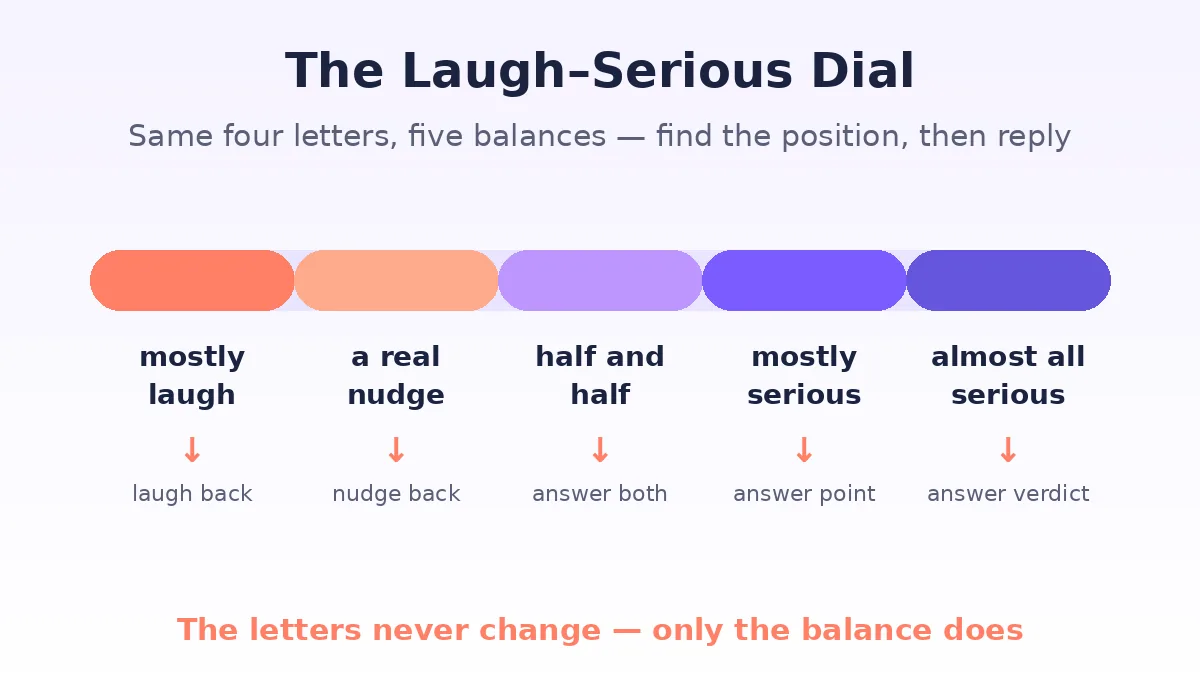
Here is the idea this article is built around. Think of LBVS as a dial with five positions, from mostly laughing to mostly serious. The letters never change. The balance does.
Position 1 — Almost all laugh. “That meeting could have been an email lbvs.” A joke that happens to be true. Position 2 — Laughing, with a real nudge. “You really need to watch that show lbvs.” The recommendation is sincere. Position 3 — Half and half. “You need to stop texting your ex lbvs.” Funny because it has happened five times; serious because the advice is real. Position 4 — Serious, with a laugh to soften it. “You were wrong for that lbvs.” The judgment is real; the laugh is the cushion. Position 5 — Almost all serious. “You really handled that badly lbvs.” A blunt verdict with a thin coat of laugh.
The dial is the reason two people can read the same LBVS message and disagree about it. The letters give no clue about the position — only the sentence around them does. A sentence about snacks sits near position 1. A sentence about a repeated mistake sits near position 4.
Where LBVS Comes From: A 2010 Definition and a Need Nobody Had Named
LBVS does not have a neat origin story, and the honest version is more interesting than an invented one. According to one slang guide, the abbreviation was first defined on Urban Dictionary in 2010 as “laughing but very serious.” No single person coined it and no viral moment made it famous. It grew the way most texting abbreviations grow: someone needed a shorter way to say something they kept saying.
What they needed was a way to laugh at something serious without pretending it was not serious. People were already laughing where laughing felt wrong — at a friend’s bad luck, at a disaster that was funny only because nobody got hurt. LOL covered the laugh and erased the seriousness. “Seriously” covered the seriousness and erased the laugh. LBVS filled the gap, which is why it survived while hundreds of other four-letter inventions quietly died.
The Two-Question Test: How to Read Any LBVS Message
This is the reader test. It takes about five seconds, and it settles almost every LBVS message you will ever receive.
Question 1: Would the sentence still be true if you removed the laugh? “You need to get some sleep.” True or false? If it is true, the serious half is real and the laugh is delivery.
Question 2: Would the sentence hurt if you removed the laugh? “You always show up late.” Without the laugh, that stings. With the laugh, it is a tease. The bigger the sting, the further toward the serious end of the dial the message sits.
Put the two answers together and you have your read. True and painless without the laugh: mostly a joke. True and painful: mostly serious, answer the point.
LBVS on TikTok, Snapchat, Instagram, and Plain Texting
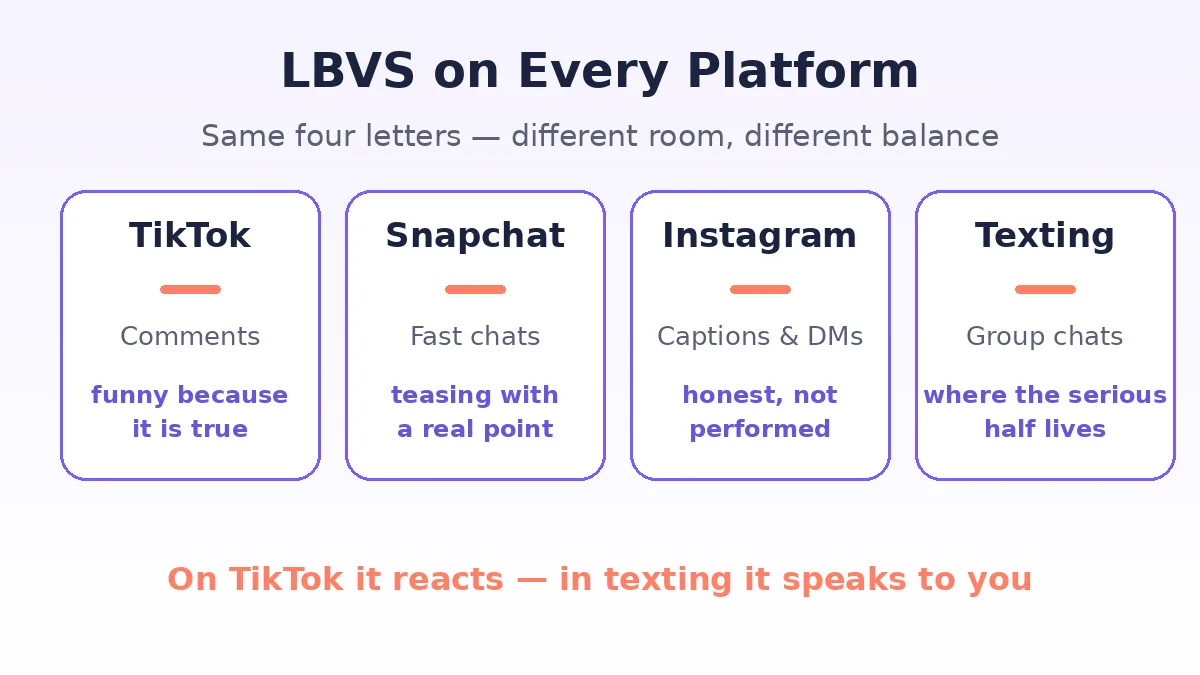
The meaning of LBVS does not change from one app to another. What changes is the situation it usually lands in.
On TikTok, LBVS lives in the comments, usually under videos that are funny because they are true. “This is exactly how my family acts lbvs” is the classic shape: the video is a joke, the recognition is genuine. It is the classic IKR moment — “I know, right?” — with a laugh attached.
On Snapchat, LBVS shows up in fast, private exchanges between friends, where it usually does the softening job. “You looked so confused in that snap lbvs” is teasing with a genuine observation underneath it.
On Instagram, LBVS appears in captions, replies, and direct messages, often as a way to make a caption feel honest rather than performed. “Still pretending I know what I am doing lbvs” is a joke about competence that is also a real admission.
In plain texting and group chats, LBVS is at home. This is where the serious end of the dial lives. “We really need a new group organizer lbvs” is a joke about chaos that is also a genuine suggestion. Texting is where the sender and the reader know each other best, so it is also where the abbreviation carries the most weight.
LBVS From Five Different Senders
The letters never change. The sender does, and with the sender the whole message changes. Most competing guides run a “from a crush” section and stop there.
From a close friend, LBVS is almost always safe. “You owe me lunch lbvs” is a tease, and the friendship is the cushion that makes the tease work.
From a crush, LBVS is a flirtation tool with a safety net. “You better text me tomorrow lbvs” is playful, and the playfulness lets the sender ask for something real — stay in touch — without risking a direct rejection. But LBVS alone is not proof of romantic interest. The abbreviation does not carry the romance. The pattern of messages around it does.
From a partner, LBVS is affectionate shorthand for “I am annoyed and I love you.” “You ate the last slice of pizza again lbvs” is a complaint wrapped in a joke the relationship is secure enough to hold.
From a parent, LBVS is rarer and usually borrowed from the child’s own vocabulary. “Nobody helps with chores around here lbvs” is a real complaint softened by slang the parent picked up from the family group chat.
From a boss, LBVS is a warning sign — not about the abbreviation, but about the message. A boss who writes “Please send the file today lbvs” is either trying too hard to sound casual or does not know what the letters mean. Either way, answer the request in plain professional language. Work has its own shorthand — FYA, “for your action,” flags a task without any joking attached.
LBVS Next to LOL, LMAO, LBS, FR, SMH, and JK
LBVS is easy to confuse with its neighbours, because they all live in the same chats and several of them involve laughing.
LBVS vs LOL. LOL means laughing out loud — amusement, full stop. LBVS means laughing and serious. “That was ridiculous lol” is a reaction. “That was ridiculous lbvs” is a reaction plus a verdict.
LBVS vs LMAO. LMAO is a stronger laugh, nothing more. It turns the volume of the amusement up. LBVS turns the meaning sideways, adding a second signal the laughter alone cannot carry.
LBVS vs LBS and SMH. LBS stands for “laughing but serious” — the same idea, minus the word “very.” SMH means “shaking my head” — disappointment with no laugh in it. “He forgot his keys again smh” is a flat judgment; “he forgot his keys again lbvs” is the same judgment with a laugh wrapped around it.
LBVS vs FR. FR means “for real,” and it stamps a sentence as true. “You need to rest fr” is serious, plainly. “You need to rest lbvs” is the same concern with a humorous layer on top.
LBVS vs JK. JK means “just kidding,” and it does the opposite job. “You are terrible at this jk” withdraws the sting — the criticism was not real. “You are terrible at this lbvs” keeps the sting — the criticism is real, delivered with a laugh. Mixing the two up is the most common LBVS mistake.
One challenger deserves a mention: a single slang site claims LBVS can mean “let’s be very serious,” used ironically. No other source supports that expansion.
When LBVS Goes Wrong: Three Mistakes
LBVS is a useful abbreviation, and it has three failure modes — all from forgetting that the laughing half is audible to the reader.
Mistake 1: Putting a laugh on someone else’s bad news. “I know you are really struggling lbvs” is a sentence no one should send. The sender may have meant the “very serious” half, but the reader hears the “laughing” half first, and it reads as mockery. If the topic is grief, illness, loss, or someone else’s pain, LBVS does not belong in the message.
Mistake 2: Using LBVS to dodge saying what you mean. LBVS is a softener, and softeners are addictive. “We need to talk lbvs” is not softer than “we need to talk” — it is vaguer, and vagueness reads as avoidance.
Mistake 3: Answering the laugh and ignoring the point. This is the reader’s mistake, and it is the most common of the three. Someone writes “You need to stop staying up till 4 a.m. lbvs,” and the reader replies with a laughing emoji and changes nothing. The sender was laughing — but they were also asking for something. Laugh first if you like. Then answer the point.
How to Reply When Someone Sends LBVS
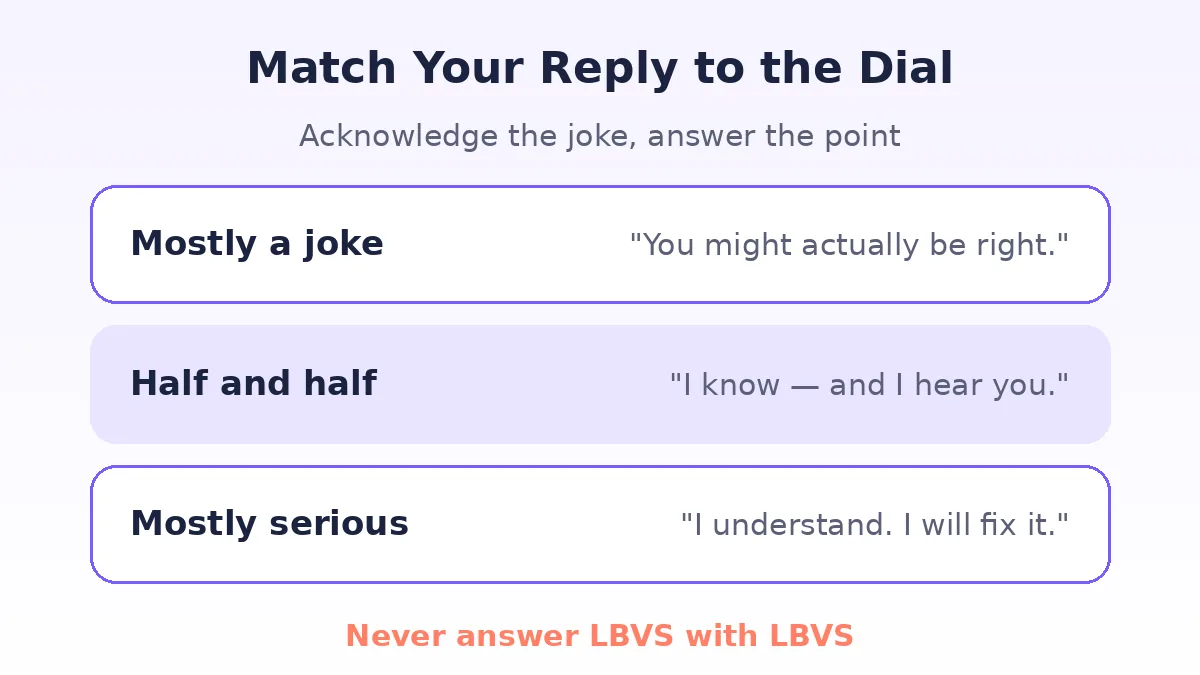
Most LBVS messages need a reply that does the same two jobs the abbreviation does: acknowledge the joke, answer the point.
If it was a joke with a small truth in it, laugh and agree. “You might actually be right.” “I know, it is getting bad.”
If it was teasing, tease back. “One bad meal and suddenly nobody trusts me.” “Or what?” A playful reply keeps the dynamic going, and it tells the sender the joke landed.
If the serious part mattered, answer the point and let the joke pass. “I understand what you mean. I will think about talking to them.” Use these whenever the test puts the message at position 4 or 5.
If you genuinely do not know what they meant, ask. “Wait — are you joking or serious?” is a perfectly good reply, and it is better than guessing wrong. Do not worry about looking clueless: most people will happily explain.
One reply to avoid: answering LBVS with LBVS. “You need to sleep lbvs” — “I know lbvs.” The second LBVS adds nothing, and the conversation stalls. If you agree, say so. If you disagree, say that.
Quick Answers
What does LBVS mean in text?
LBVS means “laughing but very serious.” Someone uses it when a message is funny and the point underneath the joke is genuine.
Is LBVS the same as LOL?
No. LOL means laughing out loud — amusement only. LBVS adds a serious layer: the sender is laughing, but they genuinely mean what they said.
What is the difference between LBVS and LBS?
LBS stands for “laughing but serious” — the same idea, minus the word “very.” The difference is emphasis, not meaning.
Can LBVS mean “let’s be very serious”?
One slang site claims it can, used ironically to mock overly dramatic conversations. No other source supports that expansion. Treat it as a weak single-source claim.
Is LBVS rude or offensive?
Not by itself. It turns rude when the laughing half lands on a topic where laughing is wrong — someone’s grief, illness, or bad news.
Does LBVS from a crush mean they like you?
Not on its own. LBVS from a crush usually means teasing with a genuine point behind it. The abbreviation does not carry romance — the pattern of messages around it does.
Can I use LBVS at work?
You should not. Every guide read for this article agrees: LBVS is casual internet slang, and in professional messages it can confuse the reader or look unprofessional.
Is LBVS in the dictionary?
No major dictionary entry for LBVS could be verified for this article — there is no Wiktionary page we could confirm, and no established dictionary lists it.
The Final Word on LBVS
LBVS is a small abbreviation that does a surprisingly honest job. Most slang exists to make a message shorter. LBVS exists to make a message truer — to let someone say “this is funny” and “I mean it” in the same breath.
The next time you see it, do not reach for the dictionary — there is not one to reach for. Reach for the dial instead. Place the message on it. Ask the two questions: would the sentence still be true without the laugh, and would it hurt without the laugh? Then answer the half that matters.