
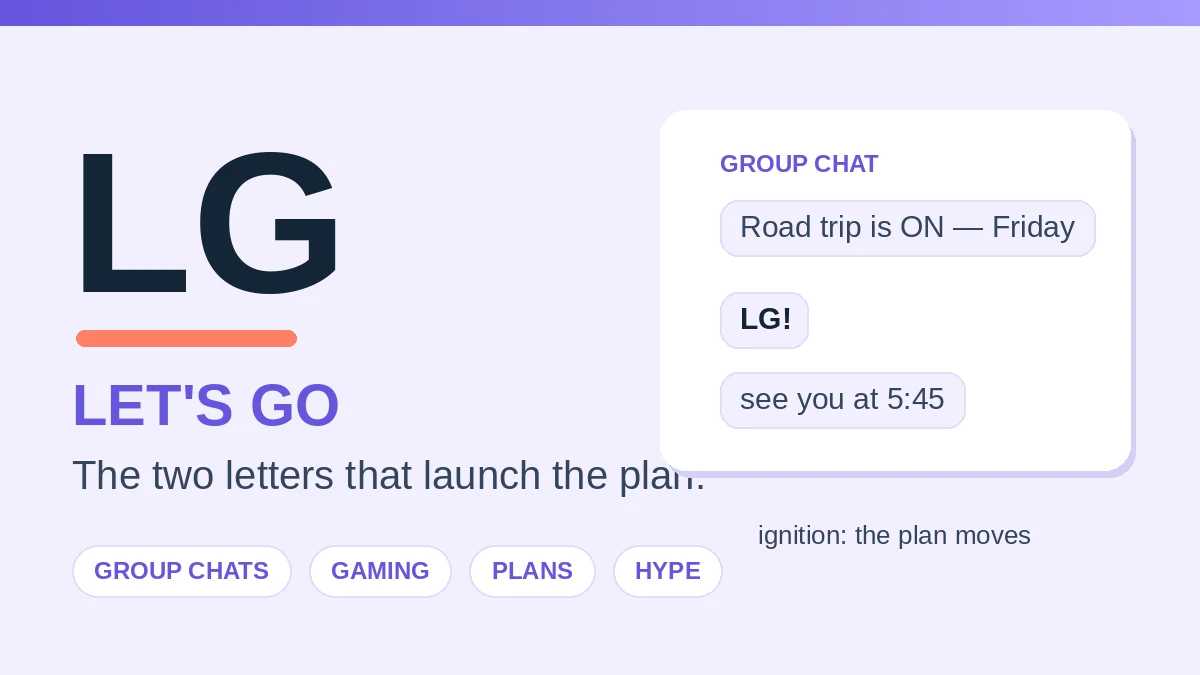
Most abbreviations describe something. LG starts something. If you’re looking up the lg meaning in text, here’s the short version: LG stands for “let’s go” — a burst of energy people send to kick off a plan, cheer on a moment, or simply say “I’m in.”
It shows up in group chats the second plans get real, in gaming lobbies when the match is about to start, and in comment sections when someone’s moment deserves a cheer. This guide covers what LG really means, a simple test for reading it right every time, the two different jobs it does, the lookalike abbreviations it’s confused with, and the honest truth about its other readings — including one this site used to claim that we’ve now withdrawn.
LG Meaning at a Glance
| Full form | Let’s Go |
| Main job | Igniting or cheering — marking the moment a plan starts moving |
| Where you see it | Group chats, gaming lobbies, sports chats, TikTok comments, sports and concert plans |
| Example | “Tickets are booked — LG!” |
The Ignition Test: The Question LG Answers
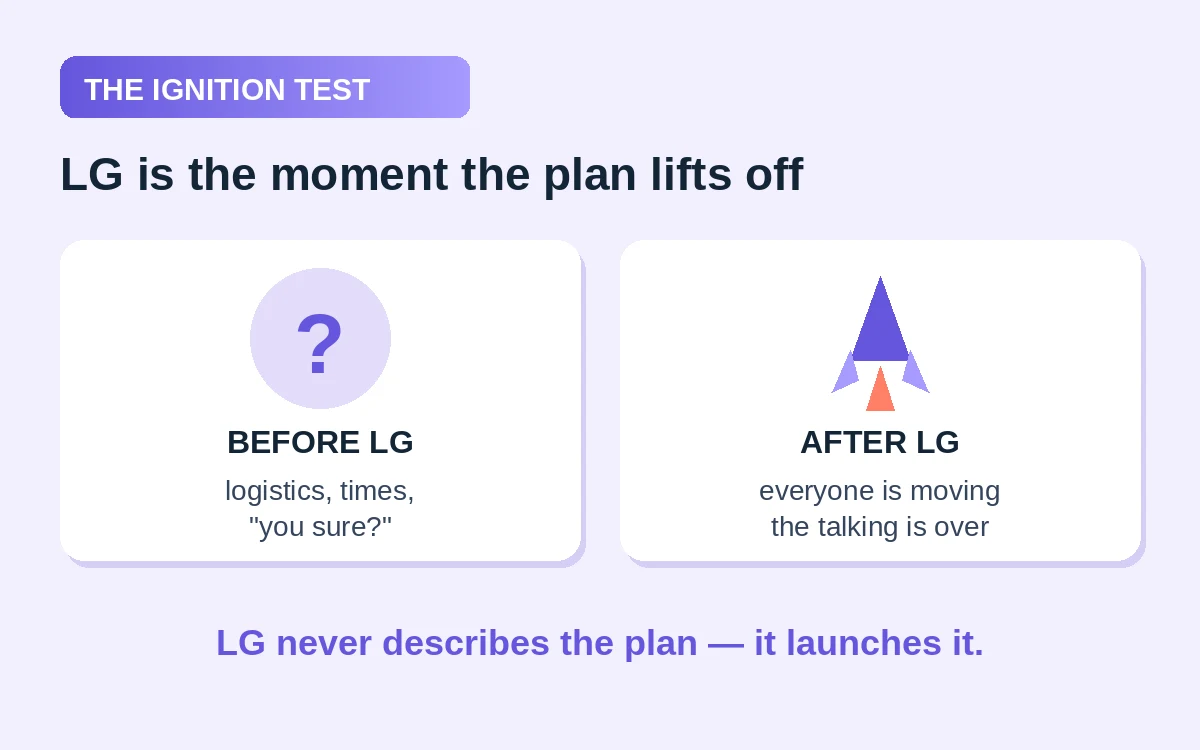
Every LG, in every chat, answers the same question — and you can read it in two seconds.
Picture the plan as a rocket on a launch pad. Before LG, everyone is still talking: logistics, times, “you sure?” After LG, everyone is moving. LG is the ignition.
Run it both ways. Reading an “LG”? Ask what’s sitting on the pad: “Concert Saturday, LG!” — the pad holds a plan, and LG is launching it. “LG!! WE WON!” — the pad holds a result, and LG is the cheer erupting from it. Sending an “LG”? Make sure there’s a rocket on the pad before you ignite it. A bare “lg” dropped into a dead chat with no plan and no news doesn’t launch anything — it’s just noise.
Notice what the test never asks: whether the plan is good. LG carries zero judgment. It doesn’t evaluate the concert, the road trip, or the comeback — it only says now we’re doing this. That’s its whole magic, and its whole limit.
And that’s why LG almost never arrives alone in the planning stage. The lead-up belongs to questions — “what time?”, “wya?” — and LG is the sound of those questions getting answered.
What LG Actually Means (and What the Dictionaries Miss)
Let’s be direct: in texts, LG means “let’s go.” That is the meaning you will meet roughly every time — the hype in the group chat, the rally cry in the game lobby, the “I’m in” when plans lock. It is informal, positive, and it always points forward, at something about to happen or something worth celebrating.
Now the honest part, because this site does honest work: no major dictionary lists this meaning. Wiktionary’s entry for “LG” covers Lieutenant Governor, the LG Corporation brand, the astronomical Local Group, and German “liebe Grüße” — “let’s go” isn’t there, and no texting sense is either. LG-as-“let’s-go” is an internet-slang reading documented by how people actually text, not by lexicographers. The dictionaries are behind; usage is the evidence.
And one correction this article owes you. The older version of this page listed “lucky guy” as a third texting meaning of LG (“You got the tickets? LG!”). We went looking for it — dictionaries, slang glossaries, competitor articles, user-generated abbreviation lists — and found nothing. No attestation anywhere. It was padding dressed up as a meaning, and it has been removed. If a reader ever means “lucky guy,” they will have to type the words; LG will not carry it for them.
One Abbreviation, Two Jobs: Ignition and Hype
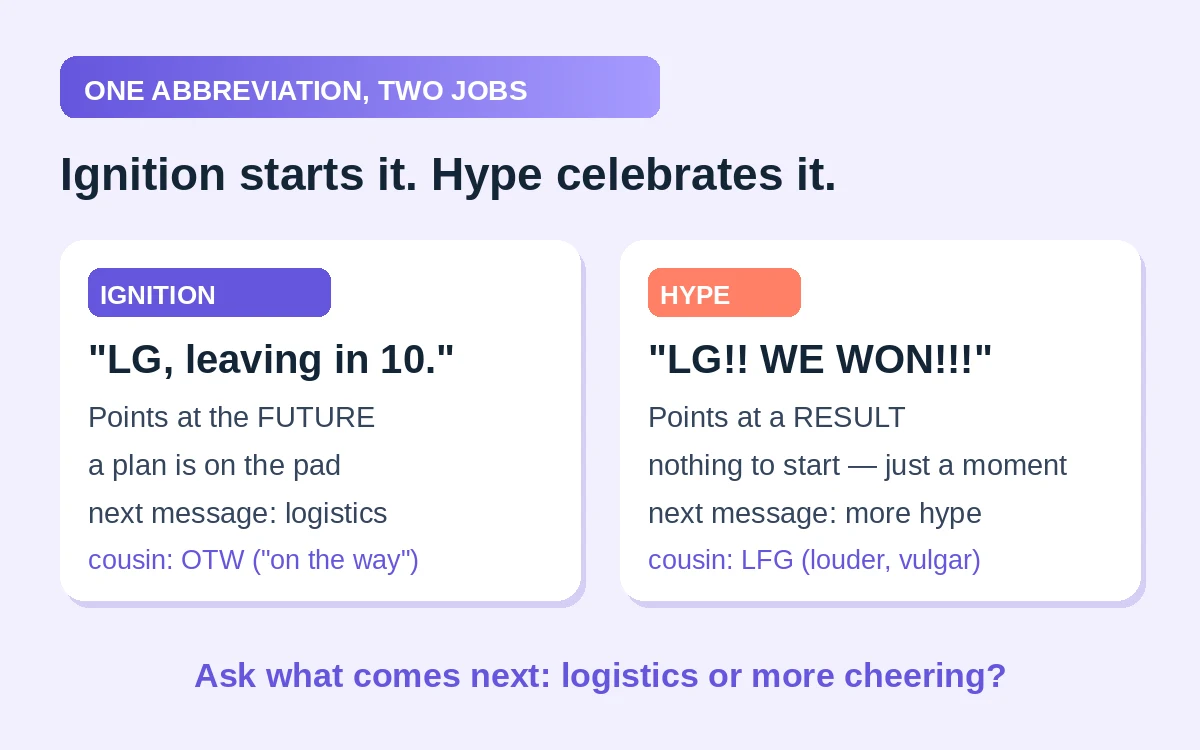
The Ignition Test reveals something competitors miss entirely: LG does two distinct jobs, and readers who can’t tell them apart will misread half of what they see.
Job one: ignition. This is LG starting the engine — the message that ends the deliberation and begins the doing. “LG, we’re leaving in 10.” “Everyone ready? LG.” Notice the shape: there’s a plan, a time, or a place attached. Ignition LG almost always points at the future, and it’s often the last message before everyone goes quiet and does the thing. (The natural sequel to ignition is already in this site’s vocabulary: once the plan launches, the follow-up is “otw” — on the way.)
Job two: hype. This is LG as a cheer — no plan to start, just a moment to celebrate. “LG!! WE WON!!!” “She got the job — LG!” “New album dropped, LG 🔥🔥” The shape is different: there’s a result, not a plan. Hype LG points at something that already happened, and its job is to amplify the feeling, not to move bodies. It often arrives with exclamation marks or fire emojis, and it works exactly like the lol energy of a group chat — pure emotional fuel, the same shared thrill that fomo runs on: something is happening and you’re part of it.
How to tell them apart: after ignition LG, the next message is logistics (“bring cash,” “meet at the gate”). After hype LG, the next message is more hype (“NO WAY,” “SO DESERVED”). If nobody’s going anywhere and nothing happened — you got the Ignition Test’s warning case: a rocket with no pad.
The Cousin Table: What LG Is and Isn’t
LG’s letters are short, which means it gets confused with its neighbours constantly. Run each candidate through the Ignition Test and the confusion clears:
| Abbreviation | What it means | Relationship to LG |
|---|---|---|
| LG | Let’s go | The ignition word itself |
| LFG | The amplified, vulgar cousin (“let’s f***ing go”) | Same job, turned to maximum volume — and with profanity attached. Don’t type LFG unless you mean the extra gear. |
| GTG | Got to go | The opposite. GTG ends the conversation; LG starts the plan. Mixing them up is the most common real-world LG mistake. |
| GL | Good luck | What people sometimes guess LG means — it doesn’t. If you mean good luck, type GL. |
| GG | Good game | Gaming adjacency: GG closes a match (it’s over, well played); LG opens one. Same arena, opposite ends of the timeline. |
The table’s real lesson: LG’s meaning lives in its direction. Everything it means points forward — at a start, a cheer, a go. Anything pointing backward (GG), sideways (GL), or at the exit (GTG) is a different word wearing similar clothes.
LG in Real Conversations
The exchanges below are illustrative examples, not real messages.
The plan locks — ignition
- Priya: “Okay, road trip is ON. Leaving Friday 6 a.m., split gas”
- Marcus: “LG 🔥 see you at 5:45”
- Priya: “lmk if you need a ride to mine”
Marcus’s LG is ignition: the plan is on the pad, and his two letters launch it. Priya’s reply shifts back to logistics — exactly the pattern the Ignition Test predicts.
The moment lands — hype
- Jade: “I GOT THE INTERNSHIP!!!”
- Theo: “LG!!!! SO DESERVED 🎉”
- Jade: “celebration dinner Saturday, you’re all coming”
No plan, no logistics — just a result and a cheer. Theo’s LG is pure hype, and notice it starts a plan (Saturday dinner) rather than responding to one.
Who Sends It Changes the Flavor
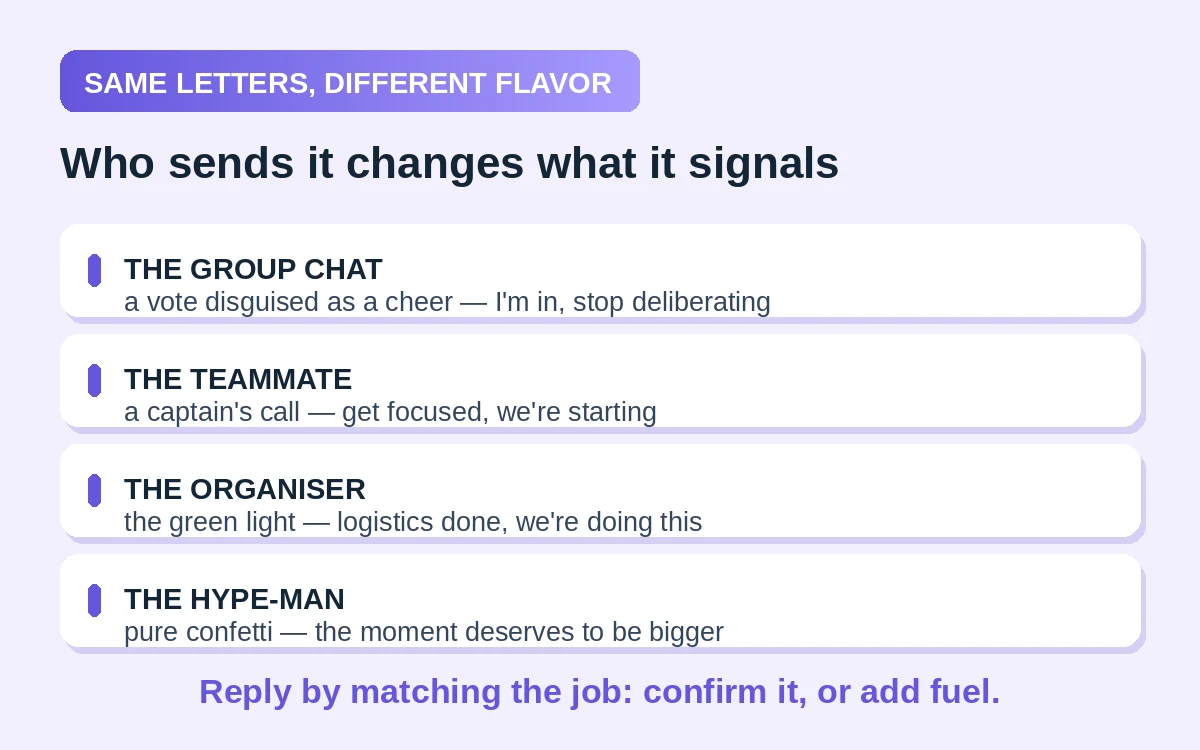
The meaning never changes — it’s always “let’s go.” But the flavor shifts with the sender, and reading the flavor keeps you from missing the social signal underneath.
The group chat itself. Most LGs you receive come from the collective, not a person — someone throws “LG!” into the group after plans land, and it’s a vote disguised as a cheer. It means: I approve, I’m in, stop deliberating. If three people LG a plan and one goes quiet, the quiet one is the one to check on — the LGs were the consensus, and the silence is the dissent.
The teammate. In gaming lobbies and sports chats, LG is a rally cry with a job description: get focused, we’re starting. “LG, let’s run it back” isn’t enthusiasm — it’s a captain’s call, and the expected reply is readiness, not banter.
The organiser. From the friend who made the plan, LG is the green light. They’ve done the logistics, collected the confirmations, and “LG!” means we’re doing this, no more debate. It pairs naturally with trust — “this place is amazing, tm, LG” — because the organiser is asking you to believe in a plan you didn’t make.
The Other Readings, Honestly
No article on LG is complete without the footnotes — but footnotes is all they are.
“Little girl” is the one alternate reading with any real-world legs. Some abbreviation lists define LG as “little girl,” and you will genuinely see it in family chats — “my LG’s first day of school 🥹” — where the kid-shaped context makes it obvious. But be honest with yourself about how this works: it needs the context to survive. “LG!” alone never means “little girl,” and nobody reading it cold will see a child in it. It is a niche, context-locked reading, not a rival meaning.
The brand. LG is also one of the world’s biggest electronics companies (the Lucky-Goldstar heritage, the “Life’s Good” slogan). Nobody texts “LG” to mean a television. But if you arrived at this page half-wondering about the brand — now you know it’s a coincidence of letters, and the chat meaning is the one above.
That’s the complete honest list. “Lucky guy” is withdrawn (see above); “good luck,” “lovely girl,” “let go,” and “long goodbye” have no attestation to earn a place here. An abbreviation this short will always attract guesses — this article’s job is to tell you which guesses survive contact with evidence.
Ways LG Goes Wrong
- Ignition with no rocket. The most common LG failure: dropping “lg” into a chat where nothing is planned and nothing just happened. Per the Ignition Test, you’ve lit a fuse with nothing attached. Either attach the plan (“LG, movies Friday?”) or skip it.
- Using LG as a goodbye. This is the GTG mix-up: both are two letters about going, but they are opposites. LG launches; GTG leaves. “LG, talk later” doesn’t say goodbye — it says you’re starting something and then confusingly walking away.
- LG in the wrong room. Like all slang, LG is casual-only — not for work emails, professors, or anywhere “let’s go” typed out would sound flippant. If spelling it out would feel wrong, the abbreviation feels worse.
- The punctuation flatline. “lg.” with a period reads as reluctance, not energy — the opposite of the word’s entire job. LG’s fuel is enthusiasm; punctuate it like you mean it, or don’t send it.
Quick Answers
What does LG mean in text?
LG means “let’s go.” It’s informal energy used to kick off a plan (“Tickets booked — LG!”), cheer on a moment (“LG!! WE WON!”), or agree enthusiastically (“Road trip? LG 🔥”). It always points forward — at something starting or worth celebrating.
Is LG short for “good luck”?
No. “Good luck” is GL — the confusion comes from the shared first letter. LG is “let’s go,” an ignition word; GL is a wish for someone else’s outcome. They’re different jobs, so keep the letters straight.
What does LG mean on Snapchat and TikTok?
Same meaning everywhere: “let’s go.” On Snapchat it’s usually a quick reaction or plan-confirmation; on TikTok it shows up in comments and captions as hype — cheering on a video or celebrating someone’s moment. The platform changes the setting, not the meaning.
How should I reply when someone texts me LG?
Match the job. If it’s ignition (a plan just locked), confirm: “LG,” “bet,” or “see you there.” If it’s hype (a win just happened), add fuel: “I KNOWWW” or your own “LG!!” back. When in doubt, an “LG” right back at them works for both — it’s the safest two letters in texting.
Why isn’t LG in the dictionary?
Dictionaries are slow and chat is fast. Wiktionary’s “LG” entry covers formal-world senses like Lieutenant Governor and the LG brand — no texting sense. The “let’s go” meaning comes from how people actually use the letters every day, and usage is older and stronger than any dictionary entry here.
The Short Version
LG is “let’s go” — the two letters that launch the plan. Run the Ignition Test: picture the plan as a rocket on a pad, and LG is the moment it lifts off. That one image separates its two jobs (ignition vs. hype), its lookalikes (GTG ends what LG starts; LFG is the louder, vulgar cousin; GL is a different wish entirely), and its honest footnotes (“little girl” in family chats, the brand coincidence, and a withdrawn “lucky guy” that never had evidence). Send it when there’s something on the pad. Match the energy when you get one. And never use it to say goodbye — that’s somebody else’s abbreviation.
