
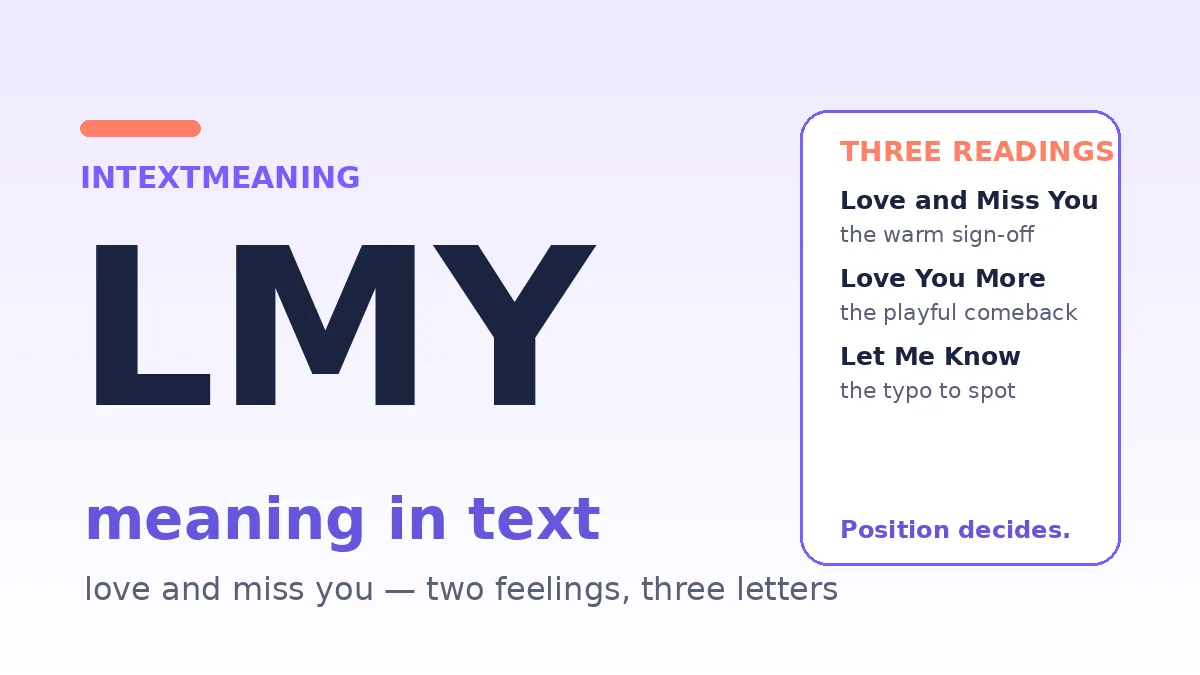
You are finishing a long, warm chat with someone you care about. The conversation winds down, they type a last line, and right at the end sit three letters: LMY. No emoji, no explanation. You know it is affectionate — probably. But is it romantic? And what are you supposed to send back?
That is the exact moment lmy meaning in text searches come from — and this guide answers it, then gives you a simple test, the Goodnight Check, that settles every real LMY.
The Short Answer: Two Feelings, One Sign-Off
LMY means “Love and Miss You.” It is a warm sign-off for a partner, a close friend, or a family member you are apart from. In plain English: “I love you, and I miss you.”
Dictionary.com says exactly that — LMY is a textspeak acronym standing for “love and miss you” — backed by real usage from 2016 and 2017, and flagged by the dictionary itself as an informal word summary rather than a formal definition. LMY is slang, but every guide that covers it agrees on this reading.
Two smaller readings ride alongside it, and both depend on where LMY sits. As a direct reply to “I love you,” LMY can mean “Love You More” — a playful comeback between couples and close friends. In the middle of a planning question, it is probably a mistyped LMK — “let me know” — a keyboard error, not a second meaning. Other readings you may see online have no evidence behind them, so they are not repeated here as readings.
Why LMY Is a Sign-Off, Not a Sentence
Here is the fact that unlocks the whole abbreviation: LMY is an ending, not a sentence. It does not ask a question or start a new topic — it closes a message the way a hug closes a visit.
That is why position tells you almost everything. “Goodnight, talk tomorrow. LMY!” — LMY sits at the end, after a warm sentence. Affection. Sign-off. “Are you free Friday? LMY.” — LMY sits inside a planning question. The sender almost certainly meant LMK. Same three letters, opposite jobs.
LMY works as a sign-off because the feelings behind it are already understood — nobody sends it to a stranger. It is built from two pieces of older chatspeak, ILY (“I love you”) and IMY (“I miss you”), folded into one line. ILY says love only; IMY says missing only; LMY says both at once — which is why it shows up at goodbyes.
The Goodnight Check: Three Questions That Settle Every LMY
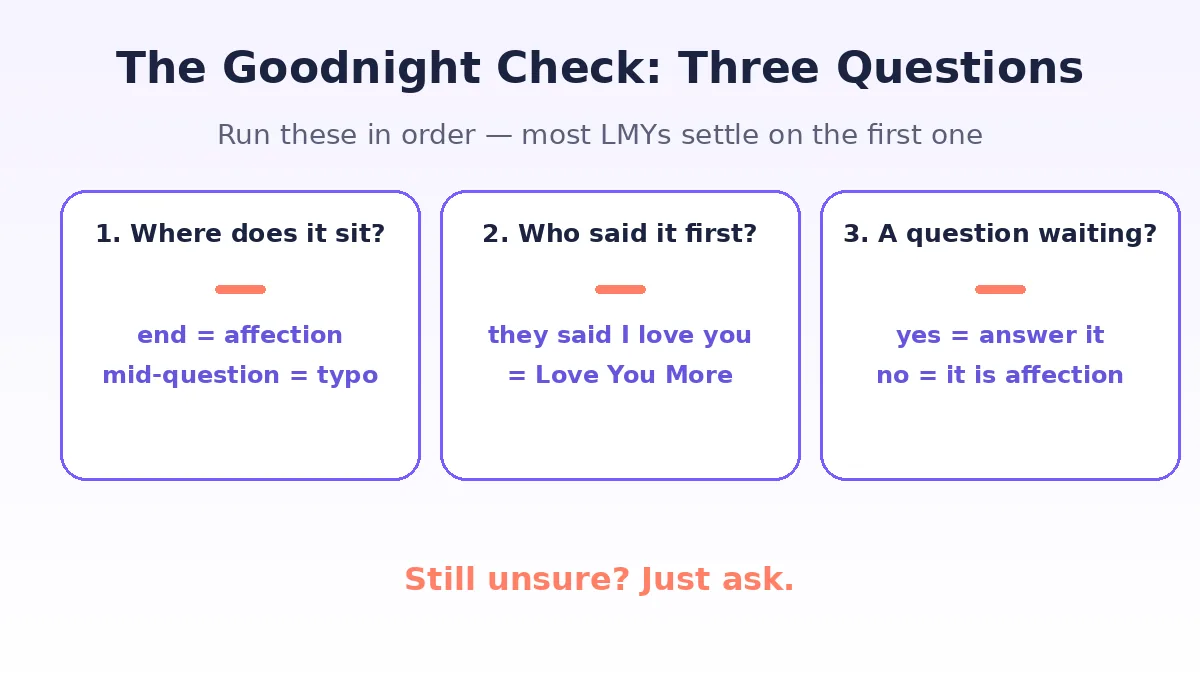
When LMY lands in your messages, run the Goodnight Check — three questions, in order, that settle almost every case in a few seconds.
Question 1: Where does it sit in the message? At the end of a warm sentence, LMY is the sign-off. Buried in a question about plans, it is almost certainly a mistyped LMK. Position is the single strongest clue you have.
Question 2: Who said “I love you” first? If the message right before it was “I love you,” read the reply as “Love You More.” That is the one place the second reading lives — it only exists as a comeback.
Question 3: Is a question waiting for an answer? If the sentence around LMY is asking you something, answer the question and ignore the letters. If there is no question waiting, the affection reading stands. Still unsure? Ask: “Wait — did you mean let me know, or love and miss you?”
The Two Feelings Inside Three Letters
LMY is unusual because it does two jobs at once: most slang says one thing, LMY says a feeling and a distance.
The love. “I love you” is the warmer half, and it is why LMY feels bigger than a casual sign-off like TTYL, which only says “we will talk again.” LMY says “you matter to me.”
The missing. “I miss you” is the quieter half, and it gives LMY its timing: it shows up when someone is not there — a friend who moved away, a partner in another time zone. The missing is about distance, not drama.
The two feelings also explain why LMY is not romantic by default. Love, in a text, is not always romance: a parent sends LMY to a child at college, a best friend after a video call. Romance is only one room in that house, and the relationship you already have decides which room you are in.
LMY From Four Different Senders
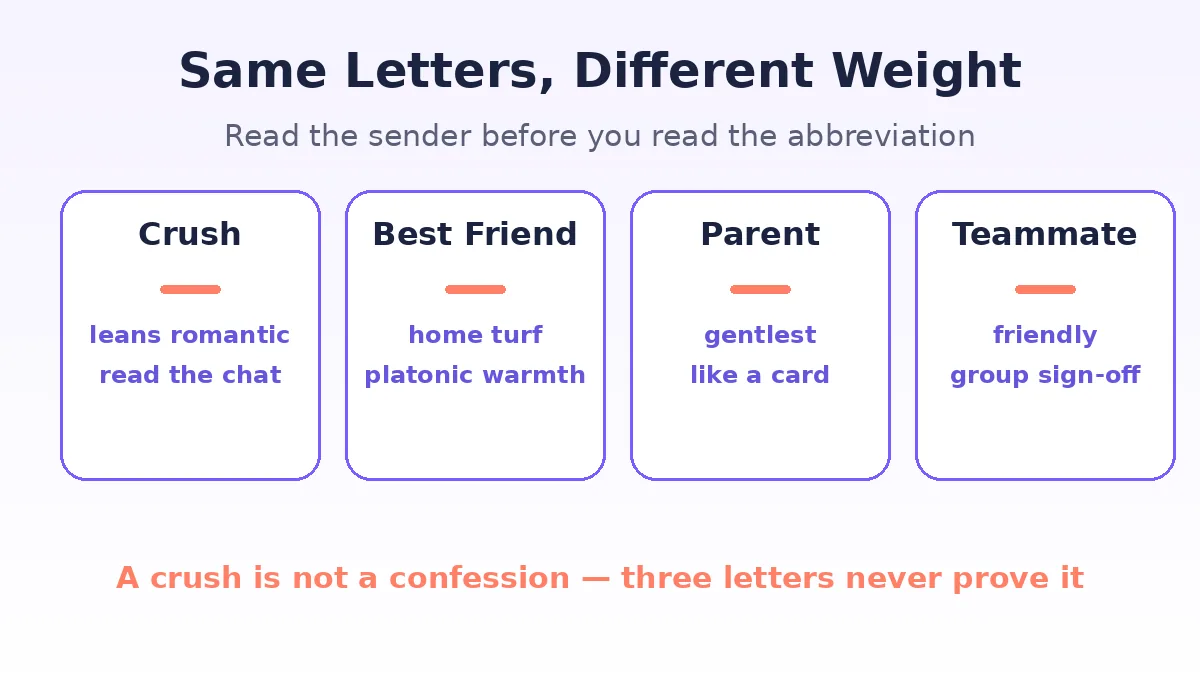
The same three letters carry a different weight depending on who typed them — read the sender first.
From a crush. This is the reading people worry about most, and the honest answer is: it depends on the conversation. If the chat is already personal, LMY leans romantic — but LMY alone does not prove someone wants a relationship. Never treat three letters as a confession.
From a best friend. This is LMY’s home turf: between close friends it is almost always platonic, and it usually shows up after a gap — a friend who moved away, a long stretch without hanging out. Friends often soften it with humour (“you’re annoying but LMY anyway”).
From a parent or family member. Family LMY is the gentlest version — it reads like the closing line of a card. A parent sends it after a visit ends; a sibling sends it after a holiday. There is no hidden meaning to decode.
From a teammate or gaming friend. In gaming chats, LMY is a friendly sign-off between people who spend a lot of time together online. “GG, heading out. LMY, same time tomorrow?” is not romance — and in a group chat, read it as aimed at the group, not at you alone.
LMY on TikTok, Snapchat, Instagram, and in Plain Texting
LMY does not change its meaning from platform to platform — it changes its stage: the letters stay the same, the room changes how public the affection is.
On TikTok, LMY lives in the comments, usually under videos about long-distance relationships or friends who moved away. A comment that just says “LMY!!” under a friend’s video is a public show of affection — the same sign-off, said where everyone can see it.
On Snapchat, LMY shows up in fast, private chats and as a caption on a snap sent to someone you miss. Messages disappear here, so people send it more freely, often with a heart emoji.
On Instagram, LMY splits in two. In DMs it behaves like texting; in comments, like TikTok — public and lighter, often under a throwback photo.
In plain texting — iMessage, WhatsApp, SMS — LMY is at its most personal, because the message before it is a real conversation with someone you know. This is where the sign-off reading is strongest and the Goodnight Check works best.
The LMK Trap: When LMY Is a Typo, Not Affection
The one real trap in LMY is three letters away: LMK, “let me know.” One of them is a request and the other is a feeling, and mixing them up is the single most common LMY mistake — it happens in exactly one place, inside a planning question.
“Are you free Friday? LMY.” Read as affection, that message is confusing; read as a typo, it is obvious — the sender wants an answer about Friday. Answer the question and move on. Do not reply with a heart.
Some guides blame the typo on the Y and K keys sitting close together. They do not — on a standard phone keyboard, Y and K are nowhere near each other. The typo happens because people type fast and autocorrect misses. If the sentence is asking you something, the letters are LMK in disguise — and if you are the one typing, type LMK when you mean “let me know.”
LMY vs ILY, IMY, LY, and XOXO
LMY sits in a family of affection abbreviations, and knowing the neighbours keeps you from reaching for the wrong one.
| Term | Meaning | When it fits |
|---|---|---|
| LMY | Love and Miss You | A warm sign-off when you are apart — love and longing together |
| ILY | I Love You | Love only, no mention of missing — the direct declaration |
| IMY | I Miss You | Missing only, no mention of love — the straightforward longing |
| LY | Love You | A shorter, lighter ILY — quick, casual affection |
| XOXO | Hugs and Kisses | A warm sign-off, slightly less intense than ILY, common in writing |
ILY says one feeling; IMY says one feeling; LMY says both — which is why LMY fits goodbyes and ILY fits everyday affirmations.
Five Times LMY Lands Wrong
Mistake 1: Answering a typo with affection. Someone asks “Are you free Friday? LMY” and you reply “aww, miss you too!” Run the Goodnight Check first — a question waiting means LMK, not love.
Mistake 2: Reading romance into a friendly sign-off. A best friend sends LMY after a video call and you spend the evening wondering if they like you. They do not — they like you the way best friends do.
Mistake 3: Sending it too early. Sending LMY to someone you barely know — a new match, a stranger in a DM — lands as too intense, too fast. With new people, spell the feeling out or leave it out.
Mistake 4: Using it where clarity matters. LMY is ambiguous by nature — one typo away from a different message entirely. Do not use it in a serious conversation, at work, or when someone just shared bad news. A warm TYSM at least says thank you.
Mistake 5: Sending it on autopilot. LMY in every message stops meaning anything. Use it when you actually feel both halves.
What to Send Back: A Reply Bank for Every Reading
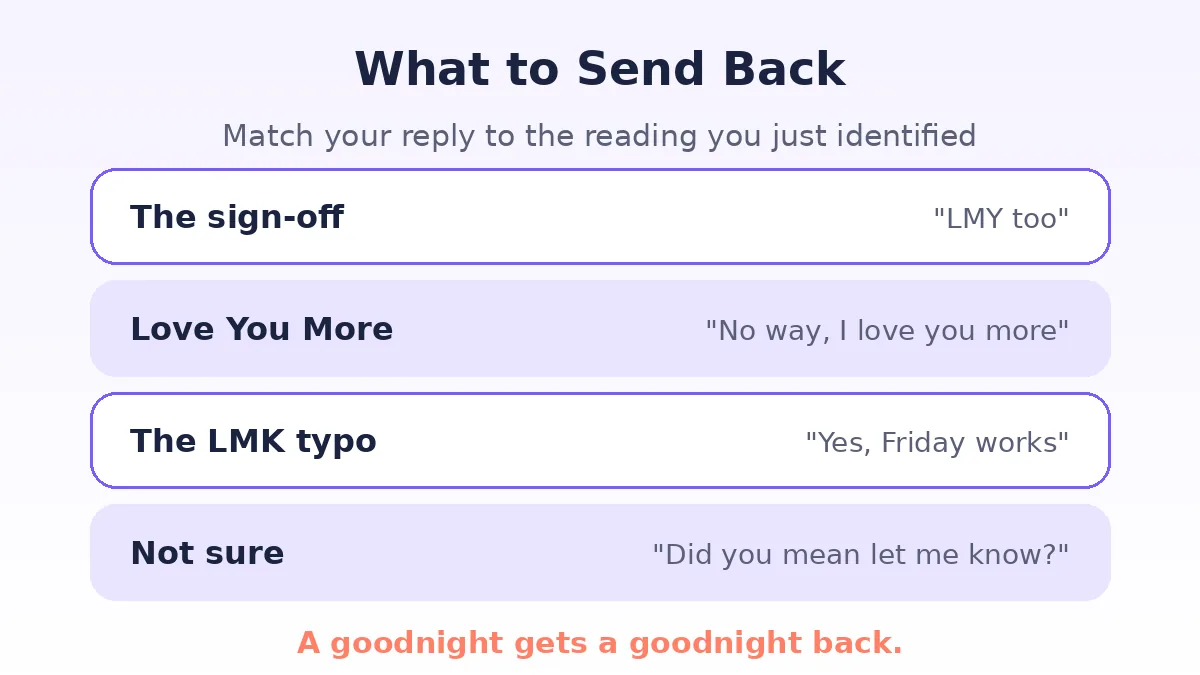
Your reply should match the reading you landed on, not the letters you received.
If it was the sign-off: answer the feeling, not the letters. “LMY too” returns it exactly; “Miss you too, talk soon” says the same thing in full words. Keep it warm and short — the sender closed the message, so your reply is a soft echo.
If it was “Love You More”: play along. “No way, I love you more” keeps the game going. A flat LOL here would be the wrong temperature.
If it was a typo for LMK: ignore the letters and answer the question. “Yes, Friday works — what time?” is the whole reply. The sender wanted a plan, not a feeling.
If you genuinely cannot tell: ask, lightly. “Wait — did you mean let me know, or love and miss you?” And if the LMY came at the end of a sweet message with no question attached, you do not need to ask at all.
If it was a goodnight: match the hour. A simple GN back, or “goodnight, LMY too,” closes the conversation the way the sender intended.
Quick Answers
What does LMY mean in texting?
LMY means “Love and Miss You” — a warm sign-off for a partner, close friend, or family member you are apart from. It says “I love you, and I miss you” in three letters.
Is LMY romantic?
Not always. LMY is sent to partners, but also to close friends, siblings, and parents. Romance depends on the conversation, not the letters.
What does LMY mean right after someone says “I love you”?
As a direct reply to “I love you,” LMY can mean “Love You More” — a playful, slightly competitive comeback between couples and close friends. Anywhere else, read it as the “Love and Miss You” sign-off.
Can LMY mean “let me know”?
Not as a meaning — as a typo. Inside a planning question (“Are you free Friday? LMY”), the sender almost certainly meant LMK, “let me know.” Answer the question and ignore the letters.
Is LMY the same as ILY or IMY?
No. ILY means “I love you” (love only) and IMY means “I miss you” (missing only). LMY is the only one of the three that says both feelings at once, which is why it fits goodbyes best.
What does LMY mean on TikTok?
In TikTok comments, usually under videos about long-distance relationships or friends who moved away, LMY is a quick public show of affection — the same sign-off, said where everyone can see it.
What does LMY mean from a crush?
It depends on the conversation. If the chat is already personal and flirty, it leans romantic — but LMY alone does not prove someone wants a relationship. Read the message around it, not just the letters.
Should I use LMY at work or school?
No. LMY is informal textspeak for close, personal chats. In a work message or anything formal, write a plain goodbye instead — and never use it when you mean “let me know.”
The Final Word on LMY
LMY is a small abbreviation with an unusually honest job: it says two true things at once, and then it stops talking. “I love you, and I miss you” — a sign-off, not a sentence.
That is also what makes it easy to misread: in a planning question it is a typo; as a reply to “I love you” it is a game; everywhere else it is the warmest three letters in a text thread.
So the next time those three letters close a message, do not panic and do not guess. Read the position, read the sender, and reply to the feeling, not the abbreviation. And if you send LMY yourself, send it when you mean both halves — the love and the missing. As IKR would put it: you already know.
