
You are halfway down a comment thread when a reply stops you cold: “OP already answered this.” If you are looking up the op meaning in text, here is the problem with most guides: they hand you a list and tell you that context matters, but they never tell you how to test which meaning is in front of you. OP is not one word with one job. It is two strong readings that live in different rooms, plus a third that only lives in one fandom — and guessing the wrong room changes your reply completely.
In a forum thread, OP is almost always a person: the one who started the discussion. In a game lobby, OP is almost always a judgement about strength: something is too powerful. In an anime chat, OP can be a song: the opening theme that plays before the episode. Same two letters, three different jobs — and the room you are standing in decides which one you are hearing.
That is why this guide does not start with a ranking. No published study counts how often each OP is used, so this guide refuses to crown a “most common” winner. Instead, it starts with a test. Run the Triple-Swap Test below on any OP you see, and you will know in about five seconds whether you are looking at a person, a power level, or a song — and which lookalikes you can safely rule out.
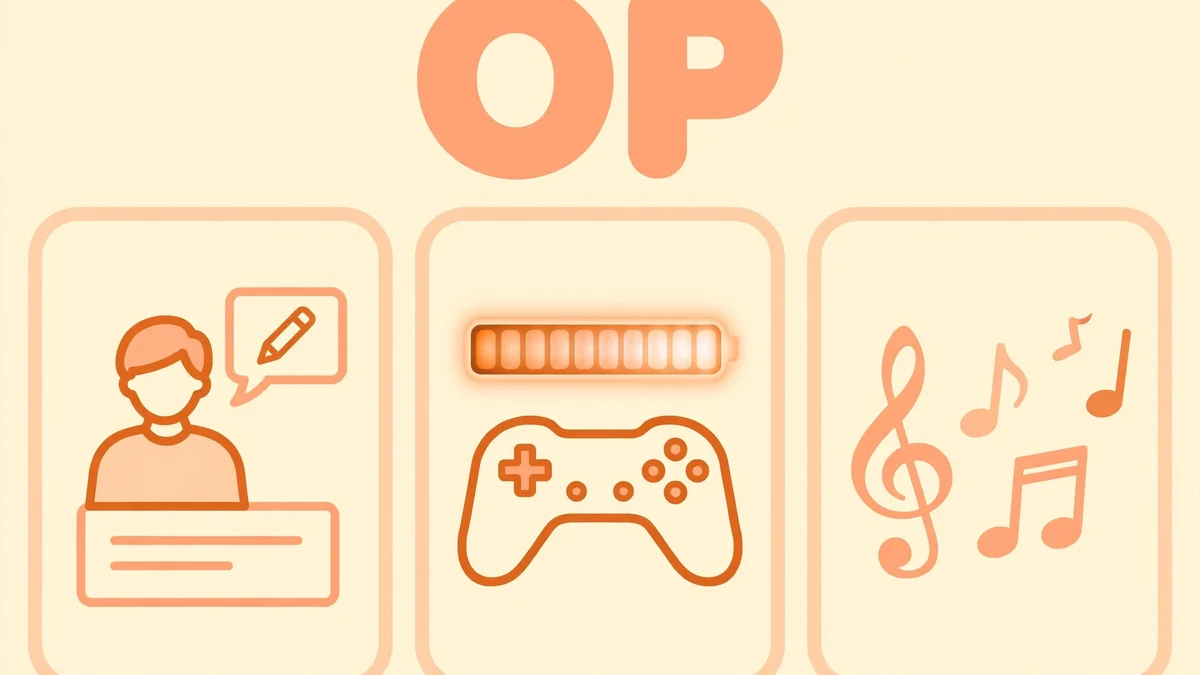
OP Meaning at a Glance
| Reading | What it means | Grade | The giveaway |
|---|---|---|---|
| Original Poster | The person who started the thread or post | Strong — forum and Reddit standard | It points at a person: “OP said…” |
| Overpowered | Too strong, unbalanced, in need of a nerf | Strong — gaming standard | It grades a thing: “that weapon is OP” |
| Opening | The opening song and sequence of an anime | Strong, but community-specific | It names a song: “the OP goes hard” |
| Original Post | The first message itself, not the person | Secondary — same letters, different noun | It points at a message: “read the OP” |
| Opp, operator, opportunity, on point | Different words that happen to share letters | Not OP meanings — see the disambiguation section | They need a different sentence to work at all |
If you remember nothing else, remember the first two rows. Original poster and overpowered carry almost every real OP you will ever meet. The opening-song reading is real too, but it stays inside anime conversation. Everything else in this guide exists to stop you wasting time on meanings that only exist on content-farm lists.
The Triple-Swap Test: Poster, Power, or Song?
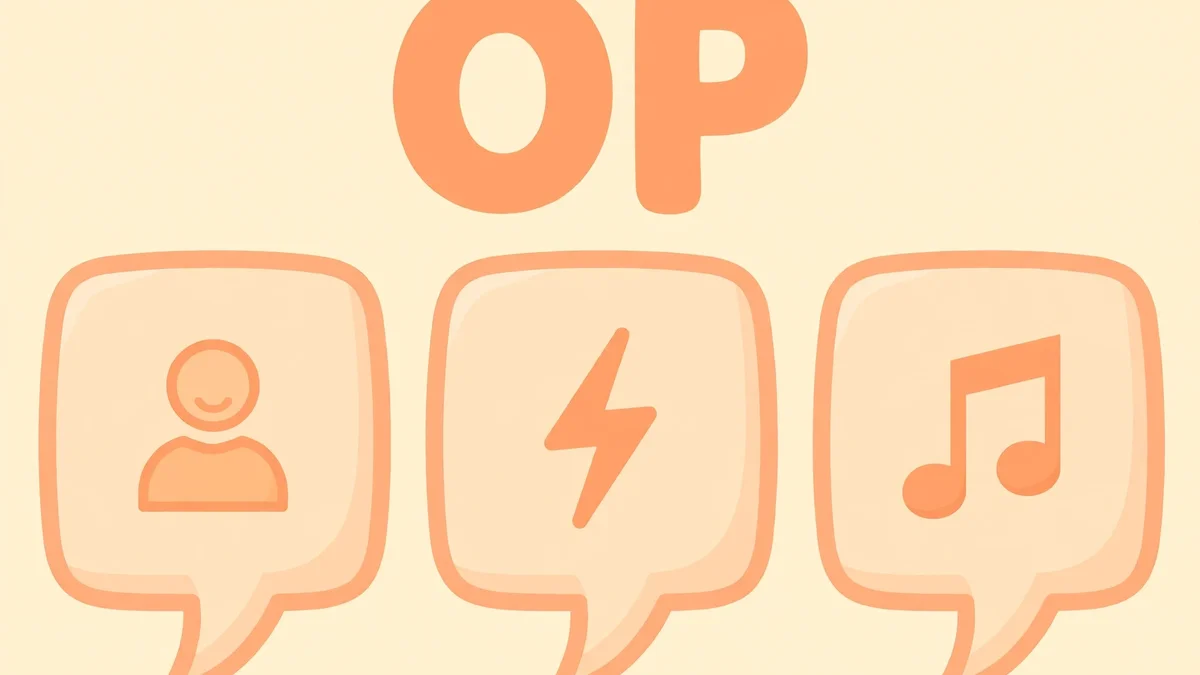
Here is the fresh reader test for this article — the Triple-Swap Test. OP is doing one of three jobs, and each job survives a different swap. Try all three, and only one will sound natural.
Step 1 — Try the person swap. Replace OP with “the person who posted this.” If the sentence still works, OP is a person. “OP already answered this” becomes “the person who posted this already answered this,” and works perfectly. That is original poster. If the swap sounds absurd — “the person who posted this gun is too strong” — move on.
Step 2 — Try the power swap. Replace OP with “too strong.” If the sentence still works, OP is a power judgement. “That gun is OP” becomes “that gun is too strong,” and works perfectly. That is overpowered. Notice what this swap proves: overpowered OP describes a thing, never a person. Nobody is “too strong” in the sense of starting a thread.
Step 3 — Try the song swap. Replace OP with “opening song.” If the sentence still works, OP is an anime opening. “The new OP is a banger” becomes “the new opening song is a banger,” and works perfectly. That is opening. If none of the three swaps works, you are probably looking at a lookalike — opp, operator, or a hashtag — and the disambiguation section at the end of this guide is where you need to be.
Try it on three real-feeling examples:
- “I agree with OP, this solution makes sense.” Person swap works → original poster. Reply to the thread starter, not to a weapon.
- “That character is so OP, it ruins every match.” Power swap works → overpowered. The complaint is about balance, not about a person.
- “Skipping the OP this time, I have heard it a hundred times.” Song swap works → opening. They are talking about a theme song, not a poster or a power level.
The test is not magic — a genuinely bare “OP” with no sentence around it still needs a follow-up question — but it kills the most common error, which is answering a person question as if it were a balance complaint, or praising a song as if it were a player. Both mistakes are embarrassing in opposite directions, and both are avoidable.
Meaning One: Original Poster — the Person Who Started It
Original poster is the forum reading, and it is the one Reddit itself documents: on Reddit, OP is the person who created the post being discussed. The logic is pure thread mechanics. In a discussion with dozens or hundreds of replies, repeating a username every time you refer to the thread starter gets messy fast. OP is the shortcut that points back to the top of the thread without naming anyone.
In practice it works like this:
- “OP asked a good question.” — The thread starter asked something interesting.
- “OP already answered this above.” — Scroll up; the thread starter covered it.
- “OP should try this method.” — The advice is aimed at the thread starter.
- “OP delivered!” — The thread starter came back with the promised update, and the thread is celebrating it.
Notice what original-poster OP never does: it never grades anything. If the sentence is praising, blaming, or ranking how strong something is, you are not in this reading. OP-as-person is a pointer, not a judgement. It carries no authority either, and that distinction matters. OP is not a moderator and not an admin. A moderator runs the community; an admin runs the platform; the OP merely started one thread. Confusing the thread starter with the person in charge is how new users end up demanding answers from someone who has no power to give them.
One honest complication, because it trips up even experienced users: OP also sometimes means the original post itself — the first message, not the person. “Read the OP before replying” usually means read the first message, not go and find the person. “OP was unclear” could mean either the person was unclear or the message was unclear, and only the rest of the sentence tells you which. The Triple-Swap Test handles this gracefully: if the person swap and the message swap both work, treat OP as “the thread and its starter together” and move on. Splitting that hair further adds nothing to your reply.
OP also does a quiet piece of social work that the old version of this article missed. Calling someone “the OP” instead of using their username can feel slightly clinical, even distancing — you are talking about them as the subject of a thread rather than as a participant in it. Most of the time that is harmless shorthand. But in a heated thread, “OP is a troll” lands colder than using a name would, because it turns a person into a role. If you are the OP in a thread that turns hostile, that distancing is worth noticing: it is not always an attack, but it is never warm.
Meaning Two: Overpowered — When OP Grades Strength
Overpowered is the gaming reading, and it is documented in gaming glossaries, not just slang lists: a character, item, ability, or strategy that is too powerful and disrupts game balance. It is a complaint dressed as a description. When a player says “that gun is OP,” they are not just saying the gun is good. They are saying it is unfairly good, that it breaks the game, and — usually, just under the surface — that the developers should weaken it. The word for that weakening is “nerf,” and the two words travel together: “that hero is OP, it needs a nerf.”
In practice it works like this:
- “That weapon is OP.” — It kills too easily; the balance is off.
- “This build is so OP right now.” — This combination of choices is stronger than the alternatives.
- “They made the new character OP on purpose, I swear.” — Suspicion, not just description: the imbalance feels deliberate.
Three things about this reading are worth getting right. First, overpowered OP is an adjective, and it almost always sits next to the thing being graded: the gun, the character, the combo, the strategy. Original-poster OP is a noun that stands in for a person. That grammar difference is the Triple-Swap Test in disguise, and it is why the test works. Second, overpowered is a contested judgement, not a measurement. Two players can watch the same match and disagree about whether something is OP or just well played, which is why gaming threads about OP things run so long and so hot. Calling something OP is the start of an argument, not the end of one. Third, overpowered OP is routinely overused — gaming guides say so themselves. After a while, players start calling anything that beats them OP, including things that are merely strong, new, or unfamiliar. If every loss produces an “OP” complaint, the word stops carrying information. A good rule for your own use: reserve OP for something that genuinely has no reasonable counter, not for something that merely beat you once.
Overpowered has also leaked out of gaming into general praise, and this is where grading gets delicate. “That playlist is OP” or “this sandwich is OP” does not mean the playlist needs a nerf. It means it is excellent, turned up past normal. Treat that as a loose extension of the gaming sense, not a separate meaning: the sentence still grades a thing as stronger or better than expected, it has just dropped the complaint. If you hear it in a non-gaming chat, the power swap still works — “that playlist is too good” — even though nobody is filing a balance report.
One neighbour worth naming here, because it causes real confusion in game lobbies: a player who steps away is not OP, they are AFK. OP grades strength; AFK announces absence. Mixing them up turns “that player is too strong” into “that player has left,” which is the opposite problem.
Meaning Three: Opening — the Song That Starts the Show
Opening is the anime reading, and it is a community term before it is a slang term. In anime discussion, OP is the opening sequence: the roughly ninety-second song and animated sequence that plays at the start of an episode, paired with its counterpart, the ED or ending. Fans rank OPs, skip OPs, learn OPs by heart, and argue about which show has the best one. “The OP goes hard” is praise for a theme song. “Skipping the OP” means skipping the intro. “That OP spoiled the whole arc” means the opening animation gave away plot points in its visuals.
The giveaway is the verb and the noun around it. Opening OP gets talked about the way songs get talked about: it is heard, skipped, replayed, ranked, and stuck in your head. Original-poster OP gets talked about the way people get talked about: they answer, deliver, ask, and clarify. Overpowered OP gets talked about the way game balance gets talked about: it is nerfed, buffed, and complained about. If the sentence could be about a song, it is about a song.
Two traps live here. The first is the joke sentence “the OP is OP,” which anime fans genuinely produce: it means “the opening song is overpowered,” i.e. so good it breaks the scale. Run the Triple-Swap Test twice — once on each OP — and the joke resolves itself: song first, power second. The second trap is exporting this reading outside anime conversation. “OP song” in a thread about a cooking video or a football match is probably not an opening theme at all; it is more likely a mishearing, a typo, or overpowered praise. Opening OP stays home in anime talk. Outside it, do not reach for it first.
Where You Will Actually See OP: Reddit, Forums, Gaming Chats, and Anime Communities
Platforms do not change what OP means. They change which reading shows up, and even that claim needs care, because no platform publishes OP statistics. What follows is what the sources support — and where they stop.
Reddit and forums. This is original-poster OP’s home ground. Reddit’s own help pages define OP as the original poster, and forum culture built the term: long threaded discussions where pointing back to the thread starter without retyping a username is genuinely useful. In a subreddit, assume OP is a person until a power or song swap proves otherwise. The classic thread behaviours live here too: “OP delivered” for a promised update, “OP, update us” as a plea, and “read the OP” as a rebuke to someone who replied without reading the first message.
Gaming chats, lobbies, and streams. This is overpowered OP’s home ground. In a match, a lobby, or a stream chat, assume OP grades strength until proven otherwise. A comment like “that build is OP” in a game thread is a balance complaint, and the thread that follows will be about nerfs, counters, and patches — not about who started the discussion. The same letters in a gaming forum’s off-topic section, though, can flip back to original poster, because the room changed even though the site did not. That is the Triple-Swap Test’s whole point: read the room, not the site logo.
Anime communities, Discord servers, and video comments. This is opening OP’s home ground. In an anime Discord, a YouTube comment section under an episode, or a ranking thread, OP is a song until proven otherwise. “Best OP of the season” is a music ranking, not a person or a power level. Outside those rooms, the same phrase would be nonsense, which is exactly how you know the reading is community-bound.
Plain texting, WhatsApp, and one-on-one chats. Here is where the old version of this article quietly misled readers: it treated OP as an ordinary texting word. In a one-on-one text, there is usually no thread starter to point at, so original-poster OP has almost nothing to do. If OP shows up in a private chat, it is almost always borrowed from one of the rooms above — a friend quoting a game (“that boss is OP”), or an anime fan quoting a song (“the OP is stuck in my head”). Read it as the borrowed reading, not as a native texting meaning. And if a post you loved reaches a platform’s front page, you may see the same thread-starter language again in the comments — compare a genuinely platform-owned term like FYP, which only makes sense on its home app, with OP, which makes sense wherever threads exist.
Tone and Sender: Who Sent It Changes How Hard It Lands
OP’s tone is never in the letters. It is in the room, the relationship, and the sentence around it — in that order. This section replaces the gendered guesswork some slang pages publish (“from a girl it means X, from a guy it means Y”) with something checkable. There is no evidence that the sender’s gender changes what OP means, and this guide will not pretend otherwise. What does change the read is this:
From a close friend, OP is low-stakes in both directions. A gaming “that is so OP” is a shared complaint or a shared joke, and an anime “the OP is amazing” is a shared enthusiasm. Friends have a history that absorbs ambiguity. If you misread a friend’s OP, the cost is one clarifying message.
From a crush or someone you are dating, an OP mention is usually just the borrowed reading doing its normal job — a game they play, a show they love — with enthusiasm layered on top. Do not over-read a song recommendation or a balance complaint as a secret message. Answer the thing itself (“yes, that song is great” or “that character really is broken”), and let any flirting sort itself out elsewhere.
From a stranger in a thread, original-poster OP is a neutral pointer, but it can feel distancing, as noted above: you are being referred to as a role, not a person. A stranger’s overpowered OP, meanwhile, is usually a public complaint aimed at the game, not at you. Neither one is personal until the sentence makes it personal.
From a coworker or in any work-adjacent chat, OP is a warning sign about register, not meaning. In a casual team channel about games or shows, both readings are fine. In a work thread about an actual project, OP is ambiguous enough to cost time: spell out “the person who posted this” or “too powerful” instead. And never use OP for an operation, a procedure, or an operator in a work message without spelling it out first — in professional writing, OP has too many technical expansions to be left standing alone.
What OP Does NOT Mean — and How to Reply Without Guessing Wrong
A good slang guide is honest about its edges. Here are the readings you can cross off, so they stop wasting your time:
- It does not mean “opp.” Opp (usually spelled with two p’s) is a separate slang word for an opponent or enemy, rooted in a different culture. OP with one p is not a shortened opp, and swapping them changes a thread reference into a threat. Keep the spelling distinct.
- It does not mean “operator” in casual chat. Operator is a job or a role — someone who runs a system, a machine, or a phone line. Nobody texts “OP” to mean the person answering the phones unless the conversation is already about that job, spelled out first.
- It does not mean “opportunity” as a texting standard. A few slang lists claim “there is an op here” for an opportunity, but the attestation is thin and the abbreviation collides with both strong readings. If someone writes it, the sentence will usually make the opportunity sense obvious — and if it does not, ask. Do not add this to your active vocabulary.
- It does not mean “on point” in the OP spelling. “On point” praise is real slang, but its abbreviation is not OP in live use; importing it here just creates a fourth collision for no benefit. By the way, if you need a quick aside rather than a new abbreviation, the clearer tool is BTW — it never gets mistaken for a person, a power level, or a song.
- It does not mean “One Piece” in texting. The hashtag #OP is used by One Piece fans, but that is a fandom tag, not a texting sense. In a chat sentence, “OP” without the hashtag and without a One Piece conversation around it is not the anime about pirates. Read the room before you import a fandom.
- It is not inherently rude, flattering, or dismissive. Those are tones that context adds. “OP is right” is neutral; “OP delivered” is celebratory; “OP is a troll” is hostile. The hostility comes from the sentence, not the abbreviation. Do not import a fight that is not happening.
How to reply, by reading:
- Original poster (“OP already answered this”): scroll up and read the thread starter’s messages before replying. If you are the OP, an update is usually what the thread wants — “OP, update us” is a request, not an insult.
- Overpowered (“that gun is OP”): answer the balance claim, not the person: agree, disagree, or name a counter. “It is strong, but it loses to…” is a better reply than “no it isn’t.”
- Opening (“the OP is a banger”): answer the song: agree, rank it, or ask which season’s opening they mean. Anime fans love a ranking; give them one.
- Genuinely unsure: ask, in plain words — and if the message was a plans question rather than an OP puzzle, you may be looking at a different abbreviation entirely, such as WYO, which asks what someone is up to. One question beats a wrong guess, every time: “Sorry — do you mean the person who posted this, or that something is too strong?”
OP vs. Its Near Neighbours
OP travels with a family of short chat tools, and mixing them up is the second most common error after misreading OP itself:
- OP (original poster) vs. mod / admin: the OP started one thread; a mod runs the community; an admin runs the platform. Same room, different power.
- OP (overpowered) vs. meta: meta is what is currently strongest and most effective; OP is the complaint that something is too strong to be fair. A meta pick is not automatically OP, and an OP pick is not automatically meta.
- OP vs. AFK, WTM, and HMU: these are not synonyms, they are neighbours in the same chat. AFK announces an absence, WTM asks about plans, and HMU is an open invitation — and confusing a plans question with a balance complaint is exactly the error the Triple-Swap Test prevents. And if someone answers your OP question with open disbelief, you may be hearing BFFR energy, not OP at all — different letters, different job.
Quick Answers
What does OP mean in text?
OP usually means “original poster” (the person who started a thread or post) or “overpowered” (too strong, in gaming). In anime conversation it can also mean “opening,” the opening song and sequence of a show. Run the Triple-Swap Test: if “the person who posted this” fits, it is a poster; if “too strong” fits, it is overpowered; if “opening song” fits, it is an opening.
What does OP mean on Reddit?
On Reddit, OP almost always means “original poster” — the user who created the post being discussed. Reddit’s own help pages define it that way. In a gaming subreddit’s match thread, though, the same letters can flip to overpowered, so read the sentence, not just the site.
What does OP mean in gaming?
In gaming, OP means “overpowered”: a character, weapon, ability, or strategy that is too powerful and disrupts game balance. Players usually follow it with a call for a nerf — the developer weakening it in a future update.
What does OP mean in anime?
In anime discussion, OP means “opening”: the opening song and animated sequence at the start of an episode. Its pair is the ED, or ending. Fans rank, skip, and replay OPs, and “the OP is OP” is a joke meaning the opening song is overpoweringly good.
Does OP mean original post or original poster?
Both, and the difference matters less than guides pretend. Original poster is the person; original post is the first message. “OP asked a question” is the person; “read the OP” is usually the message. If both swaps work, treat them as one unit — the thread and its starter — and move on.
Is OP formal or informal?
OP is informal and mainly used online in discussions, chats, and gaming. It is not suitable for formal writing, and in work messages it is ambiguous with technical expansions like operation and operator, so spell out what you mean instead.
Should I use OP myself?
Use original-poster OP freely in forums and comment threads, use overpowered OP in gaming chats when something genuinely has no reasonable counter, and use opening OP in anime conversation. Avoid all three in formal writing, avoid OP-as-opportunity and OP-as-operator unless you have spelled them out first, and never use OP to mean opp.
Conclusion
OP is two letters doing three jobs in three different rooms, and that is precisely why it confuses people. It names a person, it grades a power level, and — in one fandom — it names a song. The Triple-Swap Test exists so you never have to guess which one you just received: swap in a person, swap in a power level, swap in a song, and the sentence will tell you the truth.
So the next time a bare “OP” lands in your thread, do not panic, and do not answer a person as if they were a weapon. Read the room, run the three swaps, and ask yourself one question: poster, power, or song? Five seconds, three swaps, and the two most overloaded letters in texting become the two clearest.
