
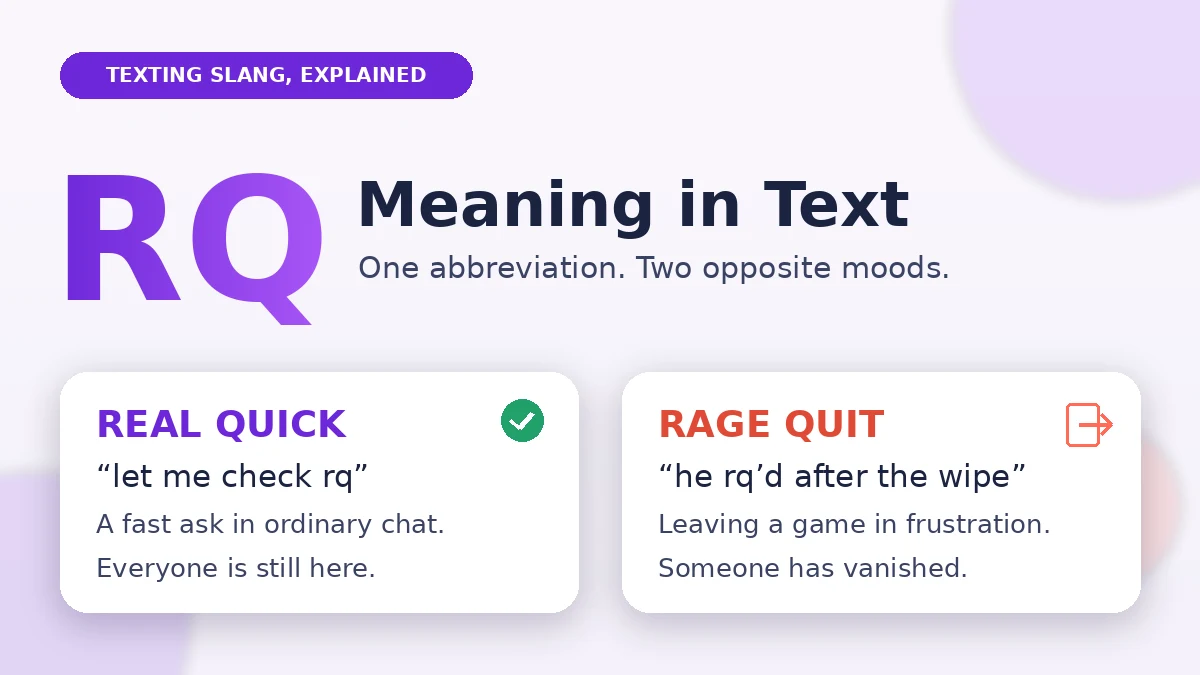
Two letters, two opposite moods. In an ordinary text, “rq” is a small, friendly hurry-up: let me check rq, come here rq. In a gaming chat, the same two letters are an exit announcement — someone got frustrated and left. If you’re looking up the rq meaning in text, the definition alone won’t save you, because both meanings are real, and picking the wrong one flips the whole message — a request for speed becomes an accusation of rage.
So first, both meanings, cleanly separated. Then a test — the Vanish Test — built on the one difference that never lies: grammar. One RQ modifies an action that still needs doing. The other RQ is an action, and the action is leaving.
RQ Meaning at a Glance
| Real Quick | Rage Quit | |
|---|---|---|
| World | Texts, DMs, everyday chat | Gaming chat, Discord, streams |
| Job | Asks for speed, or promises it | Reports a player quitting in frustration |
| Grammar | Modifies a verb: “check rq,” “send it rq” | Is the verb: “he rq’d,” “don’t rq” |
| Example | “can you send the photo rq?” | “our tank rq’d after the second wipe” |
| Someone still here? | Yes — asking, promising, waiting | No — someone has vanished |
| Natural reply | “got it, one sec” | Sympathy, a joke, an invite back |
“Real Quick”: The RQ That Stays in the Conversation
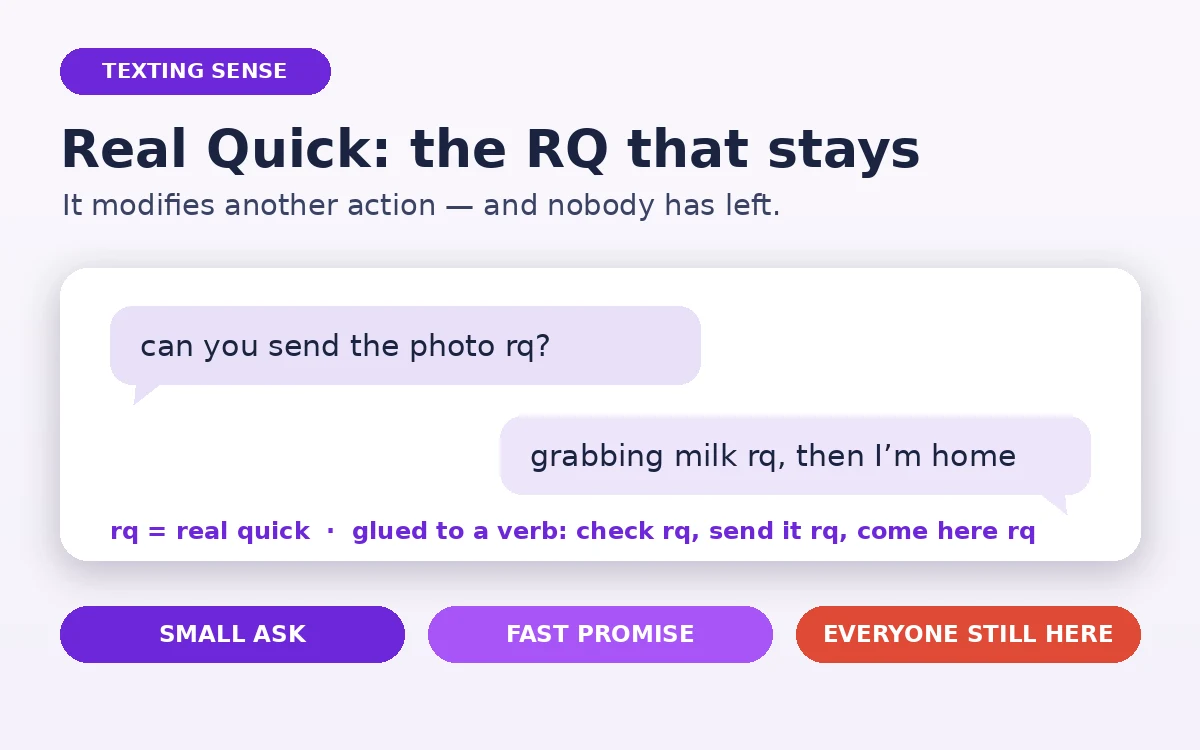
This is the texting sense, attested as instant-messenger shorthand since the mid-2000s, and the default reading outside gaming. “Real quick” is an adverb doing a small, specific job: it shrinks the size of an interruption. Can I ask you something rq? means “this will take almost none of your time.” The letters are a courtesy as much as a speed claim — they tell the other person the ask is small.
Watch how it attaches: real-quick RQ almost always leans on a neighbouring action — check rq, send it rq, call me rq, come here rq. It sits at the end of the sentence like a tail, or occasionally opens one — rq, look at this. What it never does is conjugate. Nobody writes “she real-quicked.” If the letters are glued to someone else’s verb, you’re in this world.
It belongs to the same speed family as OTW (on the way) — both compress a timing promise into almost nothing. And it does the opposite job to FYI: FYI hands you information and asks nothing back; rq asks for a fast action or answer.
In real chats it looks like this:
- The small ask: “rq — does this jacket work with black shoes? need a yes/no before I pay 🙏”
- The opener: “rq rq, trivia night moved to Thursday, tell Sam” — urgency with zero anger in it.
Lowercase “rq” is the everyday form; the case carries no meaning here. Meaning rides on the company it keeps — a verb beside it and a person still present.
“Rage Quit”: The RQ That Walks Out of the Match
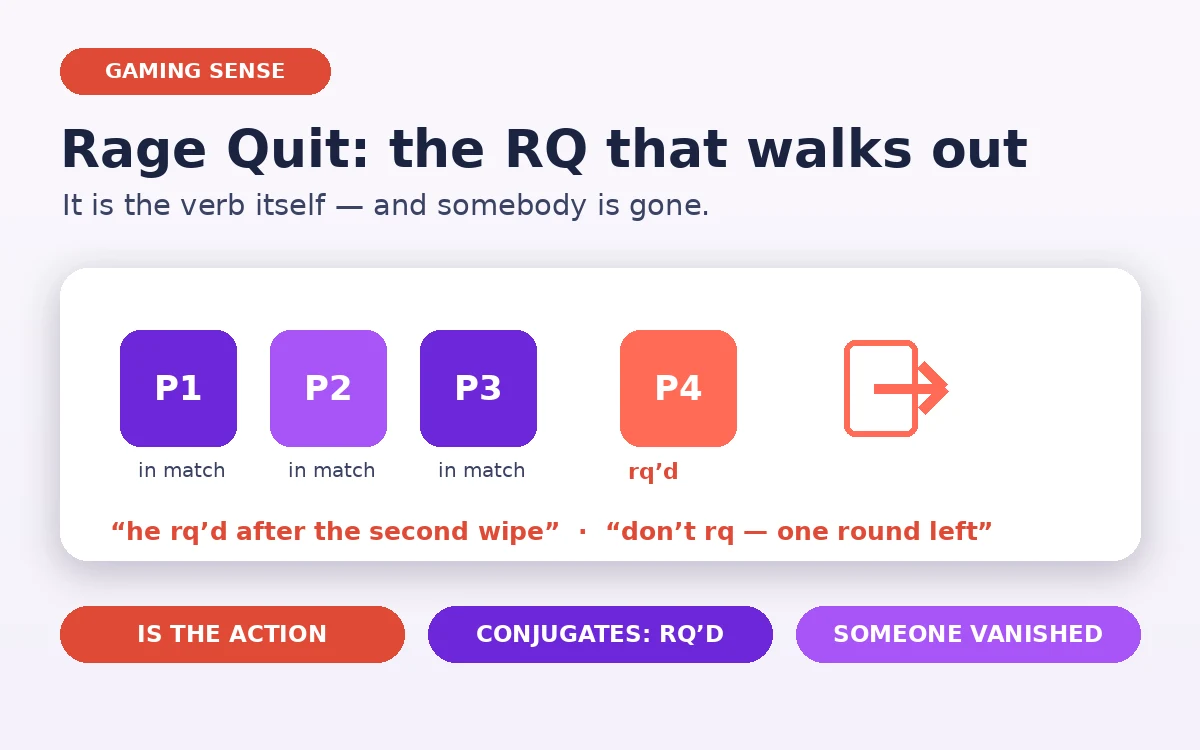
Cross into a game lobby, a Discord server, or a stream chat, and RQ changes worlds. Here it abbreviates rage quit: leaving a game in anger, before the match ends, because frustration won. Dictionaries define the full phrase exactly that way, and gaming communities shorten it to RQ as they shorten everything mid-match.
The grammar gives it away before the context does. Rage-quit RQ is the verb. It conjugates: he rq’d, she’s about to rq, don’t rq on us. It takes a player as its subject and a match as its implied object.
Tone in this world splits by relationship. Between friends, “don’t rq 😂” is affectionate teasing, and calling your own exit — “I rq’d so hard” — is self-mockery, usually followed by a sheepish FML. From a frustrated teammate about a stranger, “our support rq’d” is an accusation, and it typically earns an SMH from everyone left holding the game. Context also separates it from a calm departure: a player who simply has to leave types GTG (got to go). RQ is reserved for the exit with anger in it.
By extension, gamers carry it out of the game as a joke — “I rq’d that IKEA wardrobe halfway through.” The joke lands because everyone knows the gaming original.
The Vanish Test: Telling the Two RQs Apart in Seconds
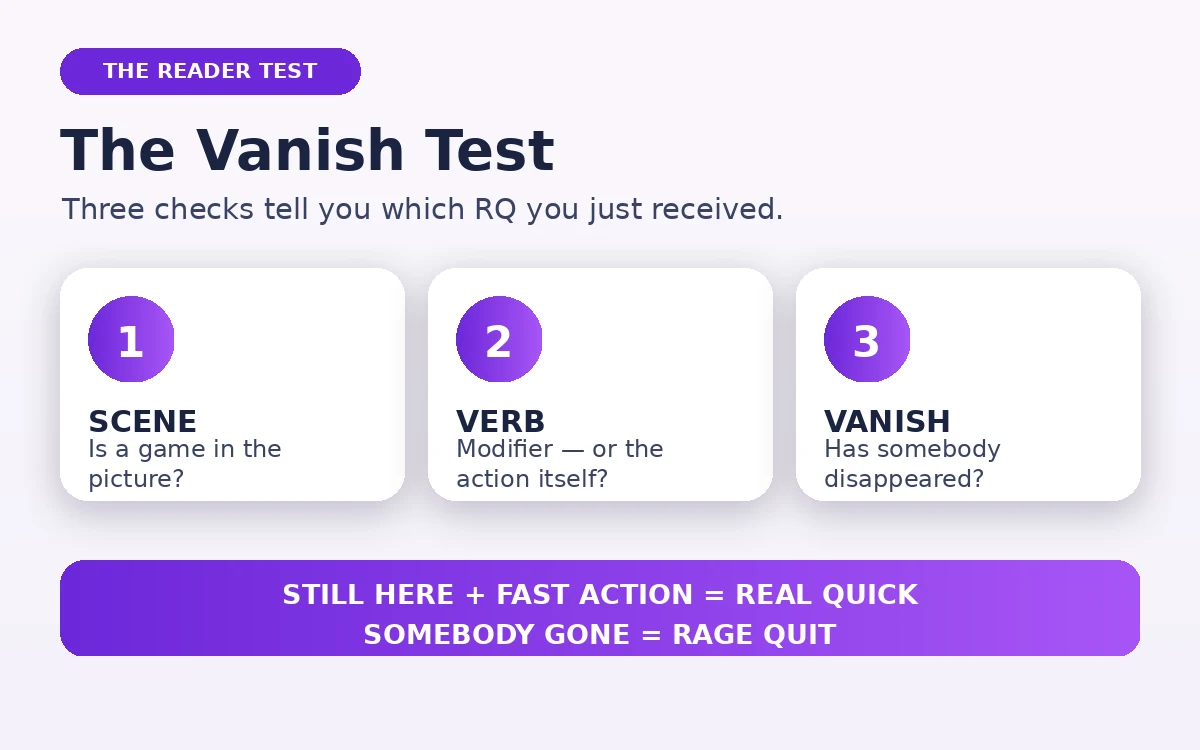
When an RQ lands and you can’t tell which world it’s from, run three checks, in this order.
Check 1 — the Scene. Is a game anywhere in the picture: a match, a lobby, a boss, a team, a stream? If nothing game-shaped exists in the conversation, stop here. It’s “real quick.”
Check 2 — the Verb. Find what RQ is doing. Glued to another action — check, send, call, look, come — it’s a modifier, and modifiers mean “real quick.” Standing in the verb’s own slot, with an ending on it — rq’d, rq’ing, gonna rq — it’s the action itself, and the action is leaving. This check settles almost everything, because the two senses never swap grammar: you cannot conjugate “real quick,” and “rage quit” never modifies anything.
Check 3 — the Vanish. Ask the question the test is named for: has somebody disappeared, or is somebody about to? If a person just left a match, a lobby, or the conversation in frustration, that’s rage quit. If everyone is still present and something just needs to happen fast, that’s real quick.
Worked pairs, same letters, opposite worlds:
- “hold rq, restarting my router” → modifier on hold, nobody left. Real quick.
- “he held us hostage then rq’d” → conjugated, a player vanished. Rage quit.
- “talk rq? mum’s calling in five” → a small ask, both people still talking. Real quick.
- “don’t rq, we’re one round from winning” → a plea aimed at a threatened exit. Rage quit.
And when all three checks still leave you unsure — it happens in crossover chats, a friend texting about a game — the honest move is to ask. A two-second WDYM beats confidently replying to the wrong RQ.
RQ Across Platforms: The Scene Decides, Not the App
RQ doesn’t change meaning from app to app; it changes with what people are doing in the app. On text messages and DMs — iMessage, WhatsApp, Snapchat, Instagram — the scene is almost always ordinary life, so RQ is “real quick”: snap me the address rq.
Discord and in-game chat are where the second world lives, because the scene is a match. “rq” typed during play defaults to rage quit, and between games it reports last night’s session (“Marcus rq’d at the boss again”). TikTok inherits whichever scene its video supplies: RQ under a gameplay clip means rage quit — usually laughing at one — while RQ under a storytime caption is just the texting sense doing caption work. Read the scene, not the logo.
Who Sent It, and What the Same Letters Cost
The sender tilts the reading before the sentence even starts. From a friend, “real quick” is at its softest — the small-ask courtesy above — and a rage-quit report is almost certainly a joke at someone’s expense, possibly their own. From a teammate mid-session, assume the gaming sense: a bare “rq” after a lost round is a departure notice, not a request.
From a crush or partner, rq is nearly always “real quick,” and it usually signals a bid for a moment of attention — call rq? is “give me two minutes of you,” which deserves a warmer reply than a bare “k.” From a coworker, the same letters get expensive: “send the figures rq” strips out the softening and reads as an order with a deadline, even when none was meant. In a family group chat, rq is real-quick but frequently unread — relatives guess, and guessing wrong is how “grab ice rq” turns into a phone call. Outside your slang-sharing circle, the full words cost almost nothing and buy clarity.
Tone, in short: real-quick RQ is friendly when it shrinks an ask, rude when it stacks demands; rage-quit RQ is funny when it’s yours or a friend’s, hostile when aimed at a stranger’s exit. The letters are neutral. The aim is everything.
Reading RQ and Replying Well
The exchanges below are illustrative examples, not real messages.
The tiny favour — just do it fast
- Sam: “rq, is the shop still open at 9? outside now”
- You: “yep, till 10 — go”
Match its size: short question, short answer.
The mid-match exit — acknowledge, then offer the door back
- Priya (in Discord): “jules rq’d. we’re down a player 😭”
- You: “rip. lmk if he wants back in for round two, I’ll hold the slot”
Don’t litigate whether Jules was right to be angry. A light acknowledgment plus an easy route back keeps the squad intact.
The bare “rq” with no scene at all
- Dev: “rq”
- You: “rq what — quick question or you quitting on me? 😄”
A standalone “rq” is the one genuinely ambiguous form. Answer it with the Vanish Test out loud — the joke lands, and you get your answer in one message.
When RQ Is the Wrong Tool
- At work, in writing that matters. “Real quick” spelled out is already brisk; the letters read as rushed and can be misread outside chat culture. Keep rq out of client emails and anything formal.
- When the action isn’t actually quick. Promising rq and delivering in three hours teaches people to discount your rq — and eventually your word. Speed claims are a currency; don’t debase yours.
- About a stranger’s exit, in public. Commenting “nice rq” under a clip or in a lobby you weren’t part of turns teasing into pile-on. Among friends it’s banter; aimed outward, it’s mockery.
- As a bare message to someone new. A lone “rq” with no verb and no scene forces the reader to run the Vanish Test with no evidence. Give the letters a sentence to live in.
A final orientation note, because acronym lists keep blurring it: outside chat, RQ legitimately means other things — research question in academic writing, a request reference on forms and support tickets, respiratory quotient in physiology. Those belong to other worlds, not to chat. And treat long lists claiming RQ also means “random question,” “real question,” “relatively quick,” or “rarely questioned” with suspicion: no dictionary or gaming community backs them.
Quick Answers
What does RQ mean in text?
In texting, RQ means “real quick” — a casual way to ask for something quickly or promise it quickly, as in “let me check rq.” In gaming chat, the same letters mean “rage quit,” leaving a match in frustration.
How can I tell if RQ means real quick or rage quit?
Run the Vanish Test. Is a game part of the scene? Is RQ glued to another verb (“send it rq”) or is it the verb itself (“he rq’d”)? Has someone vanished, or is everyone still here? A modifying RQ with everyone present is “real quick”; RQ as the leaving action is “rage quit.”
What does RQ mean on Discord?
Whichever scene the server is in. During or about gameplay, RQ usually means “rage quit” — “he rq’d after the second loss.” In a casual DM or homework channel, it’s the texting sense: “check the doc rq.”
Is RQ rude?
Not by itself. “Real quick” turns pushy when stacked onto demands — “do this rq” — and soft when it shrinks a favour — “one thing rq?” A rage-quit comment is friendly teasing among friends, mockery aimed at strangers.
Can I use RQ in a work message?
With close teammates in casual chat, it’s usually understood. In emails, client messages, or anything formal, spell out “real quick” or, better, name the actual timeframe — “by 3 pm” beats both.
Does RQ mean “request” in texting?
No — not as a chat sense. RQ appears as a request reference on forms and in some ticketing systems, but in a text conversation “rq” is “real quick” (or “rage quit” in gaming). Nobody texts “I have an rq” to mean a request.
How do I reply to “rq”?
Reply to the sense you identified. To “real quick,” answer the small ask at matching size — “sure, go” or “one sec.” To a rage-quit report, acknowledge it lightly and leave the door open. If a bare “rq” gives you no verb and no scene, ask.
The Short Version
RQ lives in two worlds. In texts and DMs it’s “real quick” — a tiny courtesy that shrinks an ask or promises a fast answer, glued to someone else’s verb, with everyone still present. In gaming chat and Discord it’s “rage quit” — the verb itself, conjugated and pointed at a player who has vanished from the match in frustration. The Vanish Test keeps you straight: check the scene, check the verb, check who’s still here. Speed for the people staying, an exit for the person gone.
