
You get a message that is just four letters long, and it stops you cold: "stsu." Is your friend laughing with you, or telling you to be quiet? That uncertainty is exactly why people search for stsu meaning in text, and it is also why a one-line definition is not enough for this term. STSU is short, blunt, and easy to misread, and the same four letters can land as a joke in one chat and as a shutdown in another.
This guide gives you the honest version. STSU is a rare, informal internet abbreviation, not a dictionary word, and much of what you will find about it online is guesswork dressed up as fact. Below is the one reading that is actually well supported, the readings we are deliberately not repeating, and a test you can run on any message in about five seconds: the No-Way Swap Test.
What STSU Stands For — and What It Does Not
STSU stands for "Shut the Sh*t Up." The middle word is a swear word, censored here in spelling only; the force of the phrase is not censored at all. It is a softened-looking cousin of STFU, built the same way: a blunt "shut up" command, a swear word for emphasis, compressed into four letters. It was not handed down by any dictionary, and nobody has documented its first use. But among the many expansions floating around online, "Shut the Sh*t Up" is the one independent slang explainers keep converging on, and the only one that fits the letters and how the term is actually used.
That honesty matters because the internet is full of other answers for STSU, and they cannot all be right: "Stay True, Stay You," "Same To Same You," "Speak To You Soon," "Stick To Something," and half a dozen more. Those pages rarely quote a real chat, rarely agree with each other, and none rests on a dictionary entry. Treat them as guesses, some invented to fill a page. The partial exception is "Stay True, Stay You" under motivational captions and confidence posts; there, the warm reading may be intended. But in an ordinary chat, do not assume it — assuming the kind reading in a chat is how misunderstandings happen.
A correction to our own earlier version of this article is also due, stated plainly. The old article said STSU stood for "Stop Talking, Shut Up" and described it as commonly used across major messaging and social apps. Both claims are withdrawn: "Stop Talking, Shut Up" is a paraphrase of what the phrase does, not what its letters stand for, and no evidence was offered for how common STSU is or where it is popular. One surveyed guide even calls STSU rare, nowhere near as widespread as LOL. This update therefore makes no popularity, age-group, or app claim. STSU is a rare term that punches above its size precisely because it is so easy to misread.
The No-Way Swap Test
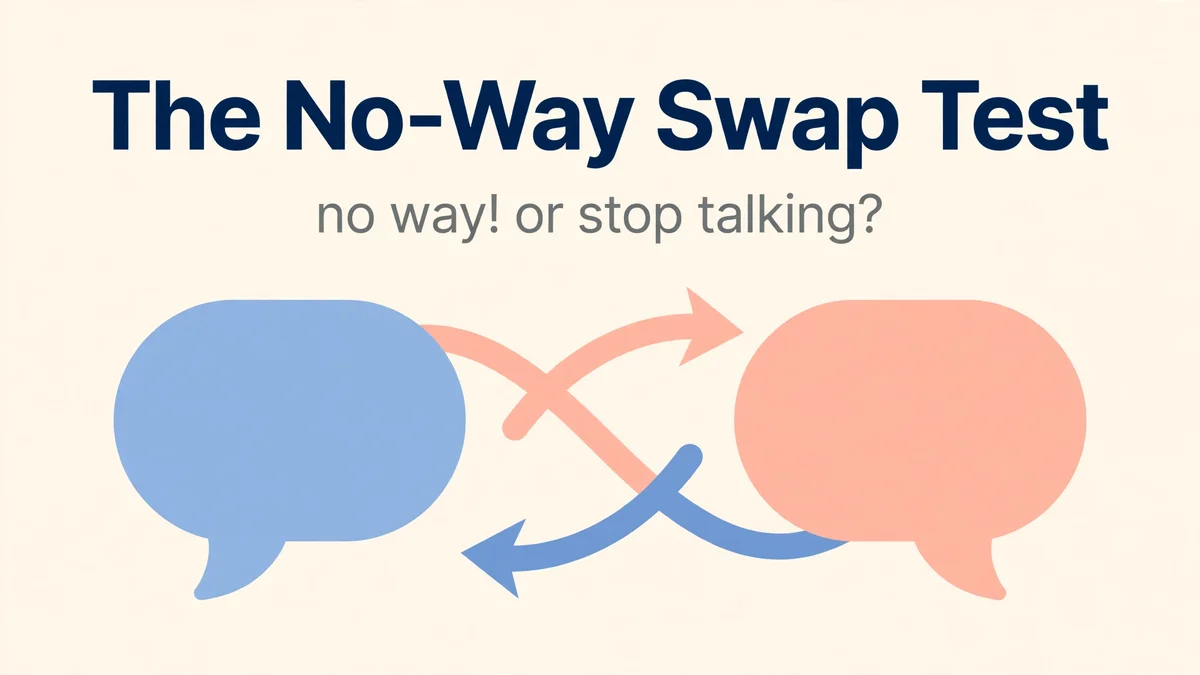
Here is the test this article is built around. When someone sends you STSU, try swapping it in your head twice, and see which replacement still makes sense.
First, swap in "no way!" If the message still makes sense — if it reads like a reaction to surprising, funny, or unbelievable news — then STSU is working as a reaction. Second, swap in "stop talking." If that is the only replacement that fits — if the message reads like an order to be quiet — then STSU is working as a command. That is the whole test, and it resolves most real messages on the first try.
Try it on three messages. "You got the job?? stsu!!" Swap in "no way!" and it fits perfectly: your friend is delighted and disbelieving. Swap in "stop talking" and the sentence falls apart. Reaction, not command. Now try "stsu. I already told you twice." Swap in "no way!" and it makes no sense; swap in "stop talking" and it fits exactly. Command, and an annoyed one. Finally, "stsu 😂 you did not just say that" points the same way as the "no way!" swap: teasing disbelief, the chat equivalent of laughing and saying "oh, shut up!" while grinning.
The test works because STSU's two jobs feel different in the sentence around them. A reaction follows news: a surprise, a joke, a confession, a plot twist. A command follows noise: an argument, a repeated point, a conversation someone wants ended. When you cannot tell which job STSU is doing, look at what came just before it. The message before STSU is usually the clue the letters refuse to give you.
Two Jobs, One Phrase: Reaction vs. Command
The two jobs are not two meanings so much as one phrase doing two kinds of work. As a reaction, STSU means something close to "I cannot believe you just said that." It is the friend who hears you bumped into your ex at the gym, or passed an exam you were sure you had failed, and answers with a burst of disbelief. The words say "shut up," but the feeling is closer to applause — which is why STSU often travels with laughing emojis and follow-up questions: "stsu 😭😭 what happened next??" Nobody who writes that wants silence. They want more of the story.
As a command, STSU means exactly what it says: stop talking, drop it, enough. It shows up when someone is annoyed, overwhelmed, or done with a topic, and shortness does not soften it. "STSU. I am trying to work" is a boundary, stated bluntly, not a joke with a missing emoji. In an argument, "STSU, you always do this" is not playful, and replying as if it were a joke usually makes things worse. A playful STSU is forgotten by dinner; a sharp one can sit in a chat thread for weeks.
Both jobs share one trait: intensity. STSU is never mild. Even at its friendliest it is loud, which is why it works as a reaction and fails when the tone is misjudged. If you would not shout the equivalent sentence in person, do not type STSU and hope the chat format will quiet it down.
Read the Wrapping: Emoji, Caps, and Punctuation
Because the letters never change, everything around them has to do the work of tone. Think of emoji, capitalisation, and punctuation as wrapping paper: the gift inside is the same, but the wrapping tells you whether it is a joke or a warning.
First, emojis. A laughing face, a crying-laughing face, or a skull (online for "I am dead from laughing") all point toward the reaction reading — the sender telling you not to take the words literally. No emoji at all, especially in capitals, points the other way. Second, capitalisation: lowercase "stsu" reads relaxed; full capitals read louder, and capitals plus a full stop — "STSU." — read like a door closing. Third, punctuation: exclamation marks add excitement ("stsu!!" is almost never a genuine order), while a full stop adds finality ("STSU." is almost never a joke). Fourth, what follows: a reaction is usually followed by curiosity — a question or a follow-up joke — while a command is followed by nothing, or by a reason: "STSU, I have heard this already."
No single signal is a guarantee, which is why the swap test comes first and the wrapping second. Together they are reliable: lowercase "stsu 😂" after good news is a reaction; uppercase "STSU." after an argument is a command. If they disagree, trust the surrounding sentence, and when in doubt, ask — "wait, are you joking or annoyed?" costs far less than a wrong guess.
Where You Meet STSU — and Why the Room Changes the Risk
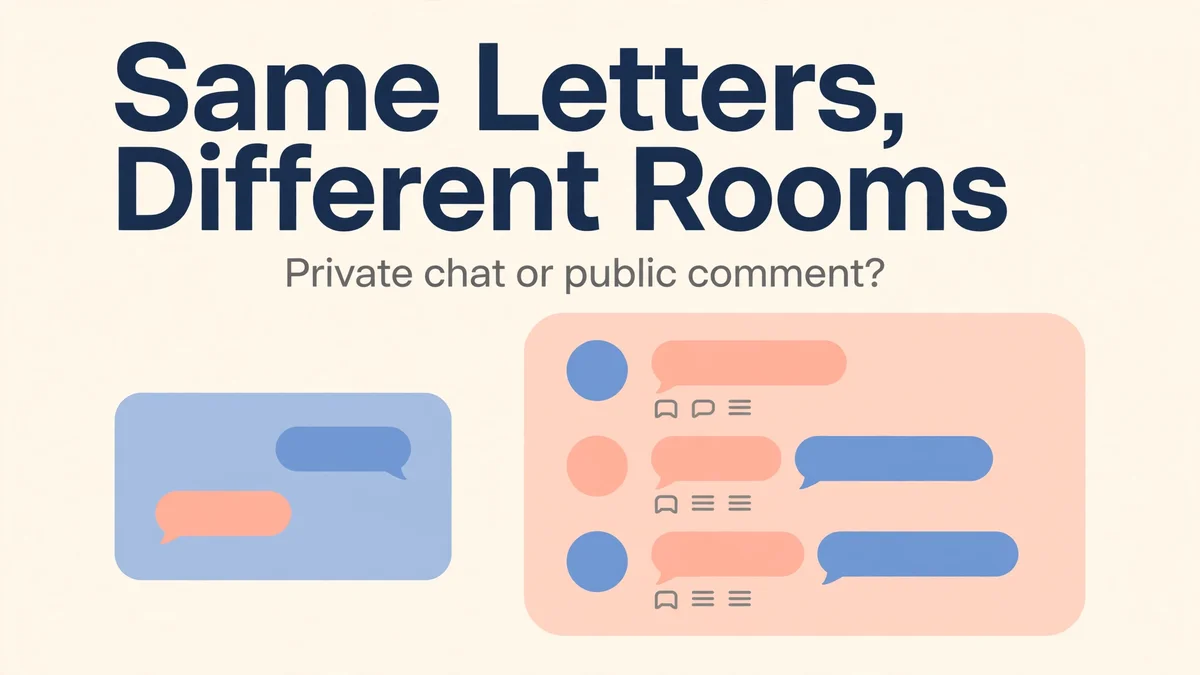
STSU does not change its meaning from app to app, and this article will not pretend otherwise. The honest statement is narrower: the room you meet it in changes how risky it is to send, and how likely it is to be misread. A private chat with a close friend carries shared history. You both know the tone you use with each other, you know what counts as teasing, and a playful STSU lands inside that history. A public comment section carries no such history. The same four letters, posted under a stranger's video or in a busy group chat, are read by people who know nothing about you, and the most cautious reading — the rude one — is the one they will reach for first.
That difference explains why STSU feels safer in fast, private messages and riskier everywhere else, without needing any claim about which app "uses" it most. In a one-to-one chat, the receiver can scroll up and read STSU inside the joke that came before it. In a comment thread, the message stands alone and is judged by strangers. Group chats sit in between: a STSU meant as a private joke can embarrass a third person who reads it as a public shutdown. If your message needs its audience to already know you are joking, add the emoji that makes the joke visible, or pick a softer phrase.
Speed is the second room effect. STSU is a fast word for fast spaces, and the sender fires it off in a second while the receiver sits with it for much longer. Before sending it, run the swap test from the other side: if a stranger read your message with no context, would they hear a laugh or a shutdown? If you cannot be sure they would hear the laugh, rewrite it.
Who Sent It? Reading STSU by Sender
The same message changes with the sender, and this is the section to re-read before you reply. From a close friend, STSU is almost always the reaction or the tease: friends have a licence to be blunt that strangers do not, and the history of the friendship does most of the interpreting. If your best friend sends "stsu 😂" after your story, keep telling the story, not apologising. From a crush or a partner, the reading depends on whether teasing is already part of how you talk. If you trade jokes like this all the time, STSU is flirtation by teasing. If you do not, or if the conversation was serious a moment ago, read it as a shutdown — a joke sent to cover a shutdown usually reads as not listening.
From a group chat, read STSU as a performance too: it may be aimed at the group rather than at you personally. Do not escalate in front of the audience; if it stung, take it to a private message. From a stranger or anyone you do not know well, read STSU as rude until proven otherwise, and do not return it in kind. From a colleague or a boss, do not send it, ever — and if you receive it, treat it as a workplace problem, not a slang puzzle.
What to Say Back
Your reply should match the job STSU is doing, not the letters on the screen. If the swap test says reaction, play along and feed the story: "I know, right?? I still cannot believe it either," "😂😂 wait until you hear the rest," or "I swear, I am not even exaggerating." If the sender is teasing you, a light return works too: "says the one who did the exact same thing last week" keeps the game going without raising the stakes.
If the swap test says command, do not joke back or argue about whether STSU was rude; both prolong exactly the conversation the sender wants ended. Short replies give space: "Got it, I will drop it," or "Okay, sorry — talk later?" If you genuinely cannot tell which job it is doing, say so in one line: "Haha — wait, are you laughing or actually annoyed?" That question lets the sender correct the tone before feelings get hurt. And if STSU hurt you even though it was meant as a joke, say so privately: "I know you meant it as a joke, but that one landed a bit hard."
When Not to Send STSU (and What to Send Instead)
Do not send STSU at work, in a formal message, to a teacher or a stranger, or in any conversation where the relationship cannot carry a blunt joke. Do not send it in the middle of a serious conversation, a disagreement, or bad news — a reaction that lands as a shutdown in those moments can do real damage, and "I meant it as a joke" is a poor repair after the fact. Do not send it to someone who has told you they do not like that kind of teasing, and do not send it repeatedly to make a point; one STSU is a reaction, three in a row is a pile-on.
The replacements keep what you meant without the risk. For delighted disbelief, write "no way!!" or "I cannot believe this 😂" — both say what the reaction version of STSU says, with no chance of being read as a command. For playful teasing, try "oh, shut up 😂" in full words; with the emoji visible, it reads softer than the abbreviation. If you genuinely want quiet, say so kindly: "Hey, I need to focus for a bit — can we pick this up later?" It is longer than STSU, but it gets you the quiet without the sting.
STSU vs. STFU and Other Sound-Alikes
STSU's closest relative is STFU, and the difference between them is one of degree, not kind. Both tell someone to stop talking, and both carry a swear word. STFU is the stronger, harsher version: it is more likely to be read as genuine anger, and it is the one to avoid most carefully. STSU looks softer only because its middle word is censored or softened in spelling, but the message is the same family, and anyone who knows STFU will hear its echo in STSU. If you are choosing between them, the honest advice is to choose neither in any conversation you care about, and to understand that a receiver who knows one will almost certainly understand the other.
The sound-alikes are mostly reactions rather than commands. LOL and LMAO are pure laughter with no shutdown in them at all; if you want to react to something funny with no risk of sounding harsh, they are safer. SMH shakes its head at something foolish or disappointing, and it judges without ordering silence. FR adds emphasis to agreement ("for real"), and TBH frames an honest opinion, while HYY is simply a casual greeting — a reminder that not every short string of letters in a chat is an instruction, and that reading the sentence around the abbreviation, as the No-Way Swap Test teaches, is a skill that works far beyond this one term. HMMM, by contrast, is the sound of thinking rather than reacting, and it never orders anyone to stop.
Quick Answers
What does STSU mean in text?
STSU means "Shut the Sh*t Up," a blunt, informal abbreviation and softened-looking cousin of STFU, used either as a playful reaction of disbelief or as a direct command to stop talking. Run the No-Way Swap Test on the message around it to tell which job it is doing.
Is STSU rude?
It leans rude by default. Between close friends with laughing emojis it usually reads as teasing, but from a stranger, in capitals, or mid-argument it reads as a shutdown. It contains a swear word even in censored spelling, so it is never polite and should never be sent at work or in a formal message.
Is STSU in the dictionary?
No. No established dictionary entry for STSU was found in this article's research, and its first use is undocumented. Without a dictionary to settle it, anyone can publish a guess — which is why so many conflicting expansions exist online.
What is the No-Way Swap Test?
Swap STSU for "no way!" If the message still makes sense, it is a reaction to surprising or funny news. Then swap it for "stop talking." If only that fits, it is a command. The message before STSU, plus its emojis and punctuation, usually confirms which swap is right.
Can STSU mean "Stay True, Stay You"?
Sometimes, but only under motivational captions and confidence posts, where the warm reading is intended. In an ordinary chat, do not assume it: the "shut up" reading is the default, and the motivational reading has no dictionary backing.
How should I reply to STSU?
Match the job, not the letters. If it is a reaction, play along and keep telling the story. If it is a command, give space: "Got it, I will drop it." If you cannot tell, ask in one line: "Are you joking or annoyed?"
Final Word: Loud Letters, Quiet Check
STSU is a small term with an outsized ability to cause confusion, which is why it deserves a careful article rather than a one-line definition. Its letters hide a swear word, its tone hides behind punctuation and emojis, and its two jobs — reaction and command — point in opposite directions. The old version of this article smoothed all of that over with a paraphrase presented as an expansion and a popularity claim the evidence never supported. This version does the opposite: it tells you what is solid, names what is not, and hands you a test for the next time those four letters appear on your screen.
So the next time you see STSU, do not answer the letters. Answer the sentence: swap in "no way," swap in "stop talking," check the wrapping, and consider who sent it. Five seconds of checking beats five days of wondering whether a friend was laughing with you or telling you to be quiet — and if you are about to send it, those five seconds might be the difference between a joke that lands and a message you wish you could unsend.
