
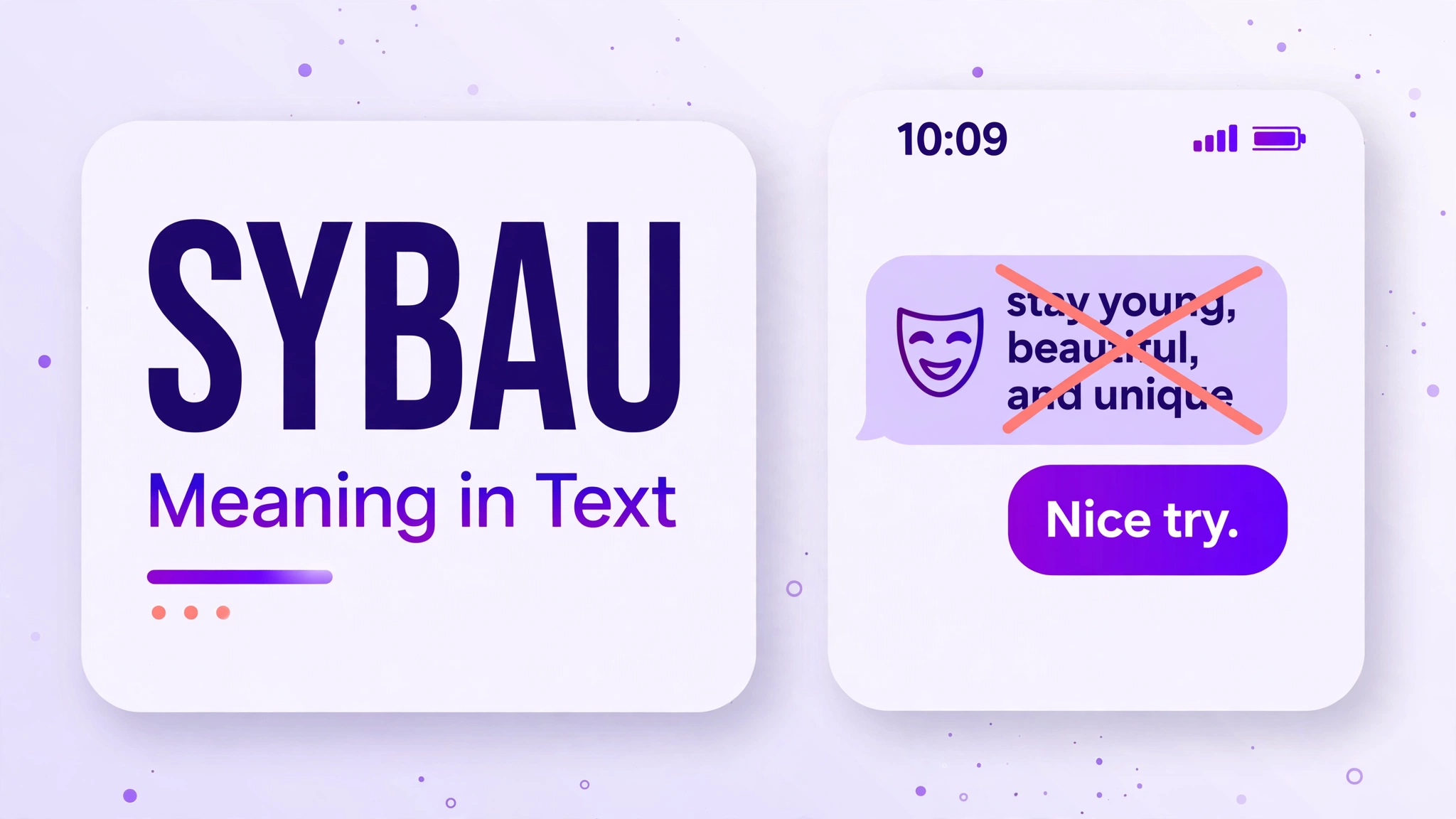
If someone told you SYBAU means “stay young, beautiful, and unique,” you were handed a cover story. That sweet expansion is a joke younger users play on adults — parents, teachers, anyone who asks. The real sybau meaning in text is a vulgar dismissal, and it is not friendly by default.
SYBAU stands for “shut your b**** a** up.” It is a blunt, profanity-loaded way of telling someone to stop talking — stronger and more personal than a plain “shut up.” Merriam-Webster’s slang dictionary documents the same expansion and notes that the term is usually used “with no small amount of vituperation” in online arguments. This guide covers the fake meaning making the rounds, what the letters really stand for, how to tell a joke from a genuine fight, and what to send back.
The Quick Verdict
| Question | Answer |
|---|---|
| What it stands for | “Shut your b**** a** up” — a vulgar order to stop talking |
| What it is NOT | “Stay young, beautiful, and unique” — a fake cover story (see below) |
| Default tone | Hostile. Joking use exists, but it is the exception, not the rule |
| How old it is | The acronym has been defined this way since 2003; its fame is a 2024–25 resurgence |
| Why initials at all | The coded form slips past profanity filters while everyone in the chat still gets it |
| Safe places to use it | Almost nowhere outside close-friend roast chats — never work, school, or family threads |
First, the Lie: “Stay Young, Beautiful, and Unique”
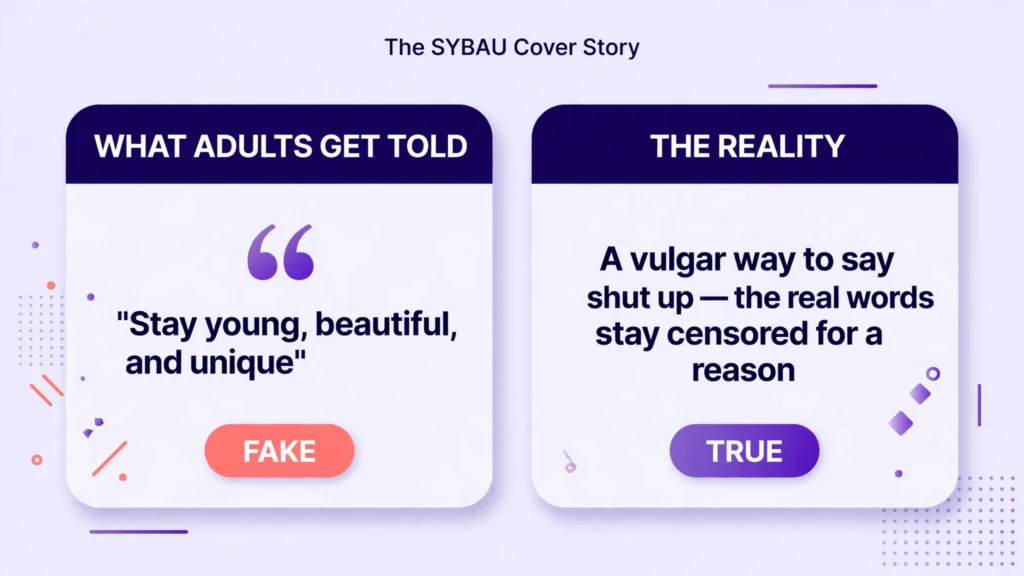
This fake expansion is so widespread that it has become part of the slang itself. Parents.com and Parade have both documented the pattern: when an adult asks what SYBAU means, kids answer with the compliment version — “stay young, beautiful, and unique,” sometimes “stay young, beautiful, and unstoppable” — and the comment sections fill with people playing along: “Yes! That’s exactly it. Should we tell him?”
The joke works because the letters fit, and because the adult usually wants to believe it. But no dictionary, slang reference, or dated source supports the compliment reading. It is a decoy, invented to hide the real meaning from the exact people most likely to ask.
You may run into other invented expansions too — affectionate or harmless-sounding backronyms that appear on low-quality slang pages. They share a tell: none of them can point to a real source older than the pages copying each other. The vulgar expansion, by contrast, has been documented continuously for over twenty years.
If a teenager gave you the compliment version with a straight face, you now know why they were smiling.
What SYBAU Actually Stands For
Behind the asterisks, the expansion is “shut your bitch ass up” — an intensified “shut up” where every added word raises the disrespect. Letter by letter: S (shut), Y (your), B, A, U (up). Merriam-Webster records evidence of the term stretching back more than twenty years, and Know Your Meme traces its first Urban Dictionary definition to November 19, 2003 — with the same expansion it carries today.
That date matters because most coverage treats SYBAU as a brand-new TikTok invention. It isn’t. What is new is the fame: a resurgence across TikTok in 2024 and 2025, capped by the March 2025 “SYBAU guy” meme — a widely shared photo of rapper Lazer Dim 700 paired with the word, which turned SYBAU into a picture you could reply with instead of typing it.
Why write it in initials at all? Partly speed, partly camouflage. SYBAU functions as algospeak: the coded form delivers the insult without tripping the profanity filters and moderation systems that flag the spelled-out phrase. Everyone in the conversation understands it; the software doesn’t.
One confusion to clear up early: SYBAU is not SYAU. Despite looking nearly identical, SYAU is a rare goodbye (“see you around”) — about as far from SYBAU’s intent as a message can get.
Joke or Fight-Ender? Reading the Delivery
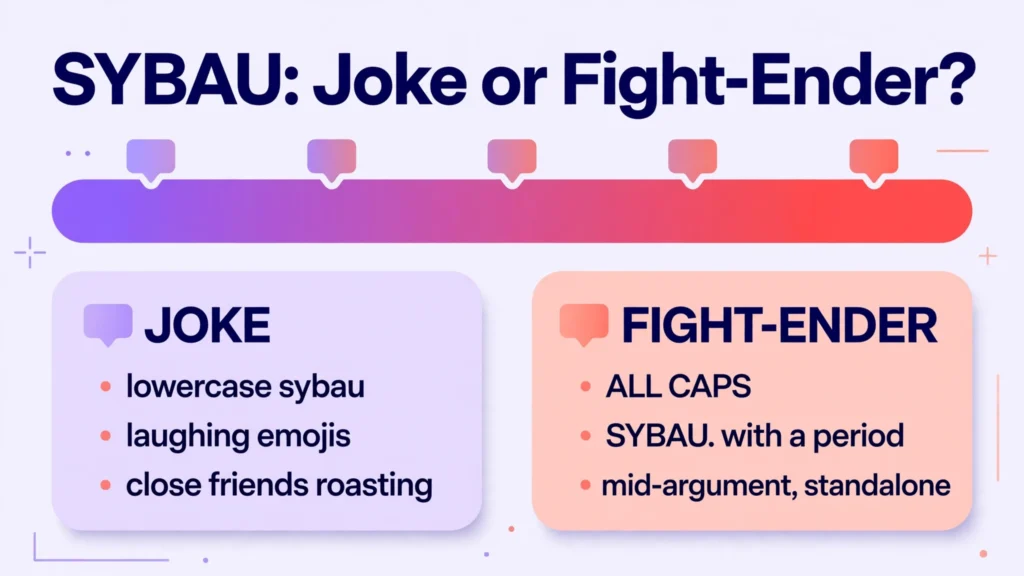
SYBAU has exactly two modes, and mixing them up is where the trouble starts. The default is hostile — Merriam-Webster allows that it is sometimes tongue-in-cheek, but “usually” it lands in the middle of an argument. The joking mode is real, but it runs on strict conditions: a close friendship, an established roast culture, and an obviously silly trigger.
Signs it’s a joke: lowercase “sybau,” laughing or skull emojis (😂 😭 💀), the meme photo sent instead of bare text, and a target that deserves teasing — a brag, a terrible take, a spoiler. Between close friends, it plays like a theatrical “oh, be quiet.”
Signs it’s a fight-ender: SYBAU as a standalone reply, in ALL CAPS, or with a hard period — “SYBAU.” In a public comment thread rather than a private chat. From a stranger, an acquaintance, or anyone who was already annoyed. Delivered flat like that, it is meant to end the conversation, and usually does.
Punctuation and capitalization don’t change what SYBAU means — they change how hard it hits. And because text strips out voice and facial expression, even a SYBAU sent as a joke tends to read harsher than intended. The safest test before sending one yourself: if you wouldn’t say the full, uncensored phrase to that person’s face, don’t send the initials either.
The dismissal family has a heat scale, and SYBAU sits near the top. IDC is a cold shrug — indifference. SYBAU is a shove — it wants the other person silenced, not just ignored.
SYBAU Out Loud: Four Conversations, Decoded
1. The friendly fire (joking)
A: just beat your high score first try btw
B: sybau 😭 you did NOT
Verdict: banter. The emoji, the lowercase, and the absurd trigger (a high score) mark this as a roast between friends — “shut up” in the delighted, no-way sense.
2. The warning light ignored (hostile)
A: you always do this. every single time.
B: SYBAU.
Verdict: genuine. Standalone, capitalized, full stop, mid-argument. If DPMO is the warning that patience is nearly gone, this is what arrives when it runs out.
3. The public pile-on (hostile, performative)
Commenter: nobody asked for this take
OP: sybau
Verdict: a clapback for the audience. In public threads SYBAU is partly performed for onlookers, which makes it land harder on the person it’s aimed at — and screenshots outlive the argument.
4. The cover story in action (deceptive)
Parent: what does sybau mean, you keep typing it
Teen: stay young beautiful and unique 🙂
Parent: aw that’s nice
Verdict: the decoy, working exactly as designed. The teen wasn’t defining the word; they were dodging the question.
These chats live in the same roast-heavy corners of the internet where friends call out someone who’s DTM — doing too much. The difference is voltage: DTM teases the behavior, SYBAU attacks the person talking.
SYBAU vs. STFU — and the Letters It Gets Confused With
The obvious comparison is STFU, and honesty matters here: both do the same job at the same hostility level. Some slang pages claim SYBAU is the “softer” of the two, but no solid source backs that up — the words behind SYBAU are not gentler. The real difference is presentation. STFU is direct and universally understood. SYBAU is coded: newer-feeling, filter-evading, and since 2025, attached to a meme. Being wrapped in initials doesn’t soften the blow for anyone who knows the expansion — which, in most chats, is everyone.
Its shelf-mates in the vulgar-dismissal family:
- SYGAU (“shut your goofy ass up”) — a deliberately softer cousin used for playful roasts. Different term, same family tree.
- JFC — an exclamation of exasperation rather than a command; it reacts to a situation instead of ordering a person to stop.
- SYAU — the look-alike from earlier: a goodbye, not a dismissal. Check the third letter before you panic.
How to Reply When Someone Sends You SYBAU
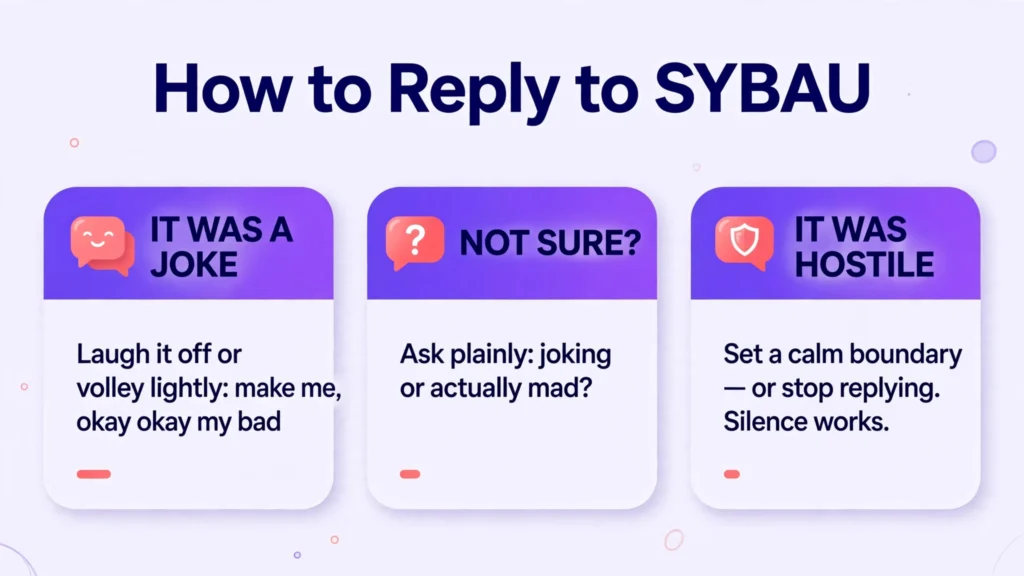
Your reply depends entirely on which mode you received — so read the delivery first, then choose:
If it was clearly a joke: laugh it off or volley lightly. “make me 😭,” “okay okay, my bad,” or the meme photo right back. Matching the energy keeps the roast alive; getting solemn kills it.
If you’re not sure: ask, plainly. “wait — joking or actually mad?” feels slightly awkward and prevents genuinely stupid misunderstandings. With close friends it’s a five-second check; with anyone else, assume the harsher reading until told otherwise.
If it was hostile: don’t match the voltage. A calm boundary works — “say it respectfully or don’t say it” — and disengaging works even better. Silence after a SYBAU isn’t losing; it’s refusing to hold the argument the sender wanted. If it keeps happening, mute or block. What you should never do is escalate with something worse; there is no prize for winning this exchange.
Where SYBAU Should Never Go
SYBAU has one of the shortest safe-use lists in texting slang:
- Work anything — Slack, email, a DM to a coworker. The initials fool nobody, and HR reads screenshots fine.
- Family threads and elders — especially given that many adults now know the cover story is fake.
- Teachers, coaches, clients, strangers — anyone who hasn’t opted into roast culture with you.
- Anyone actually upset — SYBAU aimed at a person in real distress isn’t edgy; it’s cruelty with a meme attached.
- School and formal writing — obviously, but also group projects and class chats, which get screenshotted and forwarded.
Want the feeling without the fallout? “Zip it,” “hush,” “pipe down,” and “say less” all tease at room temperature. If you’re annoyed rather than playful, SMH carries the exasperation without ordering anyone to be silent. And if you genuinely need a topic dropped, “can we pause this one?” does the job like an adult — no initials required.
Quick Answers
What does SYBAU mean in text?
It stands for “shut your b**** a** up” — a vulgar, aggressive way to tell someone to stop talking. It is usually hostile; between close friends it can be a joke.
Does SYBAU mean “stay young, beautiful, and unique”?
No. That expansion is a documented fake — a cover story younger users give adults who ask. Parents.com and Parade have both reported kids admitting the compliment version is invented.
Is SYBAU worse than “shut up”?
Yes. The added profanity makes it more personal and more disrespectful than a plain “shut up,” which is why Merriam-Webster describes its typical use as vituperative.
How is SYBAU different from STFU?
Barely, in force — both are top-tier hostile. STFU is direct; SYBAU is coded in initials (which helps it slip past profanity filters) and tied to a 2025 meme. Neither is the “nice” option.
How do you pronounce SYBAU?
It’s almost always typed, not spoken. When people do say it aloud, you’ll hear “see-bow” or “sigh-bow.”
Is SYBAU okay to use at work or school?
No. The acronym is transparent — everyone who matters can decode it — and it carries the full weight of the uncensored phrase.
Someone sent me SYBAU. What do I do?
Check the delivery. Emojis, lowercase, and a close friend usually mean a joke — volley back lightly. Caps, a period, or a mid-argument drop means it’s real — set a calm boundary or stop replying.
The One-Line Version
SYBAU is a vulgar “shut up” wearing a coded disguise: hostile by default, joking only among friends who roast each other, and absolutely not the compliment it’s pretending to be.
