
You pour your heart into a message, or you ask a simple question, and the reply comes back as two letters: “hm.” No emoji, no follow-up, no period. If you have ever stared at that reply wondering whether you were being thought about or brushed off, this guide is for you. In short, the hm meaning in text is almost always the thinking sound “hmm” written short: a pause, a moment of thought, or a quiet acknowledgment, with the exact shade decided by everything around it.
That is the whole puzzle of HM: it is a sound written down, not an acronym, so it borrows its meaning from its shape, its thread, and its sender. The method below shows you how to read all three.
What HM Means in Text
HM is not really an acronym at all. Wiktionary lists English “hm” plainly as a shorter variant of “hmm,” an interjection expressing reflection, uncertainty, or hesitation. Typing “hm” writes down the noise the mouth makes while the brain catches up.
Most of the time, HM lands in one of five shades of the same pause. Thinking: “Hm, let me check my calendar before I say yes.” Hesitation: “Hm… I’m not sure about that plan.” Mild doubt: “Hm, are you sure that’s true?” Quiet acknowledgment: “Hm, okay, that makes sense.” And low-energy distance: a bare “hm” after a long message, followed by silence. Notice the word “can”: the letters are identical to the thinking pause. Note too: HM is not a yes. Where OFC says yes outright, HM only pauses before an answer.
One honest note on a second reading: in fast casual typing, “HM” sometimes stands in for the pronoun “him,” as in “I saw HM yesterday.” That use is real but narrow, working only where a pronoun fits. If “hm” sits alone as a whole reply, it is the thinking sound. Guides calling “him” the most common meaning overstate a niche shortcut.
The Shape–Thread–Sender Check
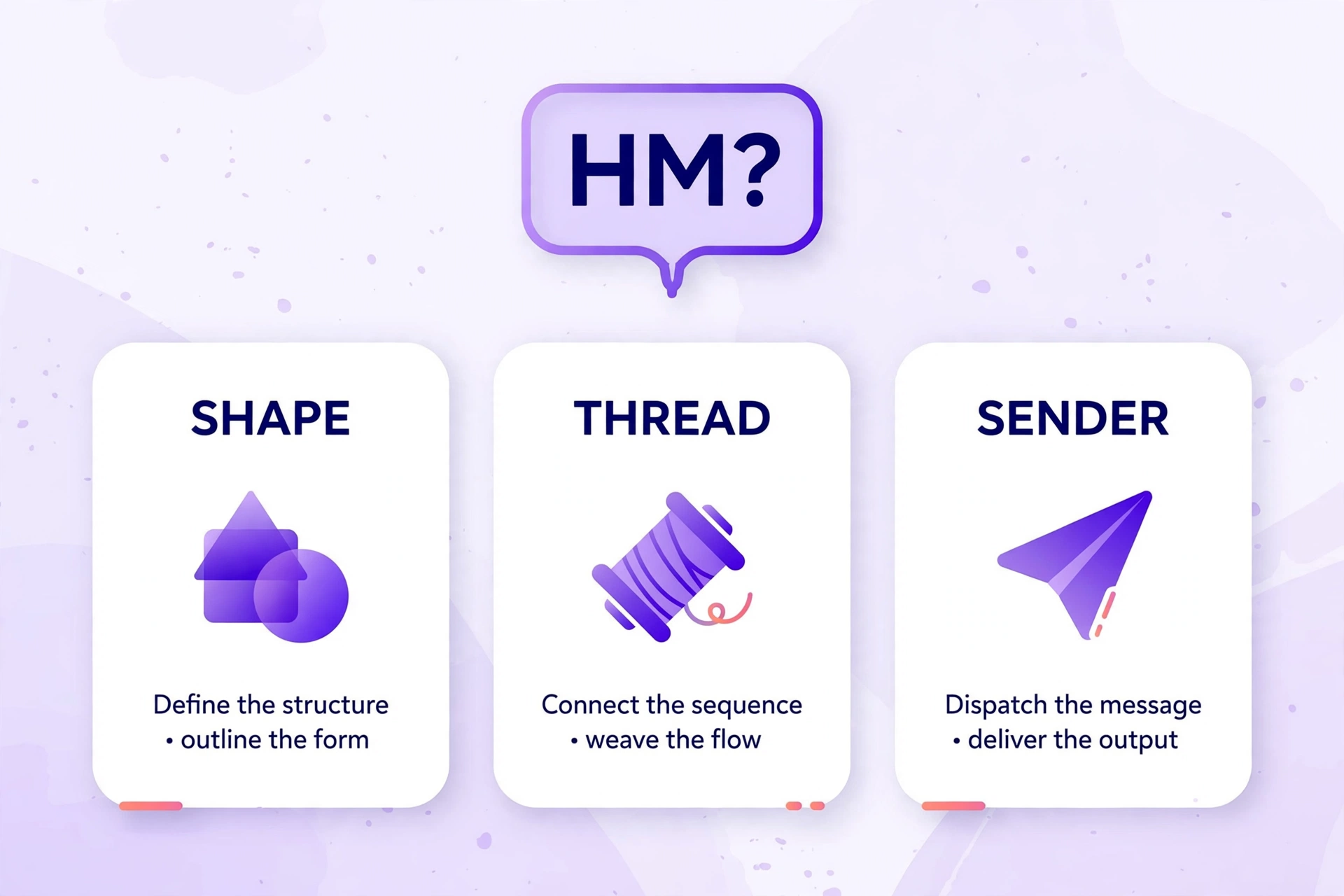
Here is this article’s named method, the Shape–Thread–Sender Check: three checks before you decide what an “hm” meant.
Check 1: SHAPE. A bare “hm” is the most neutral and most easily misread form. “Hm,” with a comma keeps talking, because the sentence continues after it. “Hm…” stretches the pause: deeper thought, or deeper doubt. “Hm?” asks for more, as in “Hm? What do you mean?” — a close cousin of asking WDYM outright. “Hm.” clips the sound short and final, which is why it reads colder than the same letters without one. Length matters too: “hmm” feels warmer than “hm,” and “hmmm” stretches into playfulness or suspicion.
Check 2: THREAD. What came immediately before it? After a question, “hm” is usually thinking or hesitation. After a claim, it is usually doubt or acknowledgment. After a long emotional message, with nothing after it, the distance reading earns its keep. Followed within seconds by a full sentence, it was just a placeholder while the sender typed the real reply.
Check 3: SENDER. Who sent it, and what is normal for them? Some people answer everything with short sounds; from them, “hm” is just how they type. Some people write paragraphs; from them, a bare “hm” is a real change of temperature worth noticing. The sender’s baseline calibrates what the letters cannot.
The same two letters, three threads: thinking after a question, distance after an emotional message, doubt after a wild claim. Nothing about the letters changed.
HM on TikTok, Snapchat, Instagram, and in Texting
On every platform, the app never decides the meaning; what changes is the room and the speed.
In plain texting, HM is at home. One-to-one chats are where the thinking pause lives: mid-conversation, while someone weighs an invitation. If most of your “hm” exchanges happen in private chats, the guide to DM covers that room and its etiquette.
On Snapchat, speed is the story. Streaks and quick chats reward the shortest possible acknowledgment, so “hm” often arrives as a placeholder reply while someone figures out what to say next. In flirty streaks it can tease, but the teasing comes from the relationship, not Snapchat.
On Instagram, HM shows up in two places. In direct messages it works like texting: a thinking pause. In comments and story replies it leans toward reaction: a short “hm” under a surprising post reads as skepticism or curiosity, a quieter version of “really?”
On TikTok, the comment section dominates. “Hm” under a video usually means “interesting” or “I’m not convinced,” aimed at the video rather than at any one person. In TikTok direct messages, the private-room rule returns: thinking and hesitation take over again. The pattern across all four: private rooms say thinking, public rooms with surprising claims say doubt, fast rooms say placeholder.
Tone and Sender Context: Who Is Sending HM, and Why It Lands Differently
HM is a small message with a wide emotional range, and the sender matters as much as the letters.
From a close friend, HM is almost always harmless: thinking, joking, stalling while they check something. A bare “hm” after a joke is a shrug in text form, not a verdict on the friendship.
From a crush, HM feels loaded because everything feels loaded early on. “Hm 😏” after a playful message is teasing, and the emoji is doing the flirting, not the letters. A bare “hm” after you shared something real can sting, but it is more often thoughtlessness than rejection. Judge the pattern across days, not the single reply.
From a partner, HM deserves more attention, not because it means something terrible but because you have a baseline to compare it against. A partner who usually replies warmly and suddenly answers a serious message with “hm.” is flagging a change. That is a prompt to ask, gently, not to accuse.
From family, HM is usually practical: “hm, let me check” is thinking out loud about logistics, not a coded message. Family chats are also where the “him” shortcut shows up most. From a stranger, HM is almost always reaction rather than relationship: a stranger’s “hm” is doubt aimed at the content, not at you.
At work, HM does not belong as a whole reply. A colleague who answers a proposal with a bare “hm” has given you nothing to act on, and a manager will hear dismissiveness. “Hm, let me check the schedule and confirm by noon” is fine; “hm” alone is not. A bare “hm” is also not agreement: where FS says “for sure,” HM has not committed to anything yet.
How to Reply to HM, and When to Spell It Out
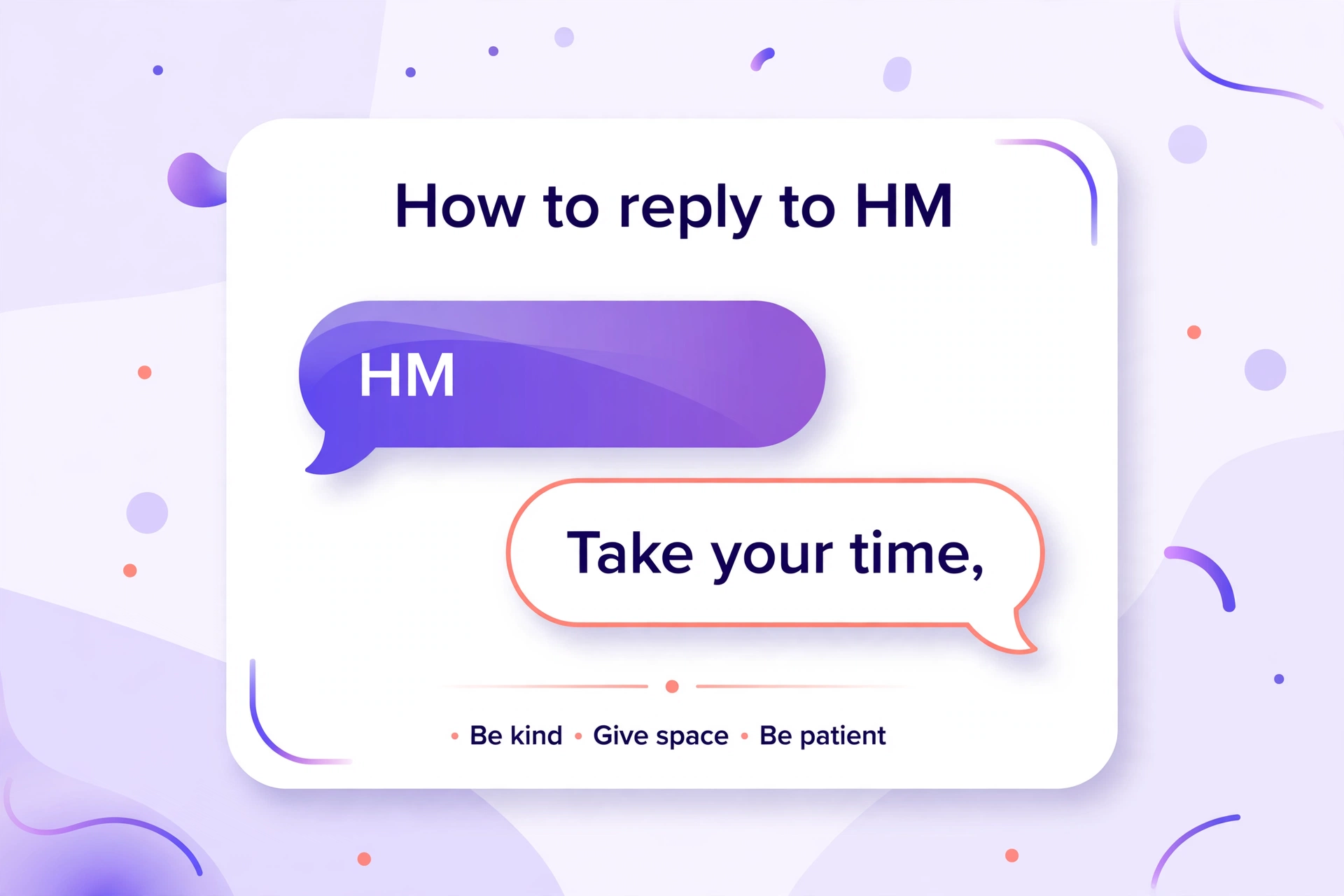
Match the reading, keep it light, and you are done.
If they are thinking, give them room or a nudge: “Take your time” or “What are you leaning toward?” If they are hesitating, make the decision easier: “No pressure either way.” And if your own follow-up needs a side note rather than another pause, even a small aside, the kind BTW introduces, carries more information than a second “hm.”
If they are doubting, answer the doubt, not the tone: “Fair question, here’s why I think so” beats getting defensive about two letters. If it was distance, do not chase it with a paragraph. A short “Everything okay?” names what you noticed without accusing, and then the ball is theirs. If distance becomes a pattern, that pattern is the conversation to have. If it was the “him” shortcut, just continue as if they wrote the full word. If it was a question, “Hm?” deserves an answer: repeat or clarify what you said.
There are times to spell it out instead of sending HM yourself. Use a full sentence for professional contacts, for anyone who may not know your texting style, and after an emotional message, where a bare “hm” would read as cold. “Let me think about that and get back to you” says it all, with none of the ambiguity.
HM vs HMM, MHM, and WDYM
HM sits in a family of short reactions, and the small differences matter.
| Term | What it usually signals | How it differs from HM |
|---|---|---|
| HMM | Deeper, more visible thinking | Longer and warmer; reads as genuinely considering, not clipped |
| HMMM | Drawn-out thought, playful suspicion | Theatrical; deep pondering or suspicion |
| MHM | Yes, agreement | A different sound entirely: confirmation, not a pause |
| WDYM | What do you mean | Asks for clarification outright, where “hm?” only hints |
The practical rule: extra m’s mean extra thought. “Hm” is a tap on the brakes; “hmm” is a longer look at the road; “hmmm” is pulling over. MHM is not on that scale: it answers yes, where HM has not answered anything yet.
Debunked: What HM Does NOT Mean
Short letters collect false meanings, and HM has collected more than most.
HM does not have one fixed meaning per app. The idea that Snapchat always means teasing and TikTok always means doubt is contradicted by the guides themselves. Placement and sender decide.
HM does not have a gender-specific meaning. Guides asking what “hm” means “from a girl” all conclude: nothing different. A girl’s “hm” and a guy’s “hm” decode the same way.
HM is not always rude. The thinking pause is friendly, or at least neutral: a sign that someone is engaged enough to pause rather than vanish. Only the bare “hm” sent as a whole reply to something emotional earns the cold reputation, and even then it may be distraction. HM is also not reassurance: DW is the reply that actually reassures, while HM only hesitates.
HM is not a precise statistic. Claims like “90% of texts” or studies with exact percentages come from listicles, not research, and this article prints none of them.
HM is not a brand, a unit, or a title in a text conversation. H&M sells clothes, HM Revenue & Customs collects taxes, and “hm” in physics means hectometre. None of those is what your friend meant. Likewise, single-guide claims like “High Maintenance” or “Hate Me” have no dictionary backing; if a meaning only appears in one listicle, do not carry it into your conversations.
When Not to Use HM
HM is a joy in its habitat and a misfire outside it. Skip it when:
- The message is emotional or serious. A bare “hm” after someone opens up reads as cold.
- A real answer is expected. If someone asked a direct question, “hm” alone leaves them guessing.
- The setting is formal. Emails and client messages are not the place for a written hum.
- You are repeating it. One “hm” is a pause; three in a row is a pattern, and patterns read as checked out.
- The reader is new. Someone who does not know your texting style has no baseline to calibrate “hm” against.
- You mean it as a shutdown. If you are sending “hm” to end an unwanted conversation, say so kindly instead.
Quick Answers
What does HM mean in text?
HM almost always means “hmm”: a written thinking sound signaling thought, hesitation, mild doubt, or quiet acknowledgment. Its shade comes from punctuation, thread, and sender.
Is HM an acronym?
No, not in its primary use. HM is a sound written down, not initials standing for words. Wiktionary lists it as a shorter variant of “hmm.” Niche expansions like “him” or “Half Marathon” exist only in specific rooms.
What does a bare “hm” with no punctuation mean?
On its own, it is neutral but risky: most often thinking or a placeholder, but easily read as distant after an emotional message. Check what came before it.
What is the difference between HM and HMM?
Length signals depth. “Hm” is clipped; “hmm” reads warmer and more thoughtful; “hmmm” stretches into suspicion or deep pondering.
What does “hm?” with a question mark mean?
Usually curiosity or a request for clarification: “What do you mean?” It openly asks for more.
What does HM mean on Snapchat?
Usually a quick thinking pause or placeholder in fast chats, sometimes teasing in flirty ones. The app does not fix the meaning.
What does HM mean on TikTok?
In comments, usually interest or skepticism. In direct messages, thinking or hesitation.
Is HM rude?
Not inherently. As a thinking pause it is neutral; as “hm?” curious. It feels rude as the entire reply to something emotional.
Can HM mean “him”?
Yes, in fast casual typing where a pronoun fits, as in “I saw HM yesterday.” But that is a narrow shortcut.
Should I use HM at work?
Not as a whole reply. “Hm, let me check and confirm by noon” carries information; a bare “hm” reads as dismissive.
Final Thoughts
HM is two letters doing the work of a pause: “I’m thinking, I’m not sure yet, hold on a second.” Run the Shape–Thread–Sender Check before you read it and before you send it. Get those three right, and HM stops feeling like a mystery.
If this guide helped, you may also enjoy the GTS guide, another short message whose meaning flips with context, and the TGIF guide.
