
You get a two-letter reply, and it stops you cold. Was that a yes, a no, or just a noise? If you have ever searched for the hn meaning in text, you already know the uncomfortable truth: these two letters can mean opposite things. In one chat, HN is a hard refusal. In another, a lowercase “hn” is a quiet yes. In a third, it is not a word at all, just a grunt. The letters never tell you which one you got. The message around them does.
That is why this guide does not hand you one definition and stop there. It gives you a test for reading any HN you meet, explains every reading with real evidence behind it, and is honest about the ones that do not hold up.
What HN Means in Text
Start with the default. In everyday English-language texting, capital HN is a short, emphatic refusal. The expansion is masked here, but the letters stand for H*ll No: stronger than a plain “no” or “nah”, closer to “absolutely not”. It almost always answers something: a question, an invitation, or a suggestion.
“Want to do a 6 a.m. run tomorrow?” — “HN.”
That answering shape is your first clue: HN after a question or plan in a casual English-speaking chat is the emphatic refusal until something says otherwise.
One honest caveat matters. This reading does not come from a dictionary entry. Wiktionary, checked first, lists HN as the country code for Honduras and lowercase “hn” as an interjection, but not the refusal expansion. The refusal rests on unanimous agreement across every major texting guide read for this article, plus a 2017 crowd-sourced slang entry defining it in exactly those terms: strong consensus, not a dictionary definition.
The second reading is just as real, and it causes the trouble. Lowercase “hn” is often not an abbreviation at all. It is a sound: a grunt or hum of acknowledgement that can mean unimpressed, uninterested, quietly agreeing, or simply thinking. Wiktionary records it as an interjection tagging a rhetorical question, quoting a 1956 novel: “Not bad for the House, hn?” A 2003 fandom entry describes the same sound in anime, where cold, brooding characters answer with a low “hn” instead of a sentence. There, it performs a mood, not a word.
The Yes-No-Maybe Flip Test
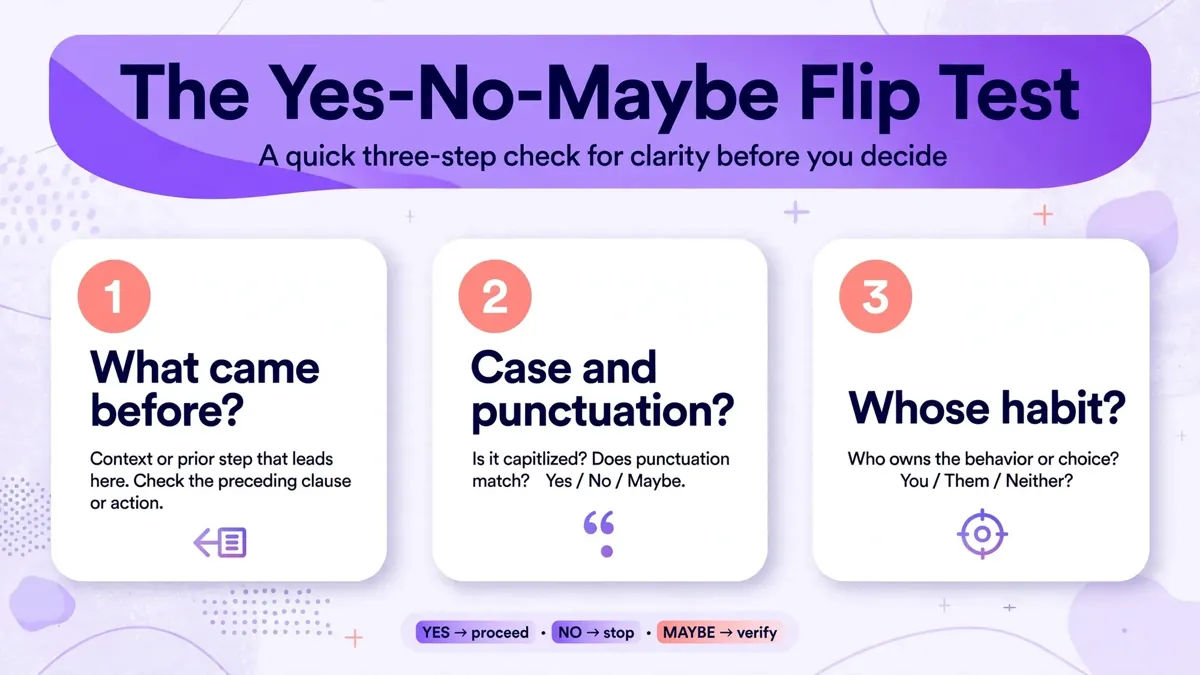
Here is this article’s named method, the Yes-No-Maybe Flip Test, built for this term because its readings genuinely contradict each other. Ask three questions, in order.
Question one: what came just before it? If HN answers a yes-or-no question, a plan, or a dare, the refusal reading leads. If it answers a statement that needed no answer, the grunt or hesitation reading leads. If the previous message was in Romanised Hindi, Urdu, or Bengali, the yes reading enters the race. The message before HN matters more than HN itself.
Question two: what do case and punctuation say? “HN!” is the firmest refusal. “HN 😂” is usually a playful refusal, the joke version of the same no. Lowercase “hn” alone is softer and more ambiguous, and “hn…” with trailing dots leans toward hesitation, like “hmm, let me think”. Case and punctuation are clues, not proof, but as a first guess they beat nothing.
Question three: whose habit is this? A friend who always answers “hn” to mean yes in a mixed-language chat is agreeing in their usual shorthand, not suddenly refusing you. When you do not know the person’s habit and the first two questions still leave you torn, ask: “Do you mean yes or no here?” It costs two seconds and beats two days of wondering. For HN, asking is the correct move, not a failure of slang knowledge.
Every HN Reading, Graded
The emphatic refusal is strongly supported: all five competitor guides agree on it, it leads every one of them, and its examples are consistent. Treat it as the default in English-language texting. The grunt and hesitation sound is strongly supported too, with the oldest evidence of any HN reading: a dictionary interjection entry, a 1956 literary quotation, and a 2003 fandom entry.
The “haan” or yes reading is contextually supported. One thorough guide documents variants han, haan, hn, and hnn as informal agreement in South Asian Romanised texting. The other guides do not cover it, a gap in their coverage rather than evidence against it — but apply it only where the language context supports it, never in an English-only chat without checking.
The tech reading, Hacker News, is contextually supported: in developer and startup writing, “Ask HN”, “Show HN”, and “on the HN front page” are its fingerprints. The handle-name reading is contextually supported too: in Japanese internet profiles and fan-fiction writing, HN can mean a screen name, met in a profile field rather than a dinner reply.
The remaining readings are weak: “how nice”, “hot now”, “here now”, “his or her name”, “host name”, “house number”, “hi neighbor”, “head nurse”, and “hospitalman”. Each appears in one or two guides with a single example and no dictionary backing. Some may occur in narrow rooms, but none is an everyday texting meaning.
HN on TikTok, Snapchat, Instagram, and in Texting
No platform gives HN a different definition, whatever some guides claim. What changes across platforms is the room and the speed, which change which reading you are most likely to meet. The definitions stay the same; the odds shift.
In plain texting — SMS, WhatsApp, iMessage — HN does its full range of work, and its contradiction lives most dangerously here, because the same phone carries your English-only group chat and your mixed-language family chat. A refusal in one thread and a yes in another can arrive minutes apart, in identical letters. Scroll up and check the history before you decide.
On Snapchat, HN is usually the refusal, fast and throwaway: a reaction-style “HN 😂” to a wild suggestion fits the platform’s tempo. On Instagram, the refusal still leads in DMs, story replies, and comments — a blunt vote under a poll, a friend’s honest veto in a DM, often softened with an emoji. A public “HN” under a stranger’s post reads colder than the same letters privately, with no shared history to soften it.
On TikTok, HN lives in comments and reply chains as the dramatic refusal (“HN, absolutely not” under a challenge video) or a grunt-like reaction to something absurd. You are also most likely here to meet HN from someone you do not know, so the Flip Test’s third question has no answer. Lean on the first two questions, and if they still leave you stuck, accept the ambiguity rather than acting on a guess.
Tone and Sender Context: Who Sent It, and How It Lands
Tone is half the meaning. A playful HN comes with laughter: “HN 😂”, “HN lol why would I do that”. A serious HN comes bare: “HN.” After a genuine question, a bare HN reads as firm, possibly cold, and the tell is the gap between the weight of what you asked and the lightness of what came back. A sarcastic HN after a complaint about a tiny inconvenience can carry an eye-roll tone of “oh, how nice for you” without ever expanding to those words; the sarcasm lives in the situation, not the letters.
From a close friend, HN is usually playful or bluntly honest, and the emoji usually tells you which. From a crush, it has no evidenced flirty meaning of its own, but a teasing refusal (“HN, you wish 😂”) is flirtation wearing a refusal’s clothes. From a partner, a bare HN after a real question deserves attention. From a family member in a mixed-language chat, lowercase “hn” is most likely agreement, and misreading it as a refusal could genuinely spoil plans. From a coworker or stranger, read it as blunt and do not send it.
If you send HN yourself, soften it. “HN, I’m way too tired for that” lands very differently from a bare “HN”. An emoji helps, and a reason helps more. If you type “hn” to mean yes, spell it out when the reader might not share your shorthand: “haan, sure” removes the ambiguity entirely.
HN vs Related Terms
HN sits in a crowded corner of texting. Against “nah”, HN is louder: nah is a relaxed no, HN is a no with emphasis, close to disbelief. Against “nope”, the difference is temperature: nope is friendly and light, while HN is heavier and more personal, which is why a stranger’s “HN” can feel like a slap.
Against “hmm”, the difference is commitment: hmm says “I am thinking”, while the refusal HN has already decided — hence “hn…” leans toward hmm and “HN!” leans hard away. Against the honesty markers, the difference is the job: TBH certifies the writer’s real opinion, while TBF balances a conversation. HN does neither. NVM cancels the sender’s own earlier message, while HN answers someone else’s. And WDYM asks for clarification — the most useful reply when an HN leaves you unsure.
Debunked: Claims About HN That Do Not Hold Up
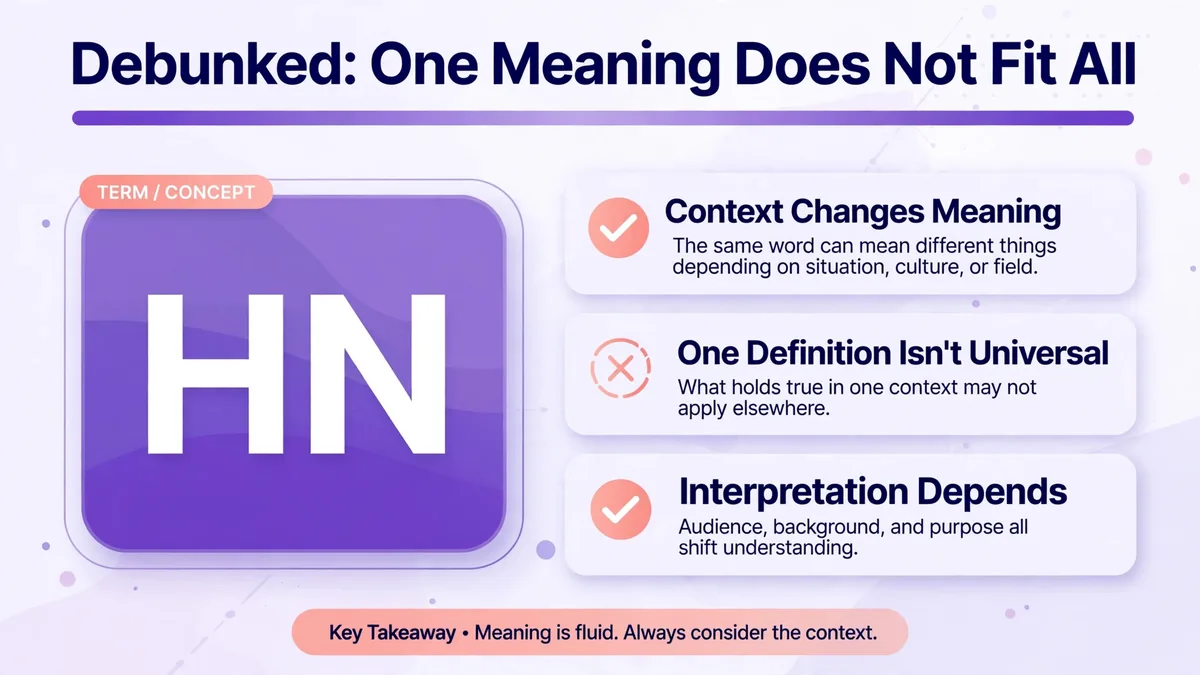
This section is the quality-escalation upgrade for this article: every claim here was found in a live guide and is rejected for a stated reason. HN does not mean hello or any greeting — one guide’s polite alternatives are replacements, not definitions. It has no secret per-platform meaning. It does not mean “hold on”, “honestly”, or “high noon” in everyday texting, each appearing in exactly one guide with no surviving example. It is not “huh?” or “hey now” as its core meaning, contradicting all five competitors. Nobody can state its frequency or generational split, because no frequency study exists, so this guide makes no popularity claim. And capitalisation alone proves nothing: the tendency is real, but people break it in both directions.
How to Use HN — and How to Reply to It
Send the refusal version only, where it belongs: casual chats with people who know your tone. Skip it at work, in messages to teachers, and with anyone you do not know well enough to be blunt with. There, write a real sentence: “I don’t think that will work for me, sorry.”
Reply to the reading you actually got. Laugh off a playful refusal (“fair enough 😂, what about tomorrow?”), accept a serious one, carry on after a yes, and give room after a hesitation (“no rush, what do you think?”). When you genuinely cannot decode an HN, ask plainly. And never answer a firm refusal with an arguing paragraph: the sender chose two letters precisely because they did not want a negotiation.
Quick Answers
What does HN mean in text?
In most English-language casual chats, HN is an emphatic refusal, masked here as H*ll No. Lowercase “hn” can also be a grunt, and in South Asian Romanised texting it can mean “haan”, or yes. The message before it decides.
Is HN rude?
It can be. A bare HN reads as blunt, and with strangers or at work it can feel dismissive. Between close friends, with an emoji or a follow-up, it usually reads as playful.
What does lowercase “hn” mean?
Usually one of three things: a grunt or acknowledgement sound, a casual yes in mixed-language South Asian chats, or a soft, low-effort refusal. Check the previous message and the sender’s habit first.
What does HN mean on Snapchat, TikTok, and Instagram?
The same as in texting: usually the emphatic refusal. No platform gives HN a different definition; the room and speed change which reading you meet most often, not the meaning.
What does HN mean in anime or fan chats?
A lowercase “hn” is a grunt used by cold or brooding characters, meaning unimpressed, uninterested, or quietly agreeing, depending on the scene. It is a sound, not an abbreviation.
Does HN mean Hacker News?
In tech, startup, and developer contexts, yes. “Ask HN” and “Show HN” point to the news site, not to a texting refusal. In a personal chat, that reading almost never applies.
Can I use HN at work or school?
No, not safely. It is informal, ambiguous, and blunt, and its expansion contains a mild swear word. Write the full sentence instead, such as “I don’t think that will work”.
How should I reply when someone sends HN?
Reply to the reading you got: laugh off a playful refusal, accept a serious one, carry on after a yes, give room after a hesitation, and ask plainly when you cannot tell.
The Short Answer
HN is a two-letter test of how well you read a room. In most casual English chats it is a firm refusal, spelled out here only in masked form. In a lowercase grunt it is a mood, not a word. In a mixed-language chat it can be a yes. In a tech thread it is a website. One-definition guides do you a disservice.
Run the Yes-No-Maybe Flip Test: what came before it, what the case and punctuation suggest, and whose habit you are reading. When the test ties, ask. And when you send HN yourself, add a little humanity — an emoji, a reason, a laugh. For softer follow-ups, HBU returns the question gently, BTW slips in a side note, and DW tells someone not to worry about it.
