
"Meet me at seven." "RD." "That band is RD." "RD, will reply soon." The same two letters, three conversations, and no agreement among the guides about which meaning is the real one. The rd meaning in text is contested in a way the other abbreviations in this batch are not. In one chat RD means "alright," a short way of agreeing. In another it means "real deal," a stamp of authenticity. In a third it means "read" or "received," a confirmation that a message was seen. All three uses are documented, none of them is a fringe joke, and no trustworthy source ranks them. This article does not pretend otherwise. It gives you a test based on the shape of the sentence, because the shape is the only reliable witness.
That honesty matters because RD is the easiest abbreviation in this batch to misread with confidence. A reader who has only met the "alright" RD will hear agreement where a "real deal" RD meant praise, and a reader who has only met the "real deal" RD will hear praise where a "read" RD meant only acknowledgement. The guides reviewed for this article split cleanly: some lead with "alright," others with "real deal," others with "read." When the guides disagree that evenly, the article's job is not to pick a winner. It is to show you how to tell them apart in the message in front of you.
RD is typed in either case, and casing hints at tone rather than meaning. All-caps "RD" reads as a firm acknowledgement. Lowercase "rd" reads as casual, sometimes uninterested. "RD." with a full stop reads polite and final. No established dictionary was found to record any of the three chat senses in this check. That absence is worth stating, because it means the evidence for RD rests on usage guides and community discussion, not on a dictionary entry, and the grading below reflects that.
What RD Means in Text
The three contenders, in plain form, are these. As "alright," RD is a short reply that agrees, confirms, or acknowledges a plan: "RD, see you there" means "alright, see you there." As "real deal," RD is a predicate or a label that praises authenticity: "That band is RD" means "that band is the real deal," genuinely talented and not hype. As "read" or "received," RD is a confirmation: "RD, will reply soon" means "I have read this, I will reply soon."
The "real deal" use is easier to separate, because its grammar is different. It appears after "is," "the," or a name: "He is RD," "the RD," "Mike RD." It praises a person or a thing. It never appears as a bare reply to a question about plans, because praise is not an answer to "meet me at seven." If RD sits where a compliment would sit, it is the real deal. If it sits where "okay" would sit, it is alright or read. That sentence-shape rule is the core of this article.
The RD Sentence-Shape Test: Where RD Sits Is What It Means
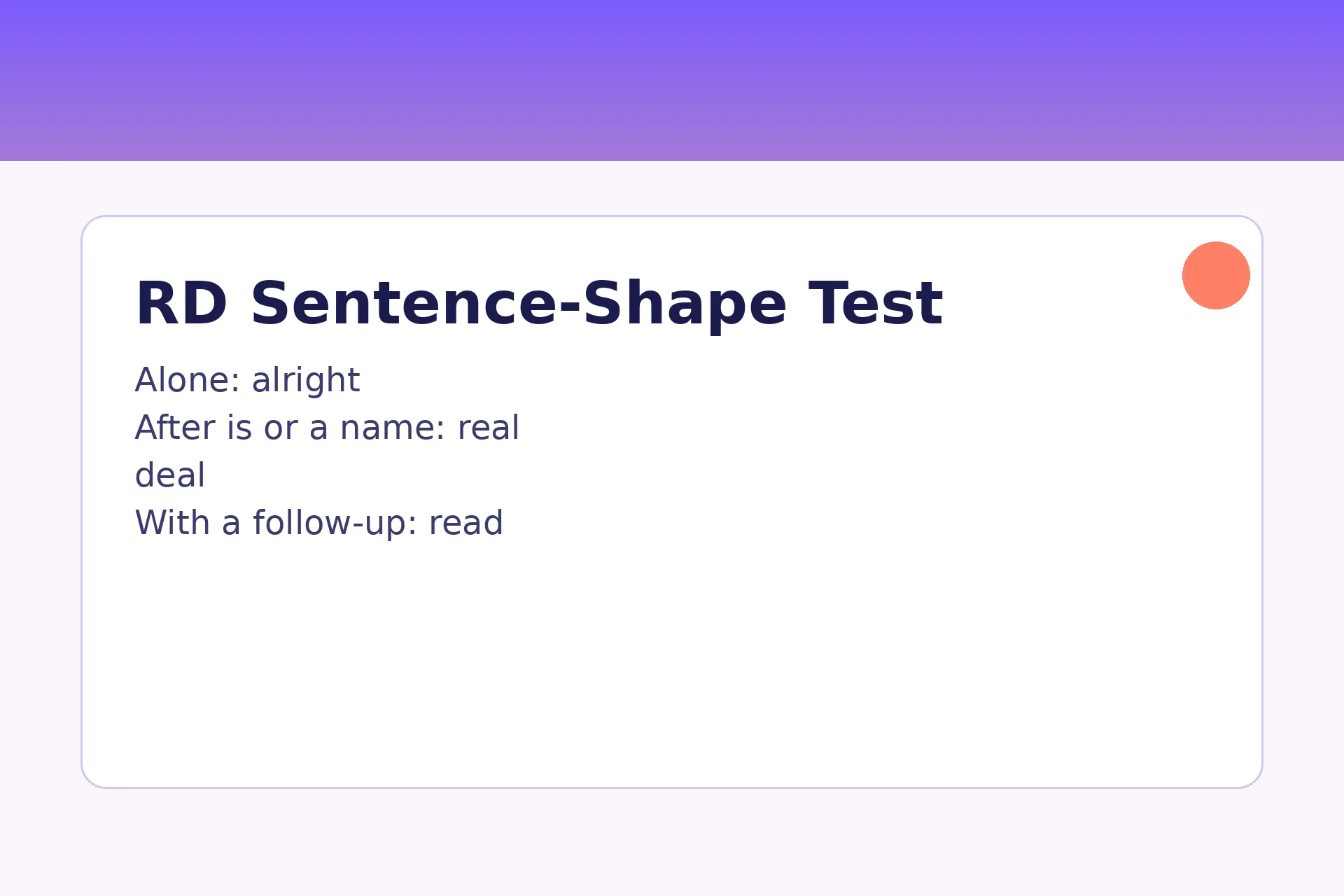
Here is this article's named reader test, the RD Sentence-Shape Test. It has three shapes, and shape beats platform every time.
Shape one: RD stands alone, or opens a short reply to a plan, a request, or a piece of news. "RD." "RD, thanks." "RD, see you later." This is the agreement shape, and it means "alright" or, in a work chat, "received." The distinction between alright and received here is usually unimportant, because both acknowledge the message. What matters is that this shape does not praise anything. It answers.
Shape two: RD follows "is," "the," or a person's name, or it stands as a label after a noun. "That album is RD." "She is the RD." "Alex RD." This is the praise shape, and it means "real deal." The giveaway is the position after a verb or a name, where a compliment belongs. No other RD meaning fits that slot. "That album is alright" is a different sentence, and "that album is read" is nonsense, so the shape alone rules them out.
Shape three: RD appears with a promise of a later reply, a thanks for a document, or a reference to something already sent. "RD, will reply soon." "RD your report, thanks." "RD earlier, got caught up." This is the receipt shape, and it means "read" or "received." The giveaway is the follow-up: a future reply, a document, or a delay. A bare "RD" with no follow-up stays in shape one, where alright and received blur together. A "RD" with a follow-up leans toward receipt, because the sender is explaining a gap between reading and replying.
RD Means Alright, and RD Means Real Deal
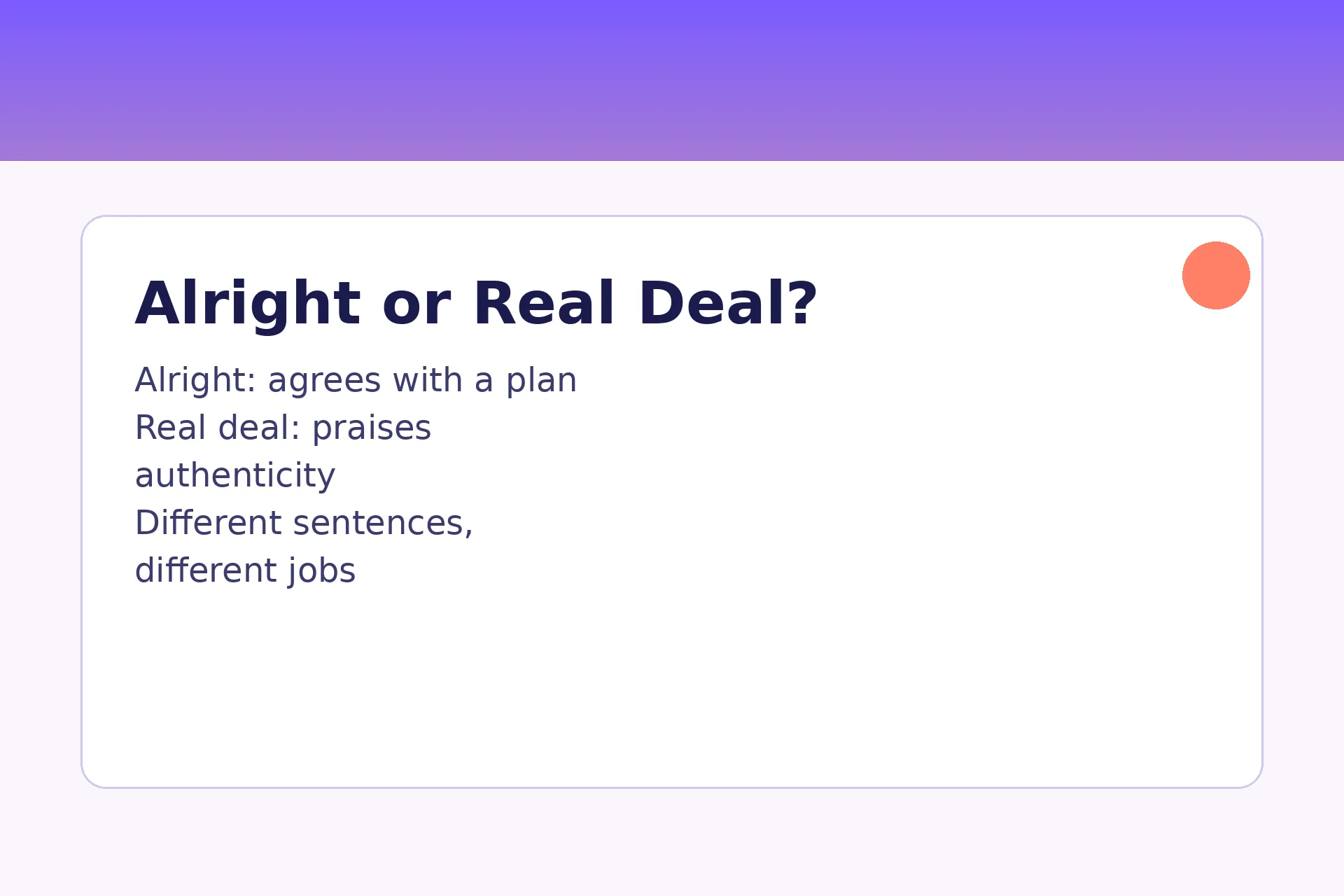
As "alright," RD is a practical shortcut, the fastest way to agree without writing a sentence. It confirms plans, ends conversations politely, and shows understanding: "RD, I will be there," "RD bro," "RD, thanks." Its tone is friendly and casual, and it is especially common in fast chats — texting, gaming, Discord — where a full sentence would slow the thread. It is less common than "OK," "K," or "bet" in many communities, according to the guides reviewed, which means some readers will not recognise it at all. That unfamiliarity is a real cost. A shortcut only saves time if the reader knows it.
The two uses rarely collide in practice, because their sentences look different. Trouble comes only when a reader knows one use and meets the other in a bare form. A "real deal" reader who receives "RD" as a reply to a plan may hear praise where agreement was meant. An "alright" reader who receives "She is RD" may hear agreement where praise was meant. The Sentence-Shape Test exists for exactly those moments. Check the shape before you check your memory.
RD Means Read or Received, and the Professional Meanings
As "read" or "received," RD is a confirmation, not an agreement. In personal chats it says "I have seen your message." In work chats, on Slack or Teams, it says "I have received this and noted it." Examples include "RD, will reply soon," "RD your report, thanks," and "RD earlier, got caught up with something." The tone is neutral and brief, and it can feel cold in an emotional conversation, because a confirmation is not a response. A sender who shares important news and receives only "RD" may reasonably feel brushed off, even when the receiver meant only to acknowledge receipt before replying properly.
Outside chatting, RD has professional meanings that are real but separate: in healthcare, "Registered Dietitian"; in business, "Research and Development"; in addresses, "Road," as in "Maple Rd." None is slang, and none should be imported into a chat.
RD on TikTok, Snapchat, Instagram, and in Texting
On TikTok, RD appears in comments and captions, where the praise shape is common: a creator or a performance called "RD" is being praised as genuine. The agreement shape appears in replies too, but comments are a public stage, and praise travels better there than a bare acknowledgement. On Snapchat, RD appears in chats as a quick agreement or confirmation, fitting the app's fast, brief style. On Instagram, RD appears in direct messages as an agreement or a confirmation, and in comments as praise, mirroring TikTok. The platform does not decide the meaning. The shape of the sentence does, and a platform table that assigns one meaning per app would mislead more readers than it helps.
Tone and Sender Context: Who Is Saying RD, and Why It Lands Differently
RD carries almost no tone of its own, which is why it misleads. From a close friend, a bare "RD" is comfortable. From a new acquaintance, it can read as closed. From a manager it can read as efficient or curt, and from a client it will usually read as curt, because clients are owed fuller acknowledgement.
How to Reply to RD, and When to Spell It Out
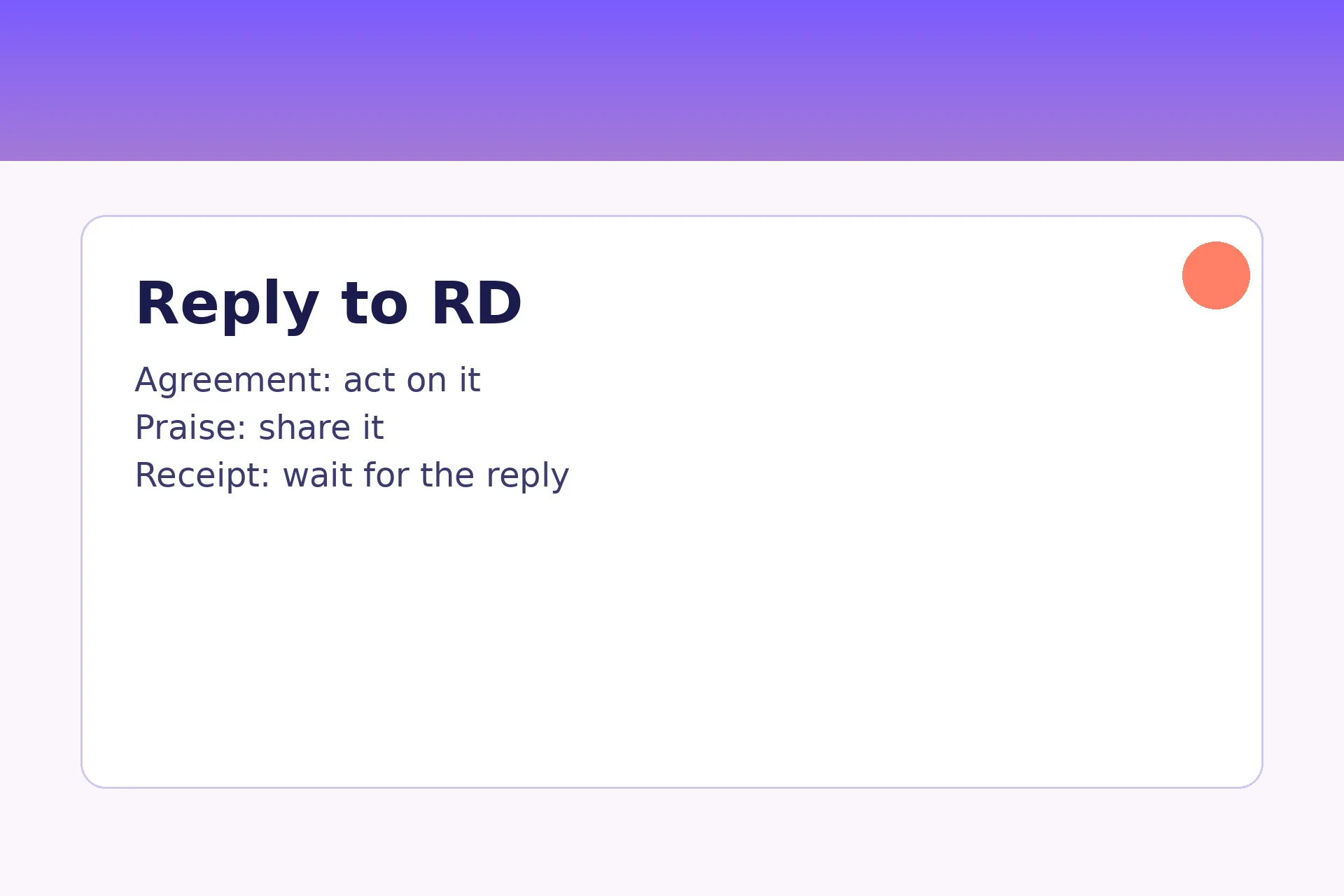
Reply to the shape, not the letters. For agreement, act on it or confirm it: "Great, see you then." For praise, accept or share it: "Agreed, they were brilliant." For receipt, wait for the promised reply, or continue the conversation yourself.
If you are sending RD, spell it out when agreement matters, when the reader may not know it, or when the message is emotional. "Alright, see you there" removes the alright-versus-received ambiguity entirely. "That band is the real deal" is clearer than "that band is RD" to anyone outside the slang circle. "Got it, thank you, I will reply properly later" is warmer than "RD, will reply soon" in any conversation where warmth matters. The abbreviation saves two or three words. The full phrase saves a misunderstanding, and that trade is almost always worth it.
RD vs Related Terms
RD's neighbours are other short replies, and the differences are about warmth and precision. The guide to TBT on this site covers a different kind of shorthand entirely — a nostalgic label, not a reply — which shows how much work context does in this family. The FOMO guide covers a feeling that often follows a missed plan, the exact situation a misread RD can create. The ASAP guide covers urgency, the opposite of RD's low-energy shrug: ASAP demands speed, while RD declines to hurry.
Three more cousins complete the picture. The LMK guide covers a reply that keeps a conversation open — "let me know" invites a future message, while a receipt RD only promises one vaguely. The DM guide covers the private channel where a fuller reply to a receipt RD often happens. The BRB guide is a temporary absence with a promised return, clearer than RD because the return is explicit. And the GTG guide is a departure, closing a conversation cleanly, while RD leaves it hanging in a way that only the next message resolves.
Debunked: What RD Does NOT Mean
Several claims about RD need rejecting openly. First, the precise percentages some guides print for RD — shares of usage by platform, or claims that one meaning holds a specific percentage of messages — rest on no published usage study, and this article prints none of them. Percentages with no source are decoration, not evidence, and a contested abbreviation is exactly where invented precision does the most harm.
Third, RD does not mean "really dumb." One guide lists that reading with unsourced percentages, but the other guides reviewed do not support it with consistent examples, so this article grades it as weak and omits it from the main body. The same grading applies to "read" as a past-tense verb ("I RD your message"): the receipt reading covers the same ground more naturally.
When Not to Use RD
Skip RD in professional emails, in messages to teachers or clients, and in any conversation where agreement, praise, or receipt needs to be unambiguous. A bare "RD" to a client reads as curt. A bare "RD" to a teacher reads as careless. A bare "RD" in reply to a plan that matters reads as a gamble. In all three cases, the full phrase costs almost nothing and removes the risk.
Quick Answers
What does RD mean in text?
RD has three main chat meanings: "alright" as an agreement, "real deal" as praise for authenticity, and "read" or "received" as a confirmation. The shape of the sentence decides which one applies.
What does RD mean on TikTok?
On TikTok it usually means "real deal" in comments and captions praising a creator or performance, though it can also be a short agreement in replies. The sentence shape decides.
What does RD mean on Snapchat?
On Snapchat it usually means "alright" or "read" in chats, as a quick agreement or confirmation. In comments praising someone, it means "real deal."
What does RD mean on Instagram?
On Instagram it means "alright" or "read" in direct messages, and "real deal" in comments praising a person, performance, or product. Check whether RD follows "is" or a name.
What does "RD" mean after someone's name?
After a name, RD usually means "real deal": the person is genuine, trustworthy, or legit. "Alex RD" is praise, not agreement.
Is RD rude?
Not by itself. RD is neutral, but a bare "RD" after an emotional message can feel cold or dismissive, because it confirms receipt without offering warmth.
Does RD mean "really dumb"?
Not as an established meaning. One guide lists it with unsourced percentages, but the other guides reviewed do not support it with consistent examples, so this article grades it as weak and omits it from the main body.
Can I use RD at work?
Better not as a bare reply. At work, write "Alright, thank you," "Understood," or "Received and noted." Those are clearer, warmer, and cannot be misread as praise or indifference.
Final Thoughts
RD is the rare abbreviation where honesty means admitting a contest. Three meanings — alright, real deal, read — all have real support, and no ranking among them survives scrutiny. Use the Sentence-Shape Test: alone or opening a reply means agreement, after "is" or a name means praise, and with a promised reply means receipt. And when the shape cannot decide, spell it out. A two-letter reply should never cost you a plan, a compliment, or a friendship.
