
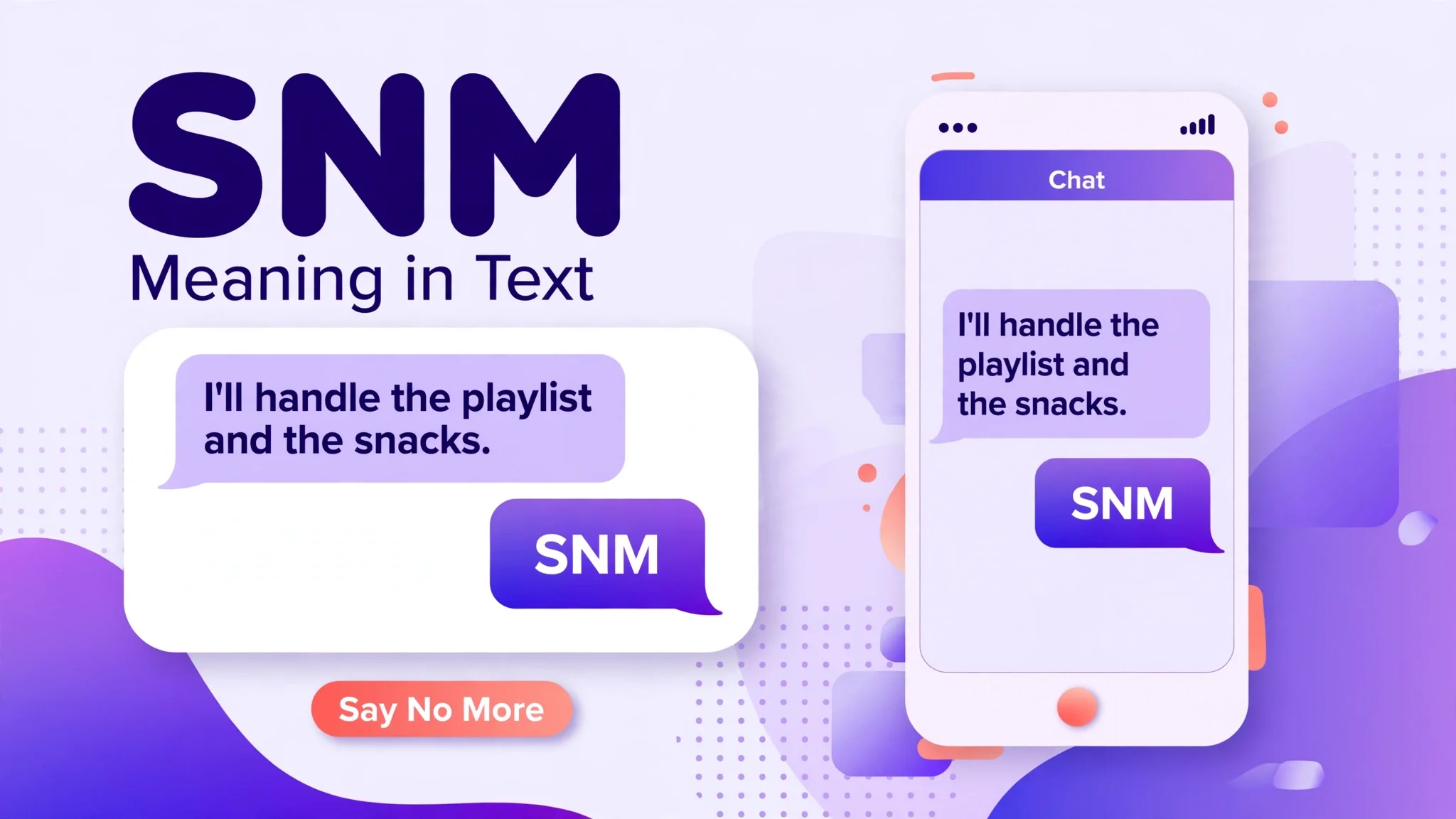
If someone just replied to your message with three letters and nothing else, you are probably wondering whether they agreed with you or told you to stop talking. That is the whole puzzle of snm meaning in text: the same three letters can be a warm yes or a cold full stop, and the difference lives in the conversation around them.
SNM usually means “say no more”: a quick way of saying “I get it, you do not need to explain further.” Someone sends it when the message has already landed or the hint was already understood. But SNM has a second face too. In the wrong moment, it can mean “I have heard enough,” and that version shuts a topic down.
What SNM Means in Text
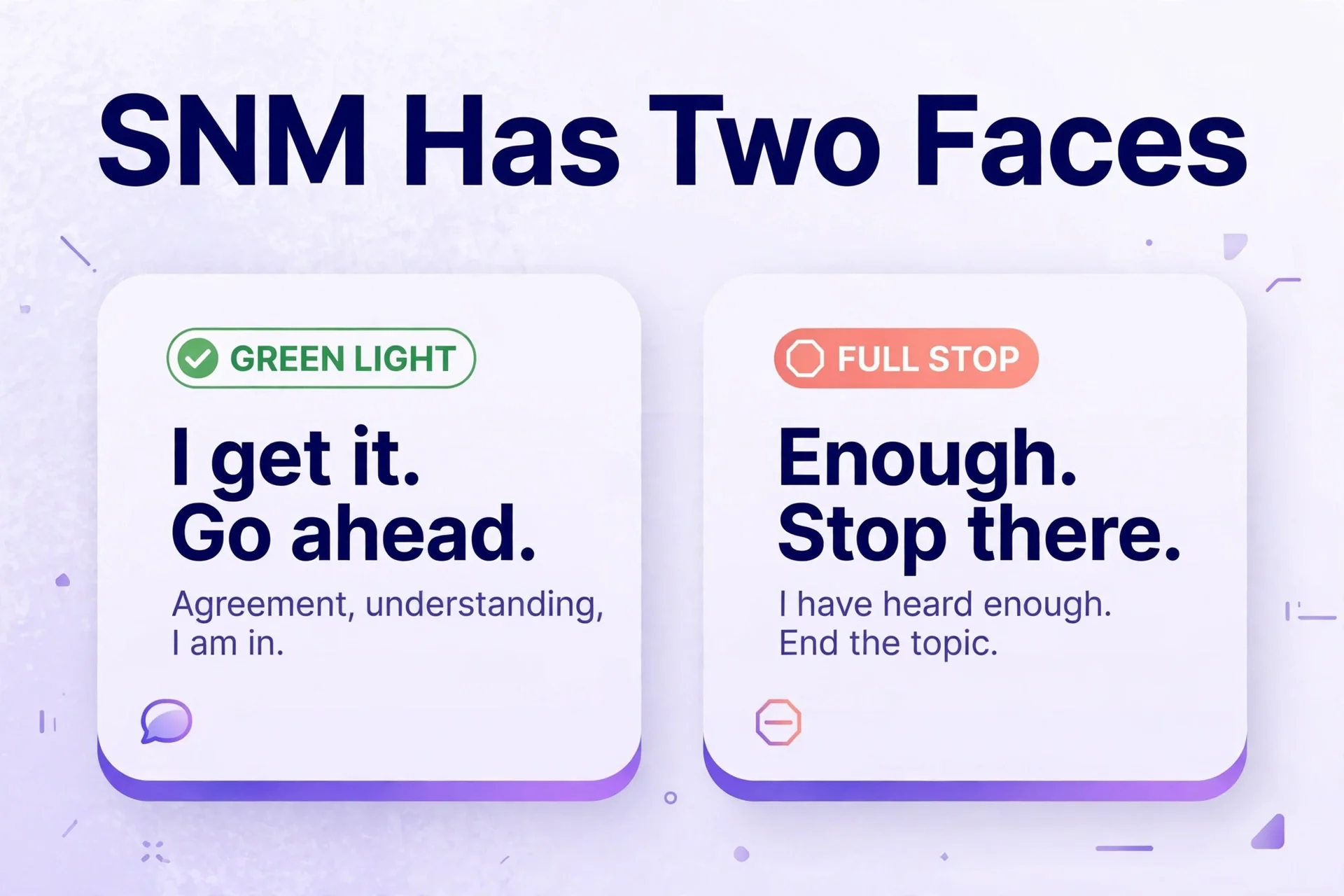
SNM stands for “say no more,” an English phrase that predates texting by decades. People have said it out loud for years to mean “I understand completely.” Texting simply squeezed it into three letters.
In plain English, SNM translates to “Got it” or “You do not need to explain.” It is a reply, not a conversation starter: it only makes sense after someone else has said something first.
That is what makes it different from a plain “ok”: “ok” confirms you saw a message, while SNM confirms you understood it. The same confident shorthand shows up in other short replies, such as what FR means in text, which also packs agreement into two letters.
SNM is informal by nature. It belongs in texts, DMs, and group chats between people who already know each other, not in a work email, or where the other person might not know texting slang.
The SNM Three-Question Test
Here is the named reader test for this article: the SNM Three-Question Test. Run through it whenever a bare “snm” leaves you unsure.
Question 1: Was something just explained, hinted at, or offered? If the previous message laid out a plan, shared news, or dropped a hint, SNM almost always means “I get it.” If nothing was explained, treat it as unclear and ask.
Question 2: Is the sender agreeing, or shutting the topic down? If things were friendly and moving forward, SNM is agreement. If things were tense or repetitive, SNM may be a door closing. The emotional temperature of the chat is the best clue you have.
Question 3: Would “got it” fit without changing the meaning? Try swapping SNM for “got it” in your head. If the conversation still flows naturally, you have the green-light reading. If “got it” feels wrong, SNM is probably ending the topic instead. If the three answers conflict, do not guess: ask “Just checking, you are good with the plan?”
SNM in Real Conversations
SNM earns its place in a chat because it fits so many ordinary moments. The examples below are illustrative, not copied from real private messages.
Agreeing to a plan. This is the most common use. Someone proposes something, and SNM says “I am in” without a paragraph of enthusiasm.
Maya: “I will grab the snacks and the speaker. You bring the playlist.”
Jordan: “SNM. See you at seven.”
Confirming shared understanding. Sometimes SNM answers a hint rather than a plan.
Alex: “Let us just say the meeting did not go well.”
Sam: “SNM. Want to talk about it later?”
Cutting a story short. The same letters can also end a topic. When a conversation is going in circles, SNM can mean “I have heard enough.”
Chris: “And then he said, and then I said, and then he said again—”
Taylor: “SNM. Let us just move on.”
Taylor is closing the subject. It also helps to know what NGL means in text — a short candid opener often sits next to SNM.
How Punctuation and Emojis Change SNM
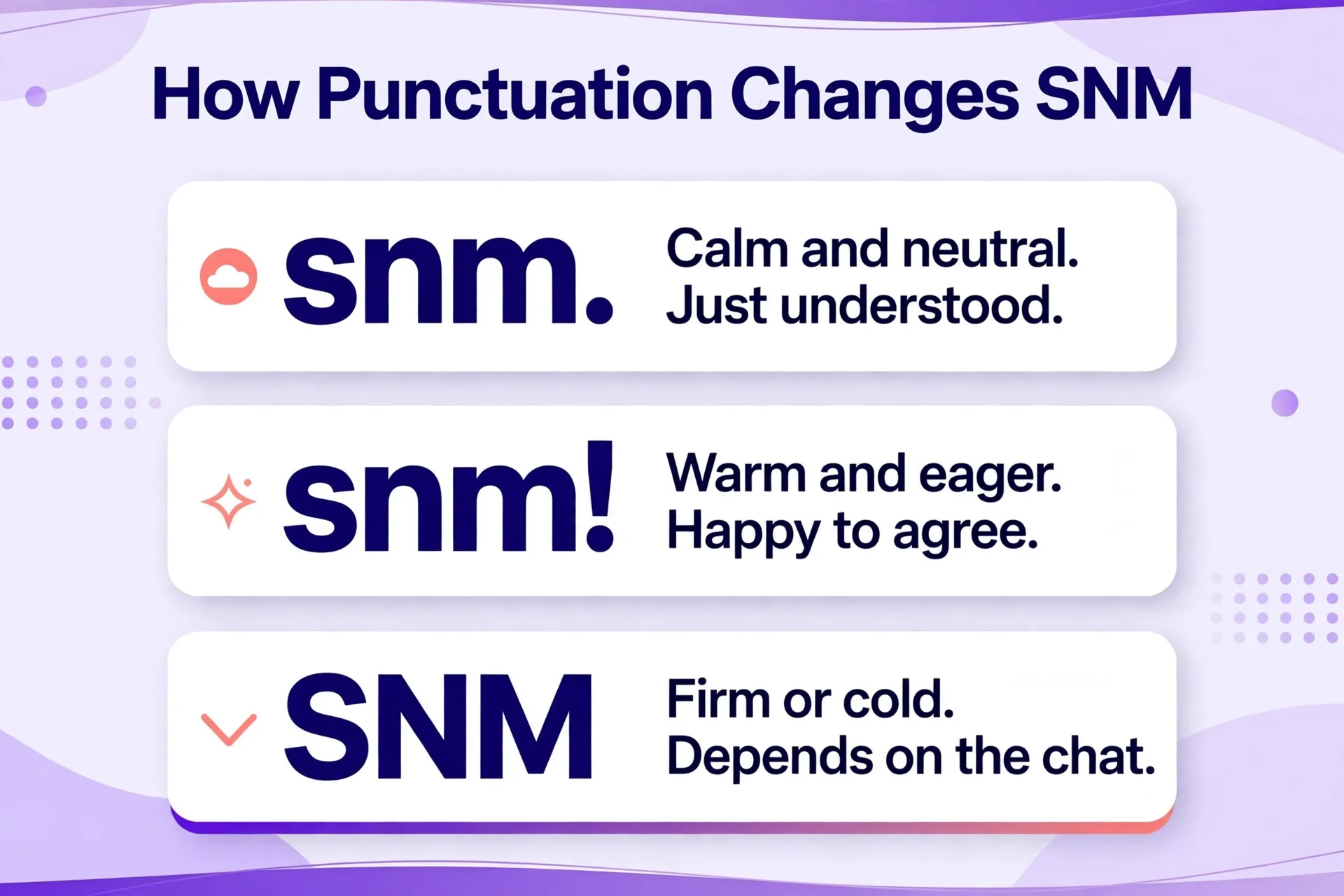
Three letters, one period, and the whole message can change temperature. Punctuation and emojis are the closest thing SNM has to a tone of voice.
“snm.” with a period reads calm and neutral: understood, no fuss, moving on. This is the safest reading, and the safest way to send it.
“snm!” with an exclamation mark warms it up, closer to “Yes, absolutely, I am in!” It suits good news and fun plans.
“SNM” in all capitals makes it firmer: confident in a friendly chat, blunt or cold in a tense one. Capitals raise the volume, so pair them with the mood of the conversation.
Emojis can flip it. An eye roll (“snm 🙄”) turns SNM sarcastic: “I have heard this before.” A laughing or fire emoji pulls it back toward warmth. When an emoji carries a negative feeling, believe the emoji over the letters.
The rule is simple: read the punctuation and the emoji first, then the letters. The tone notes in what SMH means in text work the same way.
SNM on TikTok, Snapchat, Instagram, and in Texting
The core meaning of SNM does not change from app to app: it always comes back to “say no more.”
In texting and group chats, SNM is at home: a fast reply to a plan, a piece of news, or a hint, with the full conversation right there to check. On Snapchat, the disappearing-message format makes it riskier: once the earlier messages vanish, the context that explains SNM vanishes with them. On Instagram, it behaves like a text in DMs, and in public comments it usually reacts to the post itself, meaning “This says it all.” On TikTok, it lives in comments and captions, usually meaning “You said enough, we get it.” On Discord and in gaming chats, it is a fast acknowledgment between rounds.
No major platform officially defines SNM. The setting changes the risk of misunderstanding, not the definition. Short replies are the native language of fast chats, and what BRB means in text survives for the same reason: it is short.
Who Sent It Changes What It Means
The same three letters land differently depending on who typed them.
From a close friend, SNM is almost always warm: shorthand for trust, “I know you, I get it, we are good.” Read it as agreement and move on.
From a crush, it can carry a playful charge with a winking emoji: “You do not need to say more, I like this.” Without an emoji, read it as plain understanding.
From a parent, it usually means simple acknowledgment, like “Understood” or “Okay, got it.” Do not overthink it.
From a boss or teacher, it still means “understood,” but it can sound careless in a professional conversation. Do not send it upward: “Understood, I will handle it” says the same thing without the risk.
From a stranger or a new dating-app match, SNM is genuinely ambiguous, because you do not know their habits yet. Use the Three-Question Test and send a gentle follow-up. In a group chat, it usually speaks to the whole group.
Other Meanings of SNM — and the Ones to Ignore
Most of the time, SNM means “say no more,” and you can stop there. But the letters have other readings.
A vulgar reading exists, and it is niche. In some adult and meme contexts, SNM shortens a crude phrase beginning “s**k my …” followed by a noun, usually as a joking insult. It is attested in user-generated slang sources, but it is not the default meaning in an ordinary chat. The literal wording stays out of this article’s title, summary, and images.
A related adult reading links SNM to S&M, shorthand for s*dism and m*sochism. It is niche and context-bound, and should never be assumed unless the conversation is about that topic.
Other expansions in slang lists include “show no mercy,” “smoke and mirrors,” and “sex and money,” but they have thin attestation and rarely show up in real conversations. One professional reading is “social network marketing,” real jargon in marketing discussions and irrelevant everywhere else.
Meanings to reject outright: a few pages claim SNM means “shaking my head” or “struck a nerve, mate” — confusions with other slang, not real readings. Another page claims a specific monthly search figure for SNM; no credible source supports it. What ALR means in text shows the same pattern: one dominant reading, niche ones, and invented ones to discard.
SNM vs Say Less
SNM and “say less” are the two short replies people confuse most. Both mean something like “I understand, no need to keep talking.” But they are not twins.
| SNM | Say Less | |
|---|---|---|
| Full form | Say no more | Say less |
| Core meaning | I get it, no more explanation needed | I get it, and I am on it |
| Lean | Acknowledgment | Acknowledgment plus action |
| Tone | Calm, sometimes abrupt | Confident, upbeat |
The practical difference is what happens next. SNM usually closes a topic: the explaining is done. “Say less” usually opens the next step: the person is already moving. Saying “SNM” means “Got it”; saying “say less” means “Got it, and I am already on my way.”
How to Reply to SNM
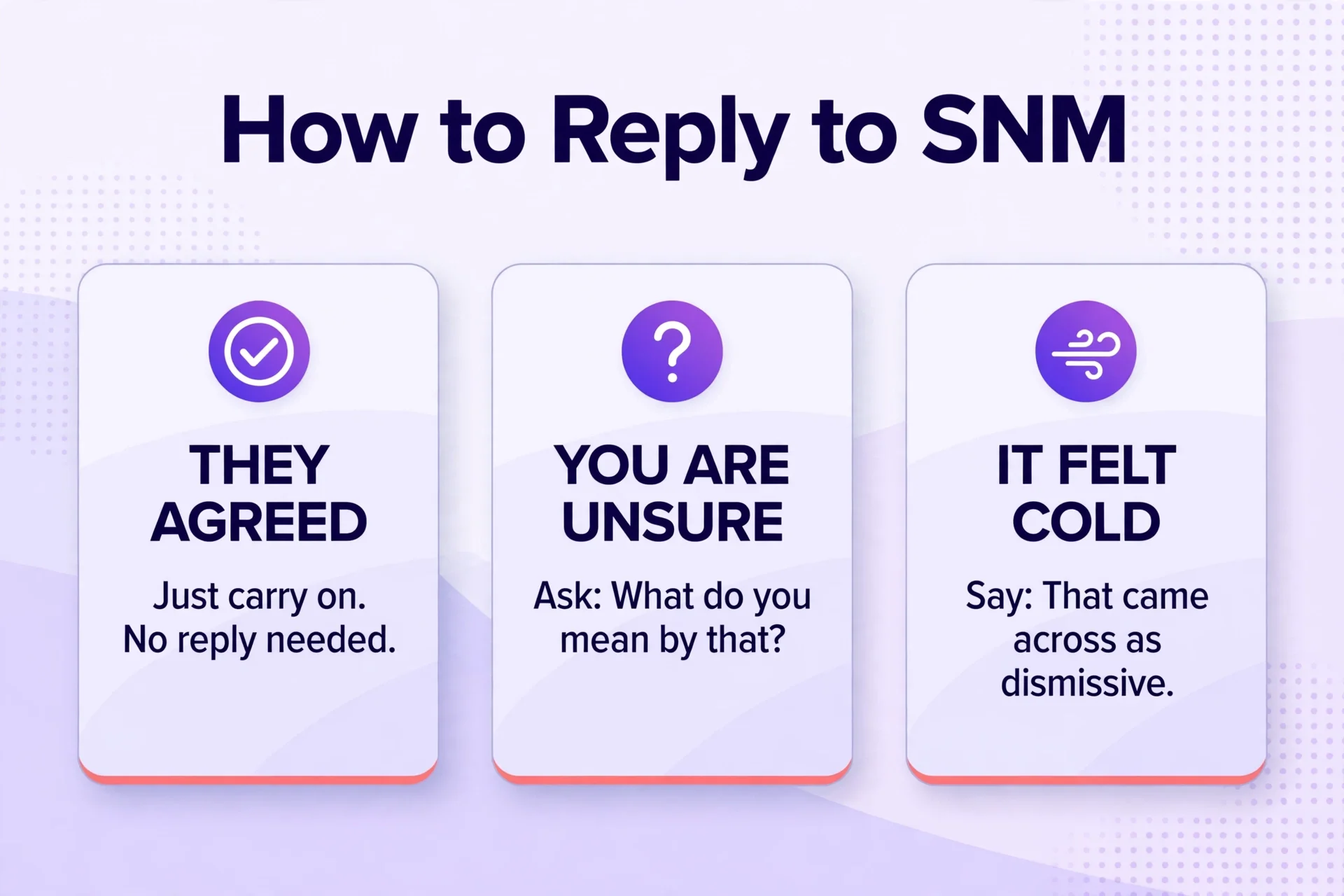
Getting a bare “SNM” back is its own small puzzle. Your reply depends on which face of SNM you just saw.
When SNM clearly meant agreement, you usually do not need to reply at all. If you want to keep things moving, just carry on with the plan: “Perfect, see you at seven.”
When you are unsure what they meant, ask in one line: “Just checking, you are good with the plan?” or “You mean you are in, right?” Both are friendly, and neither accuses the other person of being rude.
When SNM felt cold or dismissive, name it calmly instead of firing back: “That came across as a bit dismissive, did I say something wrong?” Sometimes they meant no harm, and sometimes they really were shutting the topic down.
When you sent SNM and it landed badly, fix it fast: “Sorry, I just meant I totally get it.” Short replies are easy to misread, and a few extra words are cheaper than a misunderstanding. It is also worth knowing what IMO means in text.
When Not to Use SNM
SNM is a useful shortcut, but shortcuts have edges. Leave it alone for serious or emotional news, where “SNM” reads as cold, and at work, where a manager may hear “I cannot be bothered to reply properly.” Use “Understood” or “Got it” instead. Skip it with anyone who may not know slang, and do not use it to dodge a conversation you owe someone, or when the meaning is genuinely unclear — it adds a second riddle to the first one.
These alternatives cover most situations. A laughing reply has its own shorthand too, and what LMAO means in text explains when that kind of reaction fits.
| Instead of SNM, try | When it fits best |
|---|---|
| Got it | Almost everywhere, casual and clear |
| Understood | Work chats and formal messages |
| Say no more | When you want the full phrase for warmth |
| Makes sense | After an explanation you agree with |
| Say less | When you want to sound eager and ready |
Quick Answers About SNM
What does SNM mean in text?
SNM usually means “say no more”: a short way of saying “I understand, you do not need to explain further.”
What does SNM mean on Snapchat?
On Snapchat, SNM means the same thing as everywhere else: “say no more.” Because Snapchat messages disappear, the context around it matters more.
What does SNM mean on Instagram?
On Instagram, SNM means “say no more” in DMs, just like in texting. In public comments it usually reacts to the post itself.
Is SNM rude?
SNM is not rude on its own, but it can sound rude in the wrong moment. With friends, it reads as relaxed agreement. In a serious or professional conversation, it can feel dismissive.
Can SNM be flirty?
Yes, SNM can sound flirty when paired with a playful emoji or a compliment. Without that context, read it as plain understanding.
Is SNM the same as “say less”?
Not exactly. Both mean “I understand,” but SNM leans toward acknowledgment and closing the topic, while “say less” leans toward agreement plus action.
Does SNM have a vulgar meaning?
SNM has a niche vulgar reading in some adult and meme contexts, where it shortens a crude phrase. That reading is not the default. In normal texting, SNM means “say no more.”
When should I not use SNM?
Avoid SNM at work, in formal messages, in serious conversations, and with anyone who may not know texting slang. Use “Understood” or “Got it” instead.
The Bottom Line on SNM
SNM is a small abbreviation with two faces, and now you know how to read both of them. Most of the time, it is a friendly green light: “I get it, say no more, I am in.” Sometimes it is a full stop: “I have heard enough.” The Three-Question Test, the punctuation, and the sender will tell you which one you are looking at.
