
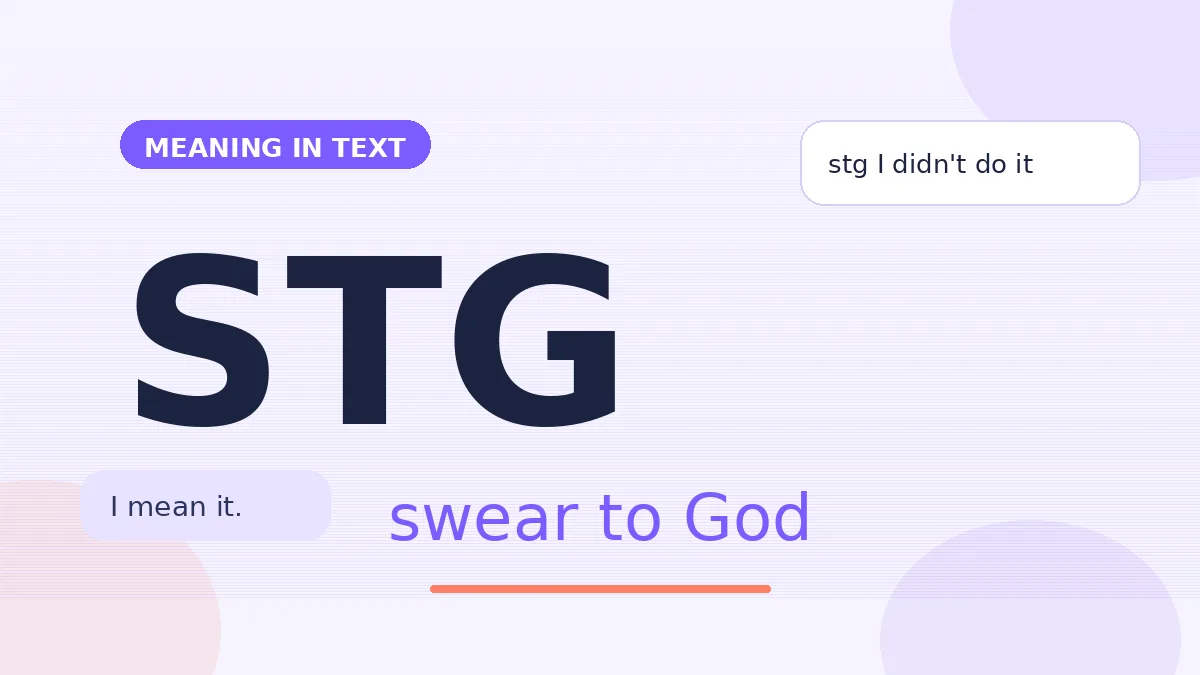
If someone just texted you “stg I didn’t do it” and you are not sure whether they are making a promise, defending themselves, or about to lose their temper, you have found the right page. That is the whole puzzle of stg meaning in text: three small letters that can sound sincere, defensive, furious, or funny, and the difference lives in where they sit in the sentence.
STG means “swear to God”: a shortcut for the spoken phrase “I swear to God,” used to insist something is true, to make a promise sound stronger, or to turn up the emotional volume. It is a stamp on the statement next to it, not a statement on its own.
What STG Means in Text
STG stands for “swear to God,” a phrase people have said out loud for generations whenever they wanted someone to believe them. Texting squeezed it into three letters.
In plain English, STG translates to “I am serious,” “I promise,” or “I am not joking.” It is an intensifier, the texting equivalent of leaning forward while you talk, like what FR means in text.
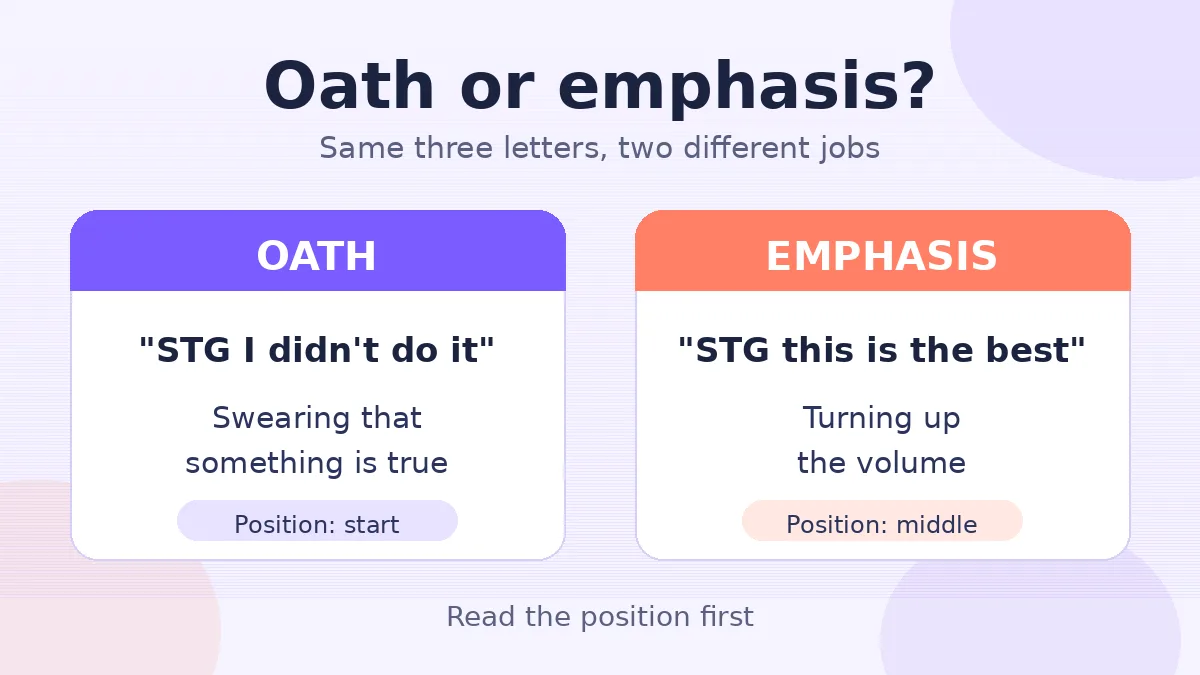
Here is what most guides miss: STG is not always an oath. Sometimes the sender really is swearing something is true, as in “STG I didn’t take your phone.” But often STG is just volume: “STG this is the best pizza I have ever had” is excitement, not a promise about pizza.
STG is informal. It belongs in texts, DMs, and group chats between people who already know each other, not in a work email or a school assignment. Because the full phrase names God, some readers find it uncomfortable.
The STG Position Test
Here is the named reader test for this article: the STG Position Test. Where STG sits in a message changes what it is doing.
Position 1: STG at the start — an oath or a promise. When STG opens a message, the sender is usually swearing that what follows is true, or promising that it will happen: “STG I didn’t say that” is a denial backed by an oath, and “STG I’ll pay you back tomorrow” is a promise with extra weight.
Position 2: STG in the middle — an intensifier. Buried inside a sentence, STG mostly turns up the volume on the feeling, not the facts: “I STG can’t deal with this week” is exhaustion, amplified. It is the most common version, and the least literal.
Position 3: STG at the end — a punchline or a vent. When STG closes a message, it lands like a period with feeling. “This app crashes every five minutes, STG” is a complaint out of patience. “Best movie ever, STG” is a verdict, not a vow.
Position 4: STG trailing off — a warning. “STG if he calls me one more time…” is the one to take seriously: a sentence that stops after STG is almost always frustration or a warning.
If the position test leaves you unsure, try the swap test: replace STG with “seriously” in your head. If the sentence still makes sense, STG was emphasis; if only “I swear” fits, it was an oath.
STG in Real Conversations
The examples below are illustrative, not copied from real private messages.
Defending yourself when nobody believes you. This is the most common use: someone doubts your story, and STG is the fastest way to push back. “Someone ate the last slice. It was you, wasn’t it?” “STG it wasn’t me. I wasn’t even home.”
Making a promise sound stronger. Sometimes STG backs a promise rather than a denial: “You always say you’ll come and then you bail.” “STG I’ll be there this time. Pick me up at seven.”
Venting about something small. STG also works as a pressure valve for everyday annoyance: “STG this traffic gets worse every single day.” “Same. I left an hour early and I’m still late.”
Agreeing with feeling. STG can confirm someone else’s take, with emotion attached: “That finale was unreal.” “STG I’ve watched it three times already.” Nobody is swearing an oath about a television show. It also helps to know what NGL means in text — a short honesty marker that often sits next to STG.
How Punctuation, Capital Letters, and Emojis Change STG
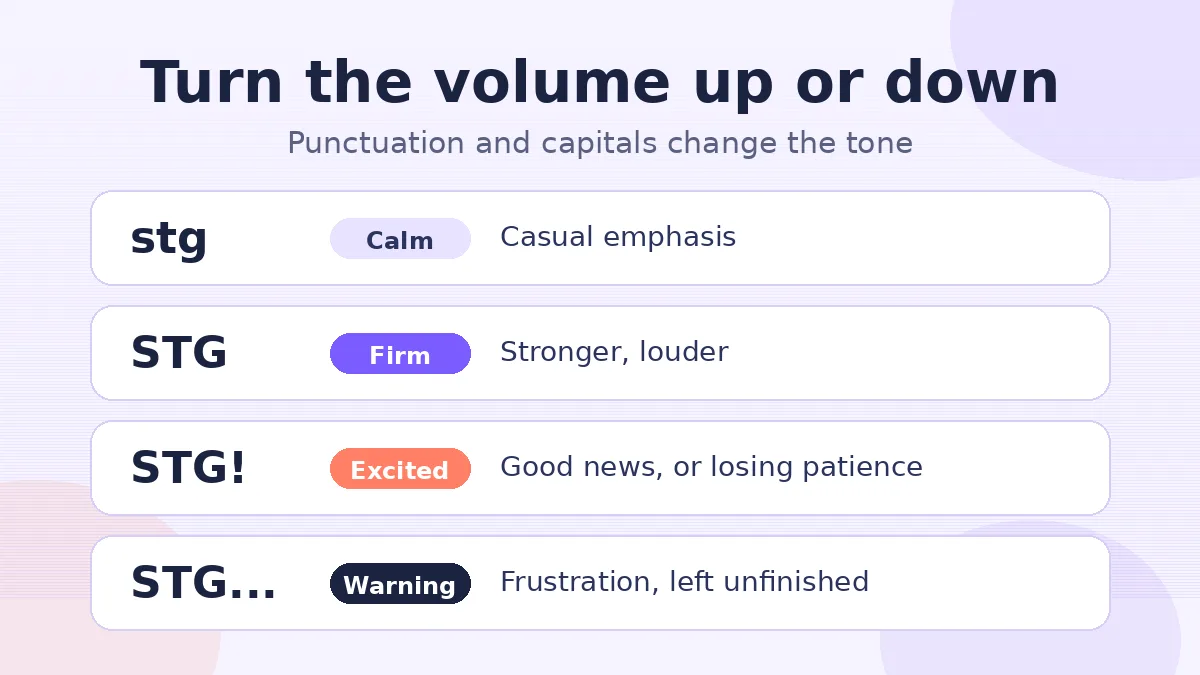
Three letters, one exclamation mark, and the whole message can change temperature. Punctuation, capitals, and emojis are the closest thing STG has to a tone of voice.
“stg” in lowercase reads the calmest: casual emphasis, the way most people type it most of the time.
“STG” in all capitals raises the volume. In a friendly chat it reads as excitement; in a tense chat it reads as shouting. Capitals plus a warning is the combination most likely to be read as angry.
“STG!” with an exclamation mark warms it up when the news is good, closer to “I am so serious, that was amazing!” But in a complaint it reads as losing patience: “STG this is the third time!” “STG…” with a trailing ellipsis is almost always frustration left unfinished: “STG if this happens again…” needs no ending to be understood, so read it as a warning, not a joke.
Emojis can flip it. A laughing emoji (“STG that was so funny 😂”) pulls STG toward playfulness; an angry or eye-roll emoji pulls it toward real annoyance. When an emoji carries a negative feeling, believe the emoji over the letters, as the tone notes in what SMH means in text explain.
Read the punctuation and the emoji first, then the letters.
STG on TikTok, Snapchat, Instagram, and in Texting
The core meaning of STG does not change from app to app: it always comes back to “swear to God.” What changes is how much context you get.
In texting and group chats, STG is at home: a fast reply to an accusation, a promise, or a complaint, with the full conversation right there to check.
On Snapchat, the disappearing-message format makes it riskier: once the earlier messages vanish, the context that explained STG vanishes with them, so ask what it was about.
On Instagram, STG behaves like a text in DMs, and in public comments it usually reacts to the post itself. A comment that just says “STG 😭😭” under a relatable video is agreement and laughter, not an oath.
On TikTok, STG lives in comments and captions, usually as emphasis on a reaction: “STG I thought I was the only one.”
On Discord and in gaming chats, STG is a fast way to insist on a fact mid-game or to vent about a loss: “STG that hit should have landed.” Short replies are the native language of fast chats, and what BRB means in text survives for the same reason.
Who Sent It Changes What It Means
The same three letters land differently depending on who typed them.
From a close friend, STG is almost always warm or funny: shorthand for “I mean it, trust me.”
From a crush, STG usually strengthens whatever came with it: “STG you looked amazing tonight” is a compliment with the volume up. But STG itself is not flirty.
From a parent, it usually means simple insistence. A parent texting “STG I told you twice” is frustrated, not swearing an oath.
From a boss or teacher, STG would be surprising: it is too casual and too intense for a professional message. Do not send it upward: “I can confirm that” says the same thing without the risk.
From a stranger or a new dating-app match, STG is genuinely ambiguous, because you do not know their habits yet. If the message is a warning or an accusation, take it seriously until you know more. In a group chat, STG usually speaks to the whole group.
Other Meanings of STG — and the Ones to Ignore
Most of the time, STG means “swear to God,” and you can stop there. But the letters have other readings.
Security Threat Group is a real meaning in prisons and law enforcement, describing a group of inmates treated as an organized threat. It has nothing to do with texting.
Sterling is a real meaning too: STG is an unofficial code for the British pound sterling, used in place of the official code GBP in some financial writing, usually in lowercase with a number attached, as in “250 million stg.”
Shoot ’em up is a gaming meaning: STG can describe the shoot-’em-up genre, where one character faces waves of enemies. In a gaming chat, check the topic before assuming “swear to God.”
“Something” in British texting is a weak claim from one slang guide, with no dictionary support. Consider it only when “something” fits and “swear to God” does not.
Meanings to reject outright: a few pages claim STG emerged in early-2000s SMS chatrooms, or attach specific popularity and search figures to it. No credible source supports those claims, so this article does not repeat them. The same pattern shows up in what ALR means in text.
STG vs ISTG vs ONG
STG has two close cousins, and people mix them up constantly.
| STG | ISTG | ONG | |
|---|---|---|---|
| Full form | Swear to God | I swear to God | On God |
| Core meaning | I mean it, I swear | I personally swear it | I swear on God, for real |
| Tone | Strong, flexible | Slightly stronger, more direct | Casual, street-slang feel |
The difference is small but real. STG is the shortest and most common form. ISTG adds the “I,” which makes it feel more personal. ONG reads as more casual, and it is the one most likely to appear as a reaction (“ONG that was crazy”). If you only learn one, learn STG.
How to Reply to STG
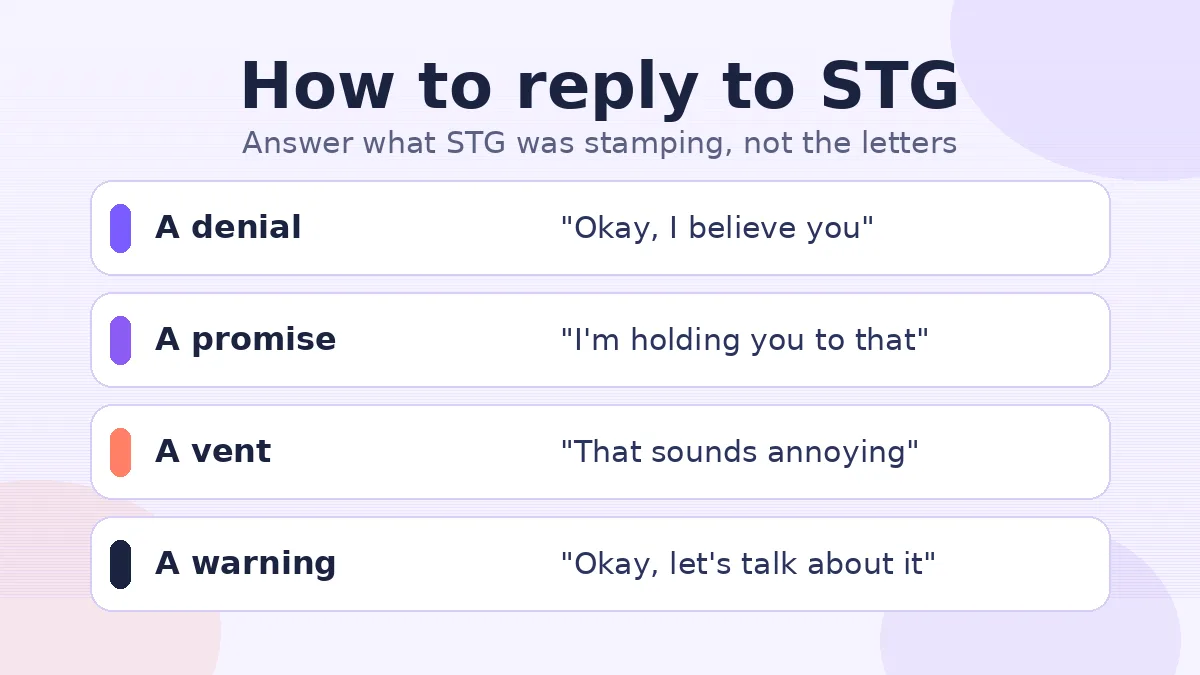
Your reply depends on what STG was stamping.
When STG backed a denial and you believe them, say so in one line: “Okay, I believe you” or “Fair enough.” It is also worth knowing what IMO means in text.
When STG backed a promise, hold them to the words: “Okay, I’m holding you to that” or “Deal.”
When STG was a vent, answer the problem, not the letters: “Yeah, that sounds annoying” or “What happened this time?”
When STG was a warning, slow down, do not joke: “Okay, I understand. Let’s talk about it.” A trailing “STG if this happens again…” signals that patience is gone.
When Not to Use STG
STG is a useful shortcut, but it has sharper edges than most, because its full phrase names God. Leave it alone at work, in school assignments, and in any formal message.
Skip it with anyone who may not know slang, and be careful with anyone who takes religious language seriously: some readers find casual swearing by God disrespectful. If you are unsure, choose a softer option. A laughing reply has its own shorthand too, and what LMAO means in text explains when that kind of reaction fits.
Do not use STG to dodge a conversation you owe someone, and do not sprinkle it into every message: when every sentence carries an oath, none sounds serious anymore. Save it for the moments that deserve the weight.
| Instead of STG, try | When it fits best |
|---|---|
| I promise | Promises you want taken seriously |
| I assure you | Work chats and formal messages |
| Seriously | Emphasis without religious wording |
| Honestly | A softer, everyday honesty marker |
Quick Answers About STG
What does STG mean in text?
STG usually means “swear to God”: a short way of saying “I am serious,” “I promise,” or “I am not joking.”
What does STG mean on Snapchat?
On Snapchat, STG means “swear to God,” the same as everywhere else. Because messages disappear, the context matters more.
What does STG mean on Instagram?
On Instagram, STG means “swear to God” in DMs. In public comments it reacts to the post itself.
What does STG mean on TikTok?
On TikTok, STG means “swear to God” in comments and captions, usually as emphasis on a reaction.
Is STG rude?
STG is not rude on its own, but it can sound rude in the wrong moment: in a friendly chat it reads as emphasis, in an argument it can feel intense or threatening. Some people also dislike its casual religious wording.
Is STG the same as ISTG?
Almost. STG means “swear to God” and ISTG means “I swear to God.” ISTG feels slightly more personal because of the added “I.”
What does STG mean from a girl or a guy?
STG has the same meaning whoever sends it: “swear to God.” Gender does not change the definition.
When should I not use STG?
Avoid STG at work, in formal messages, and with anyone who may find casual religious wording disrespectful.
The Bottom Line on STG
STG is a small abbreviation with a loud voice, and now you know how to read it. Most of the time, it is emphasis: “I mean it, I am serious, I am not joking.” Sometimes it is a real oath, backing a denial or a promise. Sometimes it is a warning, trailing off where the sender ran out of patience. The Position Test, the punctuation, and the sender will tell you which one.
