
You get a text that just says “su” and nothing else. Is your friend telling you to be quiet, or pointing you toward a link? That is the whole problem with su meaning in text: the same two letters do three different jobs, and only the setting tells you which one you are looking at.
In a private chat, SU usually means “shut up,” often playful rather than angry, more like “No way!” than a real order. On a Story, it usually means “swipe up,” an instruction to open a link. At the end of a conversation, it can quietly mean “see you.” Same letters, three jobs, and the setting decides.
What SU Means in Text
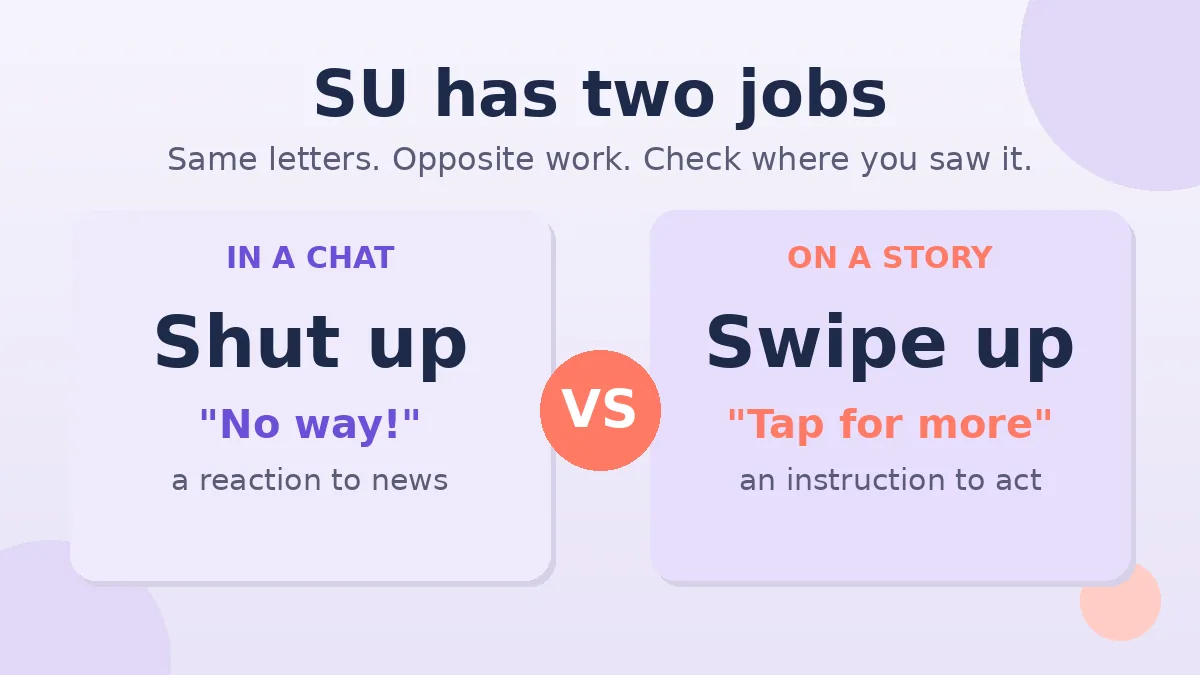
SU is an initialism, but it stands for more than one phrase. In a direct message, the phrase is almost always “shut up.” On a Story or a post with a link, the phrase is “swipe up.” The letters never change, so the reader has to do the work the letters will not do.
In plain English, SU in a chat translates to “No way!” or “I cannot believe that,” said with surprise, and sometimes with real irritation. It is a reaction, not a conversation starter: it only makes sense as a reply to something someone just said. On a Story, it translates to “tap or swipe here for more,” which is an instruction, not a reaction. Most abbreviations have one meaning with shades of tone. SU has two, one that reacts and one that directs.
No dictionary lists the slang readings, so this article grades them from real usage.
The SU Story-or-Chat Test
Here is the named reader test for this article: the SU Story-or-Chat Test. It takes about two seconds.
Clue 1: Where did you see it — on a Story, or in a chat? If SU sits on a Story, a post, or a caption next to a link or a “for more” prompt, read it as “swipe up.” If it sits in a private chat or a DM, read it as “shut up” until something proves otherwise. Placement beats everything else.
Clue 2: What came immediately before it? If the previous message was surprising news, a bold claim, or a joke, “shut up” is the reading: the sender is reacting. If the previous message was a goodbye, “see you” enters the picture. If nothing came before it at all, be suspicious, because SU almost never starts a conversation.
Clue 3: Is there a question mark, an exclamation mark, or an emoji? “SU?” leans away from a command, because nobody asks “shut up?” as an order. “SU!” is usually excitement. A laughing emoji means playful disbelief; a bare “SU.” is the coldest version. If the clues fight each other, trust Clue 1 first.
SU in Real Conversations
The examples below are illustrative.
Reacting to surprising news. This is the most common use in a private chat. Someone shares something unbelievable, and SU says “No way!” without a paragraph of disbelief.
Priya: “I got the internship. They called this morning.”
Ben: “SU! Are you serious right now?”
Ben is celebrating, not silencing anyone.
Friendly teasing. Between close friends, SU pushes back on an exaggerated claim.
Leo: “I could beat anyone at this game, blindfolded.”
Ana: “SU 😂 you lost three rounds yesterday.”
A genuine order to stop. The same letters can be literal, and usually are when the conversation is already tense.
Sam: “I am going to keep bringing it up until you admit it.”
Alex: “SU. I have heard enough.”
Alex is not joking: no emoji, no follow-up question, and the sentence before it was an argument. The same confident shorthand shows up in other short replies, such as what FR means in text, which also packs a whole reaction into two letters.
How Punctuation and Emojis Change SU
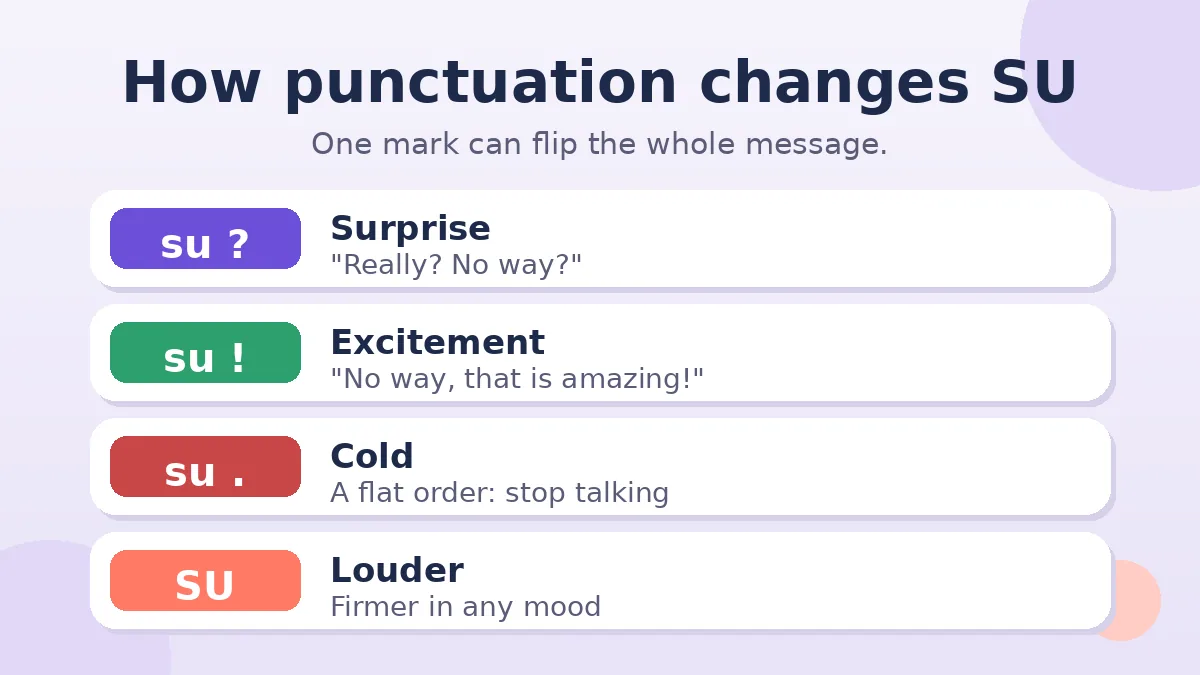
Two letters, one mark of punctuation, and the whole message changes temperature. Punctuation and emojis are the closest thing SU has to a tone of voice.
“su?” with a question mark is almost never a command. A question mark turns SU into a reaction of disbelief: “Really? No way?” Treat it as surprise first.
“su!” with an exclamation mark is excitement: “No way, that is amazing!” “su.” with a period is the coldest version, a flat order to stop talking. Take it seriously in a tense conversation.
“SU” in all capitals raises the volume. In a happy chat it sounds like delighted shouting; in an argument it sounds like an actual shout. Capitals never soften SU. Emojis can flip it. A laughing face (“su 😂”) makes the playful reading almost certain, while an eye roll (“su 🙄”) pushes it toward sarcasm. The tone notes in what SMH means in text work the same way.
SU on TikTok, Snapchat, Instagram, and in Texting
The core split in SU does not change from app to app, but the odds of each reading shift a lot. Short replies are the native language of fast chats, and what BRB means in text survives for the same reason: it is short.
In texting and group chats, SU is at home as a reaction. A private message has no link to swipe toward, so “shut up” is the default reading. In a group chat it usually reacts to whatever was just announced.
On Snapchat, both readings live side by side. In a direct chat, it behaves like a text: “shut up,” playful or literal. On a Story, “S/U” is a swipe-up prompt.
On Instagram, the Story reading is fading: Instagram replaced the swipe-up link with a link sticker in 2021, so “SU for the link” is leftover wording. In DMs, SU is a reaction like anywhere else.
On TikTok, SU is almost always a reaction. It lives in comments and captions, usually meaning “shut up” as delighted disbelief: “SU, this is too funny.” A caption might use “SU for part 2,” but check whether there is actually anything to swipe toward.
Who Sent It Changes What It Means
The same two letters land differently depending on who typed them.
From a close friend, SU is almost always warm: shorthand for trust, “I know you, I cannot believe it, tell me more.” Read it as playful surprise and move on. From a crush, it can carry a playful charge with a laughing emoji, but without an emoji, read it as plain surprise rather than flirting. The abbreviation alone is not a signal of attraction.
From a parent, it usually means simple surprise. If the tone is unclear, ask. From a boss or teacher, SU is a red flag no matter which reading was intended. As “shut up” it sounds disrespectful, and as “swipe up” it sounds like a marketing memo. Do not send it upward.
From a stranger, SU is genuinely ambiguous, so ask. In a group chat, it usually reacts to the whole group.
Other Meanings of SU — and the Ones to Ignore
Most of the time you can stop at the two main readings, but the letters have others, and some are traps.
“See you” is real, but it is the third reading, not the second. In a goodbye message with a plan already settled, “Okay, su tomorrow” can mean “see you tomorrow.” It is the less likely reading, because readers may mistake it for “shut up.”
“Sign up” is rarer still, and only in registration messages.
“What is up?” is the reading to be careful with. One guide claims SU means “what’s up?” as a greeting, but no other guide agrees; it looks like confusion with SUP.
Meanings to reject outright: a few low-quality pages claim SU means “send/upload,” “straight up,” “stand up,” or “switch user” in texting. None of these has real attestation in ordinary chats. What ALR means in text shows the same pattern: one dominant reading, a real second one, and invented ones to discard.
Outside texting, SU has real but unrelated meanings. In Unix and Linux, “su” is a command for switching to another user account. In Spanish, “su” is a possessive word meaning “his,” “her,” or “their.” None of these is texting slang. SU has no hidden vulgar expansion: “shut up” is blunt, not profane.
SU vs SUP
SU and SUP look alike but are not twins.
| SU | SUP | |
|---|---|---|
| Full form | Shut up / Swipe up | What is up? |
| Core meaning | Reaction (“No way!”) or instruction (“Swipe here”) | Greeting (“What is happening?”) |
| Opens a chat | Almost never | Very often |
| Needs a previous message | Usually yes | No |
SUP starts a conversation; SU reacts to something already said, or points at a link. A short candid opener often sits next to SU too, and what NGL means in text explains when that kind of honesty fits.
How to Reply to SU
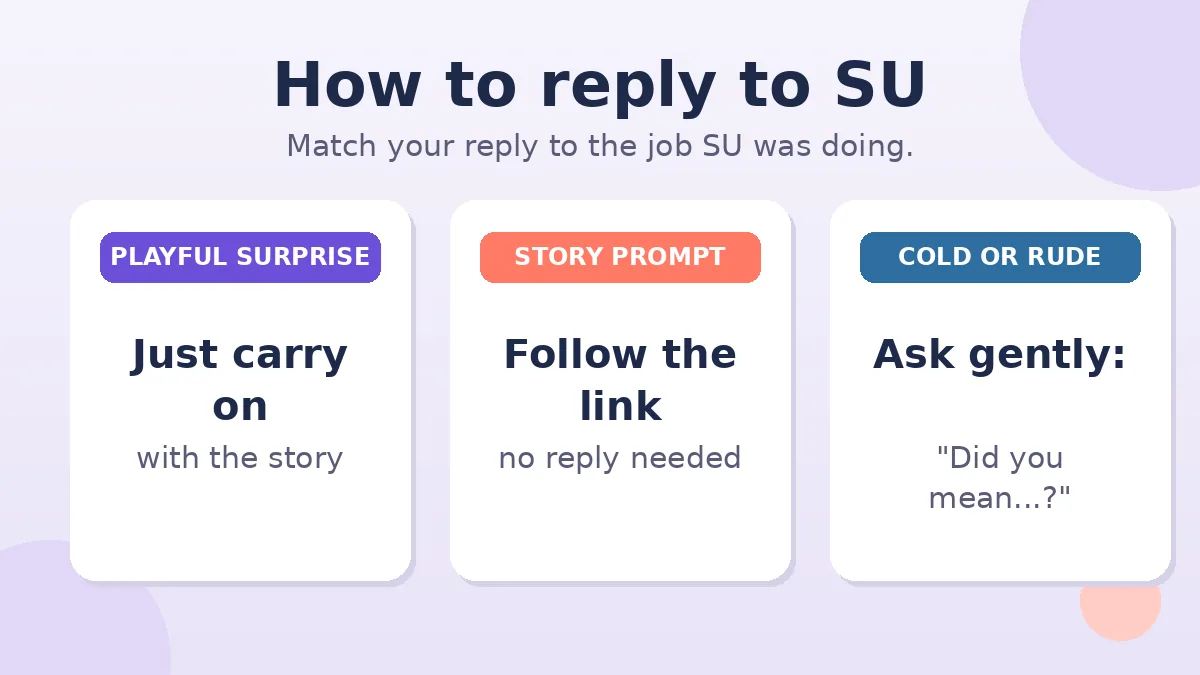
Getting a bare “SU” back is its own small puzzle. Your reply depends on which job SU was doing.
When SU clearly meant playful surprise, you usually do not need to reply to the abbreviation at all. Just carry on with the story.
When SU was a Story prompt, no reply is needed. Follow the link if you are interested.
When SU meant “see you,” close the conversation warmly: “See you tomorrow!”
When you are unsure what they meant, ask in one line: “Did you mean swipe up or no way?” It is friendly.
When SU felt cold or dismissive, name it calmly instead of firing back: “That came across as a bit harsh, did I say something wrong?” Sometimes they meant no harm.
When you sent SU and it landed badly, fix it fast: “Sorry, I just meant no way, that is amazing.” Short replies are easy to misread, and a few extra words are cheaper than a misunderstanding. It is also worth knowing what IMO means in text.
When Not to Use SU
SU is a useful shortcut, but shortcuts have edges. Leave it alone for serious or emotional news, where “SU” reads as cold, and at work, where a manager may hear “I cannot be bothered to reply properly.” Use “No way!” or “Understood” instead. Skip it with anyone who may not know slang, and never use it to dodge a conversation you owe someone. Never use it as a Story prompt without an actual link behind it.
One caution is specific to SU: Instagram replaced swipe-up links with link stickers in 2021, so writing “SU” on a Story today can confuse newer followers. If you mean “tap the link,” write that instead.
A laughing reply has its own shorthand too, and what LMAO means in text explains when that kind of reaction fits.
| Instead of SU, try | When it fits best |
|---|---|
| No way! | Playful surprise after good news |
| I cannot believe it | Disbelief you want to sound warm |
| See you tomorrow | Goodbyes with a plan already set |
| Understood | Work chats and formal messages |
Quick Answers About SU
What does SU mean in text?
In a private chat, SU usually means “shut up,” most often as playful surprise. On a Story, it usually means “swipe up.”
What does SU mean on Snapchat?
On Snapchat, SU means “shut up” in a chat and “swipe up” on a Story.
What does SU mean on Instagram?
In Instagram DMs, SU means “shut up” as a reaction. On a Story, it is leftover wording for “swipe up.”
Is SU rude?
SU can be rude when “shut up” is meant literally, especially in an argument or at work. Between friends, it is usually playful.
What does SU mean from a girl?
It depends on the conversation, not on who sent it. “SU?” usually means surprise and “SU 😂” usually means playful disbelief.
Is SU the same as SUP?
No. SUP means “what is up?” and opens a conversation. SU reacts to something already said, or points at a link. One letter changes the meaning completely.
Does SU have a vulgar meaning?
No. SU has no hidden vulgar expansion. “Shut up” is blunt, not profane; the profane version is a different abbreviation, STFU.
When should I not use SU?
Avoid SU at work, in formal messages, in serious conversations, and with anyone who may not know texting slang.
The Bottom Line on SU
SU is two letters with two jobs, and now you know how to tell them apart. In a chat, it is a reaction: “shut up,” usually meaning “No way!” On a Story, it is an instruction: “swipe up,” pointing you toward more. The Story-or-Chat Test, the punctuation, and the sender will tell you which one you are looking at.
