
You asked a question, waited an hour, and finally sent a nudge. Or someone sent you three letters and vanished, leaving you wondering whether they want a reply or are talking about something else entirely. That is the everyday puzzle of tmb meaning in text: most of the time it is a simple request for a reply, but the same three letters can also be an ordinary Spanish word hiding in plain sight.
TMB usually means “text me back”: a short way of asking someone to reply when they get a chance. It shows up at the end of a question, after a long silence, or on its own when someone is waiting. But in a Spanish conversation, “tmb” is not a request at all. It is shorthand for también, meaning “also” or “too,” as in “yo tmb,” meaning “me too.”
What TMB Means in Text
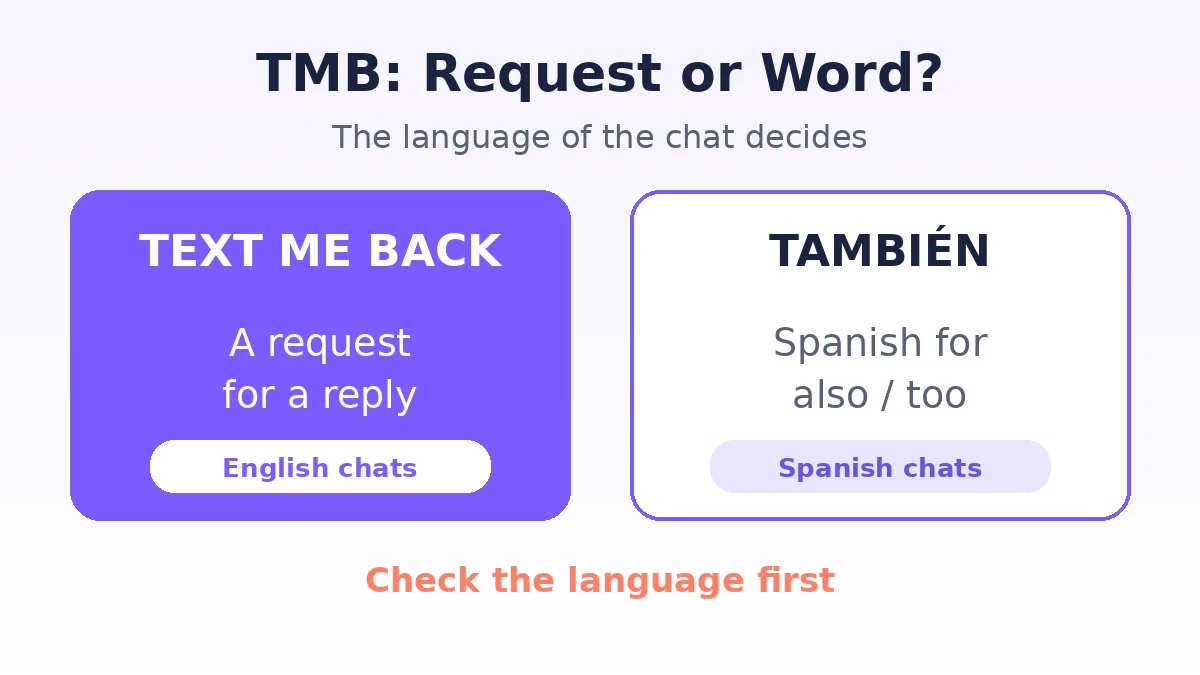
TMB stands for “text me back,” built the same way as most texting abbreviations: take the first letter of each word and drop the rest. It is an initialism, so you say the letters one by one, tee-em-bee, rather than pronouncing it as a word.
In plain English, TMB translates to “Please reply to my message” or “Get back to me when you can.” It is a request, not a statement, so it only makes sense when a reply is owed: after an unanswered question or a message that needs a reaction. The same confident shorthand shows up in other short replies, such as what FR means in text.
TMB is informal. It belongs in texts, DMs, and group chats between people who already know each other, not in a work email or a message to a teacher. It is almost always written in lowercase in real chats; lowercase “tmb” feels relaxed, while all-caps “TMB” feels louder and more urgent.
The TMB Language-and-Position Test
Here is the named reader test for this article: the TMB Language-and-Position Test. Run through it whenever a bare “tmb” leaves you unsure, and it will settle most cases in about ten seconds.
Step 1: Check the language first. If the rest of the message is in Spanish or Portuguese, read “tmb” as también, meaning “also” or “too.” A message like “yo tmb” cannot mean “yo text me back,” and this single check solves the most common TMB confusion there is.
Step 2: Check the position in the sentence. If “tmb” sits mid-sentence, as in “yo tmb voy a la fiesta,” it is almost certainly también, because a reply request does not belong inside a sentence about going to a party. If it stands alone or ends a message after a question, it is almost certainly “text me back.”
Step 3: Check whether anything is waiting for a reply. A pending question, an unanswered plan, or a missed call all point to a nudge for a reply. If nothing is waiting, and the message is a photo caption with a crying emoji, TMB may be nostalgia instead. If the three steps disagree, ask “Do you mean text me back, or something else?”
TMB in Real Conversations
TMB earns its place in a chat because it fits so many ordinary moments. The examples below are illustrative, not copied from real private messages.
Nudging after a question. This is the most common use. Someone asks something, time passes, and TMB says “I am still waiting” without sounding angry.
Maya: “Are we still on for Saturday?”
Maya, two hours later: “tmb”
Asking for a reply when you are free. Sometimes the sender knows the other person is busy and does not want to interrupt, so the request comes with its own softener.
Jordan: “Heading into a meeting. Tmb when you can.”
The bilingual misread. Sam writes “Voy al concierto. Tmb mi hermano,” meaning “my brother too,” and Chris replies “Okay, I will text you back later!” Chris got it wrong: Sam was not asking for a reply. A short candid opener often sits next to a nudge like this, and what NGL means in text explains how one works.
How Punctuation, Repetition, and Emojis Change TMB
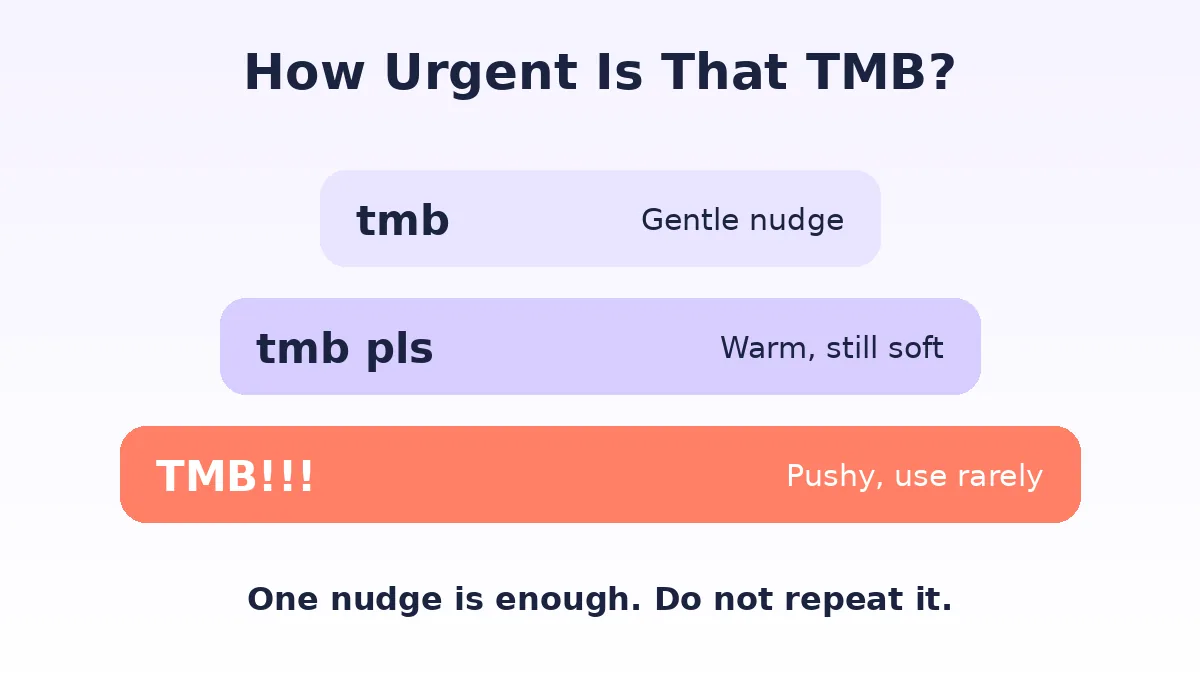
Punctuation, repetition, and emojis are the closest thing TMB has to a tone of voice, and they matter more here than with most slang, because TMB is a request aimed at another person.
“tmb” in lowercase reads calm and routine: a gentle nudge, no pressure, answer when you can. “tmb pls” softens it further. “tmb asap” or “TMB!!!” turns the volume up, so save it for genuinely time-sensitive messages.
Sending TMB again and again is where a friendly nudge becomes pressure. One “tmb” feels gentle. Five in a row feels impatient, and the other person hears “why are you ignoring me” even if that was never the intention. One request is enough in most cases.
Emojis can soften or sharpen it. A smiling face (“tmb 😊”) keeps it warm, a pleading face (“tmb 🥺”) makes it sound needy, and an angry or eye-rolling emoji turns it into a complaint. When an emoji carries a strong feeling, believe the emoji over the letters. The tone notes in what SMH means in text work the same way.
TMB on TikTok, Snapchat, Instagram, and in Texting
The core meaning of TMB does not change from app to app: it almost always comes back to “text me back.” What changes is which of the secondary meanings becomes plausible.
In texting and group chats, TMB is at home: a fast nudge after a question or a plan, with the full conversation right there to check. On Snapchat, it almost always means “text me back.” On Instagram, the meaning splits: in DMs it means “text me back,” while in public comments it can also mean “tag me back” or, under an old photo, “take me back.” On TikTok, it usually means “text me back” on a friend’s video and “take me back” under a throwback. On X, the older reading “tweet me back” is dated. Short replies are the native language of fast chats, and what BRB means in text survives for the same reason: it is short.
Who Sent It Changes What It Means
The same three letters land differently depending on who typed them. From a close friend, TMB is warm and ordinary. From a crush, it can carry a hopeful charge, “I am waiting to hear from you.” From a parent, it usually means simple impatience: “Did you see my message?” From a boss or teacher, it still means “reply to me,” but it can sound abrupt from above, so answer politely and never send one upward. From a stranger, it is genuinely ambiguous: use the Language-and-Position Test and ask a gentle follow-up.
Other Meanings of TMB — and the Ones to Ignore
Most of the time, TMB means “text me back,” and you can stop there. But the letters have other readings, and a few of them are common enough to know.
También, meaning “also” or “too,” is the second major reading. In Spanish and Portuguese chats, “tmb” shortens también or também. It sits inside a sentence, never asks anyone to do anything, and translates directly: “yo tmb” means “me too.” This reading is strongly supported, and it is the one English-only readers miss most often.
Take me back is a real nostalgic reading. Under an old photo or a throwback video, “tmb” with a crying emoji means the commenter wishes they could return to that moment, as in “best summer ever, tmb.” Without the emotion and the old post, do not assume it. Tag me back is plausible but uncommon: only read it that way when tagging is mentioned. Tweet me back is dated. Trust me, bro is a niche meme reading in gaming chats.
A vulgar reading exists, and it is niche. In some adult and meme contexts, TMB shortens a crude phrase beginning “text me, b***h,” and a related comment reading shortens a crude possessive phrase. Neither is the default in an ordinary chat, and the literal wording stays out of this article’s title, summary, and images. What ALR means in text shows the same pattern: one dominant reading, niche ones, and invented ones to discard.
Meanings to reject outright: a few forum answers claim TMB means “too much beauty,” “tell me about it,” or “too much bro.” Those have thin, contradictory attestation and no support from the main slang guides. “Top middle bottom” is a photography term, and outside texting TMB also stands for the Tour du Mont Blanc trail and a medical term, tumour mutational burden. No credible source supports a specific origin date or a search figure for TMB, so this article makes no such claim.
TMB vs CMB, MMB, and HMU
TMB lives in a crowded family of reply-request shortcuts. Each one asks for a different channel:
| TMB | CMB | MMB | HMU | |
|---|---|---|---|---|
| Full form | Text me back | Call me back | Message me back | Hit me up |
| Asks for | A text reply | A phone call | A message, any app | Contact, any way |
| Tone | Casual nudge | More direct | Like TMB | Casual invitation |
The distinction between TMB and CMB matters most: one asks for a message, the other asks for a call. MMB is nearly identical to TMB, only broader. HMU is different in kind: it opens a conversation rather than requesting a reply.
How to Reply to TMB
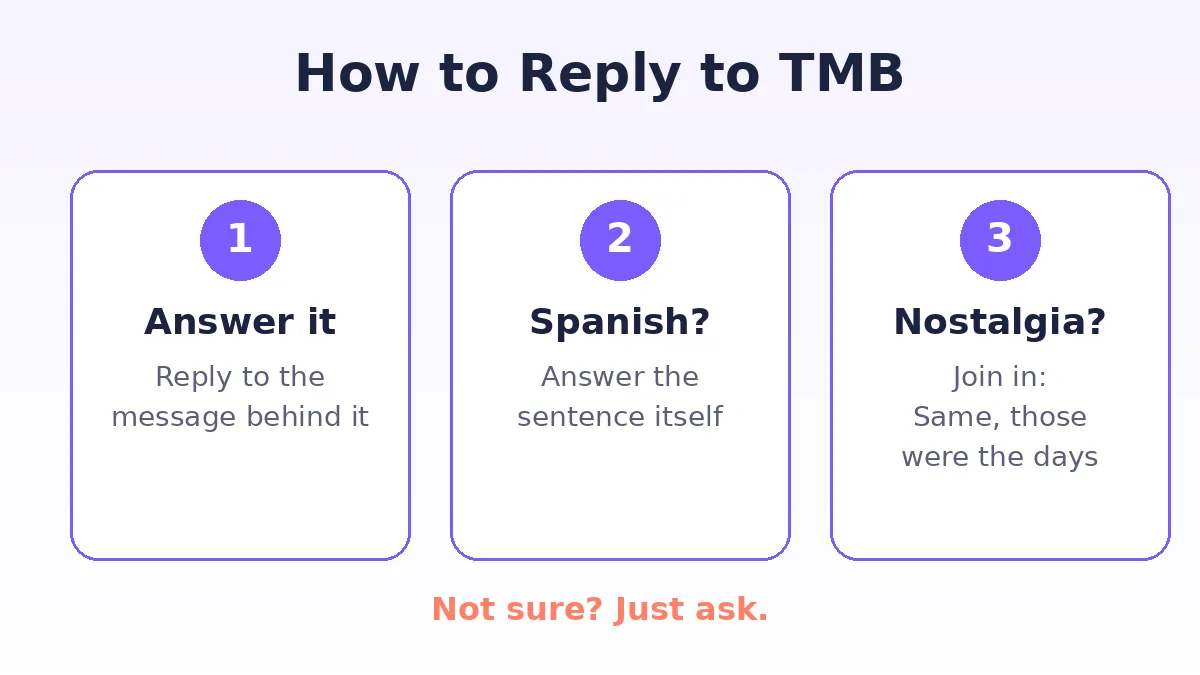
Your reply depends on which reading you just saw, and the Language-and-Position Test will usually tell you which one that is.
When TMB clearly meant “text me back”, simply answer the message behind it. If you are busy, a quick note is kinder than leaving them on read: “Sorry, was busy! Saturday works.” When TMB was Spanish, respond to the sentence itself: answer “yo tmb” as if it said “me too.” When TMB meant “take me back”, join the nostalgia with “Same, those were the days.” When you are unsure, ask: “Do you mean text you back, or something else?” What IMO means in text can help soften a reply. When you sent TMB and it landed badly, fix it fast: “Sorry, I just meant reply when you can, no rush.”
When Not to Use TMB
TMB is a useful shortcut, but shortcuts have edges. Leave it alone in work emails and formal messages, where a three-letter nudge reads as careless, and use a full sentence instead. Skip it when someone already told you they are busy, with anyone who may not know slang, and in serious conversations, where “tmb” can read as cold.
These alternatives cover most situations. A friendly invitation to keep talking has its own shorthand too, and what HMU means in text explains when that kind of opener fits.
| Instead of TMB, try | When it fits best |
|---|---|
| Let me know when you can | Almost everywhere |
| Please reply when you have a moment | Work and formal messages |
| Just checking in, no rush | When you do not want to sound pushy |
| Message me back when you are free | When any app will do |
| Call me back when you can | When you want a call, not a text |
Quick Answers About TMB
What does TMB mean in text?
TMB usually means “text me back”: a short way of asking someone to reply to your message when you get a chance.
What does TMB mean on Snapchat?
On Snapchat, TMB almost always means “text me back.” People send it when they want a reply after a snap goes unanswered.
What does TMB mean on Instagram?
In Instagram DMs, TMB almost always means “text me back.” In public comments it can also mean “tag me back” or “take me back.”
What does TMB mean in Spanish?
In Spanish chats, “tmb” shortens también, which means “also” or “too.” For example, “yo tmb” means “me too.” It is not a request for a reply.
Is TMB rude?
TMB is not rude on its own. One gentle “tmb” is fine with friends, but repeating it several times, or sending it to someone who is clearly busy, can feel impatient or pushy.
Can TMB be flirty?
Yes, TMB can sound flirty when a crush sends it while waiting for your reply, or when it sits next to a playful emoji. Without that context, read it as a plain request for a reply.
Does TMB have a vulgar meaning?
TMB has a niche vulgar reading in some adult and meme contexts, where it shortens a crude phrase. That reading is not the default. In normal texting, TMB means “text me back.”
When should I not use TMB?
Avoid TMB at work, in formal messages, in serious conversations, and with anyone who may not know texting slang. Use a full sentence like “Please reply when you have a moment” instead.
The Bottom Line on TMB
TMB is a small abbreviation with a split personality, and now you know how to read both sides of it. Most of the time, it is a friendly nudge: “Text me back when you can.” Sometimes it is not a request at all, but the Spanish word for “also.” The Language-and-Position Test will tell you which one you are looking at.
