
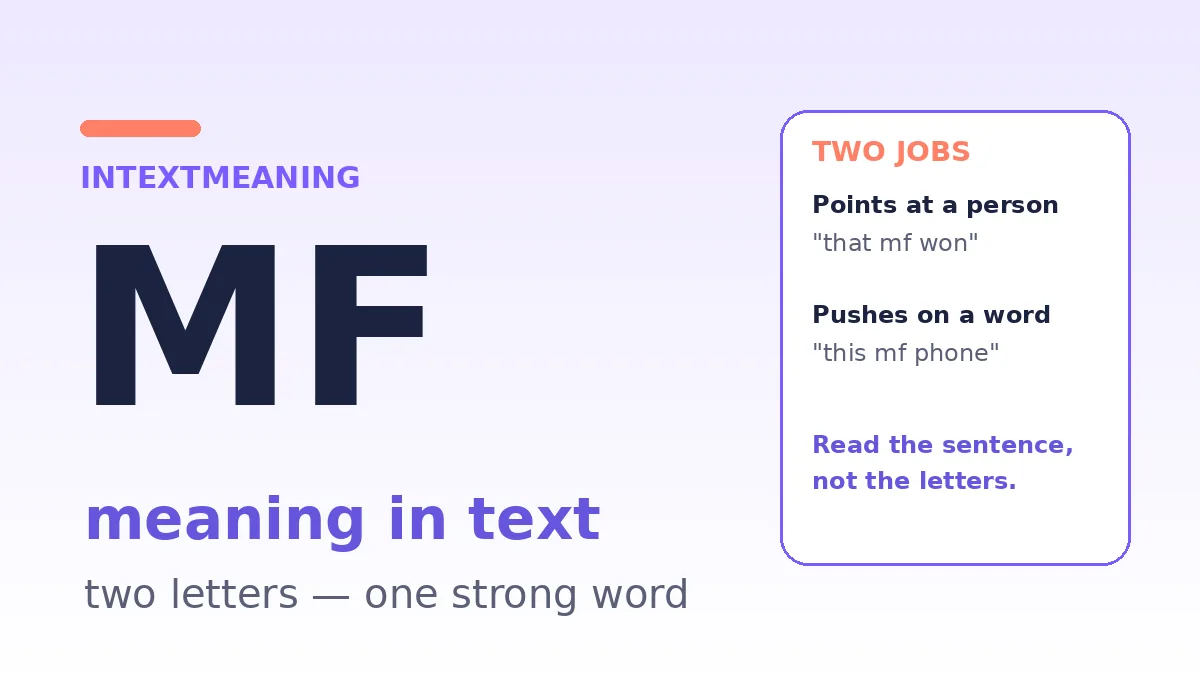
You are scrolling through a group chat when a message stops you: “you crazy mf 😂.” Is that an insult? A compliment? A joke you are supposed to laugh at? That is the whole puzzle of the mf meaning in text: the letters themselves tell you almost nothing. The sentence around them tells you everything.
MF is short for a strong swear word, and in texting it works like a label with the volume turned all the way up. It points at a person, or it pushes on a word, and the tone — praise, teasing, frustration, or anger — comes from everything around it.
The Short Answer: Two Letters, One Strong Word
Here is the one literal explanation this article gives, spelled out once and masked, because the term requires it: MF stands for “motherf***er.” Wiktionary lists it exactly that way — vulgar slang, an initialism — and the big dictionaries agree: Merriam-Webster calls the full word “a generalized term of abuse,” and Cambridge calls it “an extremely offensive name for someone you hate or for someone who has made you angry.” The word itself is old — Green’s Dictionary of Slang traces it to around 1900 — and texting just squeezed it down to two letters.
Everywhere else in this article, MF means one of two things: a person, or a push. What changes is never the word — it is the sentence, the punctuation, the emoji, and the person who sent it.
The Two-Job Test: Person or Push?

Here is the named test for this article — the Two-Job Test. Ask one question: is MF pointing at a person, or pushing on a word?
Job 1: MF points at a person. “That mf won the game.” “You funny mf.” Here MF is a stand-in for a person. Whether it is praise or an insult depends on the words beside it — that is the next section.
Job 2: MF pushes on a word. “This mf phone keeps freezing.” “This mf traffic is unreal.” Here MF sits in front of a noun and turns the volume up on it. The sentence is not about a person at all — it is about a phone or traffic. Green’s Dictionary of Slang records exactly this use: the word as “a thing, otherwise unnamed.”
Two checks confirm the job. The word right after MF: a verb or the end of the sentence means a person; a noun — “mf phone” — means a push. Try swapping MF out: if “that guy” fits, it is a person; if “this stupid” fits, it is a push.
Most misreadings come from mixing the jobs up. “This mf laptop crashed again” is not calling anyone a name — it is a person swearing at a laptop. And “you mf” with nothing after it is always a person.
The Volume Dial: From Praise to Insult on One Slider
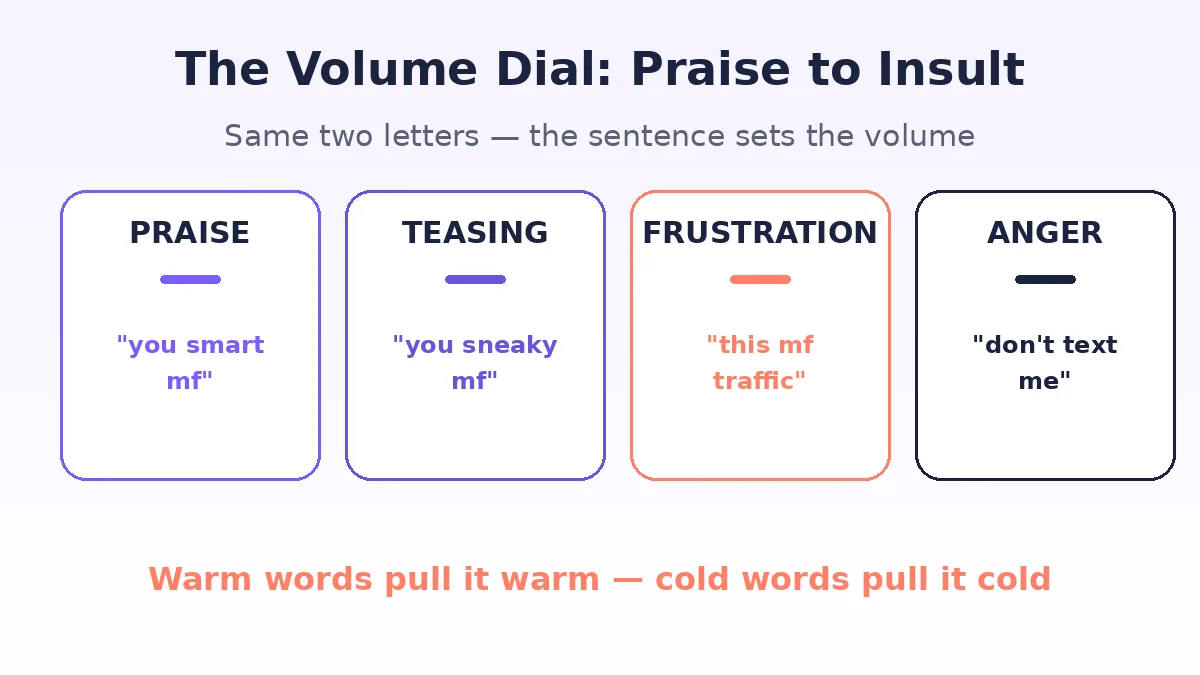
Once you know the job, the tone is a slider, not a switch. The same two letters slide from praise to insult, and the sentence sets the position.
Praise — the warm end. “You smart mf 😭🔥.” “That mf can really sing.” The words around MF are compliments and the sender likes the person they are describing. In gaming chats and TikTok comments, MF is often hype, not hostility. The closest cousin is BMF meaning in text — the version that adds “bad” in front of the same word and means impressive, not insulting.
Teasing — the playful middle. “You sneaky mf, you planned the whole party!” “You clumsy mf 😂.” The words are jokes and the relationship can carry it. Teasing MF only works between people who already joke this way — sent to a stranger, it stops being a joke.
Frustration — the annoyed middle. “This mf traffic 😩.” “I told that mf three times not to touch my car.” Something went wrong, and MF is the sigh with teeth. It is venting, aimed at a situation or a habit — not a fight.
Anger — the cold end. “Don’t text me again mf.” “That mf ruined everything.” No emoji, no joke, no compliment anywhere near it — often caps lock or a period that lands like a door slamming. This is MF as a genuine insult, usually from a stranger or mid-argument.
The words beside MF matter most, and the emoji is the second vote — but a laughing emoji does not erase the word.
Where MF Actually Lives: TikTok, Snapchat, Instagram, and Plain Texting
MF means the same thing on every app. No platform gives it a secret new meaning. What changes is the room — and the room changes how loud it sounds.
TikTok is where MF is loudest and most public. In comments and captions it is hype: “this mf song hits hard,” “that mf really ate that performance.” In that crowd it reads as applause with an edge, not a genuine insult.
Snapchat is where MF is smallest and most private. It shows up in fast chats between people who know each other — a caption on a snap, a one-line reply to a story. “Bro this mf ate all the snacks 😂” is a private joke, and that privacy is what makes it feel safe.
Instagram sits in the middle. In comments under reels, MF behaves like TikTok: public, punchy, usually praise. In DMs it behaves like texting: personal, warmer, aimed at one person.
Plain texting — SMS, WhatsApp, iMessage — is where MF matters most, because these are the threads where the relationship lives. In a group chat, MF is usually teasing or hype. In a one-on-one thread, it lands harder: “you mf” from a friend is a joke you both understand, and “you mf” from someone you barely know is a warning.
MF vs AF, WTF, and MFS: The Profanity Family
MF gets confused with its neighbours because they all live in the same loud neighbourhood. They do different jobs, and the job is the difference.
MF vs AF. MF names someone, AF strengthens a word. “That mf won” is about a person. “Funny af” is about how funny something is. MF points; AF pushes.
MF vs WTF. WTF is a question wearing a swear word: “WTF happened?” asks what happened, with shock attached. MF never asks anything — “that mf did what?” is a statement, with the shock built in. MFS is simply the plural: “those mfs left early.”
MF vs GTFO and STFU. These are the aggressive cousins. GTFO meaning in text is a hard “get out” — rude, final, aimed at ending a conversation. STFU meaning in text is a blunt dismissal. MF is softer than both: it labels a person or pushes a word, but it does not order anyone out of the room. When someone upgrades from MF to SYBAU meaning in text or GTFO, the conversation has stopped being playful.
Who Sent It, and Who It Is Pointed At
The expansion never changes. The sender changes everything.
From a close friend. This is MF’s home turf. Friends use it as hype, teasing, and venting. The relationship is the safety net: you both know the word is not literal, and you both know the joke.
From a crush. If a crush sends you MF, read the words around it, not the letters. “You cute mf” or “you funny mf” is playful teasing with a compliment inside it — a good sign, but not a confession. MF itself is not a flirt signal; the compliment is.
From a stranger. A stranger’s MF is the riskiest kind, because there is no relationship to soften it. “Watch it mf” in a comment reply is a warning, not a joke. Strangers do not get the benefit of the doubt that friends do — and if a stranger calls you an MF, you do not owe them a clever reply.
From a group chat. In a group, MF is usually a chorus: one person sends the story, two people answer “that mf 😂.” The only risk is pile-on — when the whole group aims MF at one person, the joke stops being shared.
The Rooms Where MF Does Not Belong
MF is a wonderful intensifier in the right room. In the wrong room it is a small disaster — the word hiding inside the abbreviation, and the volume it carries.
At work. Work emails, job chats, and anything archived should stay free of MF — a hidden swear word attached to your name in a permanent record is a bad trade for a joke. When a conversation is wrapping up, FR meaning in text is the clean way to agree without any edge at all.
At school. Among classmates, MF is normal. In a message to a teacher or on a school platform, it is not. The line is the audience, not the app.
With family — especially across generations. Parents and grandparents who did not grow up texting often read MF literally. In family group chats, plain words carry the same warmth with none of the risk. The same goes for serious moments: never answer bad news or an emotional message with MF — it reads as dismissal, and no emoji fixes it.
With strangers and in public comments. If you do not know the person, do not hand them a word they have to decode. And do not use it so often it stops meaning anything — MF works because it is intense.
How to Reply When Someone Sends MF
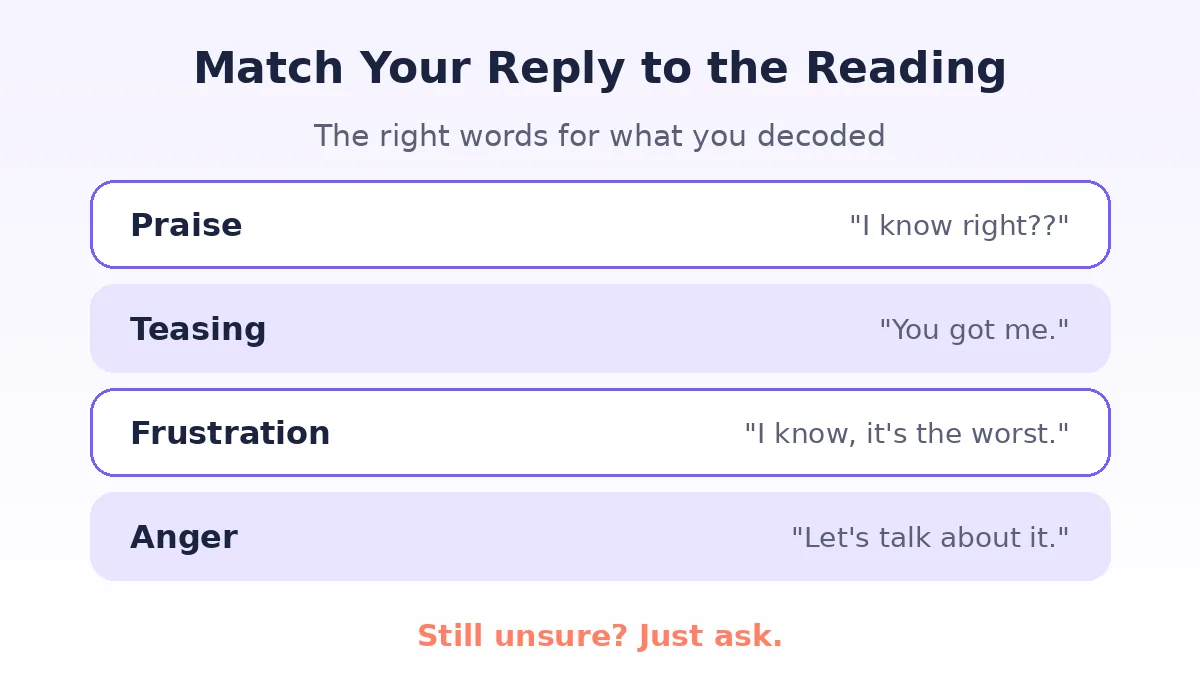
Most reply lists give you a pile of lines and hope one fits. This one is keyed to the reading the Two-Job Test just gave you.
If the dial says praise: take the compliment and keep the energy. “I know right??” “Appreciate you.”
If the dial says teasing: tease back, briefly. “You got me.” “Says the mf who did the same thing yesterday.” Match the energy, then move on.
If the dial says frustration: answer the problem, not the word. “I know, it’s the worst.” “Same, my phone did that all morning.” Frustration wants company, not a debate about language. If you are not sure whether they are venting or angry, a calm reply is the safe one — and if you want to be honest about it, NGL meaning in text is the label for that.
If the dial says anger: do not match it. “Okay, let’s talk about it.” “I hear you — what happened?” Answering anger with anger escalates; answering it calmly ends the bit. If it came from a stranger, silence is also a complete reply. And if the whole conversation has turned sour, SMH meaning in text is the quiet way to say you are done with it.
If you genuinely cannot tell: ask once, lightly. “Ha — good mf or bad mf?” One honest check beats ten guesses.
One last note: you do not have to answer MF with MF. The laugh that usually follows agreement is LMAO meaning in text — a reaction, not a label.
Quick Answers
What does MF mean in texting?
It is short for a strong swear word, used as a label for a person or an intensifier on a word. The tone — praise, teasing, frustration, or anger — comes from the sentence around it.
What is the full form of MF?
The two letters stand for the phrase spelled out — masked — in the definition section above. In plain words: a strong label for a person, or a push on a word.
Is MF always an insult?
No. Among friends it is often praise, hype, or playful teasing. But it is an insult when the sentence is angry, when it comes from a stranger, or when the relationship cannot carry it.
Can MF be a compliment?
Yes — “you smart mf” is a compliment with the volume turned up. The compliment comes from the words beside MF, not from MF itself.
What does MF mean when it points at a thing, not a person?
That is the intensifier job: frustration at the phone, not an insult aimed at anyone. If MF sits in front of a noun like phone, traffic, or weather, it is pushing on that word.
Can MF mean “mutual friends”?
Only when someone is talking about shared contacts. In an ordinary message, that reading is almost never the right one.
What should I reply if someone calls me an MF?
Match the tone: take praise warmly, tease back a friend, answer anger calmly or not at all. If it bothers you, say so: “I’d rather you not call me that.”
What does MF mean when a stranger sends it?
Treat it as a warning. Strangers have no shared history to soften the word, so their MF is usually an insult, a dismissal, or a test. You do not owe a stranger a clever reply.
The Final Word on MF
MF is two letters doing the job of a volume knob: they make a sentence louder, and the sentence decides whether that loudness is praise, a joke, a complaint, or a fight. The meaning lives in the word beside them, the emoji after them, and the person who sent them.
The skill is the reading: knowing whether MF is pointing at a person or pushing on a word, where the dial sits, and whether the room can take it. So next time those two letters show up, run the Two-Job Test, check the dial, and reply to the person, not the abbreviation.
