
You send a long message — plans, a question, something that needs an answer — and back comes a single line: “HMB.” No emoji, no explanation. Are they asking you to reply, or daring you to do something reckless? If you have ever stared at those three letters wondering which one it was, you are not alone — and the hmb meaning in text is simple to state and surprisingly easy to misread.
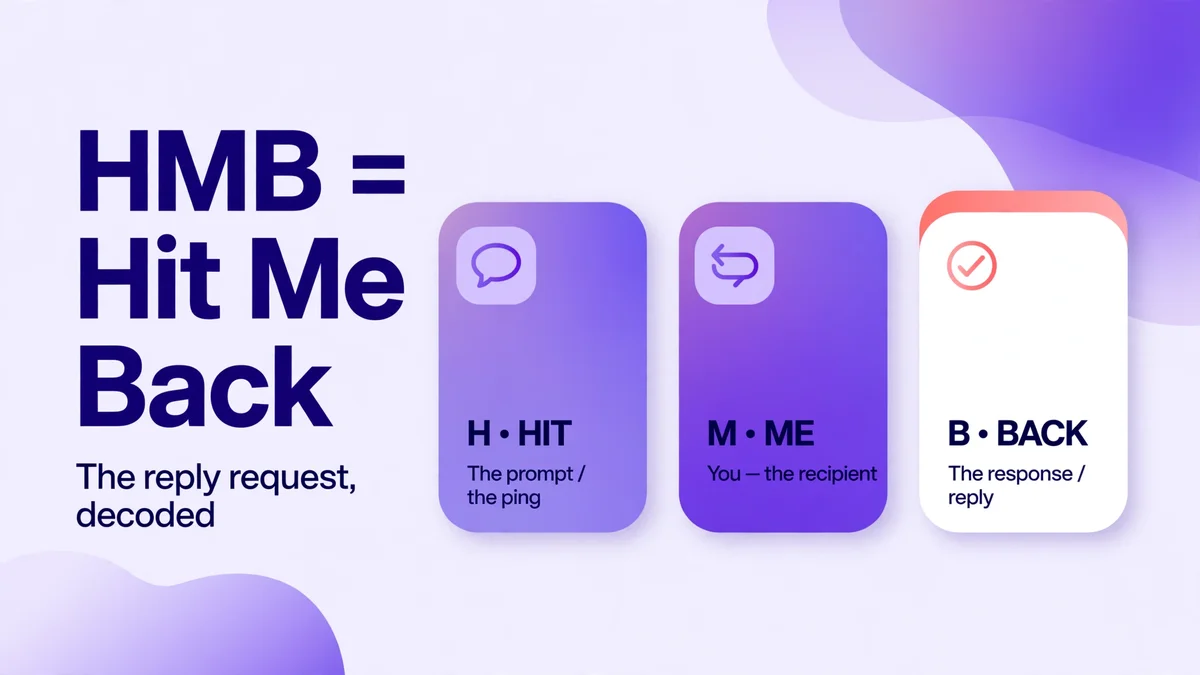
HMB means “hit me back” — a casual way of asking someone to reply, message back, or get in touch again when they are free. That is the whole definition in nearly every text you will ever receive. The useful part is telling that reply request apart from HMB’s joke twin, and reading how urgent it is — which is exactly what the Callback Test below does.
What Does HMB Mean in Text?
HMB is an initialism, and its letters spell the phrase out: Hit Me Back. Before it was texting shorthand, “hit me back” was ordinary spoken language — the phone-era way of saying “call or message me later,” as in “hit me back when you’re free.” When SMS made every character count, the phrase shrank to three letters, and the abbreviation stuck around long after character limits stopped mattering.
What HMB does is specific, and the specificity matters: it does not start a conversation, it continues one. You already messaged; HMB says “your turn, when you can.” That is the difference between HMB and its closest cousin HMU — HMU invites someone to contact you first, while HMB asks someone who already has your message to answer it.
Real-world HMB, done right:
- “Busy rn, HMB later.” — I can’t talk now, but I want the conversation to continue.
- “Sent you the photos, HMB when you see them.” — No rush, but don’t let this die.
- “HMB when you’re free.” — The softest form: reply on your own time.
One honest note about the evidence: Wiktionary’s HMB entry carries only a naval initialism, “His/Her Majesty’s Bark” — it has no texting sense at all. So this article will not pretend a dictionary blesses the texting meaning. What it rests on is unanimous agreement across every independent usage guide, plus a phrase so transparent it explains itself the moment you expand it. That is enough to be sure — and honest enough to say what the dictionary does and does not say.
The Callback Test: Reply Request, or a Dare?
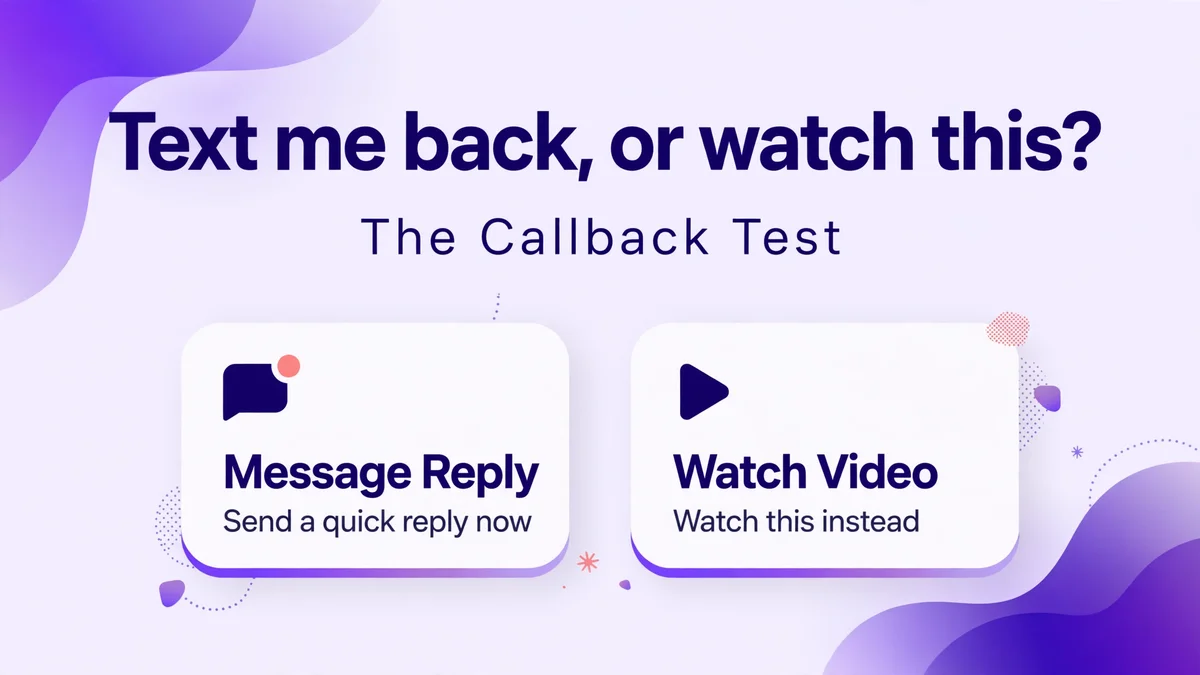
Here is this article’s named method, and it settles nearly every HMB confusion. Call it the Callback Test: three steps, run in order.
Step 1: Swap the sentence. Replace HMB with “text me back when you can” — does the sentence still make sense? Then it is Hit Me Back. Now replace it with “watch this” — does that fit better? Then it is the dare. Try it: “HMB after class” only works as a reply request. “That jump looks easy… HMB” only works as a dare. The sentence knows, even when you don’t.
Step 2: Read the clock word. HMB rarely travels alone — the word next to it sets the deadline. “Later,” “when you’re free,” and “in 10” all mean deferred: no rush, reply on your own time. “ASAP” and “now” mean urgent: they want the reply, not the gesture. No clock word at all means the default: soft, reply when you can.
Step 3: Check the room. A stunt, a dare, or a meme thread means Hold My Beer. A gym or supplement conversation means the fitness term — a different world with the same letters, and the wrong room for texting. Everything else — a normal chat, a DM, a group thread — means Hit Me Back.
Run all three and you will rarely misread an HMB again. A TBH-style honest read applies here: the abbreviation itself is neutral; the urgency and the meaning both come from the words around it.
Hit Me Back vs Hold My Beer: The Two HMBs
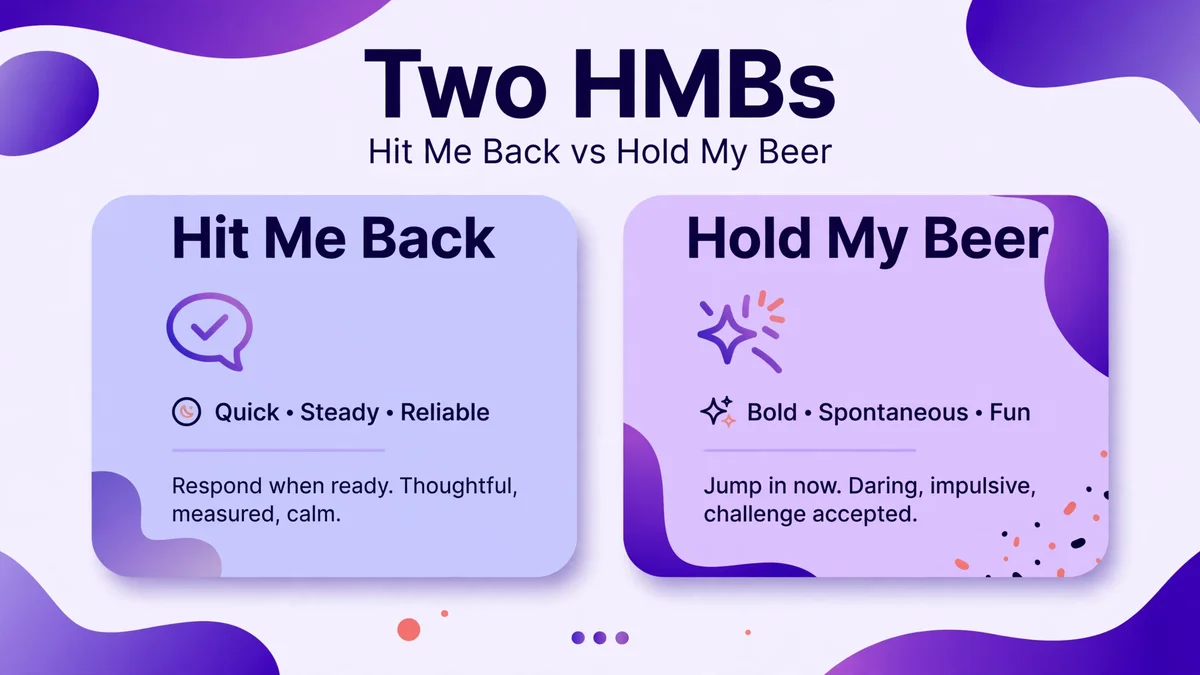
HMB has two texting lives, and they could hardly be more different.
Hit Me Back is the texting meaning: a reply request, soft by default, used when someone wants an answer later. It is the HMB you will meet in texts, DMs, and group chats, and it is the meaning this article is about.
Hold My Beer is the joke twin: a meme dare meaning “watch me do something risky or impressive.” It shows up when someone is about to attempt something bold — or something foolish — and wants an audience. “He said it was impossible. I said, ‘HMB.'” Nobody in that sentence is asking for a reply; they are asking you to watch.
Then there are the two wrong rooms. In fitness, HMB is β-hydroxy β-methylbutyrate, a leucine metabolite sold as a muscle-recovery supplement — a real term, but never what someone means in a chat. “Anyone tried HMB for recovery?” is a supplement question, not a texting meaning. And in history, HMB is His/Her Majesty’s Bark, the naval prefix Wiktionary actually lists — centuries old, and never in a text message.
The rule for all of them is the same: check the room, not just the letters.
HMB Tone: Soft Nudge, or Urgent?
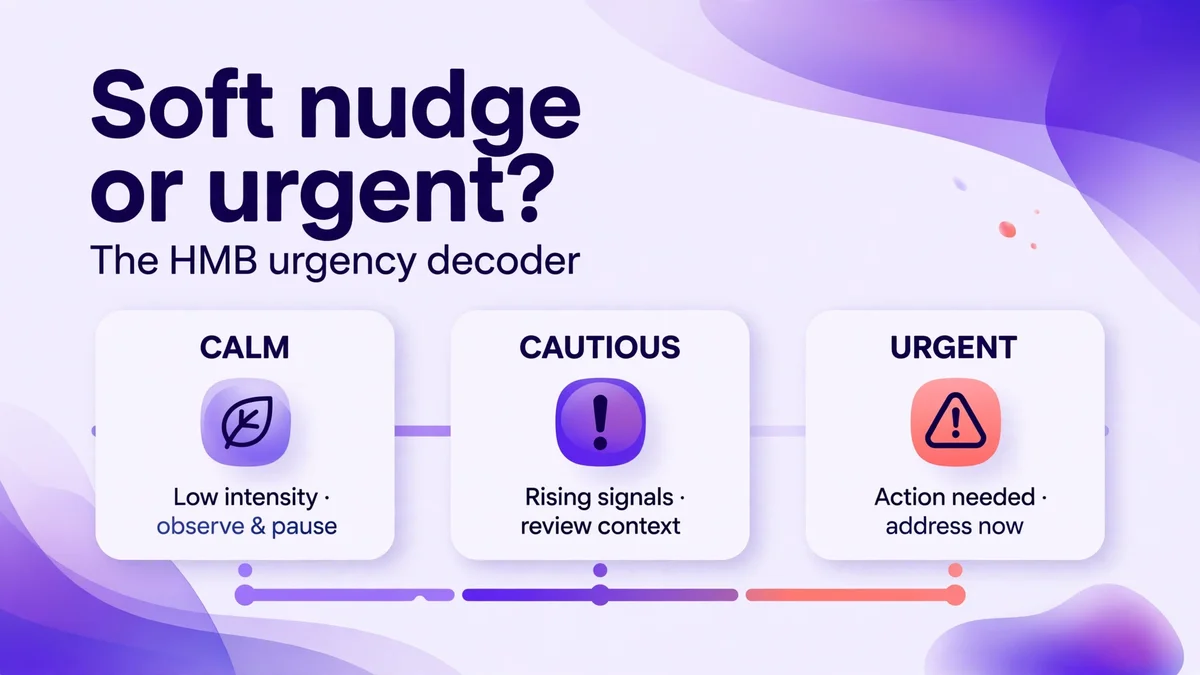
HMB’s default tone is soft. Every usage guide agrees on this: it is a gentle tap, not a demand — closer to “no rush” than to “answer me.” But the packaging changes the pressure, and here is the decoder:
Bare “HMB” — soft. The default. “HMB.” with nothing attached is a nudge, not an order. It says “your turn” and leaves the timing to you.
“HMB later” / “HMB when you’re free” — deferred. The sender is explicitly removing the pressure. This is the politest form, and the one to copy when you want to sound considerate.
“HMB ASAP” / “HMB now” — urgent. The clock word does all the work. This is no longer a nudge; it is a request with a deadline, and it deserves a fast answer or a time (“replying in 10”).
“HMB?” — checking. The question mark turns the request into a check-in: “are you going to reply?” It usually follows a message that went unanswered, and it is the gentlest form of follow-up.
Repeated HMB — nagging. One HMB is a nudge. A second HMB with no reply in between is pressure. The letters didn’t change; the count did.
Emoji softens everything: “HMB 😊” reads warmer than a bare “HMB,” though a bare “HMB” reads neutral rather than cold. And sender context matters — by relationship, not by gender. From a friend, HMB is the default room: plans, catch-ups, and “HMB later” after a busy day. From a crush, it keeps the vibe open: “Ordering food rn but HMB, don’t go anywhere” means interest plus busyness, not distance. From a stranger, a cold HMB without context reads demanding — the burden is on the sender to explain themselves first. From a boss or coworker, it belongs in a casual team chat only, never in email or anything a client sees. A BTW-style softener helps anywhere: “btw, no rush” takes the edge off any HMB.
Where You’ll See HMB: Texting, DMs, and Group Chats
HMB means the same thing on every platform: a reply request. What changes is the room, not the meaning — and no platform gives it a special definition, whatever a thin listicle claims.
Texting (SMS, WhatsApp, iMessage). This is HMB’s home. One-to-one chats, usually after a message that needs an answer: “Driving rn, HMB.” The sender is busy, the conversation is paused, and HMB is the bookmark.
DMs (Instagram, Snapchat). Same job, slightly faster rhythm: “Can’t talk rn, HMB in 10.” In DMs it often carries a time (“in 10,” “after class”) because DM conversations move faster and go cold faster.
Group chats. Here HMB keeps a thread alive without spamming it: “HMB later, need to finish this call” tells the whole group the conversation is paused, not over.
Gaming lobbies. “AFK, HMB” is the pause-and-return pattern: the player is away, the game waits, and HMB promises the return.
The pattern: the letters stay the same, but the room changes the temperature. Private rooms nudge; public rooms perform. And unlike some abbreviations, HMB is not a hashtag or caption phenomenon — it lives in messages, where a reply is actually possible.
How to Reply to HMB
Your reply depends on which HMB you just received. Run the Callback Test first, then match it.
If it was Hit Me Back: the best reply is the reply itself. “Sure, talk soon” works. “Got it, will reply tonight” works when you need time. Or simply reply — HMB asked for an answer, and an answer closes the loop. A LMK-style soft close keeps it warm: “lmk if you need anything else.”
If it was urgent (ASAP/now): answer fast, or say when. “Got it, replying in 10” beats silence, because an urgent HMB left unread feels like being ignored.
If it was the dare: play along (“😂 do it”) or ignore it. You are not obliged to accept a dare, and a dare declined quietly is not a conversation ended.
If it was the supplement: answer the fitness question. Nothing else in the message needs decoding.
If you are unsure: one clarifying question beats guessing — “reply, or dare?” costs four words and prevents the two classic mistakes: ignoring a genuine request, or answering a joke with a paragraph.
And if they were worried rather than just busy, a DW-style comfort pairs well: “dw, take your time” answers the feeling behind the HMB, not just the letters.
HMB vs HMU, LMK, TTYL, and BRB
HMB sits in a family of conversation-management shorthand, and the cousins are easy to confuse. The one-line distinction: HMU starts a conversation, HMB continues one.
| Term | Full form | What it actually does |
|---|---|---|
| HMB | Hit Me Back | Asks for a reply — continue the chat later |
| HMU | Hit Me Up | Invites contact — start the chat |
| LMK | Let Me Know | Asks for information or a decision |
| TTYL | Talk To You Later | A goodbye — ends the conversation for now |
| BRB | Be Right Back | A short pause — back in minutes |
| NVM | Never Mind | Withdraws a question or request — cancels it |
The useful contrasts: TTYL ends the conversation, while HMB keeps it open — “TTYL” says goodbye, “HMB later” says to be continued. BRB is a pause measured in minutes, while HMB is a pause measured in whenever-you’re-free. And NVM cancels something (“forget I asked”), while HMB asks for something (a reply). If a friend writes “nvm,” they may feel unheard. If they write “hmb,” they are usually telling you the conversation isn’t over.
Debunked: What HMB Does NOT Mean
Short letters collect false meanings, and HMB has collected a few:
- “Hold My Bag” / “Help Me Build” — invented. Each appears on exactly one site as a “less common local meaning,” with no attestation in real chats. Not texting meanings.
- “Heard My Back” / “Human Music Bot” — single-source, and rare by their own source’s admission. One site labels them rare and very rare. Not meanings, just page filler.
- “Homemade Bread/Brownies” — a niche food-group joke, not texting. It appears in cooking communities as a playful expansion, but nobody texting “HMB” means bread.
- “HMB is rude” — a myth. The default is soft and polite; pushiness comes from repetition and context, not the letters. A single HMB has never been rude on its own.
- Gendered sender meanings — none exist. No source splits HMB by sender gender, and this article refuses the fake sections. What changes is the relationship and the context, not the sender’s gender.
- Popularity and demographic claims — none exist either. If a site tells you HMB “peaked” in a particular year, that one generation uses it more than another, or that one region uses it most, ask for the study. There is not one, so this article prints none of it.
When Not to Use HMB
HMB is a joy in its habitat and a misfire outside it. Skip it when:
- The setting is formal. Emails, client messages, job applications, LinkedIn DMs — HMB reads as sloppy there. Write it out: “Please get back to me when you can.”
- The conversation is serious. Someone sharing something vulnerable, or someone you owe a real apology, does not need a three-letter nudge. Write the sentence.
- You are nagging. A second HMB without a reply in between is not a reminder; it is pressure. If they haven’t replied, one follow-up in full words beats another abbreviation.
- You don’t know the person. A cold HMB to a stranger — especially without context — reads as demanding. Introduce yourself and the reason first.
- There is a real deadline. “HMB” says reply whenever; a deadline needs saying: “I need this by 5, please.” The abbreviation hides exactly the information the other person needs.
Quick Answers
What does HMB mean in text?
HMB means “hit me back” — a casual way of asking someone to reply, message back, or get in touch again when they are free.
Is HMB the same as HMU?
No. HMU (“hit me up”) invites someone to contact you first — it starts a conversation. HMB (“hit me back”) asks someone who already has your message to reply — it continues one.
Can HMB mean “Hold My Beer”?
Yes, but only in memes, jokes, and dare contexts. Run the Callback Test: if “watch this” fits the sentence better than “text me back,” it is the dare.
Is HMB rude?
No. Its default tone is soft, casual, and non-pushy. It only feels pushy when repeated without a reply, or when sent cold to a stranger without context.
Can I use HMB at work?
In a casual team chat with people you know, occasionally. Never in email, client messages, or anything formal — write the request out in full words there.
Does HMB mean anything else?
In fitness, HMB is β-hydroxy β-methylbutyrate, a muscle-recovery supplement — a real term, but a different world from texting. In history, it is His/Her Majesty’s Bark, the naval prefix. In a chat, it means “hit me back.”
HMB is three letters doing the work of a gentle tap on the shoulder — “your turn, when you can.” Run the Callback Test before you read it and before you send it: swap the sentence, read the clock word, and check the room. Get that right, and HMB stays what it should be — a soft nudge, not a demand and not a dare.
