
Four letters, and they are not really about the content. They’re about your screen — who can see it, where you are, and whether this is the moment to open what someone just sent you. If you’re looking up the nsfw meaning in text, the short version is this: NSFW stands for “not safe for work,” a warning label people stick on a link, photo, video, or post that you should not open in a workplace, a classroom, or anywhere else a screen is on public display.
Unlike most slang, NSFW isn’t a reaction, a joke, or a feeling. It’s a piece of etiquette — the sender doing you a small favour before you click. This guide covers what earns the tag, a simple test for deciding whether to open (or send) something, how the label works across platforms and chats, and how who sent it changes what you should do next.
NSFW Meaning at a Glance
| Full form | Not Safe For Work (also phrased “not suitable for work”) |
| Main job | Warning — choose a private moment before opening something |
| What it covers | Explicit or nude content, graphic violence, strong language, sensitive material |
| Example | “heads up, this one’s nsfw — open it at home” |
The Shoulder Test: The One Question NSFW Asks
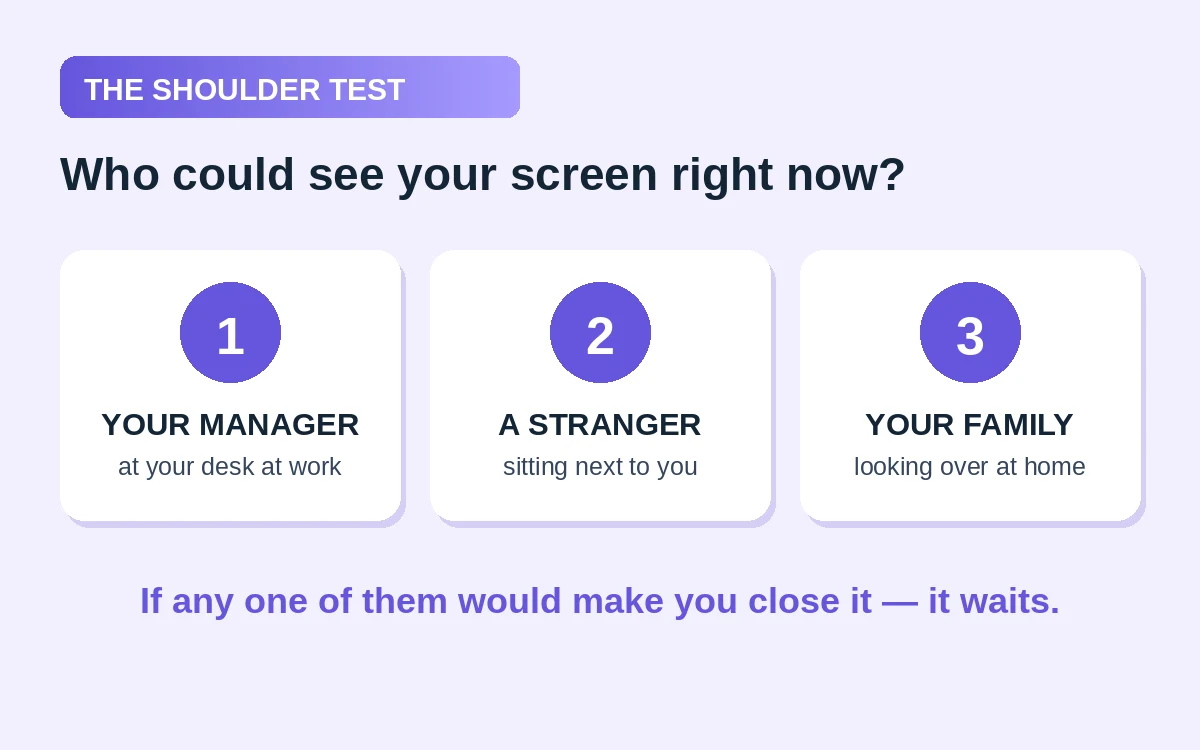
Every NSFW tag, in every app, asks the same question — and you can answer it in two seconds:
Picture three people looking over your shoulder at your screen right now: your manager, a stranger sitting next to you, and a member of your family. If any one of the three would make you close what you’re about to open — it’s NSFW, and it waits.
The test works both ways. Receiving something? Run it on your situation before you tap: desk at work, manager present — it waits; sofa at home, nobody around — your call. Sending something? Run it on the other person’s likely situation, not yours — the classic failure is sending a graphic clip to a friend at 11 a.m. because you’re on your day off. Their shoulder is the one that matters.
Notice what the test never asks: whether the content is good, bad, funny, or offensive. NSFW is not a review and not a moral verdict — a medical diagram, a piece of war reporting, and a crude comedy clip can all fail it for different reasons. The tag measures only the gap between the content and the room you’re in: the same link can be fine at 9 p.m. on your own phone and a bad idea at 9 a.m. on your work monitor.
That’s also why good taggers add a reason: “NSFW (language)” lets the other person run their own test — plenty of readers will open strong language at their desk with headphones in; almost nobody will open graphic images there.
What Actually Earns the NSFW Tag
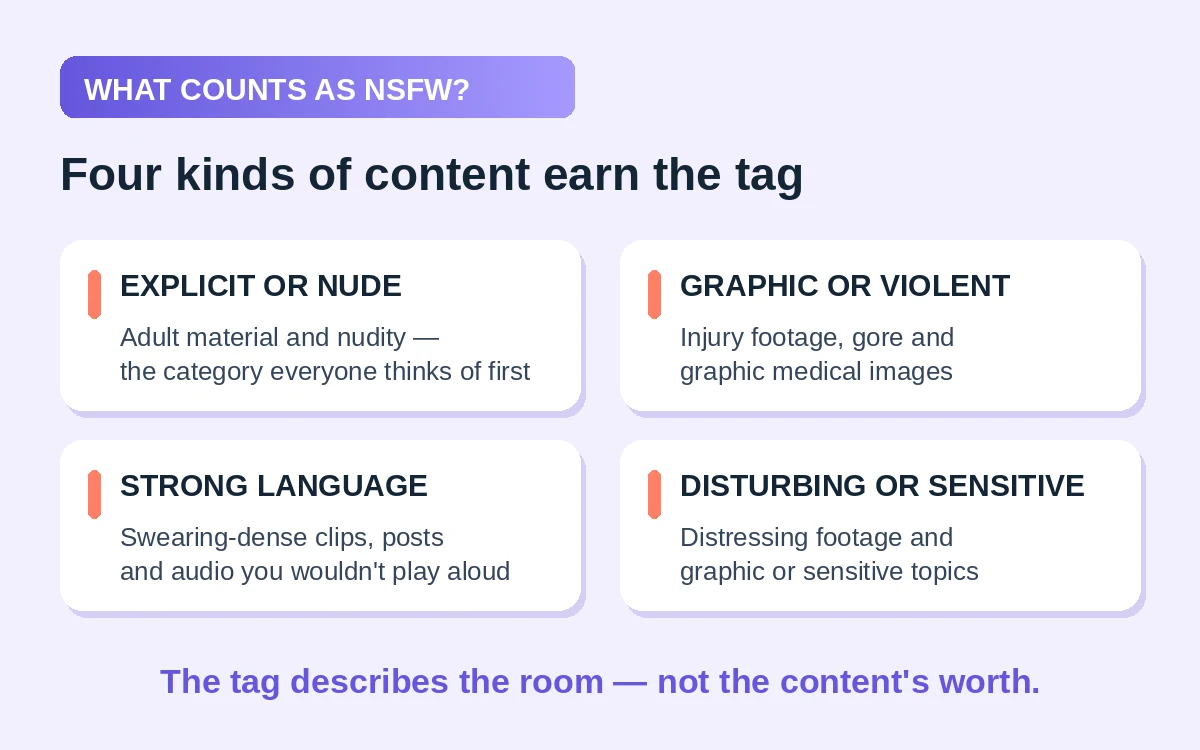
Because NSFW describes a situation rather than a genre, what earns it is wider than most people expect — four categories cover nearly everything you’ll see tagged.
Explicit or nude content is the category everyone thinks of first, and it’s real — but it’s one slice. Adult material, nudity, and sexually explicit jokes or images fail the Shoulder Test in essentially every workplace, school, and family setting, which is why it dominates the tag.
Graphic violence and gore is the second slice: real injury footage, accident photos, uncensored conflict reporting, graphic medical images. Nothing sexual is involved — it earns the tag because of what it would do to a bystander, or to you, arriving unannounced on a shared screen.
Strong language is the quiet one. A comedy clip dense with swearing, a profanity-filled screenshot, an audio message you’d never play out loud — the written cousins of blow-ups like JFC or SYBAU — earns the tag for its sound and visibility alone. It’s also the category most often tagged inside work chats: people tag it precisely because even they know it doesn’t belong there.
Disturbing or sensitive material is the flexible edge: distressing news footage, confrontational political content, graphic discussions — nothing explicit, yet exactly what someone doesn’t want opening in front of colleagues or kids. Edge cases live here too (a sex-education diagram, a post-surgery photo): not “adult content” in intent, but the tag describes the room, not the content’s worth.
One boundary matters: NSFW says nothing about legality — tagged content is usually legal material in the wrong setting, and genuinely illegal content is a different category altogether, one no label makes acceptable to share.
How NSFW Works Where You Actually See It
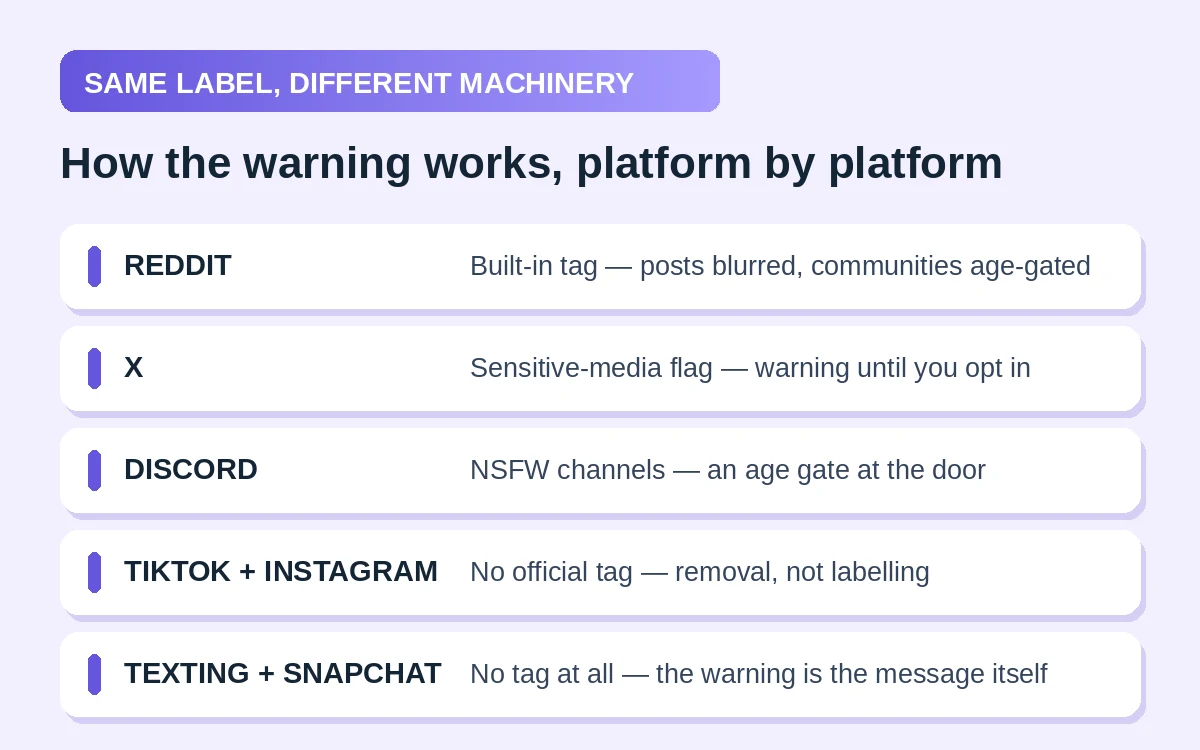
The meaning never changes from platform to platform. The machinery does — and knowing which platforms have real tagging systems (and which leave it entirely to you) decides whether a warning actually protects you.
Reddit has the most developed system: whole communities can be marked NSFW behind an age gate, and individual posts can carry the tag, which blurs content until you click through — infrastructure, not just manners. X (Twitter) works through sensitive-media flags: flagged posts sit behind a warning until you opt in. Discord tags at the channel level — an NSFW channel greets you with an age confirmation, so the warning guards the door rather than each message.
TikTok and Instagram are the important correction: neither has an official NSFW tag. Material that breaks their rules is removed, not labelled. So when a creator writes “nsfw” in a caption or warns “nsfw story ahead,” that’s a human courtesy about edgy-but-allowed material — strong language, a disturbing story told rather than shown.
Snapchat has no tag either: the warning lives in the chat around the snap, so a friend typing “nsfw, don’t open this in class” is the system. Ordinary texting works the same way — the four letters before the link are the whole safety mechanism. Work chats (Slack, Teams) are the last case: NSFW appears there mostly as a language warning on a clip or article — “nsfw (language) but this is worth it.” Read that as a risk the sender has handed you: the tag does not transfer responsibility, and if it fails the Shoulder Test in your office, its having arrived labelled doesn’t make opening it a good idea.
NSFW in Real Conversations
The exchanges below are illustrative examples, not real messages.
The question that unlocks it — ask what kind
- Dana: “sending you that thread, it’s wild”
- Leo: “is it nsfw? and lmk if it’s pictures or just language — I’m at my desk”
- Dana: “just language. headphones and you’re fine”
The untagged send — and the repair
- Marcus: [sends a graphic injury photo, no warning]
- Jade: “smh that opened in the middle of my lecture 😭 tag that next time”
- Marcus: “mb — you’re right, should’ve warned you”
Everyone has been Jade. The repair is simple: a “my bad,” a promise to tag next time, and no arguing about whether it “wasn’t that bad.” The sender’s job was the warning.
You’ll also see NSFW used ironically — “NSFW: the state of my kitchen after Sunday cooking” — tagging something harmless as a joke. It lands because everyone knows what the label genuinely means; save it for chats where the real thing rarely appears, so it doesn’t train people to ignore genuine warnings.
Who Sent It Changes How You Read It
The letters mean the same thing from everyone. What changes is what the tag is doing, and what you should do back. (In a big group chat, a tag protects the most cautious person in the room — respect it even if your own test passes.)
From a close friend, NSFW is usually pure courtesy, often paired with humour: they know your taste and know the content is fine for you somewhere else — the tag is about timing, not permission. The natural reply is thanks and a delay, not a debate; a tagger who gets a quick “yw” back is a tagger who keeps tagging.
From a moderator or the platform itself — a subreddit’s NSFW mark, a blurred post, Discord’s age-gate screen — the tag is a rule with machinery attached, not a friend’s suggestion, and it can carry consequences if ignored or misapplied.
From a stranger, a tag is information, not reassurance. Unknown content, flagged by its own sender, belongs in a private setting or not at all — a warning label is never a substitute for trusting the source.
NSFW vs. SFW, NSFL, and the Other Warning Labels
| Label | Full form | What it flags | The question it answers |
|---|---|---|---|
| SFW | Safe For Work | Nothing — content fine to open anywhere | “Can I open this here?” — yes |
| NSFW | Not Safe For Work | Explicit, graphic, profane, or sensitive content in the wrong setting | “Can I open this here?” — wait for private |
| NSFL | Not Safe For Life | Content disturbing enough that you may regret seeing it anywhere | “Do I want this in my head at all?” |
The cleanest distinction: NSFW is about where you view something; NSFL — and CW/TW (content/trigger warnings, which name a specific difficult topic in advance) — are about how it affects you wherever you are. That’s why thoughtful taggers combine them: “NSFW / CW: graphic injury” beats either label alone.
Tagging Mistakes That Make the Label Useless
- Tagging after the content. A warning below the photo has warned nobody. NSFW goes before the link, image, or clip — in the title, caption, or the message before it.
- Tagging everything, or nothing. If every second link is NSFW, the label becomes background noise and the one that matters gets ignored; if you send graphic material bare because “they’ll figure it out,” they will — on their screen, in the wrong room. Tag what genuinely fails the Shoulder Test, and tag it every time it does.
- Treating the tag as a permission slip. A label doesn’t make content welcome everywhere: some material breaks platform or group rules regardless, and some people don’t want it at any hour. The tag offers a choice; it doesn’t demand a yes.
Quick Answers
What does NSFW mean in text?
NSFW means “not safe for work.” In a text or chat it’s a warning placed before a link, photo, video, or message that shouldn’t be opened around other people — at work, at school, or in public — because it may contain explicit, graphic, profane, or sensitive material. Read it as: look later, somewhere private.
What is the difference between NSFW and NSFL?
NSFW is about the room: content that’s fine in private but wrong for a work or public screen. NSFL — “not safe for life” — is about the content itself: material so disturbing, usually extreme gore or real tragedy, that viewers may regret seeing it in any setting.
What is the difference between NSFW and FYI?
They point in opposite directions. FYI informs you — here’s something you should know. NSFW warns you — here’s something to choose your moment for. “FYI, the meeting moved” is logistics; “nsfw, open later” tells you to think before you tap.
How should I reply when someone tags something NSFW?
Acknowledge the warning and state your timing: “noted, I’ll open it at home.” If you’re unsure, ask which kind it is — language, graphic images, or adult content — and decide from the answer. If someone sends sensitive material untagged, a calm “that was nsfw — tag it next time” is a reasonable reply.
The Short Version
NSFW is “not safe for work” — the internet’s standard warning label, defined identically by every major dictionary: content that may be explicit, graphic, profane, or sensitive, flagged so you can choose where and when to open it. Run the Shoulder Test — manager, stranger, family — and you’ll never misread it: if any of the three would make you close it, it waits. A good tag comes first and carries a reason; the machinery differs by platform, but the label means the same thing from everyone — what changes is only what you should do next.
