
You already know the bffr meaning in text when you feel it — that hot little spike of disbelief when someone in the group chat says something so unserious you can’t even answer it properly. BFFR is the four-letter way of saying: come back to reality. It stands for “be f***ing for real” — a demand for honesty with a profanity-powered amplifier welded on.
But here’s what makes BFFR worth a whole article instead of a dictionary one-liner: the same four letters can land as a joke or as a slap, and the letters themselves won’t tell you which one it was. A “BFFR 😂” from your best friend and a bare “BFFR.” in the middle of an argument are two completely different messages wearing the same outfit. This guide teaches you The Eyebrow Test — a two-second tone check — walks you through the three rooms where BFFR lives, grades the murky origin story honestly, and gives you a ladder of softer things to say when the F in the middle is too much for the moment.
BFFR Meaning at a Glance
| Full form | “be f***ing for real” |
| Main job | A disbelief call-out — a reaction demanding someone stop exaggerating, lying, or being delusional |
| Tone range | Playful roast (among friends) to fed-up confrontation (in arguments) |
| Where you see it | TikTok comments, Gen-Z group chats, DMs, heated threads |
| Don’t confuse with | BFF (best friends forever) — one added letter, opposite universe |
| Clean version | BFR (“be for real”) |
The Eyebrow Test: Read the Brow, Read the Message
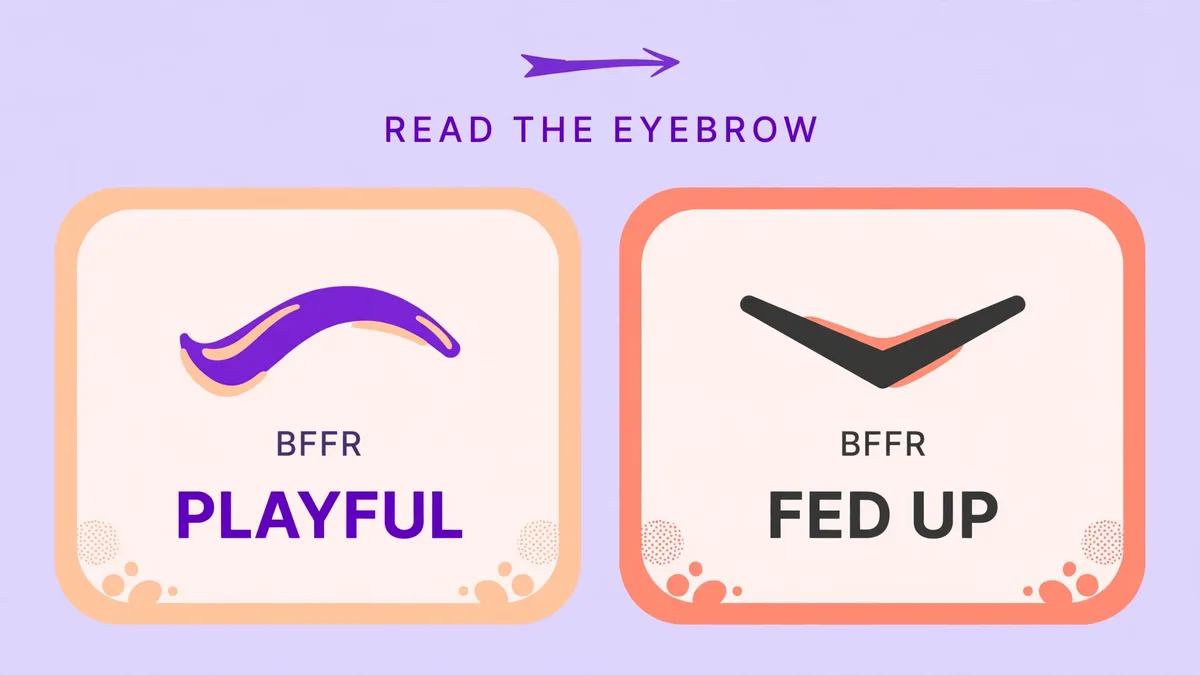
Every BFFR is a face without a face. So draw the face yourself: picture the sender’s eyebrow.
A raised eyebrow means the BFFR is a joke. This is the “you’re kidding, right?” brow — the one your friend raises when you claim you slept two hours and ran ten miles. Raised-eyebrow BFFRs travel with laughing emoji, appear in chats with a long joke history, and feel like a roast: sharp, warm, aimed at the claim, not the person. The message underneath is “you’re being ridiculous and we both know it.”
A flattened eyebrow means the BFFR is a warning. This is the “I’ve heard enough” brow — the one that shows up mid-argument when someone keeps doubling down on an excuse nobody believes. Flattened-eyebrow BFFRs travel alone, no emoji, no softening, often ending with a period: “BFFR.” The message underneath is “I don’t believe you and I’m done pretending.”
How to run the test in practice — three checks, two seconds:
- Check the company. Is there a 😂 or a “lol” nearby? Raised eyebrow. Is the BFFR standing alone at the end of a tense exchange? Flattened.
- Check the history. Do you two roast each other like this all the time? Raised. Is this the first hard pushback in a conversation that’s been getting serious? Flattened.
- Check your gut. If your stomach drops a little reading it, trust that. The eyebrow you’re picturing is the right one — texts don’t carry tone, so your read of the relationship is the tone.
The test isn’t magic, and it can misfire — sarcasm is the oldest cause of texting misunderstandings. But for a word that lives entirely in the gap between joke and confrontation, a named two-second check beats guessing. btw, if you’re the one sending it, the Eyebrow Test works in reverse: picture the brow your reader will draw before you hit send.
Three Rooms, One Reaction
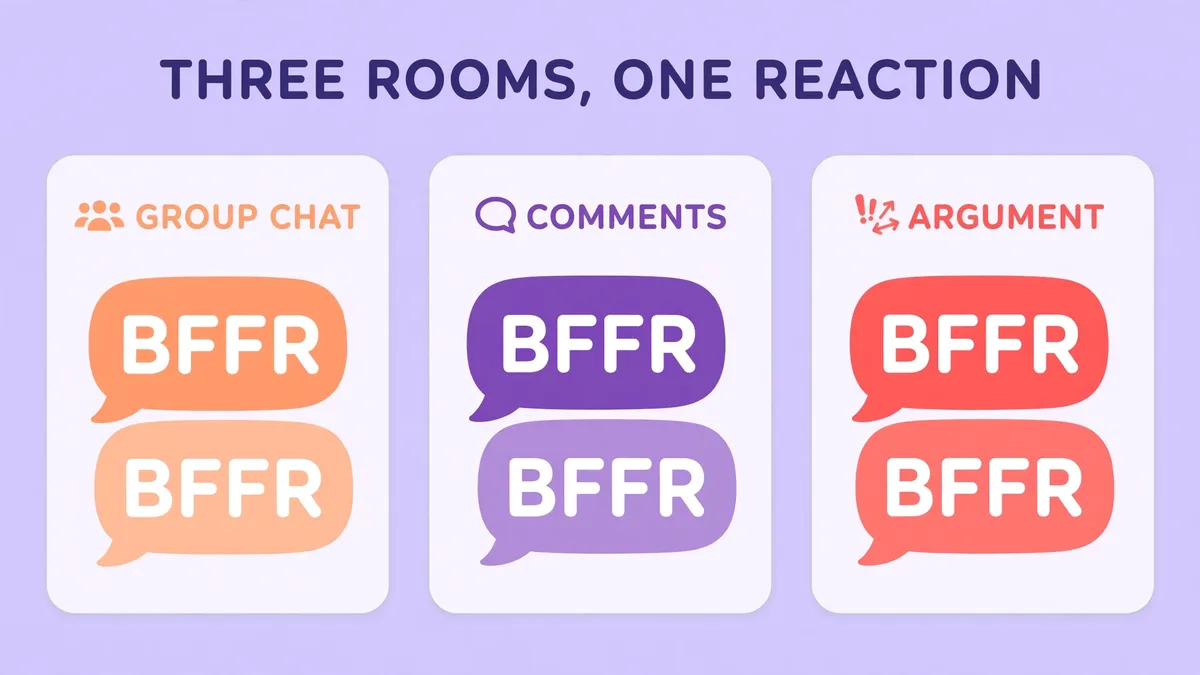
BFFR changes temperature depending on the room it’s said in. Same letters, three different jobs:
Room 1: The group chat roast. This is BFFR’s natural habitat — friends reacting to a friend’s wild claim in real time. “I could totally beat you in a race” → “bffr 😭.” Here it’s punctuation for disbelief, barely stronger than “no way,” and nobody’s feelings get hurt because the roast license is mutual. The F in the middle is doing comedy work, not aggression work. This is where the vast majority of BFFRs you’ll ever see live.
Room 2: The comment section. On TikTok, BFFR became a crowd reaction — a way for strangers to boo a video that feels staged, fake, or delusional. “They want $10 for a burger? bffr.” Nobody’s talking to anybody here, exactly; the comment is performing disbelief for the audience. The temperature is cooler than it looks — comment-section BFFRs are theater, and the creator often expects them. This room is also where the phrase exploded in 2022, when TikTok sound clips carrying “be f***ing for real” audio got remixed and the text form rode along.
Room 3: The heated argument. Here the comedy drains out. “That excuse doesn’t make sense, bffr” mid-fight isn’t a roast — it’s a credibility strike, a way of saying “you’re lying and I’m calling it” without writing the whole sentence. The F stops being funny and starts being the point: the profanity is the force behind the shove. This is the only room where BFFR can genuinely wound, because here it’s aimed at the person, not the claim.
The room rule: before you react to a BFFR, name the room. A comment-section BFFR on your video needs no reply. A group-chat BFFR needs a funnier comeback. An argument BFFR needs you to decide whether the conversation is still worth having.
Where the Letters Came From (the Honest Version)
The phrase underneath BFFR is old. “Be for real” — as in “stop playing, be honest” — has been spoken English, rooted in African American Vernacular English, for years; it was already a standard authenticity check in the 2000s. The profanity-intensified version, “be f***ing for real,” circulated on social media through the 2010s. The acronym itself, though, is a 2022 baby: that’s when TikTok’s sound-clip culture picked the phrase up, remixed it into trending audios, and the four letters became the fast way to type the reaction.
Two things we will not pretend to know. First, the exact viral clip: you’ll find competing claims about which 2022 video started it, and no reliable source settles it — so we won’t name one. Second, the precise pre-2022 timeline: reports of the acronym floating around as early as 2019 or a “be f***ing fr” post in 2013 are single-source and unverifiable. The safe, evidence-backed story: old phrase, AAVE roots, TikTok made the letters famous in 2022.
And here’s a grading detail worth saying out loud: BFFR is not in Wiktionary. We checked — no entry exists. Collins only has it as a “New Word Proposal,” still “being monitored for evidence of usage.” That’s not an insult; it’s a signal. BFFR is internet-native slang that hasn’t settled into the dictionaries yet, which means it’s still living slang — fast, informal, and mostly at home in the comment culture that birthed it. Be suspicious of any article that calls it “widely recognized” or “part of everyday digital language” as if a usage study existed. None does. It’s big in its rooms and invisible outside them — including, very possibly, to your mom. (fr, the quieter cousin BFFR grew out of, has the same street-level energy with none of the F.)
Reading a BFFR in the Wild: An Annotated Thread
Theory is nice; threads are better. Here’s a group-chat exchange with the kind of BFFR that actually happens, annotated so you can see the machinery. The exchanges below are illustrative examples, not real messages.
Zara: okay so I just found out my ex’s new gf stalks my page every day
Lena: bffr 😭
Zara: i’m serious!! my friend saw her viewing my story at 3am
Lena: bffr zara. it’s 3am, everyone is awake at 3am
Read it with the Eyebrow Test:
- Lena’s first “bffr 😭” — raised eyebrow, pure roast. The crying-laughing emoji is the tell. She’s not calling Zara a liar; she’s calling the claim dramatic. This is Room 1: the group chat roast. Zara’s feelings are safe.
- “bffr zara.” — eyebrow flattening. No emoji, name attached, period. The second BFFR isn’t reacting to the claim anymore — it’s reacting to Zara doubling down. The tone has shifted from “you’re being dramatic” to “okay, now you’re actually not listening.” Same letters, different brow, and Zara would feel the temperature change instantly.
- What Lena is really doing: the first BFFR invites Zara to laugh at herself; the second tells her the joke window is closing. Two BFFRs in a row are almost always an escalation — if you get the second one, read it as the flatter brow.
This is why “BFFR is playful” and “BFFR is aggressive” are both true and both useless as blanket rules. The meaning is in the sequence, the punctuation, and the room — which is exactly what the Eyebrow Test is built to read.
Reply Without the F: The Polite-Alternatives Ladder
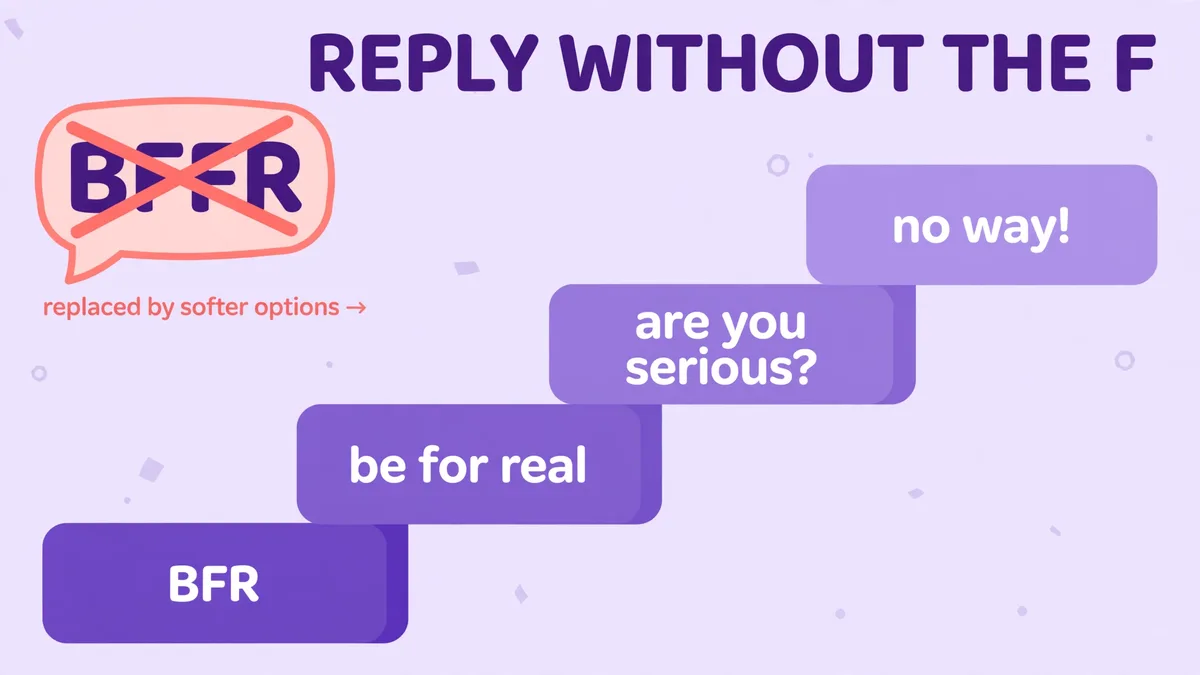
Sometimes you want the call-out without the profanity — at work, with family, or with someone whose eyebrow you can’t read. The F is doing the intensity work, so each step down the ladder drops a little force:
- BFR — the clean sibling, widely used and understood: “be for real” without the amplifier. Your safest drop-in replacement. Use it with your mom.
- “be for real” — spelled out, it reads slightly softer and more earnest than the acronym, like you actually want an answer.
- “are you serious?” — the question version. Same disbelief, zero profanity, and it invites a response instead of ending the conversation.
- “no way!” — pure reaction, no challenge. When you want the disbelief without any of the confrontation.
The ladder rule: match the rung to the room. Group chat roast? BFR keeps the joke. Comment section? “No way!” does the job. Heated argument with someone you care about? “Are you serious?” says what BFFR says but leaves the door open — which is usually what you actually want.
When Banter Becomes the Line
BFFR is a joke right up until it isn’t, and the crossing point is worth naming clearly:
- It’s banter when the roast license is mutual, the claim is the target (not the person), and there’s a laugh track — emoji, “lol,” a history of trading these. Nobody has to recover afterward.
- It becomes the line when it’s deployed mid-argument as a credibility strike, when it’s the second BFFR in a row (see the annotated thread), or when the other person has just been vulnerable. “BFFR” after someone shares something real isn’t a roast — it’s a dismissal, and it reads as contempt.
- How to reply if you got a flattened-eyebrow BFFR: don’t match the energy. “Okay, hear me out” or “I get why that sounds wild, but—” reopens the door that BFFR tried to close. tbh, answering a call-out with your own call-out is how threads die.
- Where never to use it: work chats, emails, anything with a teacher, a boss, or a stranger whose brow you can’t read. The F doesn’t clock out just because the context is professional. nvm the temptation — type “are you serious?” and keep your job.
- The BFF trap: idc how similar they look — never sign anything with BFFR unless you mean the call-out. One letter turns “best friends forever” into a confrontation.
Corrections This Page Owes You
The older version of this page made claims we couldn’t back up, and the batch-8 update means withdrawing them openly:
- “Commonly used” / “widely used in texting, social media, and online chats” — withdrawn. No usage study exists. What the evidence supports: BFFR is common in TikTok comment culture and Gen-Z group chats, and thin to invisible elsewhere. Its absence from Wiktionary is part of that evidence.
- “Become part of everyday digital language” — softened. Replaced with the room-by-room picture above. Everyday for some rooms, unknown in others.
- “Became widely recognized through platforms” — replaced with the specific, graded story: AAVE phrase roots, 2022 TikTok sound-clip spread, precise first clip unverifiable.
- Added what was missing: the BFF confusion warning, the BFR clean alternative, and the tone-decoding guidance the old page gestured at (“context matters”) without ever teaching.
Quick Answers
What does BFFR mean in text?
BFFR stands for “be f***ing for real” — a disbelief call-out demanding someone stop exaggerating, lying, or being delusional. Think “come back to reality” with the volume turned up.
Is BFFR rude?
It can be. Among friends with a roast history it reads as playful banter; in an argument or from a stranger it reads as confrontational or dismissive. Run the Eyebrow Test: raised brow (emoji, joke history) = joke; flat brow (alone, mid-argument) = warning.
What’s the difference between BFFR and BFR?
Only the intensity. BFR is “be for real” — the same call-out without the profanity. BFFR adds the F-word amplifier, which makes it stronger, cruder, and riskier. Use BFR with family, at work, or anywhere the F would cost you.
Is BFFR the same as BFF?
No — and this is the most dangerous mix-up in the acronym. BFF is “best friends forever” (affection); BFFR is a confrontation. One added letter flips the entire meaning. Never sign anything with BFFR unless you mean the call-out.
Where did BFFR come from?
The phrase “be for real” has AAVE roots as a spoken authenticity check; the intensified version circulated online through the 2010s, and the acronym broke into mainstream Gen-Z texting via TikTok sound-clip culture around 2022. The exact first viral clip is unverified — any article naming one is guessing.
How should I reply to BFFR?
Match the brow: laugh it off or fire back playfully if it was a roast (“I KNOW, wild right?”); if it was the flat-brow kind, don’t match the energy — “okay, hear me out” keeps the conversation alive. wdym you can’t tell? Ask: “wait, are you joking or serious?” takes three seconds.
Is BFFR in the dictionary?
Not in Wiktionary (no entry exists), and Collins only lists it as a monitored new-word proposal. It’s living internet slang — big in its rooms, still too young for the reference books.
The Short Version
BFFR is “be f***ing for real” — a four-letter demand for reality, born from an AAVE phrase and made famous by TikTok in 2022. Its meaning never changes; its tone always does. Run the Eyebrow Test: a raised brow (😂, joke history, group chat) means roast; a flat brow (alone, mid-argument, second in a row) means warning. Name the room — group chat, comment section, or heated argument — before you react. And when the F is too much for the moment, climb down the ladder: BFR, “be for real,” “are you serious?,” “no way!” Same disbelief, none of the fallout. fomo aside, you don’t need the sharpest word in the chat to make your point — you need the right one for the brow you’re facing. tbf, learning to read the brow is the whole skill.
