
Your phone lights up at 11:47 at night. One line, no punctuation, no emoji: “imu.” That is the whole puzzle of the imu meaning in text: the words are simple, but the feeling behind them is not.
IMU stands for “I miss you.” Three letters, three words, one ache. It is the shortest way to tell someone that their absence has a shape — that a day or a group chat feels slightly wrong without them in it. The useful question is never what IMU stands for. It is how much it means this time.
The Short Answer: IMU Is a Shorter Way of Saying Something Big
“I miss you” is a sentence people rehearse — typed, deleted, typed again. It feels heavy on the screen: formal, exposed, a little brave. IMU is the same sentence with the weight taken off.
That lightness is the whole point. A friend can send IMU after a week apart without making it a moment. But a casual “imu” from a friend and a loaded “imu” from a crush look identical on the screen — the sender and the timing decide which one you are holding.
Here is the distinction most guides skip: IMU is not a weaker version of “I miss you.” It is a lighter version. People reach for it precisely when the feeling is real but the moment is small — a Tuesday, a meme, a photo from last summer.
Three Letters, Three Words: How “I Miss You” Became IMU

IMU is an initialism: each letter stands for the first letter of a word. I — I. M — Miss. U — You.
The U is the giveaway that IMU comes from old texting. In the days of numeric keypads and per-message charges, “you” became “u” everywhere — “miss u,” “love u.” IMU is one of the last survivors of that style.
A small honesty note: Wiktionary does not list “I miss you” under IMU. Its only entry is Inertial Measurement Unit, a sensor in drones and phones that measures motion — a different IMU entirely. If someone sends you “the IMU needs recalibrating,” they are talking about hardware. If someone sends you “imu” at midnight, they are not.
The other close cousin is IMY — same three words, same meaning, different final letter. Some guides claim IMY carries slightly more emotion, but no evidence supports that.
And IMU is not ILY — “I love you.” Missing someone and loving someone are different feelings that often travel together, and people do stack them: “IMU so much. ILY.” But they are not interchangeable, and confusing the two is the most common misreading of IMU.
The Missing-Someone Meter: Three Intensities, One Abbreviation

Here is the named idea of this article — the Missing-Someone Meter: three intensities, one abbreviation. The words around IMU tell you which one it sits on.
Intensity 1: The nudge. A light check-in. “imu, we should hang out soon.” “Bro IMU. Let’s play tonight.” The tell is the second sentence: it points forward, toward a plan. Reply to the plan, not the poetry.
Intensity 2: The longing. The real ache, said quietly. “IMU. Things feel different without you.” The tell is the absence of a plan — nothing to schedule, just the feeling itself. Reply to the feeling, not the logistics.
Intensity 3: The confession. IMU as the first step toward something bigger. “IMU… more than I expected to.” The tell is the timing: late at night, after a long silence, or right after a first date that went well. Reply with care — your answer is also a test.
Same three letters, three different messages. The skill of reading IMU is asking which intensity it is sitting on — and the answer is almost always in the sentence next to it.
Four Senders, Four Meanings: Partner, Crush, Best Friend, Family
The same IMU changes its meaning with the sender. Four senders, four readings.
From a partner, IMU is maintenance — the small proof that distance is noticed. “IMU so much” after a day apart is a habit, and a good one. Reply with warmth and no ceremony: “IMU too.”
From a crush, IMU is a signal flare. A crush sends it because the full sentence felt too bold and silence felt too cold. Watch the timing: sent late or after days of quiet, it is almost always Intensity 3. But one abbreviation alone cannot confirm feelings — look at the rest of the conversation.
From a best friend, IMU is usually Intensity 1 — the nudge. “IMU bestie!” after a move or a busy month is a friendship keeping itself warm. The tell is the plural or the joke: “IMU guys.” Reply with a plan and a laugh.
From family, IMU is the gentlest version of all. “IMU Mom.” “IMU guys, see you Sunday.” It is rarely romantic — a child away at college, a sibling in another city. Reply like family: warm, plain, and soon.
Where You Will See IMU: TikTok, Snapchat, Instagram, and Plain Texting
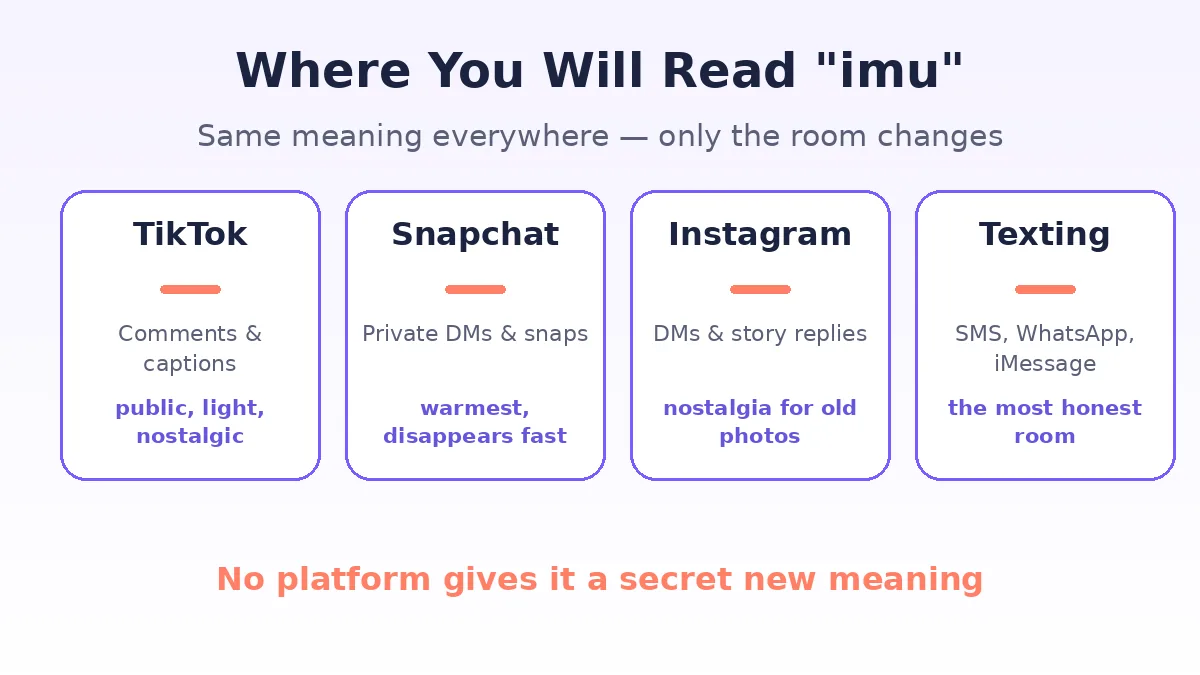
IMU means the same thing on every platform. What changes is the room — and the room changes how much weight the letters carry.
TikTok is where IMU is most public: comments and captions under videos about someone who left or moved away. Because it is public, TikTok IMU is usually Intensity 1 or 2 — a feeling performed lightly for an audience.
Snapchat is the opposite: the most private room IMU lives in. A “IMU 😭” sent to one person and gone in seconds runs warmer than TikTok IMU. Here, Intensity 2 and 3 are common. And if the person you are waiting on has stepped away entirely, BRB meaning in text is the abbreviation for that pause.
Instagram sits in between. DMs carry the private version — “IMU bestie!” under a throwback photo. The tell is the trigger: a memory, an old photo resurfacing. Instagram IMU is almost always nostalgia.
Plain texting — SMS, WhatsApp, iMessage — is where IMU is at its warmest and most honest. No audience, no performance. A 2 a.m. “imu” in a one-to-one thread is the realest version of the abbreviation there is.
What about work? IMU is rarely appropriate in professional messages. A close coworker might send it in a relaxed team chat — but in an email, write the full sentence or a plainer one: “Hope you’re doing well.”
The Reply Compass: Four Questions Before You Answer
Here is the named test for this article — the Reply Compass. Four questions, asked in order, and they point to the right reply almost every time.
Question 1: Do I miss them too? If yes, say so — “IMU too” is the cleanest reply in texting. If no, do not say it anyway: a false “IMU too” promises a feeling you do not have. “Aww, that’s sweet” is always better than a matched lie.
Question 2: Is this romantic? Look for the signals: a heart, a nickname, a late-night timestamp. If the signals say romantic and you feel the same, match the warmth: “IMU more.” If not, stay warm and plain.
Question 3: Is this too soon? IMU after one meeting, or from someone you barely know, can feel intense. If it feels too soon, you do not owe a matching intensity. A neutral reply — “It’s been a while! Hope you’re good” — keeps the door open.
Question 4: Do I need words at all? Sometimes the best reply to IMU is a plan, not a sentence: “Let’s meet Saturday.” Missing someone is a problem with a solution, and the solution is usually presence, not prose.
If you still cannot tell which intensity you are holding, treat it as Intensity 1 and reply to the plan: “Same here — let’s hang out soon.”
IMU in Real Chats: Five Exchanges, Decoded
Five exchanges, decoded with the meter and the compass.
1. The nudge. “Bro IMU. Let’s play tonight.” — Intensity 1, best friend. The second sentence is a plan, and the plan is the point.
2. The longing. “This trip feels long. IMU already.” — Intensity 2, partner. No plan, no joke, just the feeling. Reply: “IMU too. Two more days.”
3. The confession. 11:47 p.m., after a first date that went well: “imu.” — Intensity 3, crush. The message is the risk. Reply with the warmth you actually feel.
4. The family check-in. “IMU guys. See you Sunday.” — Intensity 2, family. Soft, plural, pointed at a reunion.
5. The trap: IMU after an argument. “We haven’t talked all day.” — “I know. IMU.” — Intensity 2, partner, doing repair work. Reply to the bridge, not the argument: “Me too. Can we talk tonight?”
In every exchange, the surrounding words did the decoding, not the letters.
IMU Next to IMY, ILY, IDK, IMO, TBH, and LMK
IMU belongs to a family of short emotional labels. Picking the wrong cousin is how messages get misread.
IMU vs IMY. The closest pair — and the least important distinction here. Both mean “I miss you”; the only difference is the final letter. No evidence supports the claim that IMY carries more emotion.
IMU vs ILY. ILY meaning in text is “I love you” — a bond, not an absence. People stack them — “IMU so much. ILY” — but they answer different questions: IMU says you are not here and I notice; ILY says you matter to me.
IMU vs IDK. IDK meaning in text is a shrug: “I don’t know.” IMU is the opposite — a feeling stated plainly. Together — “IDK, IMU” — they mean I don’t know what to do about it, but I miss you.
IMU vs IMO. IMO meaning in text labels an opinion. IMU labels a feeling. “IMO, we should hang out more” is a suggestion; “IMU, we should hang out more” is a longing with a plan attached.
IMU vs TBH. TBH meaning in text signals candour: “to be honest.” “TBH, IMU” is a small confession inside a confession — the TBH admits the IMU took courage to send. Take it seriously.
IMU vs LMK. LMK meaning in text — “let me know” — is a request for information: “LMK when you’re free” moves a plan forward. “IMU. LMK when you’re free” is the healthiest shape IMU takes: a feeling, plus a door.
IMU vs TTYL and NGL. TTYL meaning in text — “talk to you later” — is a goodbye; IMU is its opposite, a hello that reopens a conversation. NGL meaning in text — “not gonna lie” — is another honesty label: “NGL, IMU” means the feeling is real enough to admit out loud.
When IMU Backfires: The Mistakes That Make a Sweet Message Awkward
IMU is a kind message with failure modes. Four of them account for almost every complaint about it.
Mistake 1: Reading romance into a friendly IMU. A friend writes “IMU guys” and the reader hears a confession. The plural is the tell — “guys” means the group, not you alone. Most IMU is friendly.
Mistake 2: Answering “IMU too” when you don’t mean it. It feels polite in the moment and dishonest five minutes later — you have promised a feeling you do not have. The kind reply is the honest one: “Aww, that’s sweet.”
Mistake 3: Sending it too early. IMU after one meeting, or to someone you barely know, can feel intense. If you would not say “I miss you” to this person out loud yet, do not send IMU.
Mistake 4: Using it as the whole conversation. “IMU.” — and nothing else. IMU works best with a second sentence: a plan, a memory, a question. “IMU. Remember our road trip?” gives the other person something to hold.
Quick Answers
What does IMU mean in texting?
IMU means “I miss you.” It is a short, informal way to tell someone you miss them or wish they were with you.
Is IMU the same as IMY?
Yes. Both mean “I miss you.” The only difference is the final letter — U or Y, two old shortcuts for “you.” There is no real difference in meaning or emotion.
Is IMU romantic?
It can be, but it is not automatically romantic. Friends, family, and partners all use it — the rest of the message decides.
What does IMU mean on TikTok?
The same thing — “I miss you” — usually in a comment or caption under a video about someone who left. Because it is public, TikTok IMU is usually light and nostalgic.
What does IMU mean on Snapchat?
“I miss you,” usually sent privately to one person. Snapchat IMU runs warmer than TikTok IMU because the message is private and disappears.
How do I reply to IMU?
If you miss them too, “IMU too” is the cleanest reply. If you don’t feel the same, be warm and honest: “Aww, that’s sweet.” If a plan fits, offer one.
Can I use IMU at work?
Almost never — it is informal and personal. In emails or formal messages, write the full sentence or a plainer one.
Does IMU have another meaning?
Yes, outside texting: IMU is also the initialism for Inertial Measurement Unit, a motion sensor in drones and phones — the only meaning Wiktionary lists. In a message from a person, it almost always means “I miss you.”
The Final Word on IMU
IMU is three letters doing an old job: telling the truth about an absence. It survives because the feeling never went away — people will always miss each other, and they will always want a short way to say it.
The skill is not memorising the expansion. The skill is the meter: hearing whether someone is nudging you toward a plan, quietly aching, or taking the first brave step toward something bigger.
The next time IMU lands in your chat, do not reach for a dictionary. Reach for the meter. The sender already told you how much they miss you — in the sentence next to it.