
“Where are we meeting tonight?” — “ionk.” Four letters, one shrug, and a reply that somehow feels warmer than the three-letter version everyone already knows. If you have ever stared at “ionk” and wondered whether it was a typo or a whole new word, you are not alone. That is the heart of the ionk meaning in text: an old definition, spelled the way it sounds when you say it fast.
IONK means “I don’t know.” Say it out loud, quickly — “I don’t know” — and listen: something very close to “ionk.” That is the whole trick. It is the same answer as IDK meaning in text, written the way speech sounds instead of the way a dictionary spells it.
The Short Answer: Say It Out Loud and You Already Know It
Here is the test almost no guide starts with: read it aloud. “I don’t know.” Faster. “I dunno.” Faster still, the way you would mumble it to a friend: “ionk.” The letters line up with the sound, not with the spelling.
The I is “I.” The on is the sound of “don’t” when it loses its edges in fast speech — the same “ion” you hear in “ion care” (I don’t care). The k is “know.” Together they make “eye-on-k,” exactly how “I don’t know” sounds when nobody is enunciating.
That makes IONK unusual in slang: it is not a true acronym. IDK takes the first letter of each word — I, don’t, know. IONK takes the sound of the whole phrase and spells that. Once you hear it, you cannot unhear it. It is also not a typo — a deliberate choice, slightly longer and slightly softer than IDK.
Why the Extra Letter? IONK vs IDK Head-to-Head

IDK already does the job in three letters, so why would anyone type four? Because the two do the same job with a different feeling, and the feeling is the choice.
Meaning: identical. Both mean “I don’t know.” There is no secret second definition hiding behind IONK — anyone who tells you otherwise is inventing it.
Sound: this is where they split. IDK is clipped and flat — it reads like a statement. IONK is rounded and spoken — it reads like a voice.
Tone: IDK is neutral — a plain fact on its own. IONK leans playful and relaxed by default. “ionk 😅” feels like a laugh; “idk” feels like an answer. The same shrug, a different shrug-face.
Who understands it: IDK wins by a mile — almost everyone who texts knows it. IONK is niche, and someone outside internet slang culture may stare at it like a Wi-Fi password. If your reader might not know it, IDK is the safer pick.
So here is the pick rule every competitor skips. Talking to someone older, a teacher, or anyone outside your close circle? Use IDK, or write “I’m not sure yet.” Joking around with close friends or reacting in a comment thread? IONK fits the vibe. Same answer, different outfit.
The Shrug Scale: Five Ways IONK Lands
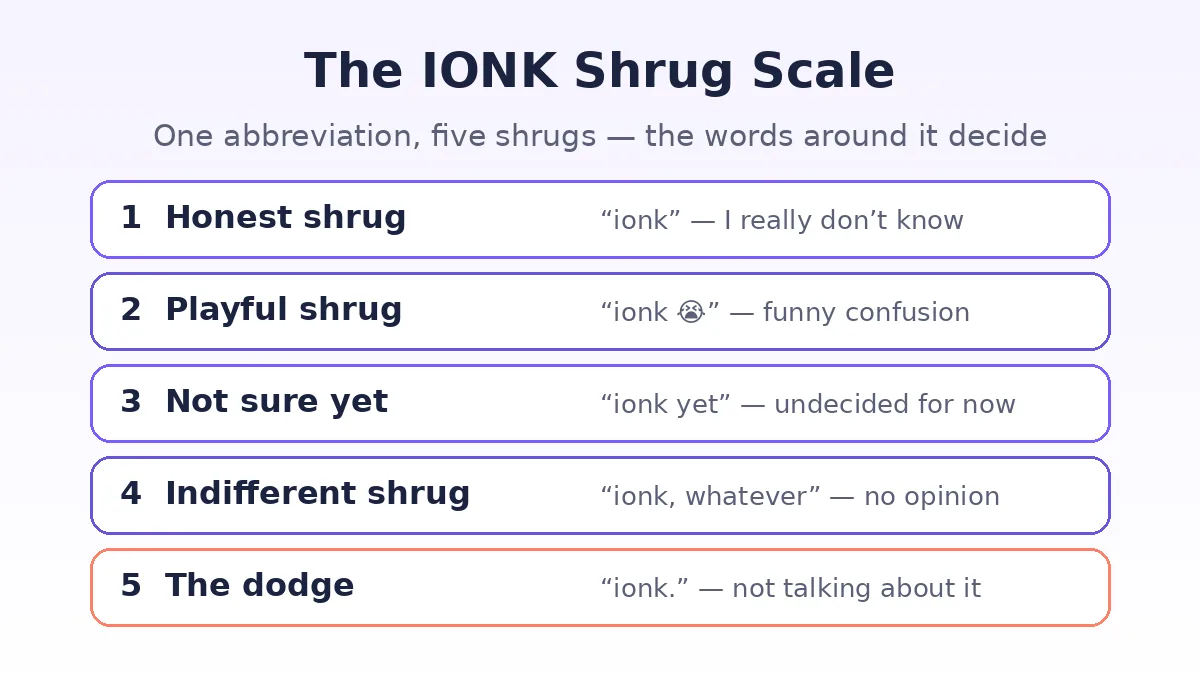
Here is the named idea of this article — the Shrug Scale: five positions, one abbreviation. IONK always means “I don’t know,” but the shrug behind it changes, and the words, punctuation, and emoji around it tell you which position it sits on.
Position 1: The honest shrug. The sender genuinely does not know, and there is nothing more to it. “Where did Jake go?” — “ionk.” No drama, no dodge. This is the most common position, and the one you should assume first.
Position 2: The playful shrug. The sender does not know and finds that funny. “Why did they delete the video?” — “ionk 😭.” The crying emoji does the work. Stretched spellings live here too — “IONKKKK” is Position 2 turned up loud.
Position 3: The not-sure-yet shrug. The sender has partial information but not enough to answer confidently. “Are you coming tonight?” — “ionk yet.” That little “yet” is the tell: undecided, not unknowable. Treat it as a pause, not a no.
Position 4: The indifferent shrug. The sender does not know — and does not much care. “What should we watch?” — “ionk, whatever.” This is where IONK shades toward IDC meaning in text (“I don’t care”) without becoming it.
Position 5: The dodge. The sender might know, or might not, but either way they do not want to talk about it. “Why did you two stop talking?” — “ionk.” One word, full stop, conversation closed. The tell is the shape: a personal question, a sudden short reply from someone who usually writes more, and silence afterwards.
Same four letters, five different messages. Reading IONK is about which position the shrug is sitting on.
Where You’ll See IONK: TikTok, Snapchat, Instagram, and Plain Texting

IONK means the same thing everywhere — no platform gives it a secret new meaning. What changes is the room, and the room changes which shrug position you are most likely to meet.
TikTok is where it performs. Comments move fast, and IONK fits the rhythm: a reaction, not an answer. “ionk why this is so funny 😭” is the classic TikTok use — confusion and amusement in the same breath, usually Position 2.
Snapchat is where it sighs. DMs and snap captions are private and fast, so IONK shows up as the casual reply between people who already know each other. “Where you at?” — “ionk, somewhere downtown 😭.” Usually Position 1 or 3.
Instagram is where it comments. DMs, comment sections, meme discussions, replies to stories. “Why did he post that?” — “ionk 💀.” The skull emoji is the Instagram tell: disbelief and amusement. In dating-adjacent chats, IONK softens a message — “ionk what I’m looking for, just here for the vibes” — approachable, not a romantic signal.
Plain texting — SMS, WhatsApp, iMessage, group chats — is where IONK is at its most ordinary. Planning gone chaotic is its natural habitat: “What time are we meeting?” — “ionk yet, waiting for everyone to reply.” In gaming chats on Discord, it is pure speed: “Where’s the last player?” — “ionk, check upstairs.” Work chats are the one room where it does not belong: in a professional email or a message to a client, “I don’t have that information right now” says the same thing without the shrug.
The Three-Second IONK Test
Here is the named test for this article — the Three-Second IONK Test. Three questions, asked in order, and they settle almost every case.
Question 1: What was the question before it? A straightforward factual question — a time, a place, a name — answered with “ionk” usually means the sender does not know. Position 1. This question alone settles most cases.
Question 2: What is stuck to it — punctuation, emoji, extra words? The attachments are the tone. “ionk 🤷” is relaxed. “ionk 😭” is playful. “ionk yet” is undecided. “ionk tbh” is honest emphasis — and if you want the full story on that little honesty label, TBH meaning in text is the place to start. But a bare “IONK.” is blunt, maybe cold.
Question 3: Who is shrugging, and how do they usually write? A friend who always writes in one-word replies is just writing normally. A friend who usually writes paragraphs and suddenly sends a single “ionk” is telling you something changed.
If you still cannot tell, treat it as Position 1: “No worries — want me to find out?” That works for an honest shrug, a playful shrug, and a not-sure-yet alike.
IONK in Real Chats: Five Exchanges, Decoded
1. The honest shrug. “Who added him to the group?” — “ionk 😭.” Position 1 with a laugh. Reply in kind: “Haha, same. Let’s just wing it.”
2. The playful shrug. “WHY WOULD HE DO THAT???” — “IONKKKK 😭😭😭.” Position 2, turned all the way up: not really an answer, a reaction — the texting equivalent of throwing your hands in the air. Reply with the same energy: “I genuinely have no explanation for this either.”
3. The not-sure-yet shrug. “Are you coming tonight?” — “ionk yet, depends on work.” Position 3. The “yet” and the reason both matter: this person will know later. Reply with patience: “No rush — let me know when you know.” If you need a firmer answer, LMK meaning in text is the abbreviation for that request.
4. The indifferent shrug. “Which dress should I buy, blue or red?” — “ionk, both are great.” Position 4. No answer, no strong opinion, softened by the compliment. Reply by deciding for them, lightly: “Blue it is, then.”
5. The dodge. “Why did she leave the group?” — “ionk.” Position 5. A personal question, a one-word answer, no emoji, no follow-up: they do not want to discuss it. Do not push: “Fair enough.” If the dodge came with an eye-roll you could feel through the screen, that is SMH meaning in text territory.
When IONK Backfires: The Mistakes That Make You Sound Checked Out
Three failure modes account for almost every complaint about it.
Mistake 1: The bare “ionk.” One word, full stop, nothing else, in answer to a question someone cared about. It reads as “I don’t know and I don’t care enough to say more,” even when you only meant the first half. The fix costs nothing: add three words. “ionk, sorry!” or “ionk, I’ll ask him” turns a door closing into a door left open.
Mistake 2: Using it as a dodge in a serious conversation. Someone asks why you did not reply or why a plan fell through — and “ionk” is your whole answer. That is not uncertainty; that is avoidance wearing uncertainty’s clothes.
Mistake 3: Repeating it until it becomes your whole personality. “ionk” as your answer to everything — plans, opinions, feelings — stops reading as casual and starts reading as checked out. If every reply is a shrug, people stop asking. Variety is the fix: sometimes say “I’m not sure, what do you think?” or “let me check.” A shrug is seasoning, not the meal. NGL meaning in text or FR meaning in text will say what you actually think.
A fourth, quieter mistake: using IONK with someone who does not know it yet. To a parent or teacher, “ionk” looks like a typo. When in doubt, IDK — or the full phrase.
How to Reply When Someone Says IONK
Match your reply to the shrug position.
Position 1, the honest shrug: keep it light. “No worries, let’s figure it out.” “Haha, fair enough.”
Position 2, the playful shrug: match the energy. “Same 😂” or “We will never know and honestly that’s fine.” The sender is laughing; laugh with them.
Position 3, the not-sure-yet: be patient, or help decide. “Want me to find out?” The sender left the door open; walk through it helpfully.
Position 4, the indifferent shrug: decide for them, gently. “Okay, I’ll pick — blue it is.” Or nudge: “No preference at all? Even a little one?”
Position 5, the dodge: do not push. “Fair enough” or “Got it” and move on. If the topic matters, come back to it later, in person, where a shrug has a face attached. And if the exchange has left you forming an opinion of your own, that is what IMO meaning in text is for.
If nobody knows and the answer matters: look it up together. Two shrugs do not make an answer, but two people looking do.
Quick Answers
What does IONK mean in texting?
IONK means “I don’t know” — a casual, phonetic way of writing the phrase, the way it sounds when you say it quickly.
Is IONK just a typo of IDK?
No. IONK is a deliberate phonetic spelling: say “I don’t know” fast and you hear “ionk” — I plus the “on” sound of “don’t” plus the “k” of “know.” Not a misspelling.
What is the difference between IONK and IDK?
The meaning is identical — both mean “I don’t know.” The difference is tone and audience: IONK is playful and niche, IDK is neutral and understood by almost everyone. Use IDK when your reader might not know IONK.
What does IONK mean on TikTok?
The same thing — “I don’t know” — but usually as a playful reaction in comments and captions, often with a laughing or crying emoji. More often a shared laugh at something confusing than a straight answer.
What does IONK mean on Snapchat?
The same thing, in a more private setting: a quick, casual reply in DMs and snap captions between people who know each other. Usually an honest shrug or a not-sure-yet, delivered without ceremony.
Is IONK rude?
Not by itself. IONK is neutral — no source gives it a rude or offensive meaning. But a bare “ionk.” with a full stop can sound blunt or checked out, especially in a serious conversation. An emoji or a few extra words keeps it friendly.
What does “ionk” mean from a crush or on a dating app?
Still “I don’t know” — there is no separate romantic meaning. On dating apps it usually softens a message and keeps things light, like “ionk what I’m looking for, just here for the vibes.”
Can I use IONK at work or school?
No. IONK is informal slang, and in professional or school settings it can read as careless or immature. Say “I’m not sure” or “Let me check and get back to you” instead.
The Final Word on IONK
IONK is four letters doing a very human job: turning a shrug into text. Someone typed the sound of their own voice instead of the spelling in the dictionary — and enough people recognised the sound that it stuck.
The skill is not memorising the expansion. The skill is the scale: hearing whether someone is honestly unsure, laughing at the confusion, still deciding, quietly indifferent, or politely closing a door — and replying to the person, not the abbreviation. Ask the three questions: what was asked? What is stuck to it? Who is shrugging?
The next time “ionk” lands in your chat, do not reach for a dictionary. Say it out loud. You already knew what it meant.