
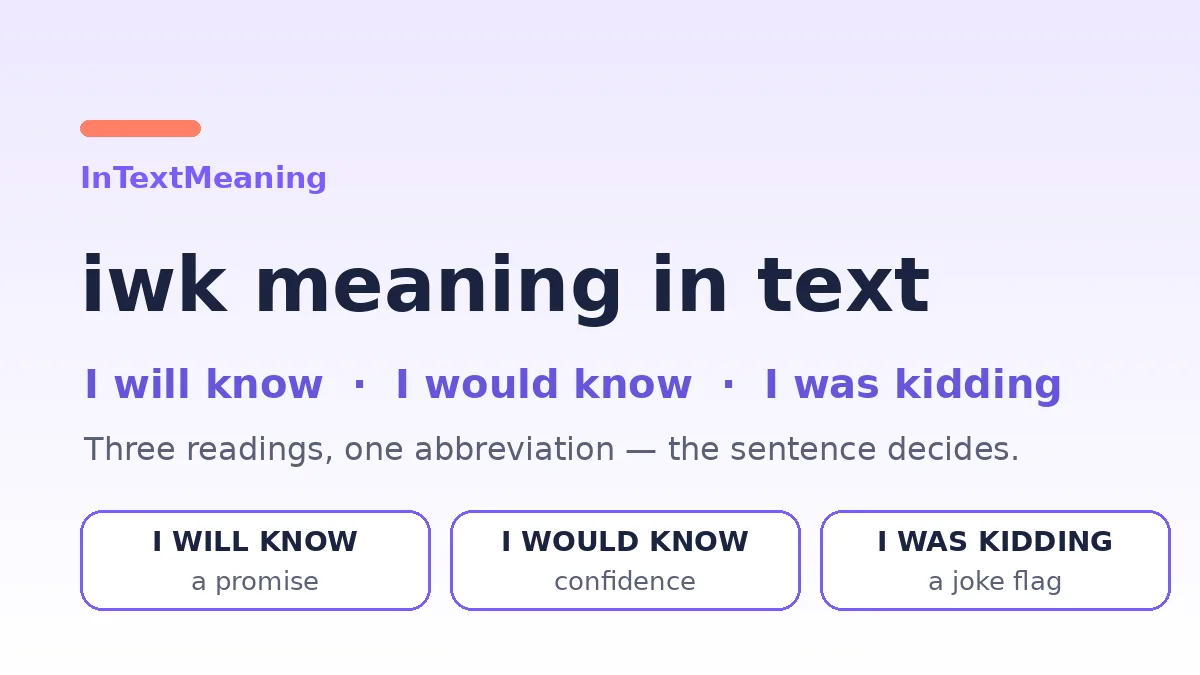
Your friend texts, “IWK by tomorrow.” Your cousin comments, “Trust me, IWK.” A stranger writes, “I just ran a marathon — IWK, I barely finished the 5k.” Same three letters, three completely different messages. That is the honest starting point for the iwk meaning in text: there is no single settled answer, and any guide that gives you one is guessing.
IWK is an abbreviation with three documented readings: “I will know,” “I would know,” and “I was kidding.” Two of the five slang guides I read lead with “I will know,” two lead with “I would know,” and one leads with “I was kidding.” This article tells you the truth about the disagreement, then hands you a test that picks the right reading from the sentence itself.
The Short Answer: Three Readings, One Abbreviation
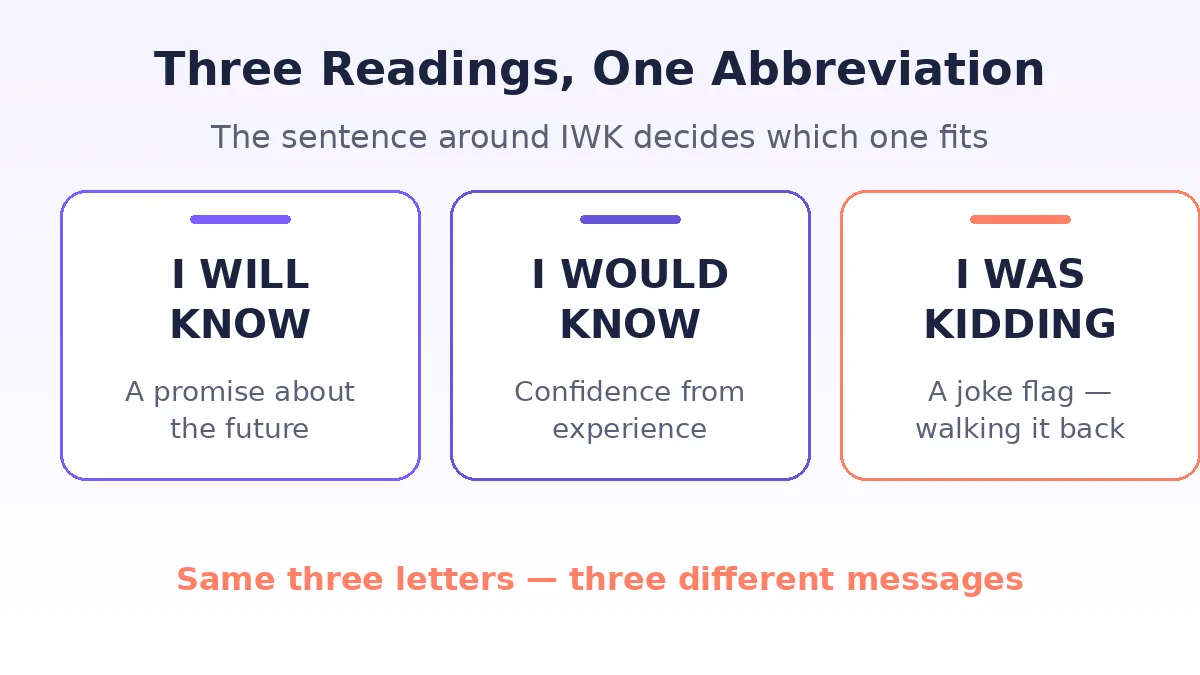
Here is the whole decoder in one paragraph. “I will know” is a promise about the future: the sender does not know yet, but they will. “I would know” is confidence from experience: the sender already knows because they have lived it. “I was kidding” is a joke flag: the sender is walking back something they just said. The letters never change; the sentence around them does all the work. (Outside texting, IWK is also the name of the IWK Health Centre hospital in Halifax — not a texting meaning at all.)
That is also why IWK is the opposite of IDK meaning in text. IDK is a shrug — “I don’t know, and I am not going to.” IWK, in two of its three readings, is the confident cousin: “I don’t know yet, but I will” or “I know, because I have been there.”
Reading One: “I Will Know” — A Promise About the Future
Two of the five guides put this reading first. Reach for it when the sentence points forward in time.
“IWK by tomorrow if the event is confirmed.” “IWK after the meeting.” In every case the sender is admitting they do not know yet, promising they will find out, and asking you to wait.
The tell is the time word. “Tomorrow,” “soon,” “after,” “by Friday,” “once” — any word that points forward. If the sentence has a clock in it, the reading is almost always “I will know.” Use it only when you genuinely intend to follow up.
Reading Two: “I Would Know” — Confidence From Experience
The other two guides put this reading first. Reach for it when the sentence points backward, at something the sender has already lived through.
“That coffee shop is incredible, IWK.” “Don’t skip that movie, IWK it’s worth it.” In every case the sender is saying, “I am certain about this, and my certainty comes from experience.” That is why this reading pairs so naturally with recommendations: “IWK” after a tip is the sender putting their own experience behind it.
The tell is the experience word. “Trust me,” “from experience,” “personally” — any phrase that says “I have been there.” Watch the sarcasm edge: said warmly to a friend, “I would know” is friendly confidence; said in an argument — “Yeah, IWK, obviously” — it can land as a put-down.
Reading Three: “I Was Kidding” — The Joke Flag
One guide puts this reading first and two more list it as an alternative. Reach for it when the sentence walks something back.
“I just ran a marathon in record time!” “No way!” “IWK! I barely finished the 5k.” The first message was an exaggeration, and “IWK” is the sender stepping out from behind it and admitting the whole thing was a laugh.
The tell is position. This reading almost always comes second — after the joke, never before it. It is a repair, not an opening, and it almost always follows something exaggerated or obviously untrue.
This reading causes the most confusion, because it does the opposite job of the other two: “I will know” and “I would know” both claim knowledge, while “I was kidding” admits there was never a claim at all.
The Tense Test: Three Questions That Pick the Right Reading

Here is the named tool of this article — the Tense Test. Three questions, asked in order, and they settle almost every case: the verb tense of the sentence around IWK tells you which reading fits, because each reading lives in a different tense.
Question 1: Does the sentence point to the future? Look for a time word — tomorrow, soon, after, by Friday, once. “IWK by tomorrow.” If yes, the reading is “I will know.” This question alone settles most cases.
Question 2: Does the sentence lean on the past? Look for experience — “trust me,” “from experience,” “personally.” If yes, the reading is “I would know.”
Question 3: Did the sender just say something exaggerated, and is this message walking it back? Look at the message before it: a wild claim, a joke, a boast that cannot possibly be true — followed by “IWK.” If yes, the reading is “I was kidding.” This question only matters when the first two say no.
If all three questions say no, the message is probably the rarer fourth reading, “I wouldn’t know” — a casual shrug when someone is asked about something outside their experience. “Do you think aliens built the pyramids?” “IWK.” Treat it as a last resort, not a first guess.
Where You Will See IWK: TikTok, Snapchat, Instagram, and Texting

TikTok is where you will see “I will know” most often. In comment sections, users drop it to show they are awaiting a reveal — a part two, a product drop, a challenge result. “Don’t worry, IWK after the drop.”
Snapchat is the home of “I was kidding.” Private snaps and streak chats are where friends trade jokes. “IWK 😂” after a wild claim is the joke flag; “IWK tmr” in a streak chat is the future promise.
Instagram splits the difference. In captions and DMs, “I would know” shows up in recommendations from experience — “This spot is unreal, IWK.” In comments, “I will know” appears when someone is waiting on news or a launch.
Plain texting — SMS, WhatsApp, iMessage — is where all three readings live side by side. Group chats planning a weekend use the future promise, a friend recommending a restaurant uses the confident claim, and a sibling teasing you uses the joke flag. The only way to tell them apart is the sentence around the letters.
One caution that applies everywhere: do not use IWK in a professional message. A three-letter abbreviation with three possible meanings is the worst tool for a message that needs to be understood the first time. In a work chat, write the full sentence — “I’ll know by tomorrow.”
IWK in Real Chats: Four Exchanges, Decoded
1. The future promise. “Are you free this weekend?” “IWK by tomorrow — checking my calendar.” Future time word, so Question 1 says yes: “I will know.” Reply: “No rush, let me know when you do.”
2. The confident claim. “That coffee shop is incredible, IWK ☕” The sender is leaning on experience, so Question 2 says yes: “I would know.” Reply: “Oh really? Tell me more!”
3. The joke flag. “I just ran a marathon in record time!” “No way!” “IWK! I barely finished the 5k.” An exaggerated claim, walked back: “I was kidding.” Reply: laugh, and do not take the marathon seriously.
4. The trap: the opposite reading. “Do you think aliens built the pyramids?” “IWK.” No future time word, no experience claim, no joke to walk back — all three questions say no. Reading: “I wouldn’t know.” Reply: change the subject, or laugh — do not read it as confidence.
IWK Next to IDK, LMK, IKR, TBH, IMO, NGL, TBF, and FWIW
IWK vs IDK. Opposites in two readings, twins in one. IDK means “I don’t know” — no answer, no promise. “I will know” is IDK with a promise attached. Only “I wouldn’t know” is close to IDK.
IWK vs LMK. LMK meaning in text — “let me know” — is a request; “I will know” is a promise. You say “LMK when you hear back,” and the other person answers “IWK by tomorrow.”
IWK vs IKR. IKR meaning in text — “I know, right?” — is agreement about something already known; “I would know” is confidence about something experienced.
IWK vs TBH. TBH meaning in text signals honesty: “to be honest.” IWK signals knowledge. People stack them — “TBH, IWK it’s worth it.”
IWK vs IMO. IMO meaning in text labels an opinion; “I would know” labels a fact from experience. “IMO, the movie was overrated” cannot be checked; “IWK, the movie is three hours long” can.
IWK vs NGL. NGL meaning in text — “not gonna lie” — says “I am about to be blunt”; “I would know” says “I am about to be certain.”
IWK vs TBF. TBF meaning in text — “to be fair” — softens a judgement by adding balance; “I would know” hardens a claim by adding experience.
IWK vs FWIW. FWIW meaning in text — “for what it’s worth” — labels the value of a contribution; “I would know” labels its authority.
When IWK Backfires: The Mistakes That Make You Sound Vague
IWK is a useful tool with failure modes, and most come from the same root: three meanings in three letters is a lot to ask of a reader.
Mistake 1: Using it as a stall. “Any update?” “IWK.” No time, no plan, no follow-up — just three letters where an answer should be. If you mean “I will know,” say when.
Mistake 2: Dropping it where the reading is unclear. “IWK” on its own, with no time word, no experience word, and no joke before it, is genuinely ambiguous. If the sentence carries no tense clue, spell the reading out: “I will know by Friday.”
Mistake 3: Using “I would know” to win an argument. “Yeah, IWK, obviously” is not a fact; it is a flex. In a debate, experience is a claim that needs evidence, and three letters are not evidence.
Mistake 4: Flagging a joke nobody laughed at. “I was kidding” only works if the joke was recognisable as a joke. If the first message sounded serious and hurt someone, “IWK” reads as a retreat, not a punchline.
A fifth, quieter mistake: assuming everyone knows IWK. It is not as mainstream as IDK or LOL — one guide says plainly that it “isn’t as mainstream.” Spell it out the first time.
How to Reply When Someone Texts IWK
You do not need a special reply for IWK — you need one matched to the reading the Tense Test gave you.
“I will know” (the promise): acknowledge the wait. “Cool, text me then.” “Alright, keep me posted.” If the promise matters, ask for the time: “When will you know?”
“I would know” (the confident claim): answer the confidence. “Oh really? Tell me more!” “I trust your judgment!” If you doubt the claim, ask: “How do you know?”
“I was kidding” (the joke flag): laugh, and move on. “Haha, you got me.” The worst reply is to keep arguing with a message the sender just said was not serious.
“I wouldn’t know” (the shrug): do not push. The sender just told you they have no information — ask someone else, or change the subject.
If you genuinely cannot tell which reading it is: ask, plainly. “Wait — do you mean you will know, or you were kidding?” It takes five seconds, and it beats replying to the wrong reading.
Quick Answers
What does IWK mean in texting?
IWK has three documented readings: “I will know” (a promise about the future), “I would know” (confidence from experience), and “I was kidding” (a joke flag).
Is IWK the same as IDK?
No — near-opposites. IDK means “I don’t know,” full stop. “I will know” means “I don’t know yet, but I will.”
What does IWK mean on TikTok?
On TikTok, IWK usually means “I will know” — it shows up in comments when someone is awaiting a reveal, like a part two or a product drop.
What does IWK mean on Snapchat?
On Snapchat, IWK is most often the joke flag (“I was kidding”) in private chats, or the future promise (“I will know”) in streak chats.
What does IWK mean on Instagram?
On Instagram, all three readings appear: “I would know” in recommendations from experience, “I will know” in comments waiting on news or a launch.
Is IWK formal or informal?
Informal. It belongs in chats, DMs, and comments — not in business emails or reports.
Can IWK mean “I want kids”?
One low-quality slang site lists “I want kids” (and “I work/kinda,” “I’ll wake”) as IWK meanings, but no other source corroborates them and their examples look invented. They are not credible readings.
How do I tell which meaning of IWK someone means?
Use the Tense Test: future (“IWK by tomorrow”) means “I will know”; experience (“trust me, IWK”) means “I would know”; a walked-back joke means “I was kidding.” If all three fail, it is probably “I wouldn’t know.”
The Final Word on IWK
IWK is three letters carrying three different messages, and that is exactly why it is worth a whole article. Most slang has one meaning and the only question is tone. IWK has three meanings and the only question is which one — and the answer is sitting in the sentence, in the tense, in the words before and after.
The skill is the Tense Test: future means a promise, past means experience, a walked-back joke means a punchline. Anyone can memorise three expansions in ten seconds; the test is what actually decodes the message.
The next time IWK lands in your chat, do not reach for a dictionary — the dictionaries do not agree anyway. Reach for the tense. The sender already told you which reading they meant.