
Your friend texts, “You owe me dinner for life… JP!” A stranger in a game lobby types, “JP servers are down.” Same two letters, two different messages — and the difference decides whether you laugh or start planning a trip. That is the heart of the jp meaning in text: not a definition, but a flag on the sentence before it. JP stands for “just playing” — typed after a tease, a joke, or an exaggerated claim to say, “I was not serious, that was play.” The useful question is never what the letters stand for — it is whether the joke landed as play, or stung anyway.
The Short Answer: JP Is a Joke Flag, Not a Definition
Think of JP as a little flag at the end of a sentence: the sentence is the joke, the flag says how to read it. Without it — “You are the worst teammate ever” — sounds like an insult; with it, the same words become a roast between friends.
Here is the part most guides skip: JP cancels seriousness, not truth. JK (“just kidding”) cancels a statement’s truth — “I did not mean that.” JP cancels its seriousness — “I meant it as play.” The tease can even be partly true: “You really do snore like a truck… JP” is a real observation wrapped in a joke.
One honesty point: Wiktionary does not list “just playing” as a meaning of JP — its entry covers only Japan, Justice of the Peace, and junior programmer. The slang reading rests on unanimous agreement across every slang guide read for this article, but it is slang consensus, not a dictionary entry. JP lives in chat, not in reference books. It was not invented by texting: people said “just playing” out loud after a tease long before anyone typed it, and in early-2000s messengers the phrase shrank to its two initials. Lowercase (`jp`) is the default; uppercase (`JP`) and “just playin'” read the same way.
The Tone Ladder: Four Rungs From Friendly to Stinging

Here is the named idea of this article — the Tone Ladder: four rungs, one abbreviation, and the words before JP tell you which rung it sits on.
Rung 1: The friendly tease. The sender is joking with someone they like. “You run slower than my grandma… JP.” The tease is affectionate, the JP is a grin, and nobody’s feelings are on the line — the most common rung.
Rung 2: The playful brag. The sender is showing off, and making clear it is all in fun. “Beat you again, JP.” The claim is exaggerated on purpose; the JP says do not fact-check it.
Rung 3: The sarcastic jab. The sender means the observation and is using playfulness as cover. “Oh, I love your cooking… JP.” The words say “joking,” the tone says “I noticed” — where JP starts doing real work, and real risk.
Rung 4: The sting line. The sender says something genuinely hurtful and hides behind the flag. “You are terrible at this game… JP.” The tell: remove the JP and the message still hurts.
Same two letters, four messages — ask which rung it sits on, not what it stands for.
JP vs JK vs J/K: Three Cousins That Are Not the Same Thing
JP vs JK. The closest pair, and the one readers confuse most. Both signal “not serious,” but they cancel different things. JK cancels the truth: “You are fired, JK” means you are not fired. JP cancels the seriousness: “You are the worst teammate ever, JP” does not deny the observation — it just says it was play. Most people use them interchangeably, but never use JP to retract a fact: “The meeting is canceled, JP” confuses everyone. That is a JK job, or a neither job.
JP vs J/K. J/K is just JK written with a slash, an older forum style. JP has no common slashed twin — “J/P” reads as a typo.
JP vs LOL, LMAO, NGL, TBH, and IMO. LOL meaning in text reacts to something funny; JP makes something funny-safe — they often appear together, “you lost again… jp lol,” one softening the joke, the other laughing at it. LMAO meaning in text is the same, one volume louder. NGL meaning in text and TBH meaning in text do the opposite job: they label a statement as honest, while JP labels one as play — people stack them — “ngl, your aim is trash, jp.” IMO meaning in text labels an opinion; JP labels a joke. If it can be argued, it is IMO.
The Other JPs: Japan, Job Points, Justice of the Peace, and a Person’s Name
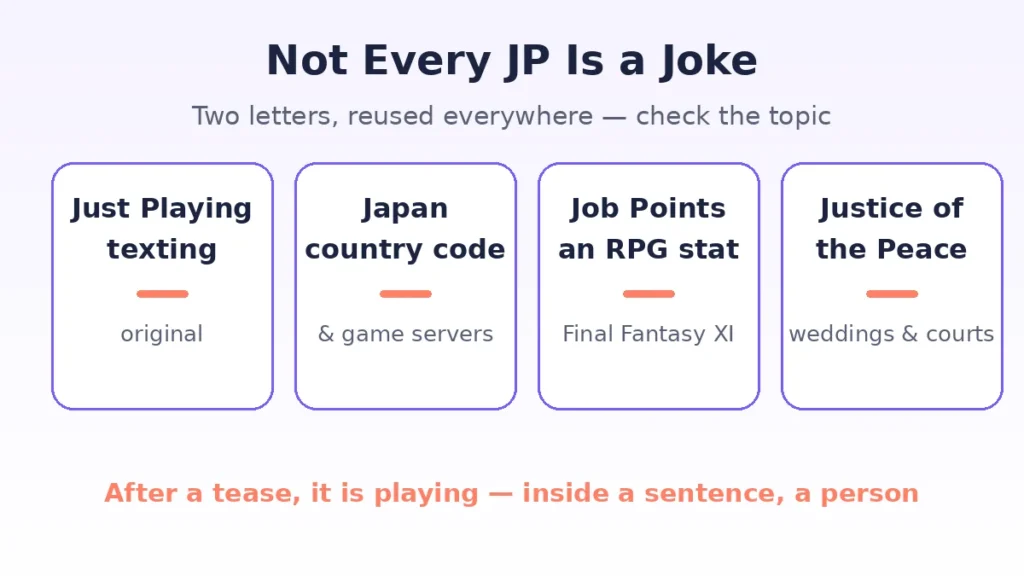
Not every JP is a joke. Two letters are cheap, so they get reused — the other readings are all real, just rarer in casual chat.
Japan. The second most common reading — Wiktionary lists JP as the ISO country code for Japan. In gaming, servers are labeled by region — “JP server,” “NA server,” “EU server” — so “anyone want to switch to JP servers” means Japan, not a joke. The tell is the topic.
Job Points. In RPGs like Final Fantasy XI, JP is a stat — Job Points, earned by leveling a character. “Your JP is too low, upgrade your gear” is a gaming sentence, not a joke.
Justice of the Peace. The formal reading, also in Wiktionary. In wedding planning or legal chats, “we are skipping the big wedding and just doing a JP ceremony” means a Justice of the Peace officiating — rare in a casual DM, but the right reading when the topic is marriage or a courthouse.
A person’s name. Sometimes JP is not slang at all — it is someone’s initials. “Ask JP if he is coming tonight.” The position gives it away: when JP sits inside a sentence doing a job — as the subject, next to “ask,” “send,” “call,” or “meet” — it is a person. At the end of a message, right after a tease, it is “just playing.” After a statement, playing; inside a sentence, a person.
Where You Will See JP: TikTok, Snapchat, Instagram, and Texting
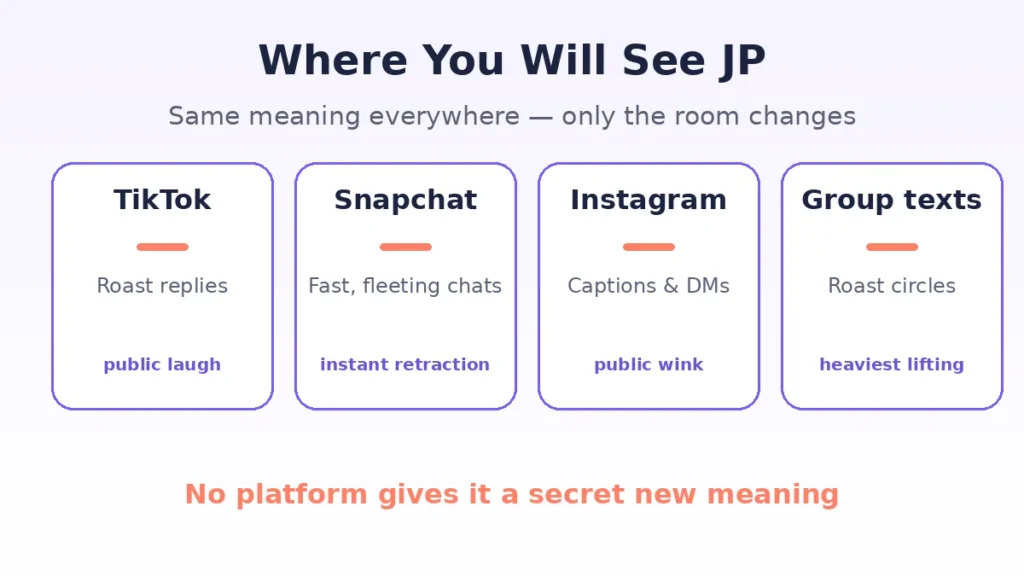
JP means the same thing on every platform — what changes is how often you see it.
TikTok is its loudest room. Roast-style replies and stitch banter are JP’s natural habitat: “you are cooked, jp” tells the creator the burn was affectionate. Usually Rung 1 or 2.
Snapchat is its fastest room. Messages disappear in seconds, so two letters do maximum work: “your streak is dead, jp” delivers the scare and the apology in one breath.
Instagram is its public room. Caption jokes and comment replies — “new profile pic who dis, jp” — a quick wink that the flex is not serious. In DMs it behaves like texting; in comments, read the room: a joke-softener only works when the other person knows you joke, so from a stranger, “nice haircut, jp” reads as an insult with an excuse attached.
Plain texting — SMS, WhatsApp, iMessage, group chats — is where JP does its heaviest lifting. Friend circles that trade roasts need it most: without tone of voice, “you are fired” reads very differently from “you are fired, jp.” And if the person you are waiting on has stepped away, BRB meaning in text is the abbreviation for that status.
Dating apps: competitors claim a special flirting use, but none shows evidence for it — “You are kind of cute… JP” is a playful tease, not a secret code.
The Two-Second JP Test
Here is the named test — the Two-Second JP Test: three questions, asked in order, that settle almost every case.
Question 1: Was there a joke or tease right before it? A roast, a fake threat, an exaggerated claim — “you lost again… jp.” If yes, it is “just playing”; this question alone settles most cases.
Question 2: Is JP doing a job inside the sentence? “Ask JP if he is coming,” “send it to JP.” A name in a sentence means a person, not a joke — if JP is the subject or sits next to an action word, stop: you have found the person.
Question 3: What is the topic? Travel, servers, anime, or shipping means Japan; a wedding or a courthouse means Justice of the Peace; stocks means JP Morgan; a game stat means Job Points. The topic is the last check.
If you still cannot tell, ask — “Wait, JP as in joking, or JP as in Japan?” One extra signal: the joke “jp” is usually lowercase at the end of a message; the name “JP” is capitalized next to action words.
JP in Real Chats: Three Exchanges, Decoded
Three exchanges, decoded with the ladder and the test.
1. The friendly tease. “You run slower than my grandma… JP.” — Rung 1. A small tease, instantly softened: “Says you — race me then.”
2. The sting line. “You are terrible at this game… JP.” — Rung 4. Remove the JP and the message still hurts — that is the tell. Reply to the message: “That one actually stung.” JP does not make a real insult harmless.
3. The trap: JP the country. “JP servers are down again, switch to NA.” — Not a joke at all. Question 1 says no, Question 3 says Japan (servers, regions). Reply to the topic: “On my way, what is the ping like?”
In every exchange, the words around JP did the decoding, not the letters.
When JP Stings: The Mistakes That Make a Joke Land Wrong
JP is a useful tool with failure modes — three of them account for almost every complaint about it.
Mistake 1: Using JP as a shield for a real insult. “You look terrible, JP” still stings. A softener cannot rescue an actually cruel message, and using one to deliver cruelty and then deny it is a form of gaslighting, as one competitor puts it. If the joke needs a JP to be survivable, consider whether it needed saying at all — this mistake costs friendships, not just laughs.
Mistake 2: Using JP to retract a fact. “The meeting is canceled, JP” confuses everyone — was it canceled or not? JP cancels seriousness, not truth, so for facts use JK or neither — the same goes for serious news.
Mistake 3: Using JP at work or in formal messages. In a work email or anything official, JP reads as casual slang at best — and at worst, as someone’s initials or a job posting. Write the joke out, or skip it.
How to Reply When Someone Says JP
Match your reply to the ladder rung.
Rung 1, the friendly tease, and Rung 2, the playful brag: fire back playfully — “Says you,” “You almost got me” — or play along: “Enjoy it while it lasts,” “Rematch?,” “JP right back at you.”
Rung 3, the sarcastic jab: answer the observation, ignore the cover. “Fair point — what would you do differently?” If it stung, name it gently: “lol but that one hurt a little.”
Rung 4, the sting line: do not laugh it off. “That one actually stung” is a complete reply. If the thread is already hostile, often the best reply is none at all — TTYL meaning in text is the clean way to step out, and SMH meaning in text the honest reaction when a joke was never a joke.
If JP meant Japan, a person, or a game stat: reply to the topic, not the letters. “Oh nice, when are you going?” “I will send it to JP now.” The letters were never the message.
If you genuinely cannot tell: ask. “Wait — joking, or Japan?” takes two seconds and saves a misunderstanding.
Quick Answers
What does JP mean in texting?
JP means “just playing” — a tone-softener on a teasing message, signaling it was not serious. “You lost again… jp” means “I am joking around.”
Is JP the same as JK?
Close, but not identical. JK cancels a statement’s truth — “I did not mean that.” JP cancels its seriousness — “I meant it as play.” Most people use them interchangeably.
Can JP mean Japan?
Yes. JP is the country code for Japan, and in gaming and travel chats it usually means exactly that — “JP servers,” “flights to JP.”
What does JP mean on TikTok?
The same as everywhere else: “just playing.” On TikTok it shows up in roast-style replies and captions — “you are cooked, jp.”
What does JP mean on Snapchat?
“Just playing,” used in fast chats after a joke or a dramatic line — “I am never talking to you again, JP.”
Is JP rude?
No — JP itself is not rude; it exists to be the opposite. But a genuinely hurtful comment stays hurtful with “jp” attached — the rudeness lives in the message before it.
Does JP mean the same thing from a girl or a guy?
Yes. JP means “just playing” no matter who sends it — no separate meaning by gender.
Should I use JP in a work message?
Best avoided. In professional chats JP reads as casual slang, and it can be misread as someone’s initials or a job posting. Write the joke out, or skip it.
The Final Word on JP
JP is two letters doing an old job: telling the truth about whether you were serious. Text still cannot carry tone — short flags like JP fill the gap.
The skill is not memorising the expansion — anyone can do that in ten seconds. The skill is the ladder: hearing whether someone is teasing you fondly, bragging playfully, jabbing sarcastically, or hiding a sting behind a flag. Ask the three questions: a joke before it? A name doing a job? What is the topic? The next time JP lands in your chat, reach for the ladder — the sender already told you whether they were playing.