
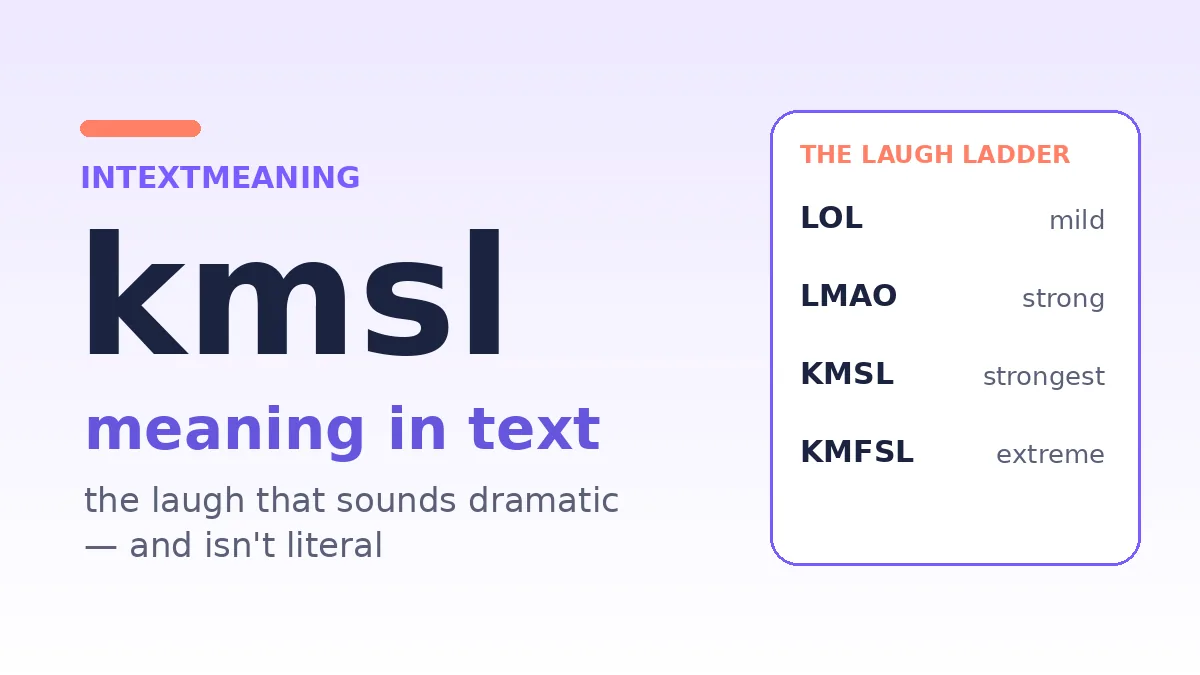
If you searched for the kmsl meaning in text because a message just landed in your chat and one word in it stopped you cold, you are not overthinking it. Four letters, and the first word they spell is “killing.” That pause is the whole story of KMSL.
KMSL is a reaction, not a statement. Somebody sends it when something made them laugh hard — the kind of laugh where you have to put your phone down for a second. It takes the most dramatic words available and uses them to describe the least dramatic thing possible: laughing at a joke.
The Short Answer: KMSL Is a Laugh, Not a Warning
KMSL stands for “killing myself laughing.” That is the whole definition, and every source that covers the term agrees on it — all five of the guides I read for this article say the same thing, word for word, and none of them offers a second texting meaning.
Here is the part worth saying once, plainly: the “killing myself” in KMSL is hyperbole — the same exaggeration as “I’m dying.” It is not literal, not a cry for help, and not a reference to self-harm.
The Laugh Ladder: Where KMSL Sits on the Scale
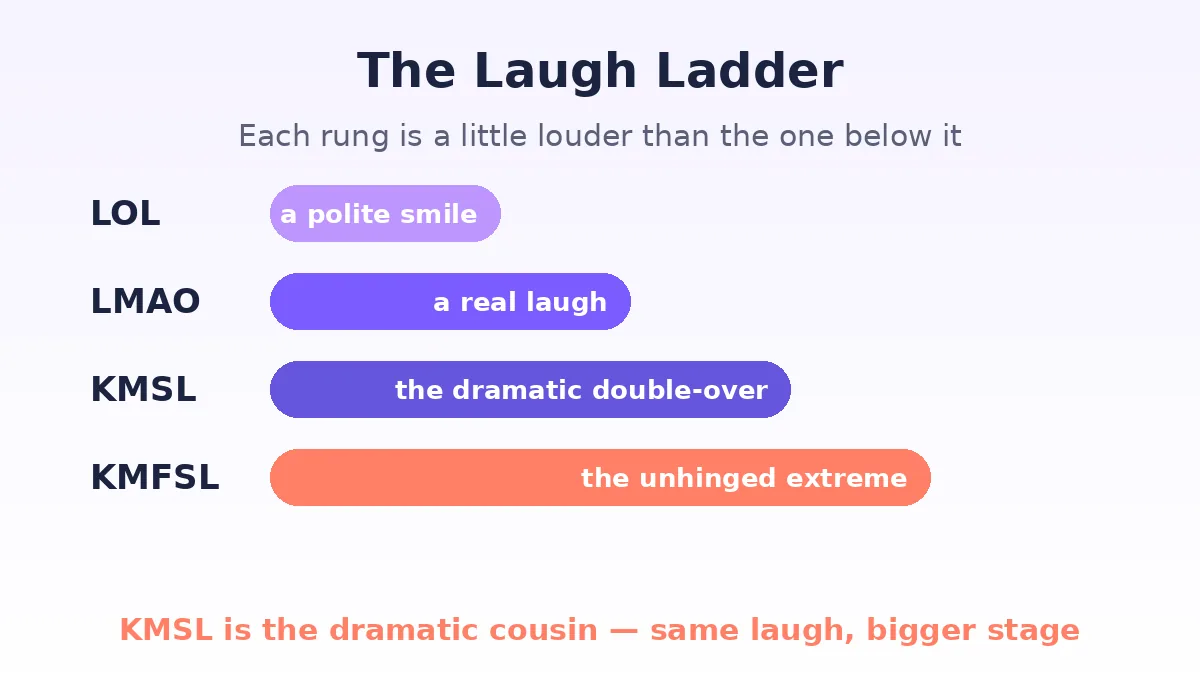
Not all laughter acronyms are equal, and that is exactly why KMSL exists. If every funny thing got the same “lol,” the word would mean nothing — and after thirty years of use, “lol” often means nothing at all.
Think of it as a ladder, with each rung a little louder than the one below it. At the bottom is LOL, the mildest rung — the everyday reaction for something lightly funny. LOL can be genuine, but it can also be a social lubricant, the texting equivalent of a polite smile.
One rung up is LMAO, which says the laugh was real and bigger than a smile. Then comes KMSL: roughly the same height as LMAO, but more theatrical — somebody doubled over, phone in one hand, tears in their eyes.
The L-Test: Three Questions That Settle Every Confusing Case
Here is the test this article is built around: three questions, asked in order, that settle every confusing KMSL moment. I call it the L-Test.
Question 1: Is there an L at the end? KMSL ends in L, for “laughing.” KMS does not. KMS — “kill myself” — is a different phrase entirely, one people use when they are genuinely distressed. If the message says KMSL, with the L, you are looking at laughter.
Question 2: Is somebody actually laughing? Look at what came before the acronym. Was there a joke, a meme, an embarrassing story? If the message before it was funny, the case is closed. If it was serious, the laugh does not fit — you are probably looking at sarcasm.
Question 3: Is anyone actually upset? Even with the L present and a joke in the chat, KMSL can sting if the joke was at somebody’s expense. Laughing at a friend’s embarrassing story is bonding; laughing at a stranger’s bad day is mockery.
KMSL vs KMS: The One-Letter Boundary That Matters
KMSL and KMS look almost identical on a screen — four letters versus three, one letter apart — and they mean opposite things. One is the loudest laugh in texting. The other is a phrase people use when they are hurting, and it deserves a caring reply, not a laughing emoji.
This is not a theoretical risk. Every guide I read mentions it. People confuse the two in the same two ways: somebody who has never seen KMSL reads it as KMS and panics, or somebody reads a genuine KMS as a joke and replies with laughter.
If you see KMSL, the laugh is in the letters. If you see KMS with no L, and the message around it sounds serious or sad, treat it seriously. Ask if the person is okay. The cost of taking it seriously when it was a joke is a slightly awkward conversation; the cost of joking when it was serious is much worse.
Where KMSL Shows Up: TikTok, Snapchat, Instagram, and Plain Texting
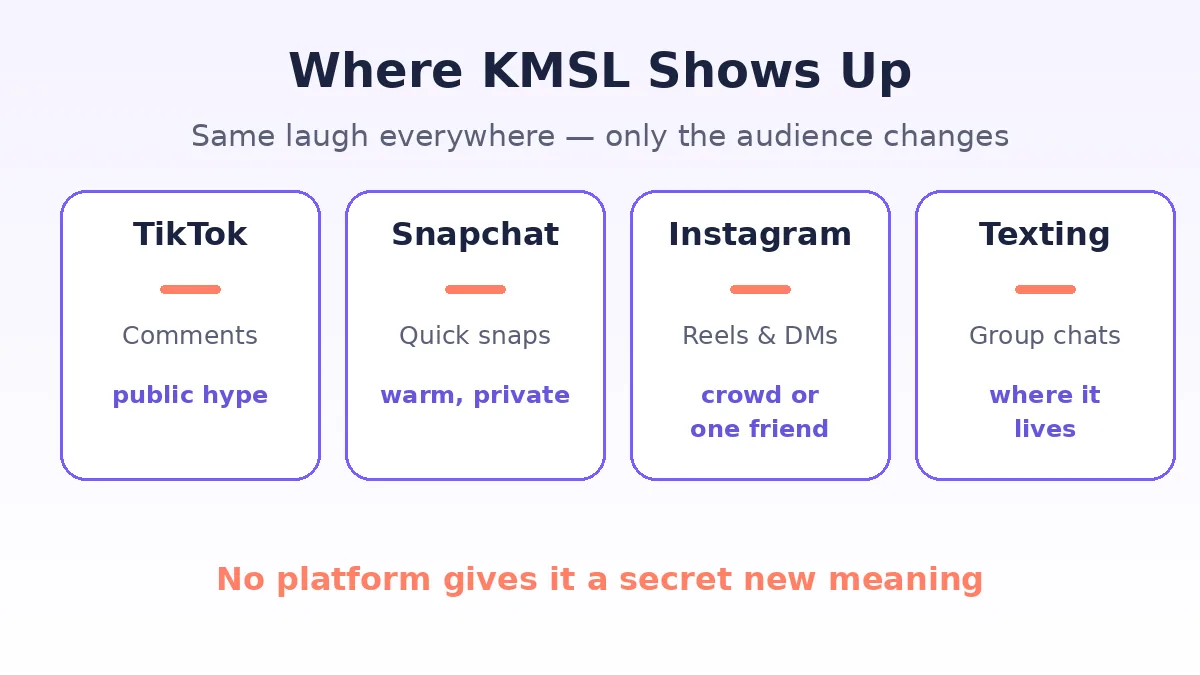
KMSL does not have a secret meaning on any platform. That is worth saying clearly, because a lot of slang guides invent a different definition for every app, and it is almost always fiction. The meaning is the same everywhere: something was extremely funny.
On TikTok, KMSL lives in the comments. Somebody posts a video of a fail or a perfect roast, and the comments fill with KMSL from strangers. Here it is hype as much as laughter — a way of saying “this deserved to go viral” without typing a paragraph.
On Snapchat, it is the opposite: small, fast, and private. A friend sends a snap of a filter gone wrong, and KMSL is the one-word reply that says “I saw it, it killed me, carry on.” Snapchat is quick reactions between people who know each other, so KMSL here reads warmer than anywhere else.
On Instagram, KMSL shows up in two places: the comments under reels and memes, and the DMs where somebody shares a post directly with you. In comments it behaves like TikTok — public and punchy. In DMs it behaves like texting — personal, a reaction to something chosen just for you.
And then there is plain texting, which is where KMSL is most at home. Group chats, one-on-one threads, late-night conversations about the day’s disasters — this is where your friends tell you the embarrassing stories that nobody else would find funny. No platform gives KMSL a second meaning.
KMSL From Three Different Senders
The same four letters land differently depending on who sends them.
From your best friend, KMSL is background noise, and that is a compliment. It means the friendship is comfortable enough that your disasters are shared entertainment. “I tripped in front of everyone.” “KMSL stop, I can’t breathe.” The laugh is the friendship.
From your crush, KMSL is a good sign wrapped in a small risk. It means your joke landed — they chose the loudest laugh available instead of a safe “haha.” But it is still just a laugh, not a confession. Do not read romance into an acronym.
From a group chat, KMSL is a vote. Somebody told a story, the group reacted, and the KMSLs pile up like applause. If your message gets three KMSLs and a skull emoji, you won the group chat for the day.
Genuine or Sarcastic? The Contradiction No One Noticed
Here is something the five guides I read do not agree on, and none of them notices the disagreement. One says KMSL is “most frequently used as a sarcastic response to a dumb message.” Another says it is “almost always positive.” Both cannot be right.
The sarcastic use is real. Somebody says something obviously wrong, and the reply is a flat “kmsl.” No emoji, no follow-up, lowercase letters. That is not laughter — it is a raised eyebrow in four letters. The lowercase matters: all caps with crying-laughing emojis is almost never sarcastic.
But the genuine use is the norm, not the exception. Most KMSLs are sent after something that was actually funny, by people who actually laughed. The sarcastic use is the minority — memorable precisely because it is rarer, and because it stings more than a polite “lol” would.
So here is the middle position: KMSL is genuine by default, sarcastic by context. All caps plus emojis means genuine. Lowercase plus a period means look closer. When you cannot tell, take it as genuine.
KMSL Next to LOL, LMAO, IMAO, and ROFL
KMSL vs LOL: LOL is the mildest and most common laugh in texting, and the most worn out. It can mean genuine laughter, polite acknowledgement, or nothing at all. KMSL is stronger, rarer, and harder to fake. Use LOL for everyday funny; use KMSL when the joke genuinely got you.
KMSL vs LMAO: these two sit on the same rung of the ladder, and the difference is flavor, not strength. LMAO is blunt and physical; KMSL is dramatic and theatrical. Either one works. The choice is style.
KMSL vs IMAO: IMAO — “in my arrogant opinion” — is not a laugh at all, and that is exactly why it shows up here: people confuse it with LMAO, and then with KMSL, because the letters look alike. IMAO is an opinion marker. KMSL is a laugh.
KMSL vs ROFL: ROFL is the old-school extreme laugh, from the era of forums and early chat rooms. It says the same thing KMSL says, in an older accent. ROFL reads dated now; KMSL reads current. The laugh is the same size. The generation is different.
One more comparison: KMSL and K have nothing in common except the first letter. K is the coldest letter in texting — one letter, minimal effort, often read as dismissive. KMSL is the opposite: four letters, maximum effort, almost always warm.
When KMSL Goes Wrong: Three Mistakes
Mistake one: laughing at the wrong message. Somebody tells you they missed their flight or had a terrible day, and you reply KMSL because you were on autopilot. A laugh at bad news reads as carelessness. Before you send KMSL, check what you are laughing at. SMH — shaking my head — fits bad news far better than any laugh acronym.
Mistake two: dropping the L. Type KMSL carefully. If you drop the final letter, you have written KMS, and you have told somebody something you did not mean. The L is the difference between a joke and a distress signal, and autocorrect will not save you.
Mistake three: using it where it does not belong. KMSL is slang, and slang has a place: friends, group chats, memes, and casual social media. It is not a work email, not a message to a teacher, and not a condolence text. In those settings, plain words do the job better.
How to Reply When Someone Sends KMSL
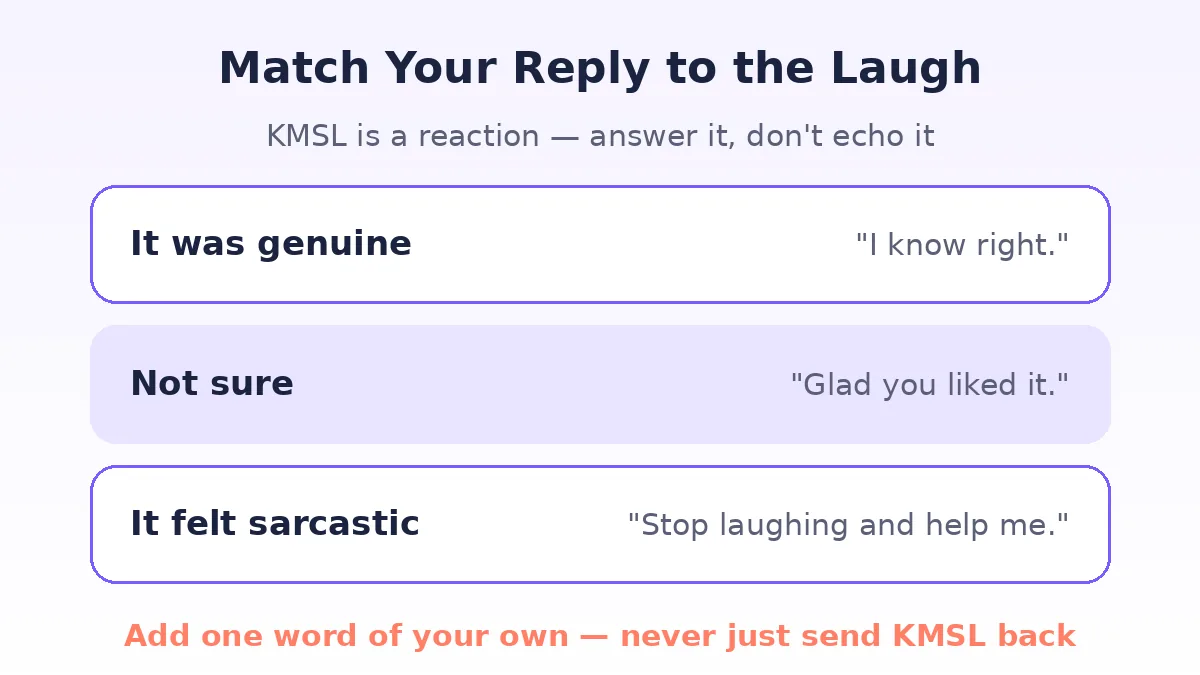
Somebody just sent you KMSL. What now? It is the easiest reply in texting, because KMSL is a reaction, not a question. It does not need an answer — just an acknowledgement that you saw the laugh and you are still in the conversation.
The simplest replies are the best ones. “I know right.” “It gets worse.” “Wait till you hear the rest.” If the joke was yours, match their energy: “Stop laughing and help me.” “You’re supposed to support me.” “I suffered for that story.”
If you want to keep it short, an emoji does the work: 😂, 💀, or a simple “haha.” And if you are TBH not sure whether they were being genuine or sarcastic, the safest reply is a warm one. Reply as if the laugh were real.
One reply to avoid: answering KMSL with KMSL. It reads as an echo, not a conversation. Add one word of your own, and the exchange becomes a conversation again. And if you are NGL still unsure what to say, “glad you liked it” works in every situation.
Quick Answers
What does KMSL mean in texting?
KMSL stands for “killing myself laughing.” It means something was extremely funny — a stronger, more dramatic version of LOL.
Is KMSL the same as LOL?
Not exactly. LOL means “laughing out loud” and can be mild, polite, or even meaningless after years of overuse. KMSL is stronger and rarer — a real, hard laugh.
What is the difference between KMSL and KMS?
The letter L. KMSL ends in L for “laughing” and is always a joke about something funny. KMS has no L and is a serious phrase people use when they are distressed. Never confuse the two.
Is KMSL rude or offensive?
Usually no. It is informal, not offensive. It can feel rude only when used in the wrong place — laughing at bad news, mocking somebody, or dropping it into a professional chat. The acronym is not rude. The timing can be.
Is KMSL sarcastic?
Sometimes, but not usually. Most KMSLs are genuine laughter. Sarcastic use exists — usually lowercase, no emoji, after a message that was not funny — but it is the minority. By default, read KMSL as genuine.
Do people still use KMSL?
Yes. It is less common than LOL and LMAO, which dominate American chats, but it is still in everyday use in casual texting, group chats, and social media comments — and it appears more often in British, Irish, and Caribbean online communities.
Can I use KMSL at work or in formal writing?
No. KMSL is internet slang and does not belong in professional emails, school essays, or formal messages. In those settings, use plain words instead: “That made me laugh,” or “That was hilarious.”
What should I reply when someone sends me KMSL?
You do not need a clever answer — KMSL is a reaction, not a question. Try “I know right,” “It gets worse,” or “Wait till you hear the rest.” Avoid replying with KMSL itself; add one word of your own.
The Final Word on KMSL
KMSL is four letters that look like a warning and work like a compliment. It says “that was so funny I can’t contain it,” in the most dramatic way texting allows. The interesting part is the letter L, and the three questions that follow it.
So the next time KMSL lands in your chat, do not pause on the scary word. Look for the L, check the joke, check the room — and then, FR, enjoy the laugh. Somebody just told you that you are funny, in the loudest way they know how.