
If a message with "smth" in it just made you pause, here is the quick version. The smth meaning in text is simple: smth means "something" — a shortened spelling of one word, and in most messages you can swap it back and the sentence works the same way.
The word itself never changes. What changes is the job it is doing in the sentence — and this article shows you the four jobs, the one test that sorts them out, and how to answer.
The Short Answer: SMTH Means "Something"
SMTH is short for "something." It is not an acronym built from the first letters of a phrase, the way LOL or BRB are. It is a contraction: the writer kept the consonants s-m-t-h, dropped the vowels, and ended up with a four-letter version of a nine-letter word.
Read it out loud as "something," not as the separate letters S-M-T-H. Nobody says "smth" out loud. It lives in writing — texts, DMs, comments, and group chats — almost always in lowercase. Capital letters do not change the meaning.
One warning: do not mix it up with SMH. The two look nearly identical, but SMH means something completely different. Here is what SMH means in text — a reaction of disapproval or disbelief, while smth is just a shorter way to write "something."
Smth is not rude, sexual, or offensive — simply informal. It fits a message to a friend, not a job application or an email to a teacher.
The Or-Something Test: The Four Jobs SMTH Does
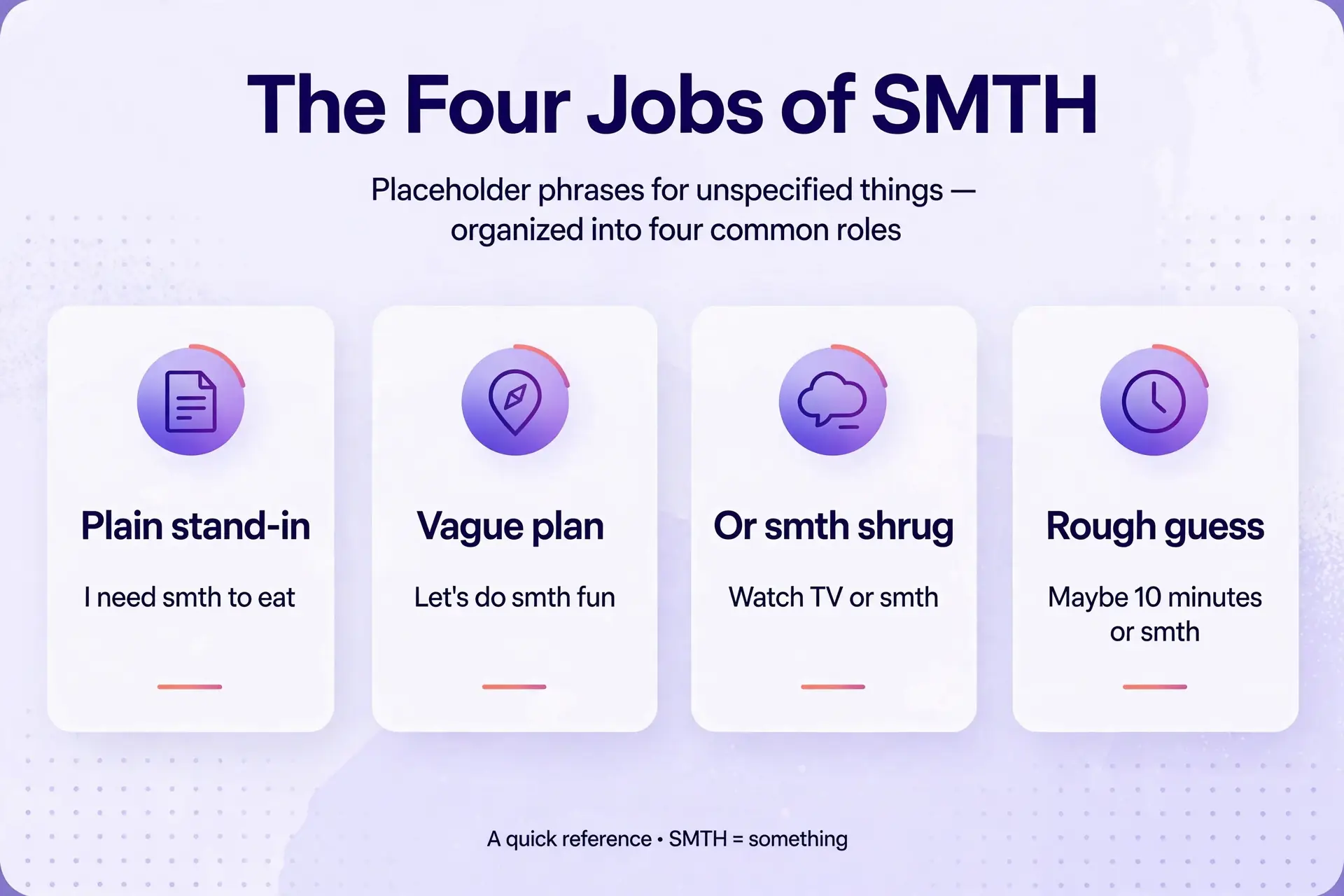
Here is the named test for this article. It is called the Or-Something Test: replace "smth" with "something" and read the sentence again, then check where smth was sitting. Those two clues tell you which of its four jobs it is doing.
Step 1 — Swap it. Put "something" back in. If the sentence still makes sense, you have the plain meaning. If it sounds odd or unfinished, the word was doing extra work.
Step 2 — Check the position. Smth at the start or middle of a sentence is usually a plain stand-in. At the very end, especially after "or," it is usually a shrug.
Step 3 — Ask what is missing. If a thing, plan, or feeling is left unnamed on purpose, smth is holding that empty space — the sender does not know the detail yet, does not want to commit to one, or expects you to fill in the blank.
| Job | What smth is doing | Example |
|---|---|---|
| 1. Plain stand-in | Replaces "something" with no change in meaning | "I need smth to eat." |
| 2. Vague plan | Suggests an activity without naming one | "Let's do smth fun tonight." |
| 3. Noncommittal afterthought | Adds "or smth" at the end to soften a statement | "I'll watch TV or smth." |
| 4. Rough guess or unnamed feeling | Marks an estimate, or a problem the sender cannot name | "Maybe 10 minutes or smth." |
Job 1 is the most common. "I bought smth for your birthday" and "Tell me smth funny" work by direct substitution. Nothing is hidden — the sender just typed fewer letters.
Job 2 is where smth starts to do social work. "Let's do smth tonight" is an open invitation — "I want to hang out, and I am happy for you to pick what we do." The vagueness keeps the plan light.
Job 3 is the one that confuses readers most. When smth lands at the end of a sentence after "or," it becomes a shrug. "I'll watch TV or smth" does not mean the sender definitely wants to watch TV — they have not given the evening much thought. The pizza in "We could order pizza or smth" is a placeholder, not a decision.
Job 4 covers the rough guess and the unnamed feeling. "Maybe 10 minutes or smth" marks an estimate; "Smth feels off today" points at a problem the sender can sense but cannot name yet.
Smth often travels with other casual shortcuts. It pairs naturally with IDC — "I don't care" — in messages like "idk, watch smth or whatever, idc." That company tells you the tone: relaxed, unplanned, and unbothered.
SMTH in Real Messages
The fastest way to get comfortable with smth is to see it inside real conversations. Each exchange below shows a different job.
1. The plain stand-in
A: "Can you grab smth to eat on your way home?"
B: "Sure, want a sandwich or a salad?"
A means "something to eat." Nothing is vague here except the food itself.
2. The vague plan
A: "What should we do this weekend?"
B: "I don't know, maybe go hiking or smth else?"
B has no plan yet. The "or smth else" leaves the door open for A to suggest anything at all.
3. The shrug
A: "What are you doing tonight?"
B: "Probably just watch TV or smth."
B is not announcing a plan to watch TV. B is saying the evening is unplanned and TV is one possibility among many.
Swap in "something" and each sentence works — but the position and the words around it tell you how much the sender has actually decided. That is the Or-Something Test doing its job.
Tone, Punctuation, and Who Sent It
Smth itself is neutral. It carries no emotion of its own — the tone comes from the punctuation, the emoji, the rest of the sentence, and your relationship with the sender.
Punctuation does the heavy lifting in short messages. "Let's do smth" is relaxed. "Let's do smth!" is enthusiastic. "Let's do smth." sounds flat or final. "Do smth?" is a question or a nudge. "Smth…" trails off, hesitant. A period after a two-word reply can make it feel colder than intended, so do not read anger into "smth." on its own.
Who sent the message matters too — not because the meaning changes, but because the same vagueness lands differently. From a close friend, "let's do smth" is a warm invitation. From a crush, "wanna do smth this weekend?" can feel like a careful, low-pressure way to ask you out. In a group chat, "anyone free for smth Friday?" polls several people at once.
Tone also shifts next to other abbreviations. With TBH — "tbh I need smth to eat" — the message reads as honest and unfiltered. With NGL — "ngl, smth feels weird about this" — it reads as a nervous confession. With LOL — "let's do smth dumb lol" — it reads as playful. None of these change what smth means, only how the message lands.
The one tone to watch for is the dismissive shrug. "Say smth" can sound impatient, and "I need smth" with no detail can sound demanding — not because the word is rude, but because the message gives the other person nothing to work with.
SMTH on TikTok, Snapchat, Instagram, and in Texts
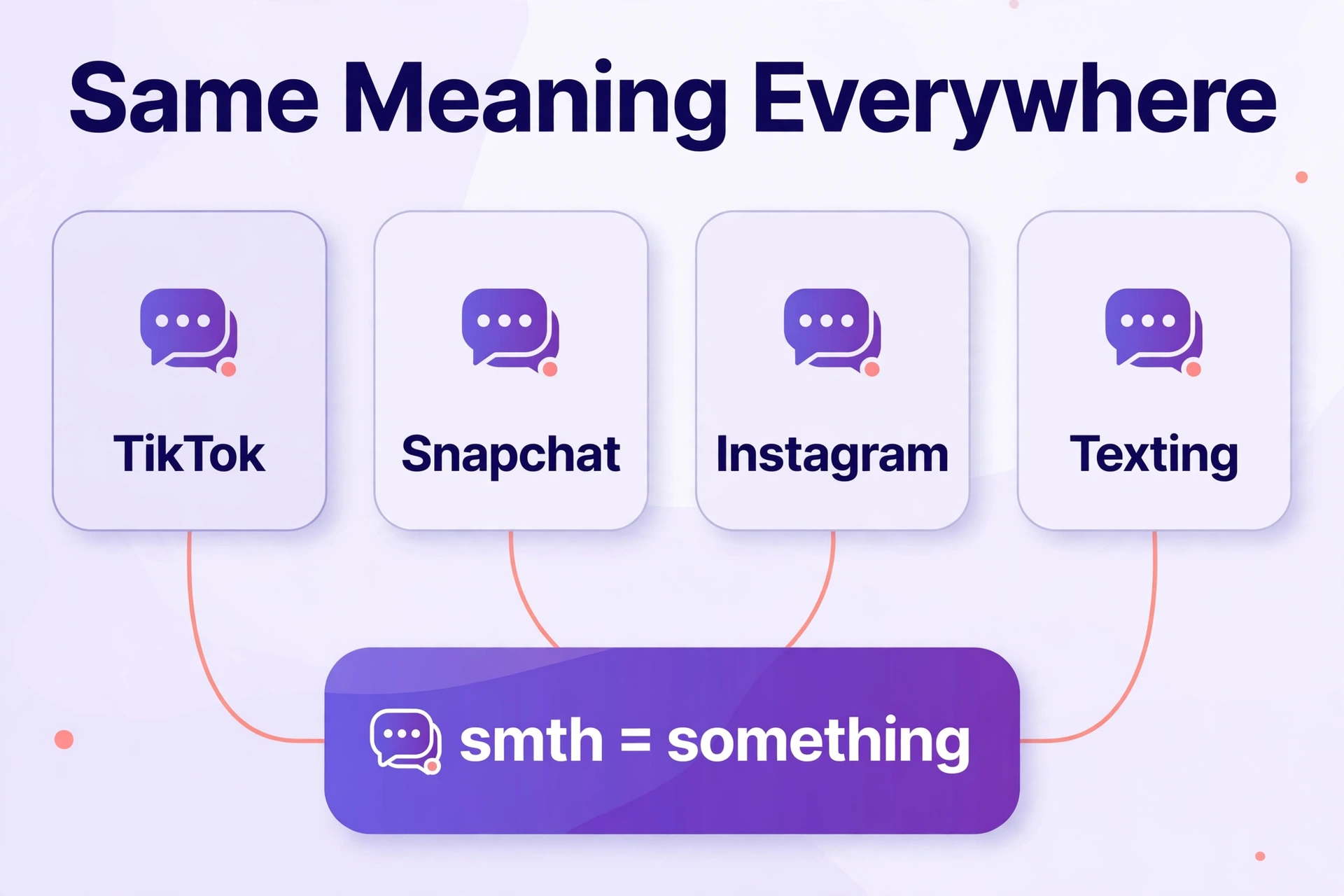
The meaning of smth does not change from one app to another. It means "something" on TikTok, on Snapchat, on Instagram, and in a plain text message.
On TikTok, smth shows up in comments and captions, where speed matters. "This is smth else 😭" means the video is impressive, strange, or hard to describe.
On Snapchat, smth lives in quick chats, where senders lean on shortcuts. "Wanna do smth later?" is a plan in the making, not a finished one.
On Instagram, you will see smth in DMs and comments. "This outfit is smth 😍" is a deliberately vague compliment, and in a DM, "can I ask you smth?" is a soft opening before a real question.
Texting is still smth's home base. In a one-to-one thread, the word has the most room to do its four jobs, because the conversation has history — you know whether your friend's "or smth" means relaxed or avoiding a decision.
SMTH vs. STH, SMH, and Other Look-Alikes
Smth has a small family of look-alikes, and two of them cause real confusion. Here they are:
| Form | What it means | How it differs from smth |
|---|---|---|
| SMTH | Something | The casual texting spelling |
| STH | Something | Same word, but mostly used in dictionaries, grammar books, and language-learning notes |
| SMH | Shaking my head | A completely different meaning — a reaction of disapproval or disbelief |
| SMTHG / SMTHNG | Something | Longer, much less common spellings of the same word |
STH is the one people meet in a different place. In a dictionary entry or grammar pattern, you might see "tell sb sth," where "sb" means somebody and "sth" means something. That is notation, not texting slang.
SMH is the real trap. It differs from smth by a single letter. "I feel like smth is wrong" means something feels wrong; "I feel like smh is wrong" means nothing at all. Replying "smth" when you meant "smh" tells a frustrated friend "something" instead of showing sympathy. Check the middle letter: T means something, H means shaking my head.
When to Spell Out "Something" Instead
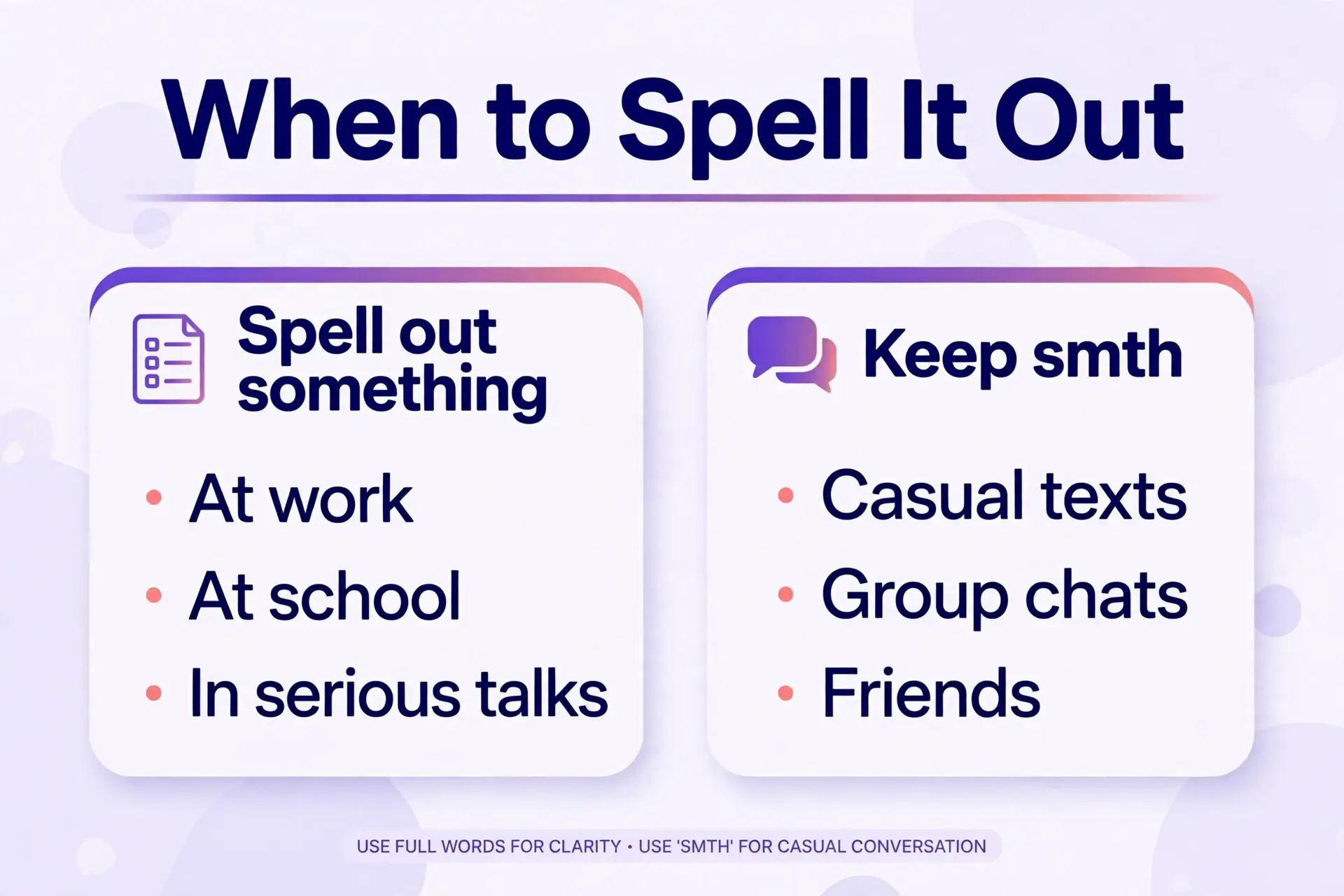
Smth is a good shortcut, but shortcuts have limits. Spell out "something" whenever the message needs to be clear, respectful, or permanent.
School and work come first. An essay, a job application, a formal email, or a message to a teacher or a client should always use the full word — it signals that you took the message seriously.
Serious conversations are second. If a friend is upset, "wanna talk about smth else?" can sound like you are brushing the topic aside. "Do you want to talk about something else?" is warmer.
Clarity is third. "I need smth" is a request with the most important part missing. If you know what you need, name it.
How to Reply When Someone Sends "Smth"
Your reply depends on which job smth is doing.
When it is a vague plan. "Let's do smth tonight." Pick something, or ask for a direction: "How about that new taco place?"
When it is a shrug. "I'll watch TV or smth." The sender has not decided, so do not treat the first option as a plan. If you need a real answer, ask: "Do you want to watch something, or go out?"
When it is a rough guess. "Maybe 10 minutes or smth." Treat the number as an estimate: "Okay, no rush" is usually the right reply.
When it is an unnamed feeling. "Smth feels off today." This one deserves care: "Want to talk about it?" invites them to open up, while "like what?" can feel like an interrogation.
When you genuinely cannot tell. Sometimes the message is just too vague. "I need smth." Then the honest reply is a question: "Smth like what?" That is not rude. BTW adds a light nudge — "btw, what do you need?" — and if the exchange is going nowhere, NVM is a graceful exit: "nvm, I'll figure it out."
Quick Answers
What does smth mean in text?
In text messages, smth means "something." It is an informal shortened spelling for an unspecified thing, idea, activity, or situation, read aloud as the full word "something."
Is smth short for something?
Yes. Smth is a shortened spelling of "something," made by keeping the consonants and dropping the vowels — a contraction of one word, not an acronym.
Is smth rude or offensive?
No. Smth is not rude, sexual, or offensive — simply informal. It can sound vague in the wrong setting, for example "I need smth" with no detail, but the word itself carries no insult.
What does "or smth" mean at the end of a sentence?
"Or smth" at the end of a sentence is a noncommittal afterthought. It signals that the sender has not decided or does not care much about the detail. "I'll watch TV or smth" means the evening is unplanned, not that TV is the plan.
What is the difference between smth and sth?
Both mean "something." Smth is the form people use in casual texting and social media. Sth is the form you are more likely to see in dictionaries and grammar books, often in patterns like "tell sb sth."
Can I use smth in formal writing or at work?
It is better not to. Use the full word "something" in school essays, job applications, formal emails, and messages to teachers, clients, or managers. Smth is fine in casual texts, DMs, and group chats.
How do you pronounce smth?
You pronounce it as the full word "something" (/ˈsʌm.θɪŋ/). People say "something" out loud and only write "smth" when typing.
What does smth mean on TikTok and Snapchat?
It means the same thing on TikTok and Snapchat as anywhere else: "something." On TikTok it appears in comments and captions, and on Snapchat in quick chats. Only the setting changes.
The Bottom Line
Smth means "something," and that is the whole definition. The useful part is everything around it: where it sits in the sentence, whether it follows the word "or," and what the rest of the message is doing. Run the Or-Something Test — swap in "something," check the position, and ask what is missing — and you will read it correctly almost every time.
