
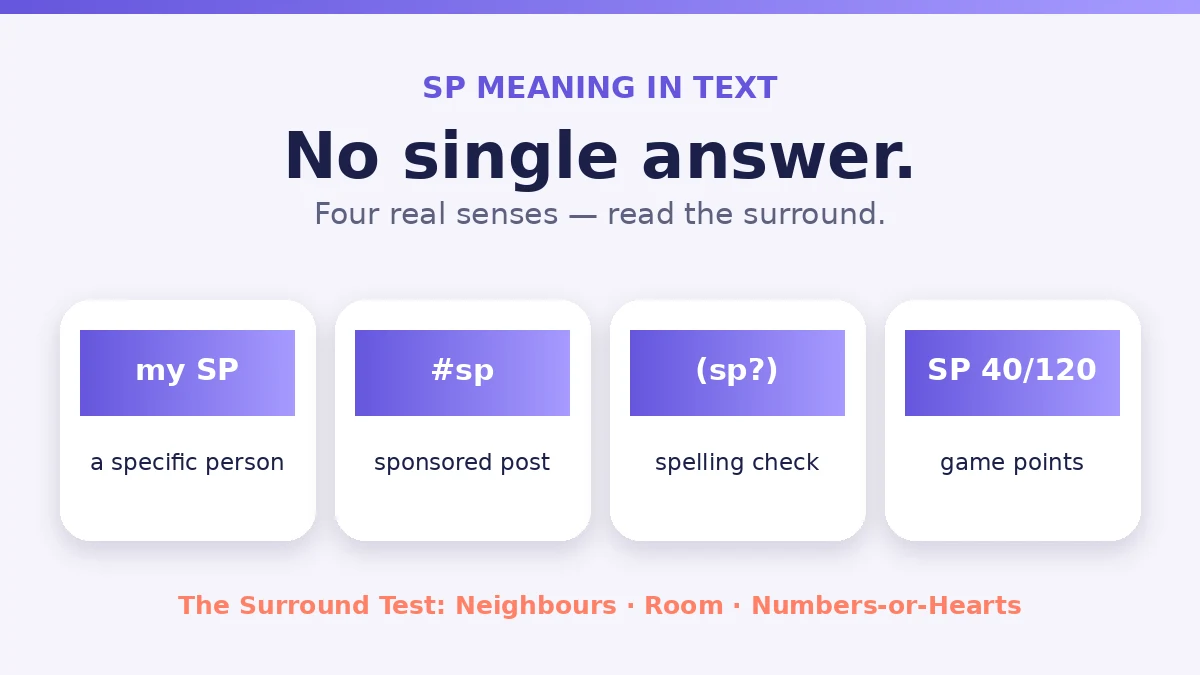
Most slang has a home. SP doesn’t. If you’ve searched for the sp meaning in text hoping for one clean answer, here is the honest one first: SP has no single dominant meaning in texting. It is a two-letter shell that different worlds fill in different ways — and sites giving you one confident “most common” answer are guessing: line the top results up, and each crowns a different winner.
It isn’t bad news: SP is easy to read once you read what’s around the letters — a person in one community, an advert in a hashtag, a spelling flag beside a wobbly word, a points bar in a game. This guide covers each real sense, names the invented ones, and gives you a three-check test — the Surround Test — that decodes any SP you receive.
SP Meaning at a Glance
| Single meaning? | No — context sets the sense |
| Specific Person | The person someone is focused on (manifestation communities) |
| #sp | Sponsored — a paid-post tag in captions |
| sp? | Spelling — “(sp?)” = “not sure of this spelling” |
| In games | A points pool — Skill, Spell, Special or Stamina Points, by game |
| “the SP” | Dictionary sense: the lowdown — “what’s the SP?” = what’s the situation? |
| Tone | Neutral; the room gives SP its attitude |
| Avoid | Bare “SP” outside the shared context — even FYI is clearer |
The Honest Headline: Five Sites, Five Different Answers
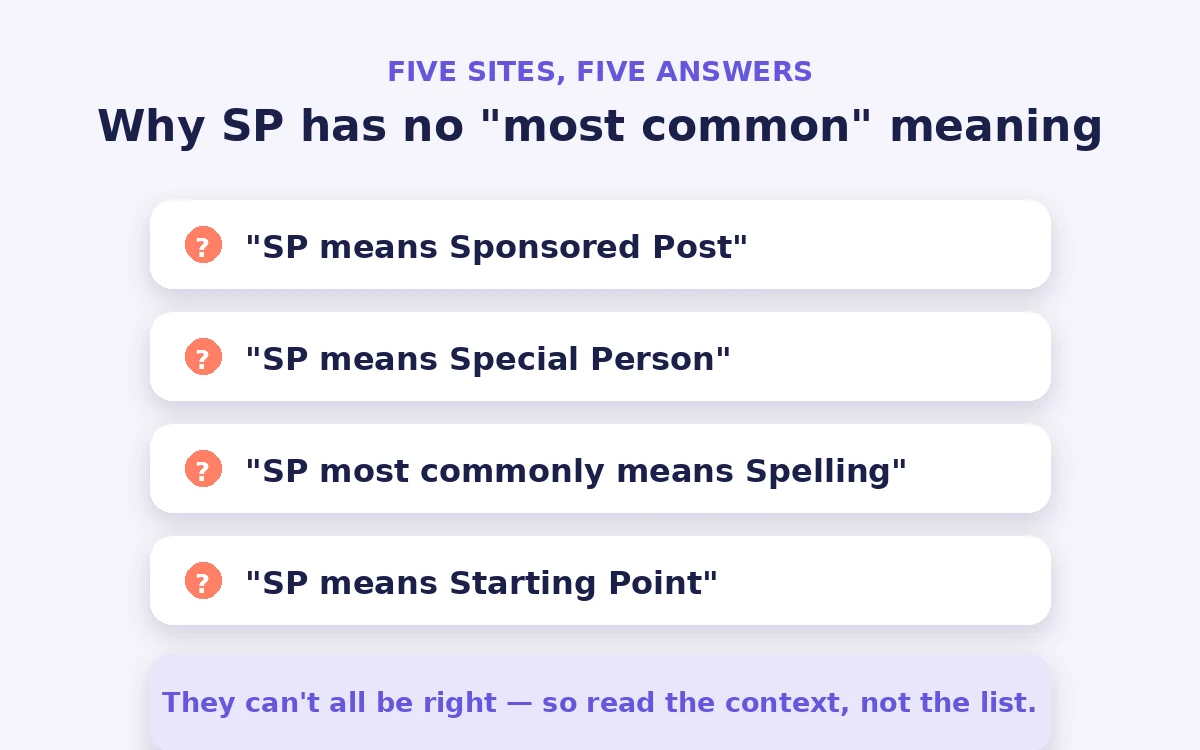
Search this term and watch: one site says SP typically means a sponsored post. Another says a special person. A third says spelling. A fourth crowns “starting point.” They can’t all be right — and that disagreement is the key fact: there is no settled, general texting meaning to crown. When a term has a genuine dominant sense, dictionaries record it and explainer sites converge. SP fails both tests — dictionaries give racing odds and “the lowdown,” not a chat meaning. The real senses live inside specific communities that never agreed to share the letters.
So this article grades its own meanings: every sense below is documented by a dictionary, a regulator, or a living community — and a later section names the popular “meanings” we checked and rejected.
The Surround Test: Three Checks That Decode Any SP
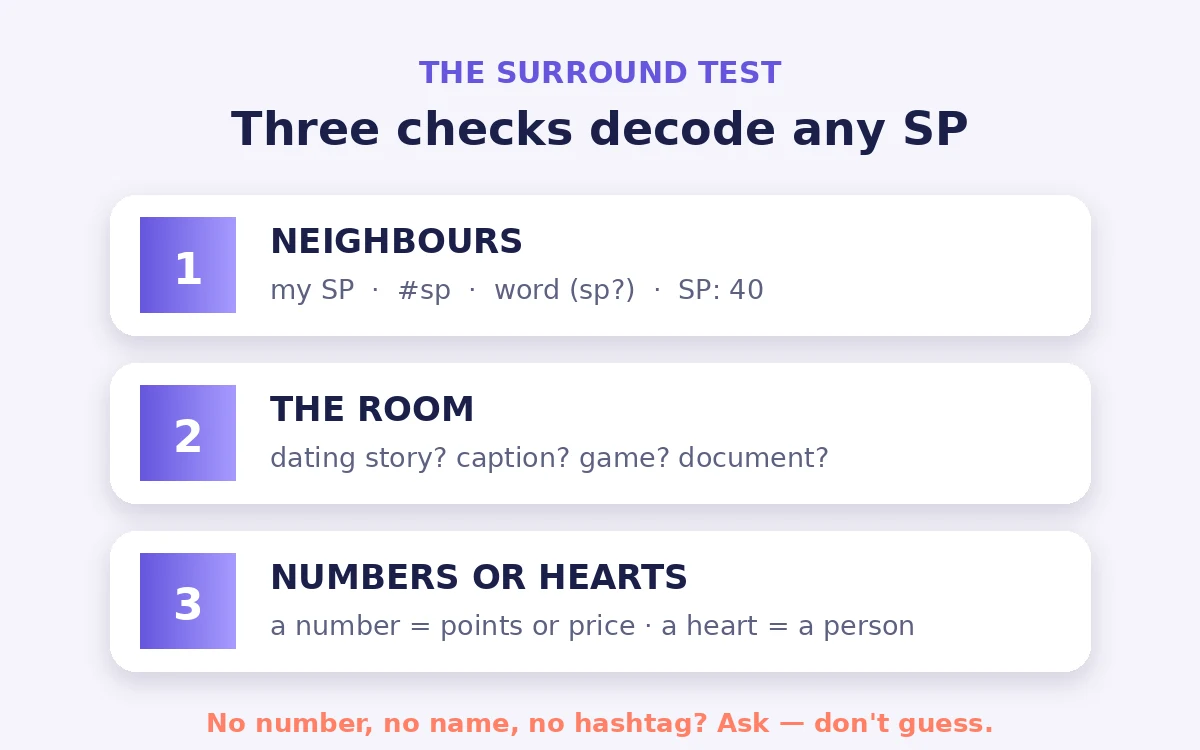
Since the letters alone tell you nothing, read the surround. Three checks, five seconds:
Check 1 — The Neighbours. “My” or “your” before SP, or a heart nearby, points to a person. A hashtag before it (#sp) points to a sponsored post. A misspelled-looking word directly before it — “recieve (sp?)” — points to spelling. A number beside it (“SP: 40/120”) points to game points.
Check 2 — The Room. A manifestation or dating-advice space runs on Specific Person. A creator’s caption runs on sponsored tags. A game chat runs on points and modes. A document or study chat is where spelling flags live. The room narrows SP to one or two candidates instantly.
Check 3 — Numbers or Hearts. SP travels with data or feelings, rarely both. Numbers, bars and levels mean a game stat or a price. Emojis, names and relationship talk mean a person. If SP arrives with neither, it is genuinely ambiguous — ask, don’t guess.
Neighbours, Room, Numbers-or-Hearts.
SP as a Specific Person: The One Real Chat Sense
In manifestation and Law of Assumption communities — a large, active world of posts, comments and DMs — SP means Specific Person: the one particular person someone is focused on, usually a crush, partner or an ex they want back. People write “my SP texted me” and “manifesting my SP.” Inside that world the term is precise and instantly understood — the closest thing SP has to a true texting meaning.
Note what it is not: a generic pet name for anyone you like. An SP is a specific person — the named target of someone’s romantic focus — the way BTS belongs to behind-the-scenes creator talk. Sender check: it comes from someone telling you about their love life, earnestly, mid-story. Reply to the story, not the abbreviation.
#sp Means Sponsored: The Hashtag Sense
In creator captions, #sp means sponsored — the post was paid for, gifted or incentivised by a brand. It sits at the end of captions beside #ad and #gifted, and regulators have ruled on it: the US FTC has said “sp” is not an acceptable disclosure precisely because ordinary readers don’t know what it means, while Australia’s consumer watchdog lists #sp and #spon as known signals of a paid post. The tag is real, widespread, and meant to be spotted.
This SP never appears in a private text — only in public, commercial posts, wearing a hashtag, and the # is part of the meaning (Check 1). Contrast NF (no filter), which promises a post is untouched; #sp quietly admits money touched this one. Brands run on FOMO — #sp is the fine print underneath it.
sp? Means Spelling: The Quiet Written Sense
The oldest SP in the wild isn’t slang at all. In writing, “sp” flags spelling: teachers and editors mark “SP” beside a misspelled word, and writers flag their own uncertainty with “(sp?)” after a doubtful word — “we met in Reykjavik (sp?)”. Abbreviation dictionaries have listed sp. for spelling for generations.
You’ll meet it in comments, docs and study chats — anywhere people write about writing. It always hugs the word it doubts, making it the most unambiguous SP there is. A reply of a correction plus “sp” flags a typo, not a person; answer with a quick fix and a MB (my bad).
SP in Games: A Points Bar, Not a Person
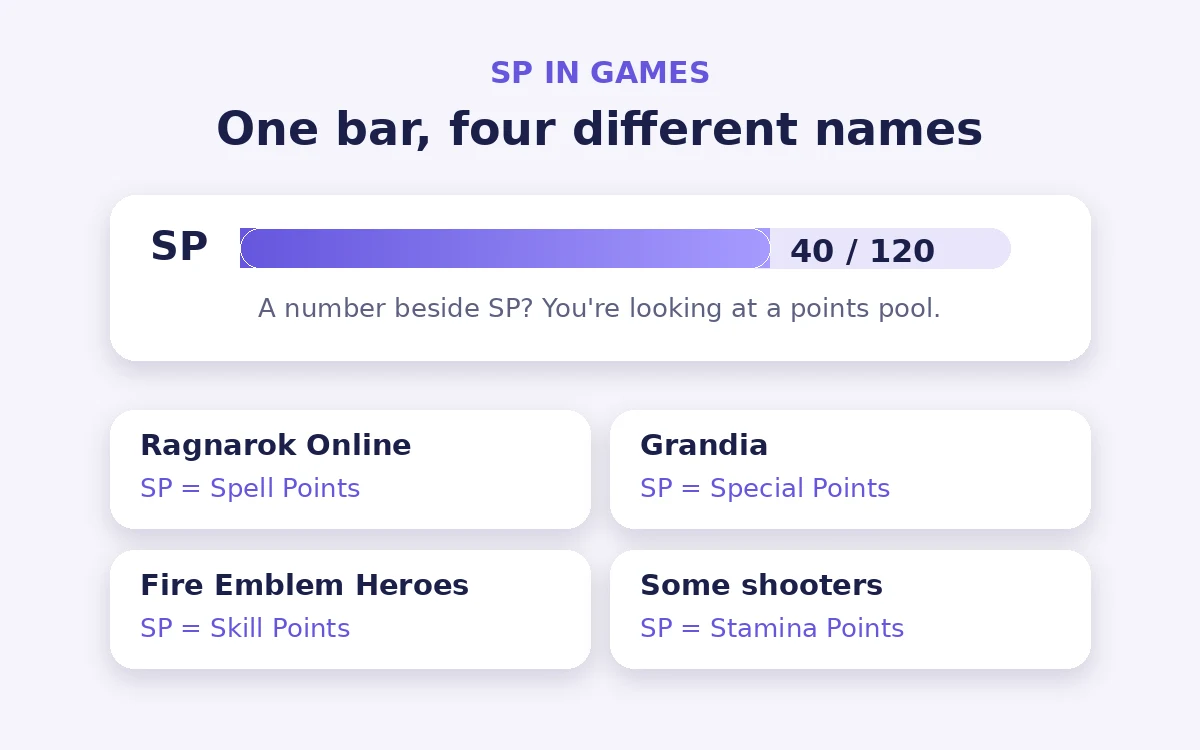
In gaming chats SP is a resource — but here’s the catch no listicle admits: the expansion changes with the game. Ragnarok Online: Spell Points, the pool that pays for skills. Grandia: Special Points. Fire Emblem Heroes and Chained Echoes: Skill Points, earned and spent on abilities. Some shooters: Stamina Points, the sprint bar. Same letters, four full forms — all correct, each only inside its own game.
SP also labels a mode: in gaming glossaries, SP = Single Player — “does it have SP or is it co-op only?” What it does not mean is “support player”; no game glossary documents that. Run Check 3: beside a number or bar, SP is points; beside “mode” or “campaign,” it’s single player. Asking “SP as in points?” RQ (real quick) is always safe.
The Dictionary Senses: Starting Price and “the SP”
Two genuine SPs live in standard dictionaries. SP is the starting price in racing and betting — the odds at the moment a race starts — so “took the SP” in a betting chat is about odds, not people. And informal British English keeps “the SP,” meaning the lowdown: “what’s the SP?” asks what’s the situation; “give me the SP on him” asks for the full story.
Beyond those, SP initialises dozens of formal terms — selling price (“SP: 499”), service pack, state police, São Paulo. None is a texting meaning; sites presenting the acronym dump as “meanings in text” are padding.
Meanings We Checked — and Rejected
SP attracts invented expansions. Each of these is widely repeated; none survived checking:
- “Special Person” / “Sweet Person” — the headline claim on several top pages, with invented histories (WhatsApp “around 2010”; MSN Messenger). No dictionary records it; no community uses it. Almost certainly a copy-error of Specific Person, repeated until it looked established.
- “Sleep” — no attestation anywhere. Letter-guessing, not a meaning.
- Snapchat “Story Post” / “Streaks Partner” — appears on exactly one slang site, nowhere else. Snapchat’s vocabulary has no SP term. Invented.
- “Starting Point” — acronym filler. Any S+P phrase can be initialised; that doesn’t make it a chat meaning.
- “Support Player” — asserted by the previous version of this very article, and withdrawn: no gaming source documents it.
- “Self-partnered” — a real phrase (happily single), but nothing connects it to the abbreviation SP. A letter-fit is not evidence.
Rule of thumb: an SP meaning found on slang sites but in no dictionary, community or second source was manufactured to fill a page.
Reading SP in Real Conversations
Illustrative examples, not real messages.
The manifestation SP — reply to the story
- Lena: “my SP finally unblocked me 😭”
- Priya: “wait — actual movement?? tell me everything”
Specific Person — confirmed by the Room (an ongoing saga about one ex) and Check 3 (pure hearts, no numbers). Reply to the story; nobody here needs the letters explained.
The caption SP — read the fine print
- Caption: “morning routine with my new favourite serum ✨ #sp #skincare”
No conversation to decode — Check 1 only: the hashtag is the disclosure, however quietly it’s tucked away. Weigh the review accordingly.
The spelling SP — fix and move on
- Tom: “we’re meeting at the libary (sp?) at 6”
- Ana: “library* — and yep, 6 works”
Tom flagged his own doubt; Ana answered it in a word — the lowest-stakes SP in existence.
The gaming SP — check the number
- Kai: “can’t cast yet, SP is at 12”
- Ren: “chug a potion, boss in 30”
Numbers-or-Hearts settles it: 12 of something spendable. Which points depends on their game — and insiders never need the expansion, because the surround carries it.
When Not to Use SP
- As a bare message outside the context. Outside its home room, nobody can run the Surround Test for you. Spell it out.
- As a disclosure. Posting paid content? Regulators have ruled “sp” discloses nothing to a normal reader. Write “ad” or “sponsored” in full.
- In work or formal messages. Formal SPs (state police, service pack) will hijack your sentence. Like NSFW, SP only lands where context is shared.
- To mean “special person.” You’d repeat an invented meaning — and manifestation readers will hear a different, specific claim in it.
- Without a number, in game chats. “SP 12” beats “low SP” — the number is the surround that makes you understood.
Quick Answers
What does SP mean in text?
There is no single answer — any site giving you one confident expansion is guessing. In real usage SP means a Specific Person in manifestation communities, sponsored in creator hashtags (#sp), spelling in writing (sp?), and a points pool in games. Run the Surround Test — Neighbours, Room, Numbers-or-Hearts — to tell which you’ve got.
What does SP mean from someone talking about dating?
Most likely Specific Person: the particular crush, partner or ex that person is focused on, in manifestation / Law of Assumption vocabulary. “My SP” in a dating story is that one person — not a generic term for anyone special.
What does #sp mean on Instagram or TikTok?
Sponsored — the creator was paid, gifted or incentivised to post. US and Australian regulators have both addressed #sp; the FTC says it isn’t clear enough to count as a proper disclosure, since most readers don’t recognise it.
What does “sp?” after a word mean?
The writer isn’t sure of that word’s spelling: “Reykjavik (sp?)” = “I think that’s how it’s spelled.” Teachers and editors also mark SP beside errors. A writing convention, not slang.
What does SP mean in games?
A spendable points pool — Spell, Skill, Special or Stamina Points, depending on the game; no universal expansion exists. Beside “mode” or “co-op,” SP means Single Player. It does not mean “support player” in any documented glossary.
What’s the SP — what does that question mean?
In informal British English, “the SP” is the lowdown — the information on a person or situation. “What’s the SP?” = “what’s going on?” A genuine dictionary sense, unrelated to the chat uses.
Does SP mean “special person”?
No reliable source says so. Dictionaries don’t record it, no community uses it, and it appears to be a copy-error for Specific Person that slang sites repeated from each other.
The Short Version
SP is a two-letter shell with no owner. Manifestation communities fill it with a Specific Person; creator captions with “sponsored”; writers with a spelling doubt; games with a points bar whose name changes by title; dictionaries with starting prices and “the SP,” the lowdown. The skill was never memorising the list — it’s the Surround Test: Neighbours, Room, Numbers-or-Hearts. And when a site offers a sixth, seventh and eighth meaning with no source behind any of them, you’ll know what you’re looking at: not SP’s meaning, just somebody filling a page.
