
You open your phone and there it is: two letters, no explanation. “TB.” Did someone just ask you to text them back, or did they just post a photo from three summers ago? That split second of confusion is the whole story of tb meaning in text: the same two letters can be a request or a memory.
TB most often means “text back” in a private chat and “throwback” on social media. This guide untangles both, plus the smaller readings, so you can read any TB in about a second.
What TB Means in Text
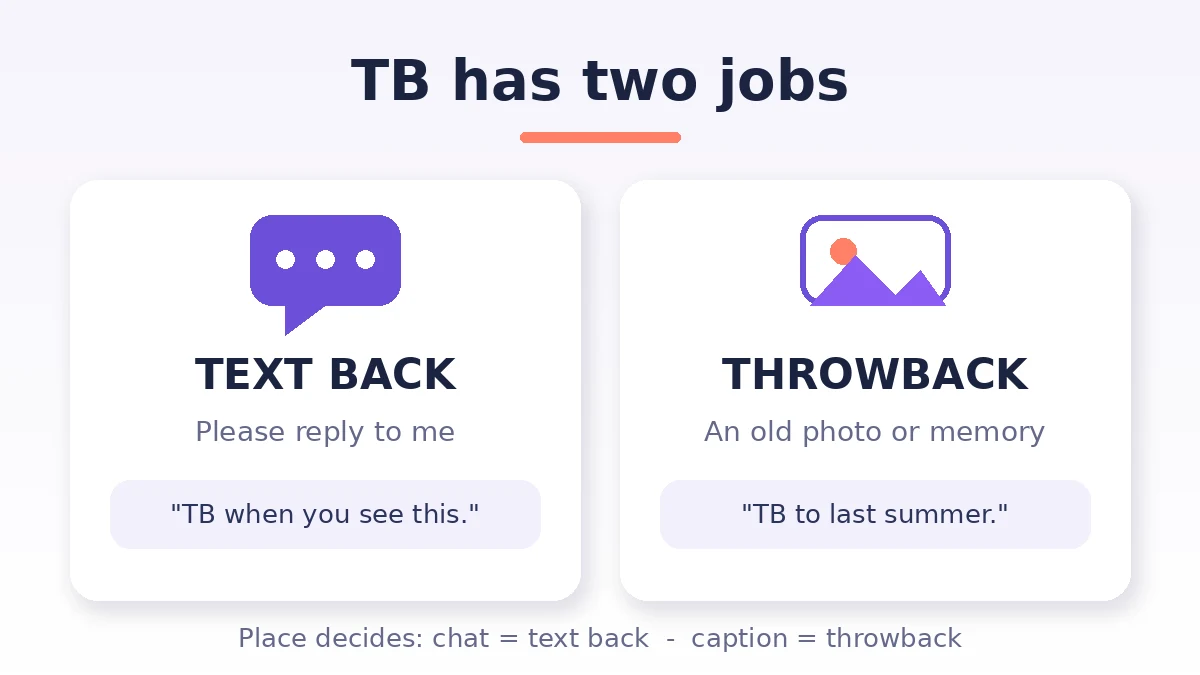
TB is short for two different phrases that share the same two letters, and that accident is the entire source of the confusion. In a private message, TB usually means “text back”: a quick way of saying “please reply to me” or “I will reply to you later.” In a caption or a comment, TB usually means “throwback”: a nod to an old photo, video, song, or memory being shared again.
“Text back” is a verb phrase: it asks for action. “Throwback” is a label: it points at the past. “TB when you get this” can only be a request, and “TB to our road trip” can only be a memory. TB also works as a verb: “I will TB you later” means “I will text you back later.”
| Reading | What it means | Where you see it | Example |
|---|---|---|---|
| Text back | Please reply / I will reply later | Private texts and DMs | “TB when you see this.” |
| Throwback | An old memory or photo | Captions, comments, posts | “TB to last summer.” |
| To be | Not decided yet | Plans and schedules | “Venue TB confirmed.” |
| Talking 'bout | Talking about | Fast group chats | “Who are you TB?” |
| Too bad | That is a shame | Reactions to bad news | “TB, we will miss you.” |
TB is informal in every reading: it belongs in texts, DMs, and group chats, not in a work email. Similar shorthand: what FR means in text.
The TB Place-and-Purpose Test
Here is the named reader test for this article: the TB Place-and-Purpose Test. Run through it whenever a bare “tb” leaves you unsure.
Question 1: Where did you see it? A private chat or DM points to “text back.” A caption, comment, or post with a photo points to “throwback.”
Question 2: Is it asking for something, or pointing backward? If the message wants a reply, TB is a request: “text back.” If it is sharing or remembering something, TB is a label: “throwback.”
Question 3: The Swap Test — try each meaning in the sentence. Replace TB with “text back,” then with “throwback.” Only one will fit. “TB later” becomes “text back later,” which works, while “throwback later” sounds wrong. “TB to 2019” becomes “throwback to 2019,” which works, while “text back to 2019” sounds wrong.
If the three answers still conflict, do not guess. Ask one line: “Do you mean text back, or is this a throwback?”
TB in Real Conversations
Asking for a reply. The most common use in private chats.
Priya: “I sent you the address for Saturday. TB when you see this.”
Sam: “On it, checking now.”
Sharing a memory. The most common use on social media.
Alex: “TB to the road trip. Three years ago today and I still think about it.”
Jordan: “Best week ever. We have to go back.”
A plan that is still open. TB can mean “to be confirmed.”
Chris: “Venue TB confirmed, will update tonight once they call back.”
Taylor: “Got it, I will wait for the update.”
Fast group-chat shorthand. In a quick-moving group chat, TB can shorten “talking 'bout.” This reading is real but thin: only use it when both main readings fail the Swap Test. The same goes for “too bad,” a short reaction to disappointment that leans heavily on tone. A candid opener often sits next to it: what NGL means in text.
How Punctuation and Emojis Change TB
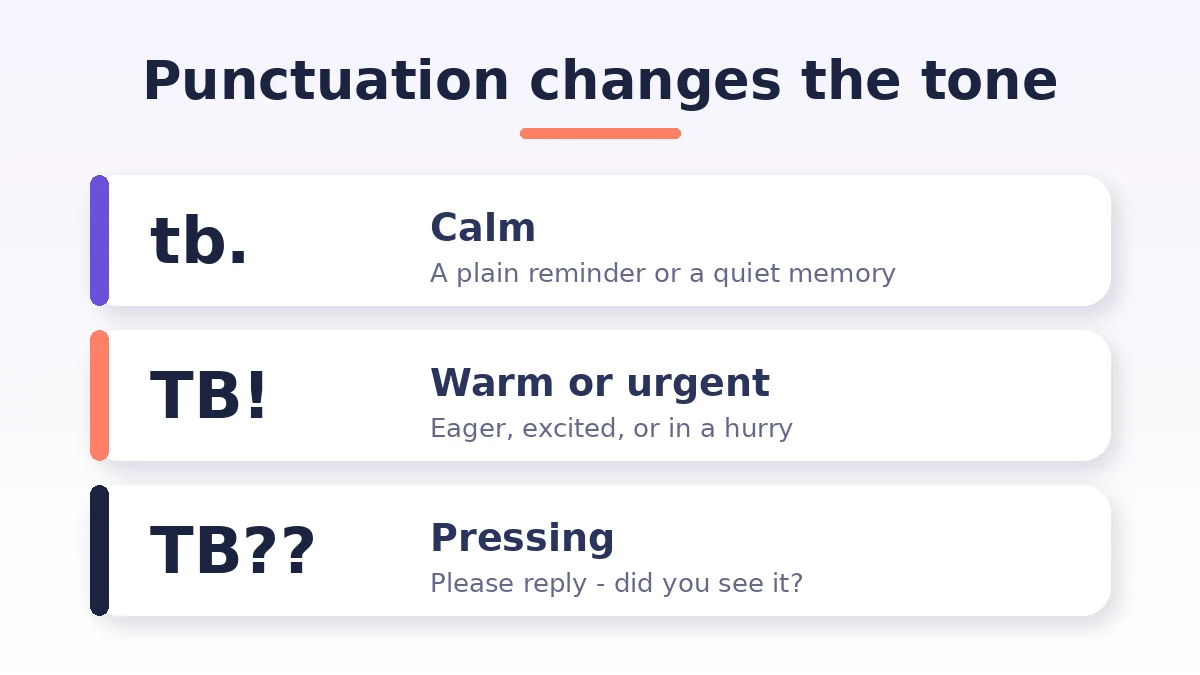
Punctuation and emojis are the closest thing TB has to a tone of voice.
“tb.” with a period reads calm and neutral: a plain reminder or a quiet memory, no urgency attached. “TB!” with an exclamation mark warms it up or speeds it up: “TB! I need the answer,” or “TB! Look at us back then!” “TB??” with question marks is almost always “text back,” and it is pressing: “Did you see my message?” “TB” in all capitals makes it firmer: confident in a friendly chat, blunt or impatient in a tense one.
Emojis can flip it. A crying or nostalgic emoji (“TB 😭”) pulls toward throwback. An eye roll (“TB 🙄”) pulls toward “too bad” with sarcasm. A fire or heart emoji pulls a throwback toward warmth. When an emoji carries a strong feeling, believe the emoji over the letters. The tone notes in what SMH means in text work the same way.
TB on TikTok, Snapchat, Instagram, and in Texting
The core readings of TB do not change from app to app, but the odds of each one do — and that shift is the most useful thing to know about TB online.
In texting, SMS, and WhatsApp, TB is at home as “text back”: a fast nudge to reply, with the full conversation right there to check. On Snapchat, TB can be either reading, and that is what makes Snapchat the riskiest place for it. In a DM it usually means “text back,” but on a Story or a snap of an old photo it usually means “throwback.” Because Snapchat messages disappear, the context that explains TB vanishes with them.
On Instagram, TB is usually “throwback” in captions and comments: “TB to the best weekend ever.” Instagram helped popularize throwback culture through hashtags like #Throwback and #TBT. In Instagram DMs, though, it flips back to “text back,” just like any other private chat.
On TikTok, TB lives in captions and comments and almost always means “throwback”: an old clip reposted, a childhood video, a memory the creator wants seen again. One TikTok explainer puts it plainly: on TikTok, TB is understood as a throwback, not a medical term and not a request.
No major platform officially defines TB. Short replies are the native language of fast chats, and what BRB means in text survives for the same reason.
Who Sent It Changes What It Means
From a close friend, TB is almost always easy: “text back” means “reply when you can, no pressure,” and a throwback means “remember this?” From a crush, a throwback TB can carry a playful charge: they are sharing a memory with you on purpose.
From a parent, TB usually means simple “text back”: “TB when you are home safe.” From a boss or teacher, TB still means “text back,” but it can sound careless in a professional conversation. Do not send it upward: “I will reply shortly” says the same thing without the risk.
From a stranger or a new dating-app match, TB is genuinely ambiguous, because you do not know their habits yet. In a group chat, it usually speaks to the whole group.
Other Meanings of TB — and the Ones to Ignore
Most of the time, TB means “text back” or “throwback.” But the letters have other readings.
“To be” is contextually supported. In planning messages, TB can mean “to be,” as in “to be confirmed” or “to be decided.” Most people write TBC or TBD instead, so use it only when a decision is clearly pending. “Talking 'bout” is contextually supported in fast group chats, but the attestation is thin, so treat it as a fallback. “Too bad” is contextually supported too: a reaction to disappointing news, with a tone that runs from sympathetic to sarcastic. Never assume it from the letters alone.
Tuberculosis is strongly supported — in medical contexts only. Wiktionary lists TB as an initialism of tuberculosis. Terabyte is strongly supported — in tech contexts only. Wiktionary lists TB as an abbreviation of terabyte.
Meanings to reject outright: “try back,” “true blue,” “team bonding,” and “tough break” each rest on a single isolated mention. In Brazilian Portuguese, “tb” shortens “tambem,” meaning “also,” but that is a different language. No credible source supports a specific monthly search figure for TB. The same pattern — one dominant reading, niche ones, and invented ones to discard — shows up in what ALR means in text.
TB vs TBT vs TBH
TB gets confused with two lookalikes more than with anything else. The table clears it up at a glance.
| TB | TBT | TBH | |
|---|---|---|---|
| Full form | Text back / Throwback | Throwback Thursday | To be honest |
| Core meaning | Reply to me / An old memory | An old photo, posted on Thursday | I am about to be candid |
TBT is TB with a calendar attached: a throwback posted specifically on a Thursday. TB is the casual version with no day attached, and it can also mean “text back,” which TBT never does. TBH is unrelated to either: it introduces an honest opinion, not a memory or a reply. Another short reply with two faces is what SNM means in text.
How to Reply to TB
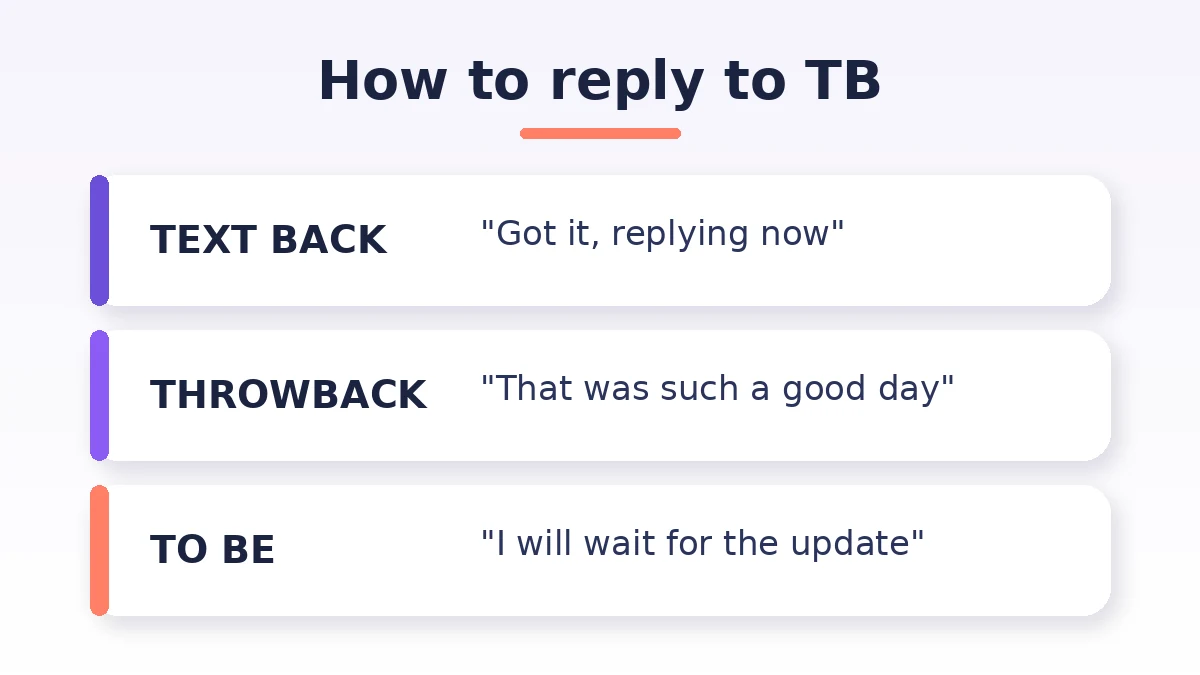
The right reply depends entirely on which TB you just received. Pick your script by the meaning, not by habit.
When TB meant “text back,” acknowledge it and give a timing: “Got it, replying now” when you can answer straight away, or “Saw this, will reply after dinner” when you cannot. When TB meant “throwback,” react to the memory, not to the letters: “That was such a good day” or “I miss those days.” Add your own detail if you have one: “I still have that playlist.”
When TB meant “to be,” confirm you are waiting. When you are unsure what they meant, ask in one line: “Do you mean text back, or is this a throwback?”
When you sent TB and it landed badly — someone read your nudge as impatience, or your “too bad” as sarcasm — fix it fast: “Sorry, I just meant reply when you can.” It is also worth knowing what IMO means in text.
When Not to Use TB
Leave TB alone for serious or emotional news, where it reads as cold or dismissive, and at work, where a manager may hear “I cannot be bothered to reply properly.” Skip it with anyone who may not know slang, and do not chase someone with it repeatedly. If you need an answer by a deadline, spell it out — “Could you reply by 6 pm?” — instead of hiding the deadline inside two letters.
A laughing reply has its own shorthand: what LMAO means in text.
| Instead of TB, try | When it fits best |
|---|---|
| Text me back when you can | Almost everywhere, casual and clear |
| I will reply shortly | Work chats and formal messages |
| Throwback to… | When you want the full word for warmth |
| Let me know | After a question you are waiting on |
| Reply when you are free | When there is no rush at all |
Quick Answers About TB
What does TB mean in text?
TB usually means “text back” in a private chat: a short way of asking someone to reply. On social media it usually means “throwback,” a reference to an old photo or memory.
What does TB mean on Instagram?
On Instagram, TB usually means “throwback” in captions and comments, as in “TB to last summer.” In Instagram DMs, it usually means “text back,” just like in any private chat.
What does TB mean on Snapchat?
On Snapchat, TB can mean either “text back” or “throwback.” In a DM it is usually “text back”; on a Story or a snap of an old photo it is usually “throwback.”
Is TB rude?
TB is not rude on its own, but it can sound rude in the wrong moment. A “text back” nudge can feel impatient if it is repeated, and “too bad” can sound dismissive or sarcastic.
Can TB mean tuberculosis?
Yes, but only in a medical context. TB is the standard abbreviation for tuberculosis in health discussions, and for terabyte in tech discussions.
What is the difference between TB and TBT?
TB can mean “text back” or “throwback,” with no day attached. TBT means “Throwback Thursday”: a throwback posted on a Thursday.
What does “TB later” mean?
“TB later” almost always means “text back later”: the sender is busy now and will reply later.
When should I not use TB?
Avoid TB at work, in formal messages, and with anyone who may not know texting slang. If you need a reply by a deadline, spell the deadline out instead of hiding it in two letters.
The Bottom Line on TB
TB is two letters with two jobs. In a private chat, it is usually a request: “text back, when you can.” On social media, it is usually a memory: “throwback to a good day.”
