
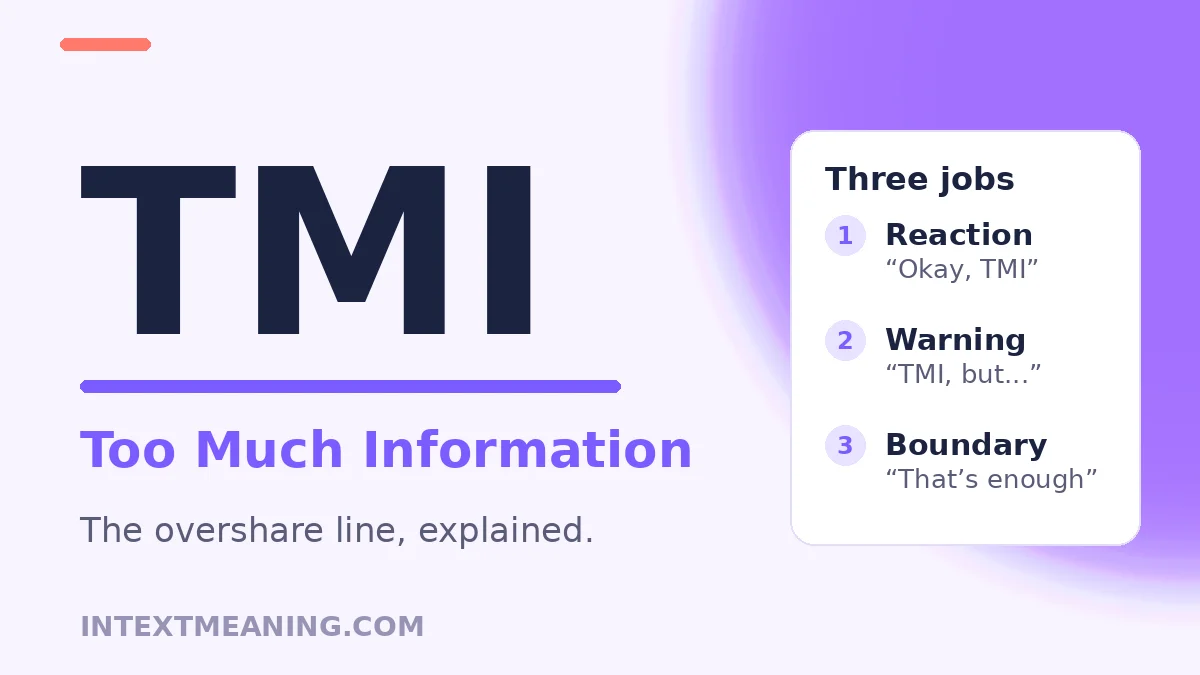
You are eating lunch, scrolling through a group chat, when a friend starts describing their stomach bug in vivid, minute-by-minute detail. You like this friend. You did not need the play-by-play. One small reply ends the story without ending the friendship, and that is exactly what tmi meaning in text is about.
TMI stands for “too much information.” People send it when someone has shared more personal detail than anyone wanted to hear: usually light and half-joking, but also a real boundary. This guide covers the three jobs TMI does, the self-warning version that starts with “TMI, but…”, and the K-pop meaning.
What TMI Means in Text
TMI is an initialism for “too much information,” and the full phrase was in spoken English long before texting shortened it. Wiktionary lists it as informal slang for exactly that phrase.
In plain English, TMI means “That is more detail than I wanted or needed to know.” It is a reaction, not a conversation starter: it only makes sense after someone else has already said something. You do not open a chat with TMI. You send it because the chat just went somewhere you did not want to follow.
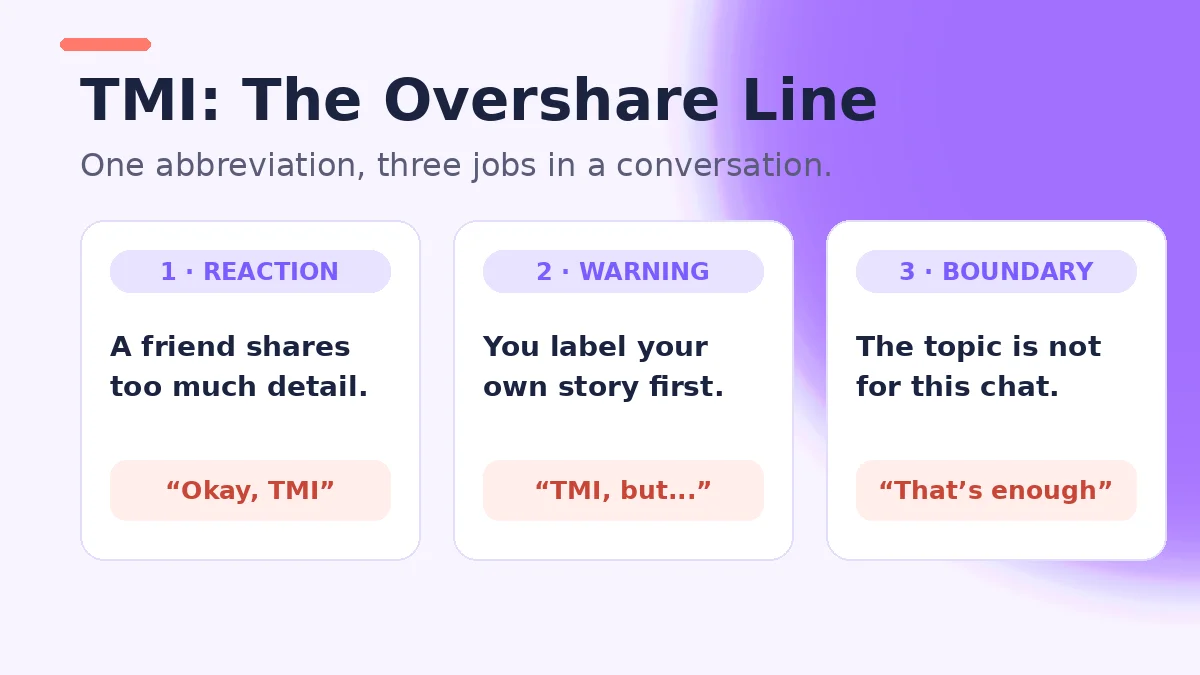
TMI does three jobs. First, reacting to an overshare: a friend shares graphic or overly personal details, and TMI draws the line. Second, warning before an overshare: people label their own stories in advance. Third, setting a boundary: sometimes it is about a level of closeness the relationship has not earned yet. Oversharing is the action, TMI is the reaction. Most of the time it lands as humor, not criticism, which is why it has survived since the 1990s. When the reaction is disbelief rather than discomfort, what SMH means in text covers that reaction.
The TMI Line Test
Here is the named reader test for this article: the TMI Line Test. Run through it before you send a personal story, or when you are deciding whether a message you just got crossed the line.
Check 1: Would I say this to them face to face, in a crowded room? Texting removes the faces in front of you, so it is easy to type things you would never say out loud. Psychologists call this the online disinhibition effect: behind a screen, people feel invisible, so the filter loosens.
Check 2: Do they need this detail to understand the story? “I was sick all night” gives your friend everything they need. If cutting the detail changes nothing about the point, cut it.
Check 3: Am I sharing a feeling, or a graphic detail? Feelings are almost never TMI: “I am scared about my test results” is a real thing a friend needs to hear. Graphic details are where the line sits. TMI is for details, not for feelings. If a message fails even one check, label it first (“TMI, but…”) or trim it.
TMI in Real Conversations
The examples below are illustrative, not copied from real private messages.
The medical overshare. This is the most common TMI moment of all: someone describes symptoms or a bathroom emergency in high definition, and the listener reaches for the brakes.
Priya: “I ate something bad and spent all night in the bathroom, let me describe it—”
Sam: “Okay, TMI. I am eating.”
The group chat play-by-play. A friend narrates a date in far more detail than the group signed up for.
Alex: “We kissed for like twenty minutes and then—”
Jordan: “Whoa, TMI! I do not need all the details.”
Notice the pattern: TMI never attacks the person, only the amount of detail. When the overshare is really a cry for help dressed up as drama, what FML means in text explains that heavier reaction.
“TMI, But…” — The Self-Warning That Changes Everything
The most useful version of TMI is the one you send about your own message, before anyone else has to. “TMI, but…” sits at the start of a message and admits the story is personal, gives the reader a chance to opt out, and asks for permission to continue, all at once.
It works because it respects the reader. A bare overshare takes the reader hostage; a labeled one lets them choose. Use it when the detail matters but you know it is personal, like medical news you need advice about. Do not use it as a shield for something you should not send at all. A blunt honest opener pairs well with it, and what NGL means in text shows how friends cushion a blunt message.
How Punctuation and Emojis Change TMI
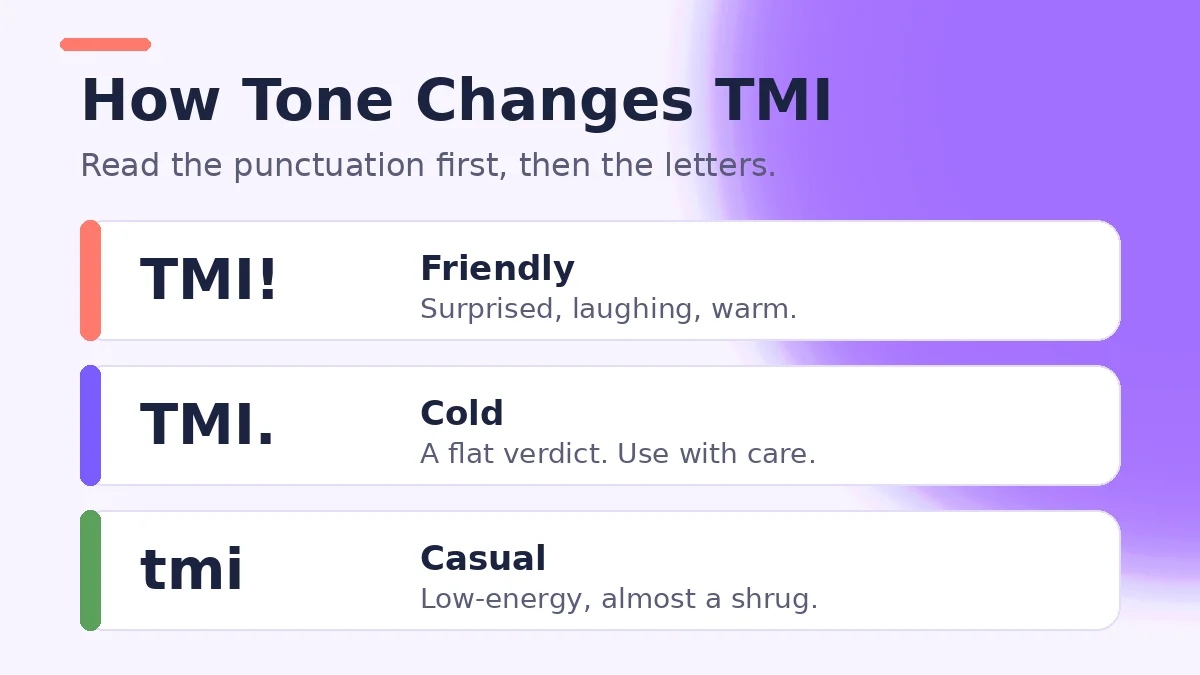
Three letters, one punctuation mark, and the whole message can change temperature. Punctuation and emojis are the closest thing TMI has to a tone of voice.
“TMI!” with an exclamation mark is the friendly default: surprised, laughing, a little overwhelmed, but warm. It is the version you will see most often. “TMI.” with a period is colder: a flat verdict, genuinely annoyed or disgusted. Send it only when you mean the edge.
Emojis do the heaviest work. A laughing or cringing face (“TMI 😅”) keeps it playful. But a disgusted or eye-roll emoji turns TMI into a real rebuke. When an emoji carries a negative feeling, believe the emoji over the letters.
TMI on TikTok, Snapchat, Instagram, and in Texting
The core meaning of TMI does not change from app to app: it always comes back to “too much information.” What changes is where you see it, and how much context survives around it.
In texting and group chats, TMI is at home: the full conversation is right there to check. Group chats are where TMI does its hardest work: one stranger in the member list turns a funny story into a nightmare.
On TikTok, TMI floods the comments of storytime videos that go one detail too far. Creators use “TMI, but…” in captions to warn viewers before a personal story.
On Snapchat, it is a quick DM reaction between friends, usually with a laughing emoji to keep it light. The disappearing-message format makes it riskier: once the earlier messages vanish, the context that explains the TMI vanishes with them. On Instagram, TMI appears in comments and DMs reacting to overly personal captions. On Discord and in gaming chats, it is a fast acknowledgment between rounds. Short reactions are the native language of fast chats, and what DW means in text survives for the same reason: it resets an awkward moment in two letters.
Who Sent It Changes What It Means
The same three letters land differently depending on who typed them, because “too much” is measured against the relationship.
From a best friend, TMI is almost always warm: shorthand for “I love you, but I did not need that image in my head.” Read it as a joke, laugh, and move on. From a crush, it can carry a playful charge with a laughing emoji; without one, read it as plain boundary-setting.
From a parent, it usually means simple discomfort rather than judgment: some details are not meant to travel upward. From a boss or coworker, TMI is a real signal, not a joke. Never send TMI upward yourself: “let us keep this high-level” says the same thing without the slang.
From a stranger or a new dating-app match, TMI is a warning worth hearing: an early overshare can end a conversation before it starts.
The Other TMI: K-Pop Trivia, Three Mile Island, and the Ones to Ignore
Most of the time, TMI means “too much information,” and you can stop there. But the letters have other readings, and one of them flips the meaning almost completely.
The K-pop meaning is the one that trips people up. Wiktionary records that Korean borrowed TMI from English, but uses it for unnecessary information you do not need to know: extra trivia, explicitly not taboo information, unlike English. When a fan account posts “TMI: he likes his coffee with lots of ice,” nobody is oversharing anything private. The clue is the content: if the detail is harmless and the poster seems delighted, it is the fandom meaning. The other common TMI is Three Mile Island, the US nuclear power plant, seen in history and energy news, never in a chat.
Meanings to reject outright: a few slang lists claim TMI is short for “thanks, I hate it,” but that is TIHI, a different abbreviation. Others claim it started as a TikTok trend. No credible source supports either claim: the phrase was in use through the 1990s, and Urban Dictionary carried its first definition in 2002. Honesty softens a blunt correction, and what TBH means in text shows how friends frame an uncomfortable truth.
TMI vs Oversharing — and the Abbreviations People Confuse It With
TMI belongs to the boundary-setting family: the quick signals people use to manage how a conversation flows.
| Abbreviation | Stands for | What it does |
|---|---|---|
| TMI | Too Much Information | Reacts to oversharing |
| TIHI | Thanks, I Hate It | Reacts to something disturbing |
| SMH | Shaking My Head | Shows disbelief at someone’s behavior |
| NGL | Not Gonna Lie | Frames a blunt honest take |
| TBH | To Be Honest | Softens an honest opinion |
| IMO | In My Opinion | Marks something as opinion |
Oversharing is the action: sharing too much. TMI is the reaction. And the difference between TMI and TIHI is the target: TMI reacts to personal details you did not want to know, while TIHI reacts to something disturbing you did not want to see. Opinions about where the line sits are common, and what IMO means in text marks fact from feeling.
How to Reply When Someone Says TMI to You
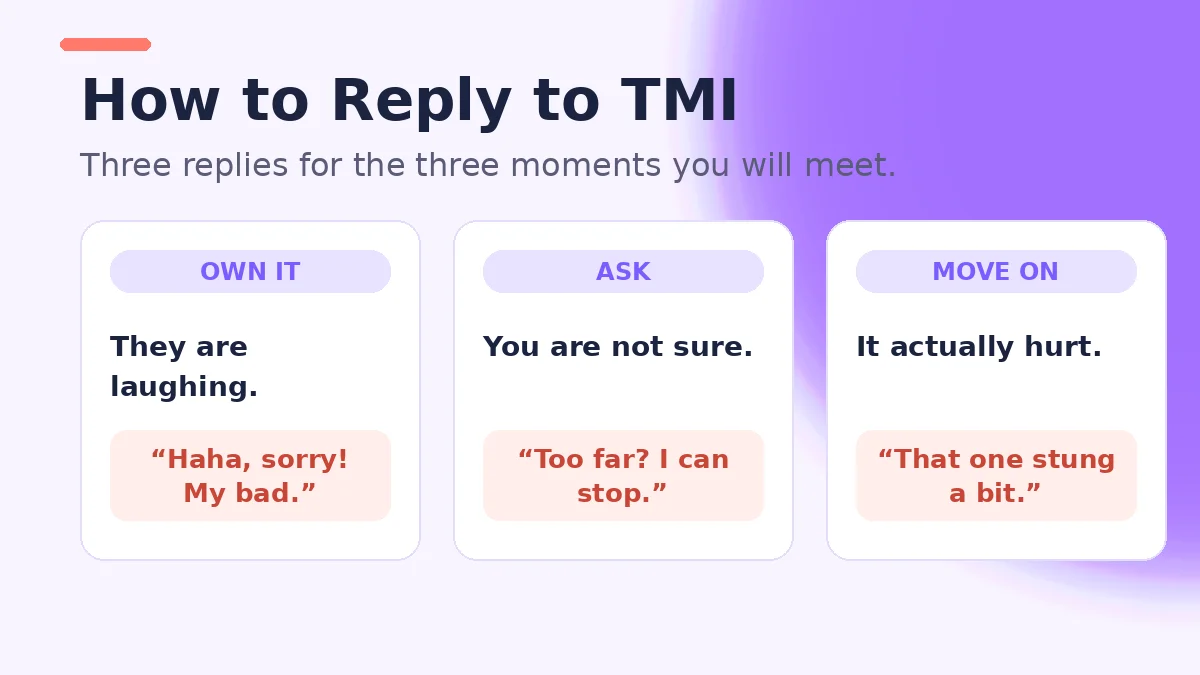
Getting a “TMI!” back is its own small puzzle, and your reply depends on which side of the overshare you are on.
When you overshared and they are laughing, own it lightly: “Haha, sorry 😅” or “My bad, I will spare you the rest.” Do not defend the detail; the explanation is usually a second overshare.
When you are not sure whether they were joking, ask in one line: “Too far? I can stop there.” It shows you heard the boundary instead of arguing with it.
When someone prefaces with “TMI, but…”, your reply is a permission slip: “Go for it” or “I am all ears” if you are willing, “Maybe spare me 😅” if you are not.
When TMI actually hurt, say so plainly: “That one stung a little, I was sharing something real.” TMI should punch at details, not at people. A laughing reply can reset the mood, and what LMAO means in text explains when that fits.
When Not to Use TMI
TMI is a useful shortcut, but shortcuts have edges. Leave it alone when someone is sharing something vulnerable: a health scare, a breakup, a real problem. They need support, not a boundary. Save TMI for the graphic details, never for genuine emotion.
Skip it at work, where a manager may hear “I cannot be bothered to listen properly,” and in formal messages, where it reads as careless. Do not use it to dodge a conversation you owe someone. Try “That is more detail than I need, thanks” at work and “Let us keep this high-level” in meetings.
Quick Answers About TMI
What does TMI mean in text?
TMI means “too much information”: someone has shared more personal detail than you wanted or needed to hear.
What does “TMI, but” mean at the start of a message?
It is a warning that the sender is about to share something personal, and they know it. It gives the reader a chance to opt out first.
What does TMI mean on TikTok?
On TikTok, TMI means “too much information”: in comments on storytime videos that go one detail too far, and in captions warning “TMI, but…” first.
What does TMI mean on Snapchat?
On Snapchat, TMI means “too much information” in DMs. Because messages disappear, a bare “TMI” can read harsher later than it felt.
What does TMI mean in K-pop?
In Korean fan spaces, TMI means harmless extra trivia, such as a singer’s favorite snack, not an embarrassing overshare.
Is TMI rude?
Not on its own. With friends and a laughing emoji, it reads as a joke. Aimed at a vulnerable moment, or sent as a bare “TMI.” with a period, it can feel dismissive.
The Bottom Line on TMI
TMI is a small abbreviation with a big job: it guards the line between sharing and oversharing, and it does it with a joke instead of a lecture. Most of the time it is a friendly speed bump: “love you, but I did not need that image in my head.” Sometimes it is a real boundary. Run the TMI Line Test first, and remember: aim it at the details, never at the feelings.
