
Your manager forwards an email thread — forty messages long — with three letters on top: “FYI.” Your friend texts “fyi, the gate changed to B12” and saves your sprint through the airport. One felt like a chore dumped on your desk; the other felt like a favour. If you’ve ever stared at an FYI wondering whether you were helped or warned, you already understand the real question behind fyi meaning in text: the expansion is the easy part. The tone is the message.
FYI stands for “for your information.” Every dictionary agrees — no second texting meaning hides underneath. What the dictionaries also quietly admit is that an FYI is allowed to warn you. That one word is why the same abbreviation can be a kindness at 9 a.m. and a shot across the bow by noon. This guide covers where FYI came from, a three-check test for its tone, how it behaves at work versus in the group chat, and why the sender changes everything.
FYI Meaning at a Glance
| Full form | For Your Information |
| Main job | Flagging information the reader should have — classically, no action and no reply required |
| Tone | Neutral on paper; in practice, from thoughtful heads-up to quiet warning |
| Common in | Work email and Slack, texts, group chats, DMs, captions |
| Example | “FYI, the side entrance is locked today — use the front” |
| Capitalization | FYI and fyi mean the same; capitals are the conventional, formal dress |
| Watch out for | A bare “FYI” atop a forwarded thread; any FYI repeating what you were already told |
Older Than Texting: FYI’s Long Paper Trail
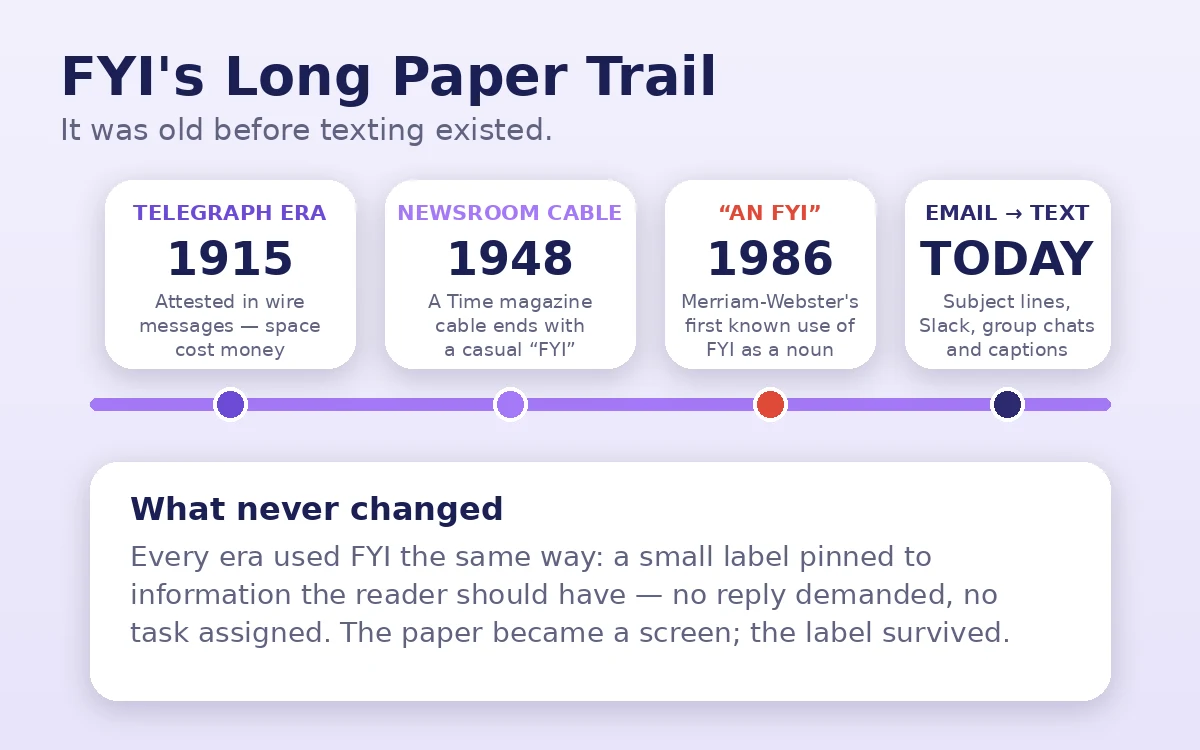
FYI was not born in a chat app. It was born where words cost money: attested in the telegraph era — by 1915 it was being described as a space-saver on wire messages, charged by the word — and used by 1930s journalists on wire copy to mark material for the receiving editor’s eyes, not for publication.
Wiktionary preserves a perfect fossil from 1948: a Time magazine photographer’s cable from Cairo, closing with the casual postscript “FYI, Burke narrowly escaped death outside Jerusalem a few days ago.” Near-death, reported in a postscript — FYI was already doing its modern job.
From newsrooms it moved to the office memo: a stamp for material you should read but not act on. Email inherited the memo wholesale — “FYI:” on a forwarded thread is the paper memo in a new coat. Merriam-Webster dates the noun use — an FYI, something you can send and count — to 1986. Texting didn’t invent FYI; it just pinned the label to everything.
The Aftertaste Test: Reading Any FYI in Five Seconds
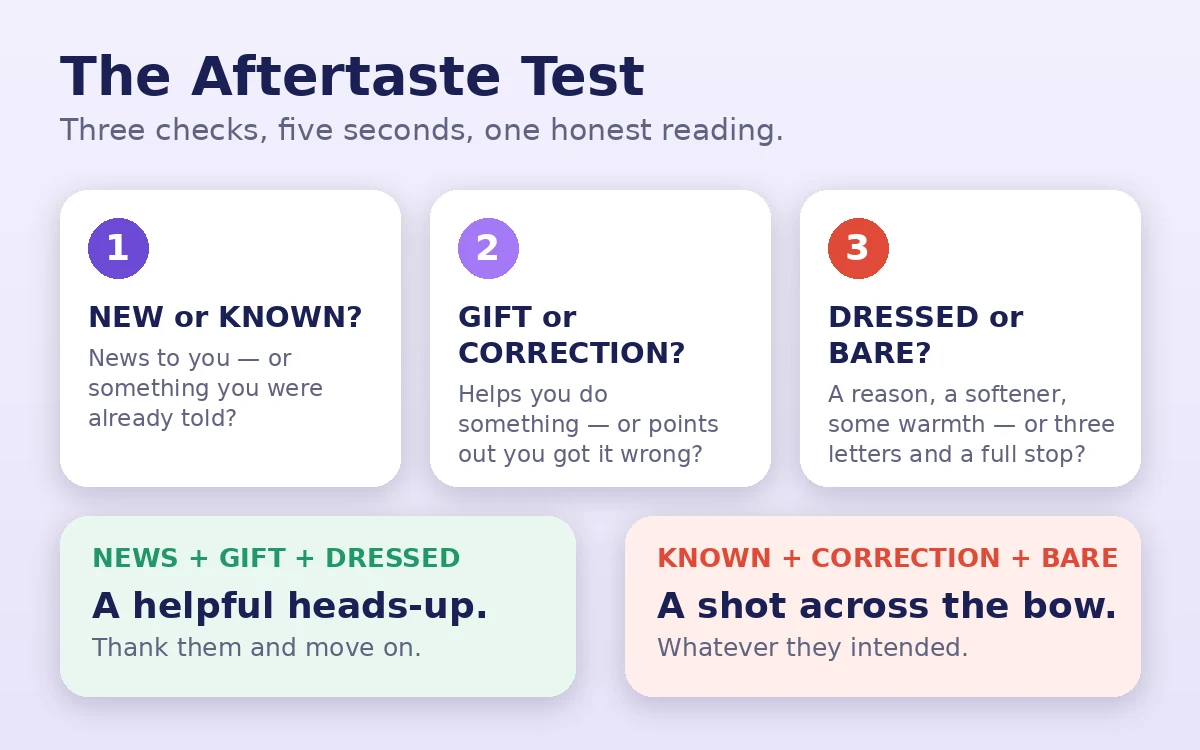
The problem with every simple answer about FYI: “it’s neutral, tone depends on context” is true and useless at 9 a.m. with a forwarded thread on your screen. Use a test instead — three checks that name the aftertaste every FYI leaves:
Check 1 — New, or known? Is the fact news to you, or something you were already told? News is a gift; a repeat is a reminder — and a reminder carries a whisper of you should have caught this the first time.
Check 2 — Gift, or correction? Does it help you do something — catch a flight, avoid a closed door? Or is its main job pointing out you had something wrong? Corrections aren’t rude by themselves, but one wearing an FYI label arrives with no cushioning.
Check 3 — Dressed, or bare? Did it arrive with anything around it — a reason, a softener (“just,” “quick”), a word of warmth? Or is it three letters, the fact, and a full stop? Bare is the highest-risk form in any medium; even the spelled-out phrase “for your information” runs cold standing alone.
Now score it. New + gift + dressed is a helpful heads-up: thank them and move on. Known + correction + bare is a shot across the bow — whatever the sender intended, every element points at you. Most real FYIs fall in the middle: a new fact, sent bare, by a busy person. Read those as neutral. Senders: you control all three dials — flip any one and the aftertaste changes.
FYI at Work: The Label, the Forward, and the Trap
Work is FYI’s ancestral home, and where it is most useful and most dangerous. In email and Slack, it does one clean job: separating awareness from action. A subject line starting “FYI:” promises no task inside — a small mercy in a crowded inbox, and why FYI survives in offices that banish most other abbreviations. (One of the few short forms safe in front of a boss — unlike anything marked NSFW.)
The forwarding ritual is its oldest office form: you should see this thread, not act on it. Done well, it carries one line of framing — “FYI, the client moved the deadline; no action from you.” Done badly, it is the bare forward: three letters on top of forty messages. That fails the Aftertaste Test on check 3 alone, and creates real work: the reader must excavate the thread to learn whether they were informed, warned, or quietly handed a problem. Spend ten seconds on the framing line.
The second trap is smuggling a request inside FYI. “FYI, the draft still needs the budget table” is not information; it’s an assignment in a trench coat. If you need something done, say so plainly — who, what, by when. If you need an answer, close with a LMK (“let me know”) instead. FYI promises no reply; honour that in both directions.
FYI in Texts and on Social Platforms
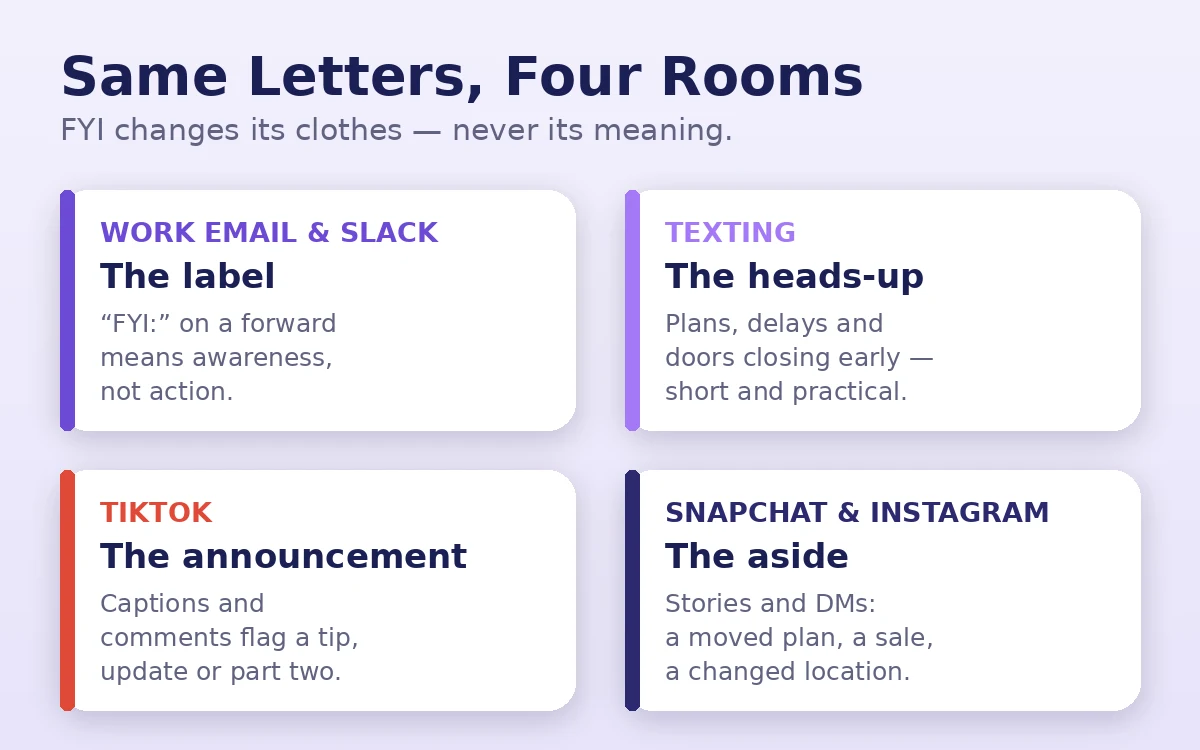
Off duty, FYI loosens its tie but keeps its job. In text messages, it’s the heads-up form: plans, delays, doors closing early. “fyi, running ten minutes late — otw though” is the classic pairing: the label carries the news, the rest carries the reassurance. Lowercase is the native dress here; case is clothing, not content.
On TikTok, FYI becomes an announcement to strangers: a caption or pinned comment flagging a tip, an update, or a correction to an earlier video — “FYI, part two fixes the measurements.” Being public, it reads neutral-to-helpful; no one person is being corrected. On Snapchat, it lives in fast, disposable chats — a moved location, a changed plan. On Instagram, Stories and DMs use it the same way: a sale starting, a link moved, a venue changed.
Notice what never changes: the definition. Anyone claiming FYI means something different on TikTok than in an email is inventing it. What changes is the room — a bare FYI in a sleepy group chat is invisible; in a one-to-one DM after a disagreement, it’s a foghorn.
Who Sent It Changes What It Means
Run the same sentence through four senders and watch the aftertaste move. The exchanges below are illustrative examples, not real messages.
From your boss: “FYI, the client call moved to 2.” Almost always logistics — bosses use FYI as the awareness label it was designed to be. The risk runs the other way: a boss’s FYI about your work (“FYI, the figures in your deck were from March”) lands with authority behind it, so even a neutral correction feels formal. Fix what’s fixable, reply briefly — no jokes, no SMH; the power gap makes casual read as careless.
From a coworker: “FYI, I sent the updated file.” The peer-to-peer FYI is the healthiest form — equals trading awareness. The exception is the repeat: a second FYI about the same thing is a nudge with an edge, and both of you know it. Sending one? Dress it (“sending again in case it got buried”).
From a friend: “fyi, your ex just walked in 😅” In friendship, FYI is usually pure gift — a lookout doing lookout work. Friends also use it playfully: a drumroll before gossip, a mock-formal announcement (“FYI, I have secured the last slice”) — a joke that works because the real form is so buttoned-up. And a friend correcting themselves with a follow-up NVM (“never mind — found it”) is the one correction that never stings.
From a partner: “FYI, I’ll be home late.” Intimacy raises the stakes of check 3: a partner’s bare FYI can read as distance — a memo to someone who expected a conversation. The fix costs four words: “train’s delayed, sorry love.” Same fact, dressed.
Sending an FYI That Lands Well
Everything above reverses into a sender’s checklist:
- Pass your own test before sending. New? Gift? Dressed? If your message scores known + correction + bare, rewrite it — you’re about to fire a warning and label it information.
- Frame every forward. One line — why you’re sending it, whether action is needed — makes it professional.
- Never let FYI carry a hidden task or deadline. Name the job outside the label.
- Soften corrections with the specific, not the vague. “FYI, it’s Thursday, not Friday” plus one kind word beats a paragraph of cushioning. Keep FYI out of sensitive moments — bad news and apologies deserve full sentences, the way a confession deserves a TBH. FYI informs; TBH admits.
- Use the variants honestly. “Just FYI” genuinely softens a heads-up, and some people type the expanded JFYI — “just for your information” — for the same reason. But “just” is a ribbon, not armour: it cannot rescue a correction. A RQ (“real quick”) heads-up between friends is charm; at work, on a correction, the same speed is a faster sting.
On the receiving end, match the register: a heads-up gets “Got it — thanks”; a bare forward gets one question — “Anything you’d like me to do with this?”; a shot across the bow gets the fact acknowledged, nothing more.
Quick Answers
What does FYI mean in text?
FYI means “for your information.” It flags something the sender thinks you should know — an update, a document, a change of plan. Every major dictionary gives this single expansion; there is no second texting meaning.
Is FYI rude?
Not by itself. FYI is neutral letters carrying whatever the sentence after them delivers. A new, useful fact sent with warmth reads as a heads-up; a repeated correction sent bare — “FYI, I already sent that” — reads as a warning. Run the Aftertaste Test to tell them apart.
Do I need to reply to an FYI?
Usually not — that’s the label’s promise, especially at work. A brief “Got it, thanks” is polite when the information helped you. If the message quietly contains a question or task, reply to that part.
What’s the difference between FYI and BTW?
FYI flags information the sender believes you should have — it carries a small sense of importance. BTW (“by the way”) adds a side note that wandered in. “FYI, the office closes at four” affects your plans; “BTW, nice shoes” affects nothing.
Is lowercase “fyi” different from “FYI”?
No — the same abbreviation in different dress. Capitals are conventional and safer in professional messages; lowercase is the everyday texting form. The surrounding sentence sets the tone.
When should I avoid using FYI?
For sensitive news, apologies, and emotional conversations, where a label feels like distance. When you need action or an answer — say what you need instead. And never as a bare forward at work, the form most likely to read as dismissive.
The Short Version
FYI is “for your information” — a label born on telegraph wires, perfected on office memos, now pinned to everything. The letters never change; the aftertaste does. Read every FYI with three checks — new or known, gift or correction, dressed or bare — and you’ll know whether you were handed a heads-up or a warning. Send yours framed, honest about action, and dressed with at least one human word.
